

Most grooming salon owners don't get into trouble because they're trying to cheat anyone. They get into trouble because payroll compliance is a quiet system — the kind that works fine right up until a worker files for unemployment, a state auditor sends a letter, or a groomer you "1099'd" three years ago decides they were really an employee the whole time.
By then it's not a small fix. It's back taxes, penalties, misclassification fines, and sometimes a Department of Labor conversation you really don't want to have.
This isn't a "what is a W-2" article. You know what those are. This is about how the whole payroll compliance machine fits together in a salon specifically — where you've got commission groomers, tipped workers, booth-ish arrangements, cash tips, retail commissions, and an owner who sometimes pays themselves whatever's left in the account. That combination is exactly where things break.
Why salons are uniquely exposed on classification
Grooming sits in a weird spot. The work feels independent — a groomer brings their own shears, has their own regulars, works their own pace. That feeling is what pushes a lot of owners toward 1099 arrangements. It seems fair, it's simpler on payroll, and the groomer often prefers the bigger check.
The problem is that how it feels has almost nothing to do with how the law actually classifies the relationship. Classification turns on control and independence, not vibes. And most grooming setups fail the independence test badly.
The pattern that shows up constantly: an owner sets the prices, owns the booking software, controls the schedule, provides the tub and dryers, sets the service standards, handles the client payments, and markets the salon under one brand — then calls the groomer a contractor. On paper that's an employee wearing a contractor label. If a state agency looks, they'll see it in about ten minutes.
-
The IRS cares about federal payroll taxes you didn't withhold or match.
-
Your state labor/unemployment agency cares about unemployment insurance you didn't pay.
-
Your state workers' comp system cares about coverage you skipped.
One misclassified groomer can trigger all three. And they talk to each other more than owners assume — an unemployment claim from a "contractor" is one of the most common ways the whole thing unravels.
The employee vs. contractor decision tree
Instead of memorizing legal tests, run the arrangement through the questions that actually move the needle. The federal and most state tests weight these heavily. Walk each real worker through it.
Never miss a grooming appointment again.
Furlyly helps you book, confirm, and manage every pet grooming appointment effortlessly.
- Unified appointment scheduling
- Automated client reminders
- Staff availability & shift management
No credit card required
-
Step 1 — Who controls how the work gets done? - You dictate process, standards, start/stop times, and which clients they take → leans employee - They decide their own methods and schedule entirely → leans contractor
-
Step 2 — Who provides the tools and space? - You provide the tub, dryers, table, products, and the physical station → leans employee - They bring everything and could pack up and work elsewhere tomorrow → leans contractor
-
Step 3 — Whose clients are they? - Clients book through your system, pay you, and belong to the salon → leans employee - They have their own book, their own brand, and invoice independently → leans contractor
-
Step 4 — Can they realize profit or loss like a business? - They get paid per groom or per hour, no real business risk → leans employee - They set prices, carry costs, and can lose money on a bad month → leans contractor
-
Step 5 — How permanent is the relationship? - Ongoing, indefinite, "part of the team" → leans employee - Project-based or clearly temporary → leans contractor
Use this quick workflow when evaluating each worker.
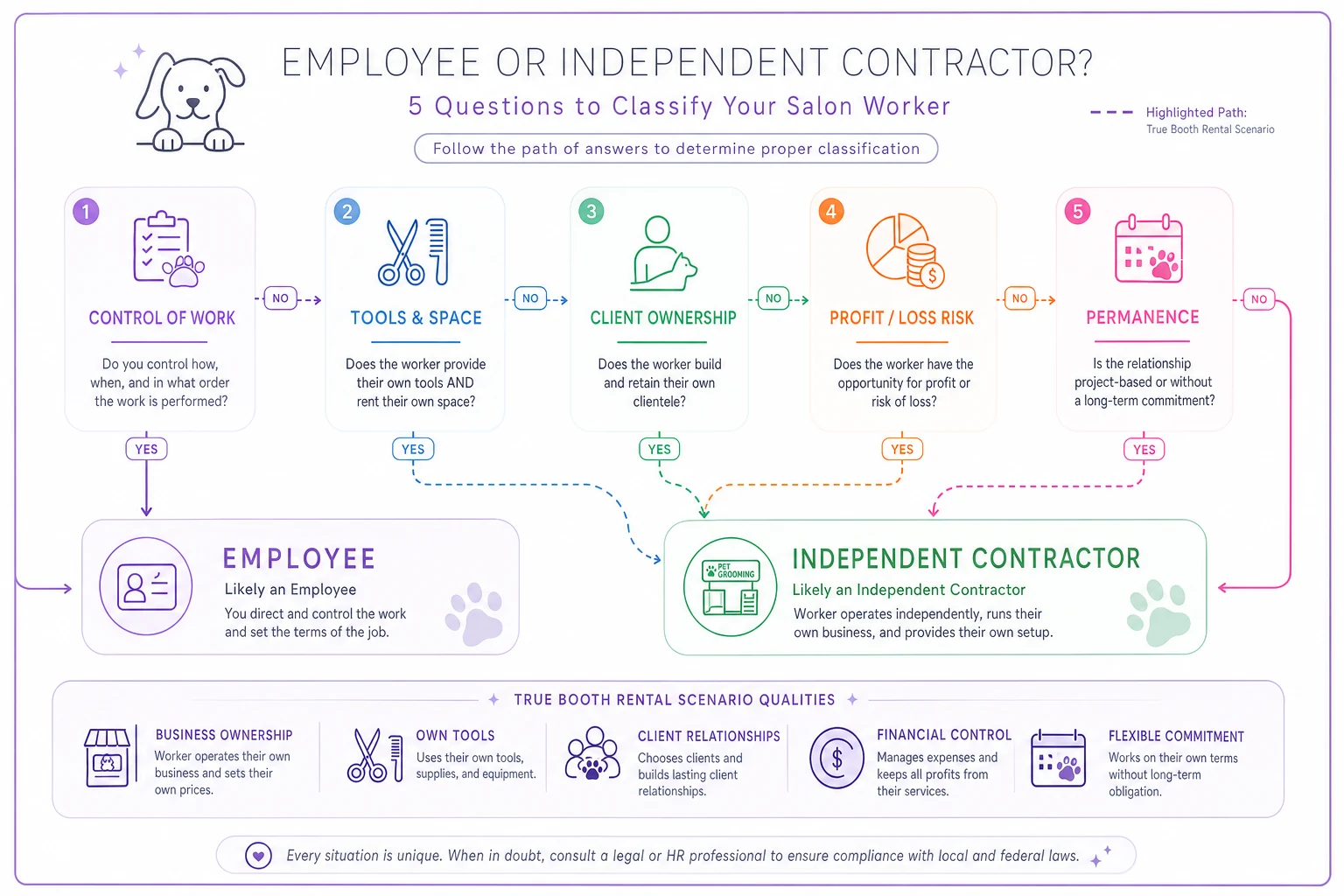
If you land on "employee" for even three of these five, you almost certainly have an employee — regardless of what the person signed. A signed contractor agreement does not override the facts. Auditors treat those agreements as basically irrelevant if the day-to-day reality says employee.
The one arrangement that genuinely survives as contractor is a true booth rental: the groomer pays you rent, sets their own prices, keeps their own books, handles their own client payments, and runs their station like their own business. That works — but only if you actually run it that way. The moment you start controlling their schedule or pricing "just a little," you've converted them back into an employee in the eyes of the state.
A quick comparison most owners find useful
| Factor | True Contractor (booth rental) | Employee (commission or hourly) |
|---|---|---|
| Sets own prices | Yes | No — salon sets them |
| Pays rent for the station | Yes | No |
| Controls own schedule | Yes | Mostly no |
| Uses own tools/products | Yes | Usually salon's |
| Client payments go to | The groomer | The salon |
| You withhold taxes | No | Yes |
| You carry workers' comp | No (they do) | Yes |
| Unemployment insurance | No | Yes |
The honest gut check: if you'd be uncomfortable with that groomer raising their prices 30% tomorrow or turning away your regulars, they're not really a contractor.
Tip pooling, because this is where "simple" salons quietly break the law
Tips are the second landmine, and they're trickier than classification because the rules are genuinely jurisdiction-dependent. What's legal in one state is a wage violation across the state line.
A few things that trip up salon owners repeatedly:
-
Owners and managers generally cannot take from a tip pool. This one surprises people constantly. If you, the owner, are grooming dogs all day and sharing in the tip pool, that's a problem under federal rules — even if you did the work. Supervisors with real authority over the tipped employees are excluded from pools too. Small salons blur this because the owner is also "just one of the groomers," and that blur is exactly what gets flagged.
-
Who can be in the pool depends on whether you take a tip credit. In states that still allow a tip credit — paying tipped workers below the standard minimum and making up the difference with tips — the tip pool generally has to stay among traditionally-tipped staff. In states that don't allow a tip credit, several of which pay full minimum wage to everyone, you often have more flexibility to include back-of-house or bather staff in the pool. This is why copying another salon's tip policy from a Facebook group is risky: their state may run on completely different rules.
-
Mandatory "service charges" are not tips. If you add an automatic charge and distribute it, that money is typically treated as wages, not tips — which changes tax treatment and overtime math. Salons that switched from tips to auto-gratuity to "simplify" sometimes create a bigger mess.
Three jurisdiction-aware tip-pool models
Model A — Tip-credit state, groomer-only pool. Tipped groomers pool and split by hours worked or by individual service revenue. Bathers who aren't customarily tipped stay out. Owner stays out entirely. Cleanest option where tip credit applies.
Model B — Full-minimum-wage state, inclusive pool. Groomers and bathers both share, split by a weighted formula — say groomers weighted 1.0, bathers 0.5. Legal in many no-tip-credit states and better for morale, since the person drying the dog isn't left out. Owner and managers still excluded.
Model C — No pool, individual tips only. Each groomer keeps their own tips, you just track and report them. Simplest to defend, avoids pool-composition risk entirely. The downside is it discourages team help, which can hurt throughput.
Whichever model you run, the non-negotiable is documenting cash tips. Card tips are easy — they flow through your system. Cash tips are where salons under-report without even meaning to, and that gap is a classic audit finding. Your tip policy and your reconciliation habits need to live together, which is why it's worth reading alongside the deeper breakdown in Payments and Tip Policies That Stop Payroll Headaches — the mechanics of card-on-file and monthly reconciliation are what actually keep tip reporting honest.
What payroll actually looks like in the books
Owners hand this part to a bookkeeper and never look at it again, which is a mistake — not because you need to do the entries, but because you need to recognize when they're wrong. A groomer's paycheck isn't one number. It's commission or wages, plus tips, minus withholdings, with employer taxes layered on top.
Below is a simplified version of what a single pay run should look like in your journal. Numbers are illustrative for one period with a couple of groomers.
Dr Wages & Commission Expense 4,200 Cr Wages Payable 4,200
Dr Wages Payable 4,200 Cr Federal Income Tax Withheld 410 Cr Social Security/Medicare (EE) 321 Cr State Income Tax Withheld 180 Cr Net Pay (Cash/Checking) 3,289
Dr Payroll Tax Expense 360 Cr Social Security/Medicare (ER) 321 Cr FUTA/SUTA Payable 39
Dr Tips Payable 640 Cr Cash/Checking 640
Worth noticing: tips that run through card payments create a Tips Payable liability the moment the client pays. If your books don't show that liability building and clearing each period, tips are getting handled informally somewhere — and informal is where compliance problems hide.
Ask your bookkeeper to show you the 'Tips Payable' liability each pay period so you can verify it's being recorded and cleared.
One more detail owners miss: when card tips are large and you're in a tip-credit state, employer payroll taxes apply to those tips too. That's a real cost that surprises people at year-end. If your tip volume is high, that employer tax line is bigger than you probably assume.
What breaks as you scale
A one-chair owner-operator can be sloppy and survive. The exposure grows faster than headcount, and it compounds at specific thresholds.
One or two groomers. Risk is concentrated but small. Usually the issue is a single misclassified contractor. Fixable before it metastasizes.
Three to six groomers plus bathers. This is where tip pooling becomes a real liability, because now you've got a mix of tipped and non-tipped roles and someone's doing the split in their head or in a spreadsheet nobody audits. Overtime also starts mattering here — commission employees still get overtime, and a lot of salons forget commission doesn't exempt you from overtime rules.
Two locations. If those locations sit in different states or even different cities, you can be running under two different minimum wages, two tip regimes, and two workers' comp requirements simultaneously. Owners expanding across a state line sometimes copy their first location's payroll setup wholesale — and that's how one location ends up out of compliance from day one.
The failure mode at scale is almost always the same: a policy that was "fine when it was just me and one person" never got rewritten as the salon grew. Payroll compliance isn't a one-time setup. It has to get re-examined every time you add a role, a location, or a pay structure. This connects directly to the broader people systems covered in the HR and performance playbook — classification and tip rules are really just one piece of the same workforce system.
The owner-facing audit and red-flag checklist
Print this part. Run it quarterly, or hand it to your bookkeeper and ask them to confirm each line. If you can't confidently check a box, that's your to-do list.
Classification
-
Every worker has a defensible classification I could explain to an auditor
-
Any "contractor" genuinely sets their own prices and schedule
-
Booth renters pay actual rent and keep their own client payments
-
No contractor is doing the same job, same way, as my employees
Tips
-
Our tip-pool model matches our state's rules (tip credit vs. no tip credit)
-
Owner and managers are excluded from any tip pool
-
Cash tips are reported, not just card tips
-
Tips Payable shows up and clears in the books each period
Wages and overtime
-
Commission employees still receive overtime when owed
-
We meet minimum wage after accounting for any tip credit
-
Each location uses the correct local minimum wage
Filings and records
-
Payroll tax deposits are made on time, every period
-
W-2s and 1099s went out and match what's in the books
-
Workers' comp covers everyone it should
-
Employee files include I-9s, W-4s, and signed pay agreements
Red flags that mean call a professional this week
-
A former "contractor" filed for unemployment
-
You got a letter from the state labor or revenue department
-
You pay a regular worker on 1099 but control their whole day
-
Nobody can explain how tips are split if asked
If you can't confidently check a box, that's your to-do list.
A real scenario
A two-groomer salon doing roughly $18k–$20k a month had both groomers on 1099s. The owner set prices, owned the booking system, ran the schedule, and provided all the equipment. Classic misclassification, just not labeled as one.
One groomer left, filed for unemployment, and got denied because "no wages were reported." That denial triggered a state review of the arrangement. The ruling: both groomers had been employees the whole time, going back about two years.
The bill came together across unpaid unemployment contributions, the employer share of payroll taxes the salon should have paid, plus penalties and interest. All-in it landed somewhere in the $9k–$12k range for a salon that size — and that's before the cost of converting everyone to proper payroll going forward.
The fix wasn't complicated, just overdue: reclassify both groomers as commission employees, set up real withholding, move tips through payroll properly, and add workers' comp. Monthly payroll cost went up because the employer taxes were now being paid honestly — but the owner stopped carrying a six-figure-sized question mark on the balance sheet, and the next unemployment or audit event wouldn't blow up the business. For any owner who plans to sell eventually, that cleanup matters even more; buyers and their accountants dig straight into classification and payroll history, something worth keeping in mind well before any exit or succession planning conversation starts.
When a contractor model actually makes sense — and when it doesn't
It makes sense when you're genuinely renting out space to independent groomers who run their own businesses: their prices, their clients, their books, their tools, their rent check to you every month. That's a real landlord-tenant relationship and it holds up.
It's a bad idea when you want the control of an employer but the lower cost of contractors. You can't have both. Every bit of control you keep pushes the classification back toward employee, and the gap between what you're doing and what you're calling it is exactly what gets measured in penalties.
Who should not run contractors at all: any owner who dictates the schedule, sets service prices, owns the client relationships, and trains groomers on a house standard. That's a team you're building — pay them like one. It's cheaper than the alternative.
Pulling it together
Payroll compliance in a grooming salon isn't a single rule you follow. It's a system where classification, tips, wages, overtime, and local jurisdiction all touch each other — and where a decision you made as a solo operator quietly becomes a liability once you've got a team and a second location.
The owners who stay out of trouble aren't the ones with the fanciest setup. They're the ones who re-check their arrangements every time something changes, keep tips flowing through the books instead of around them, and can explain every worker's classification in a sentence or two. Print the checklist, hand the journal-entry structure to your bookkeeper, and pressure-test your contractor arrangements against that decision tree. The cost of doing it now is a slightly bigger payroll run. The cost of ignoring it is the kind of letter that ruins a quarter.
Ready to streamline your grooming business?
Join 500+ pet groomers using Furlyly to save time, reduce scheduling conflicts, and deliver exceptional client experiences.