


Most owners start thinking about selling their grooming salon about six months before they want out. That's the problem. By then, the financials are already what they are, the team is running on tribal knowledge stored in your head, and there's no time left to fix the things that quietly cut your sale price in half.
Exit planning isn't a document you produce at the end. It's an operational state you build toward over a year or two. A buyer — whether it's a competitor, a first-time owner, or one of your own senior groomers — isn't buying your revenue. They're buying how confidently that revenue survives without you standing in the building. Everything below is aimed at that one question.
This follows how a serious buyer or their advisor actually evaluates a salon, because once you understand what they're looking for, the prep work more or less writes itself.
Why most grooming salons sell for less than they should
Here's an uncomfortable pattern. A salon doing around $480k in annual revenue with the owner as lead groomer looks great on paper. Then the buyer digs in and finds that the owner personally grooms 40% of appointments, holds every vendor relationship, approves every schedule change, and is the only person clients ask for by name. That's not a business. That's a high-paying job that happens to have employees.
Buyers discount that heavily. What could have been a 2.5–3x multiple on adjusted earnings becomes 1.5x, or a deal that collapses in due diligence entirely. The gap between those two outcomes is almost entirely operational readiness, and nearly all of it is buildable if you start early enough.
The reason this happens across so many salons comes down to how they grow. In the early years, doing everything yourself is efficient. You are the quality control, the scheduling logic, the client relationship. That instinct never gets unwound, so by year seven the whole operation is a set of habits living in one person's head. Transferability was never designed in, and you can't retrofit two years of it in the last quarter before a sale.
The four things a buyer is really testing
Before any checklist, it helps to name what all this prep is actually proving. Every task ties back to one of these:
Never miss a grooming appointment again.
Furlyly helps you book, confirm, and manage every pet grooming appointment effortlessly.
- Unified appointment scheduling
- Automated client reminders
- Staff availability & shift management
No credit card required
-
Can I trust the numbers? (Clean, defensible financials)
-
Does the work happen the same way without the owner? (SOPs and QA)
-
Will the team and clients stay? (Transferable roles and relationships)
-
What can I do to make more money after I buy it? (Valuation drivers you've left visible and improvable)
Keep these four in mind and you'll stop treating exit prep as busywork and start treating it as a value-creation project.
Clean financials: start here, because everything else depends on it
Buyers and their accountants will normalize your books whether you help them or not. Normalizing means stripping out personal expenses run through the business, adjusting owner pay to a market wage, and separating one-time costs from recurring ones. If your books are messy, they normalize conservatively — which always favors them, not you.
A typical example: an owner pays herself $30k on paper but takes another $70k in distributions, runs a personal vehicle and phone through the business, and has a family member on payroll doing light work. None of that is illegal, but all of it clouds true earnings. A buyer has to guess, and buyers price uncertainty as risk.
-
Clean separation of personal and business spending, ideally for two full years before sale, so trailing financials are already clean when a buyer asks.
-
A documented owner add-back schedule — every expense that wouldn't continue under new ownership, listed and explained.
-
Monthly close done consistently, not reconstructed at year-end. If you're not already running a tight month-end routine, that's the first system to lock in.
-
Revenue broken out by service line and by groomer, so a buyer can see where the money actually comes from.
That last point matters more than owners expect. A salon that can show profit per service line — bath vs. full groom vs. specialty breeds vs. retail — is far easier to underwrite than one reporting a single lump revenue figure. If you've built a habit of running 30-day margin sprints across pricing, labor, and retail, you already have most of this data structured the way a buyer wants to see it.
SOP bundles: turning your head into a manual
The single biggest transferability killer is that the salon runs on things you know but never wrote down. How you handle a matted double-coat. Which clients get a courtesy text vs. which get charged a late fee. What "done right" looks like on a specific breed. When you leave, that knowledge leaves with you, and the buyer watches quality drift for months.
SOP bundles are grouped, usable procedures organized by role and moment — not a 200-page binder nobody opens. Think in bundles:
| SOP Bundle | What it covers | Why a buyer cares |
|---|---|---|
| Front-desk / intake | Booking, check-in, consent flags, deposits, difficult-pet triage | Proves client experience is repeatable |
| Grooming floor | Breed time standards, tool prep, safety holds, finishing checks | Proves service quality isn't owner-dependent |
| Closing / cash | Till counts, retail reconciliation, end-of-day reporting | Proves financial controls exist |
| Vendor / supply | Reorder par levels, approved suppliers, pricing terms | Proves supply continuity after handover |
| People / scheduling | Shift coverage rules, PTO, performance expectations | Proves the team can be managed by someone new |
The goal isn't perfection. It's that a competent new manager could open the salon on a Tuesday and run a normal day using these documents. If you've ever considered a second location, this is the same discipline — the location-readiness approach using SOP bundles, role matrices, and QA templates is essentially exit prep in disguise. A salon that can be replicated can obviously be transferred.
One mistake owners make: they write SOPs as they wish the salon ran, not how it actually runs. Buyers figure that out within a week and then trust nothing. Document reality first, improve it second.
Start by documenting the most frequent or highest-margin processes first — buyers notice consistency in revenue drivers.
Document reality first, improve it second.
Transferable team roles: the owner should be replaceable on paper
A buyer will quietly ask themselves: "If the owner disappeared tomorrow, who runs this?" If the honest answer is "nobody," your price drops.
Transferable roles mean the responsibilities that currently live with you are assigned, in writing, to actual positions — even if you're still doing some of them today. A lead groomer who owns quality standards. A front-desk lead who owns scheduling and client comms. Someone who owns supply ordering. The point isn't to fully step back overnight; it's to prove the structure exists so a buyer can picture themselves at the top of it rather than buried inside it.
-
Client relationships tied to the salon, not the person. If half your book only trusts you, that's a retention risk. Rotating clients across groomers, building the "our team" brand rather than the "owner" brand, and making sure clients rebook based on results — that's slow work that pays off at sale.
-
A senior person who could be the successor. Sometimes the best buyer is already on your payroll. An internal succession — selling to a lead groomer or manager over a structured earn-out — often preserves more value because the knowledge never leaves.
When internal succession makes sense (and when it doesn't)
Selling to your own team is appealing but not always the right call.
It makes sense when you have someone who already manages daily operations, understands the numbers, and has the temperament for ownership — and you're willing to be patient on payout terms.
It's a bad idea when your "successor" is a fantastic groomer but has never managed money, staff, or vendors. Grooming talent and ownership capability are different skills. Promoting the wrong person to save on a broker fee can wreck both the sale and the salon.
QA sampling plan: proof that quality is measured, not hoped for
Any owner can say their grooms are consistent. A QA sampling plan proves it. This is one of the most underused pieces of exit prep, and a quiet differentiator because most salons have nothing documented.
You don't inspect every groom — you sample. A workable plan looks like this:
-
Randomly pull 10–15% of completed grooms each week for a quick standardized check (finish quality, nail work, ear cleaning, notes matching the service billed).
-
Score against a simple rubric — pass, minor rework, redo.
-
Log results by groomer over time.
-
Review the trend monthly and tie recurring misses back to training, not blame.
When a buyer sees six months of QA scores holding steady across different groomers, they stop worrying that quality is secretly propped up by you. It also does something useful right now — it surfaces problems before clients complain.
Salons that start a QA sampling plan almost always find one or two service types drifting that nobody noticed, usually the higher-margin specialty grooms. Fixing those before sale doesn't just improve the QA record — it lifts the actual earnings the buyer is pricing.
Packaging everything for buyers: the deal book
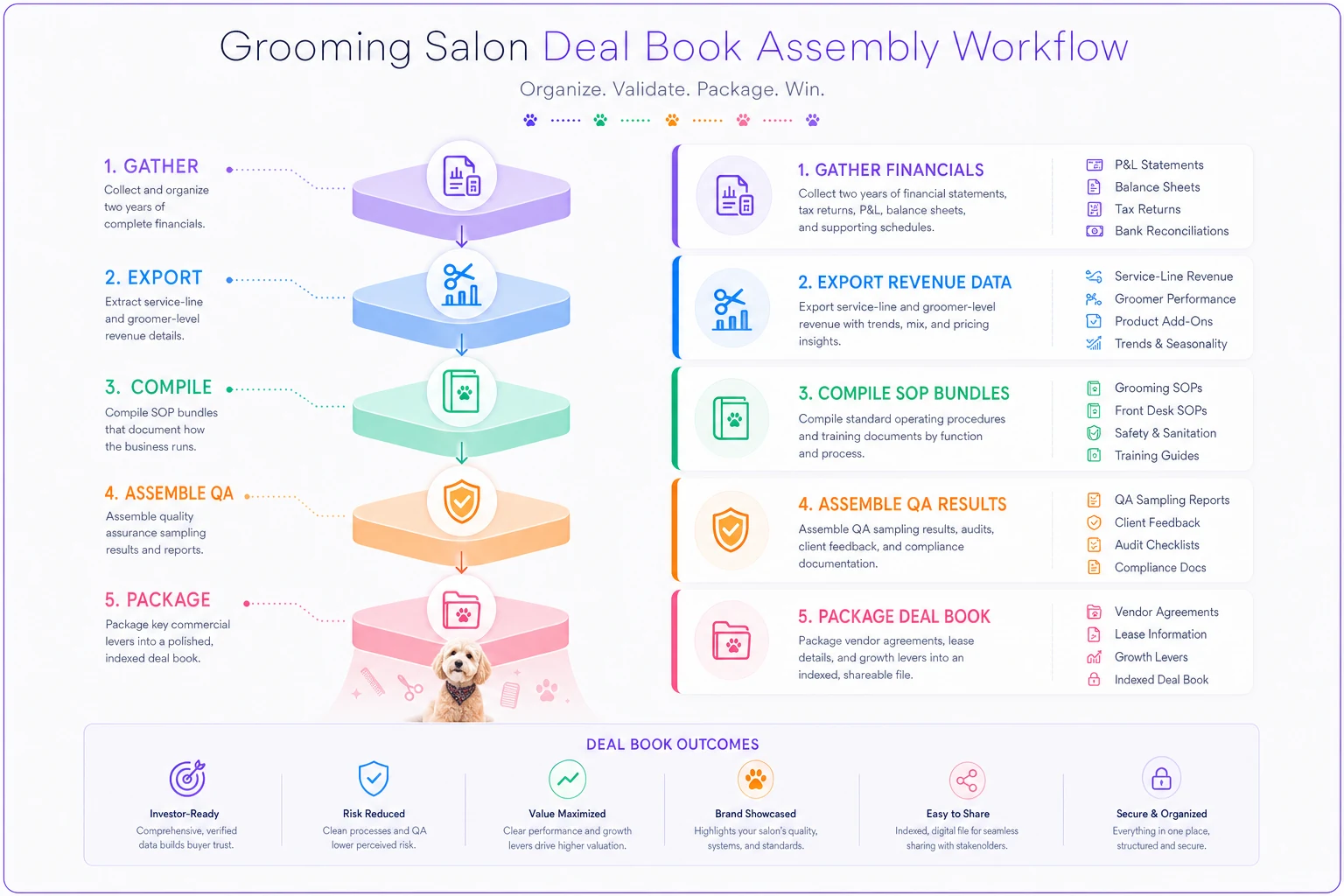
By the time you're 6–12 months from selling, all of the above should live in one organized package a buyer can actually review. Call it a deal book. Messy sellers hand over a shoebox of documents on request. Serious sellers hand over a clean, indexed package — and it changes how the buyer treats them in negotiations.
-
Two years of clean, normalized financials with the add-back schedule explained
-
Revenue breakdown by service line, by groomer, and recurring vs. one-time clients
-
SOP bundles organized by role
-
Org chart and role descriptions showing who does what without the owner
-
QA sampling results over at least six months
-
Key client concentration data — what percentage of revenue comes from the top clients (buyers want this low)
-
Vendor and lease details, including remaining lease term and renewal options
-
A simple list of growth levers you haven't pulled, so the buyer sees upside they can capture
That last item is deliberate. You want to leave visible money on the table for the buyer — an underused retail category, a service you never scaled, hours you never opened. It signals honesty and gives them a reason to pay a fuller price today.
This diagram shows the workflow for assembling the deal book.
That last item is deliberate. You want to leave visible money on the table for the buyer — an underused retail category, a service you never scaled, hours you never opened. It signals honesty and gives them a reason to pay a fuller price today.
The valuation drivers you can actually influence
Owners fixate on things they can't change — like the multiple the market pays — and ignore the drivers they can actually move in 12–24 months. Here's where the real leverage is:
-
Owner dependence — the single biggest one. Every hour of owner-only work you transfer to a role raises the price.
-
Revenue predictability — recurring, rebooked clients on regular cycles are worth more than churny walk-in volume. A healthy base of every-6-week regulars prices better than a salon chasing new clients constantly.
-
Client concentration — if your top handful of clients or one referral source drives a large share of revenue, that's risk a buyer prices in. Diversify before sale.
-
Margin health — a salon with disciplined labor and supply costs is simply worth more per dollar of revenue.
-
Lease stability — a buyer inheriting a lease with one year left and no renewal option is buying a problem. Lock in renewal options early.
-
Documented systems — everything above. Systems convert "risky small business" into "manageable asset."
None of these require you to grow revenue dramatically in your final year. They're mostly about de-risking what already exists, which is a much more achievable project than a last-minute growth push that buyers see through anyway.
A real scenario
A two-groomer suburban salon, roughly $410k in annual revenue, owner working full-time on the floor. First informal valuation came in around 1.6x adjusted earnings — buyers flagged heavy owner dependence, books mixing personal spend, and no documented anything.
The owner gave herself 20 months. Over that window: cleaned the books so two trailing years came out normalized, wrote SOP bundles by role, promoted a senior groomer into a floor-lead position that owned quality and scheduling, started a weekly QA sample, and rotated a chunk of her personal client book to the other groomers so no single person held the relationships.
Revenue barely moved — up a few percent. But the second valuation, with all systems documented and a functioning management layer in place, came in closer to 2.4x, and the eventual sale closed near that number. Same salon. Roughly the same earnings. The difference was almost entirely operational readiness and the confidence it gave the buyer.
Where the software layer quietly helps
None of this requires fancy tools, but the prep gets a lot easier when your operational data isn't scattered across a paper calendar, a notebook, and your memory. Salons running on an AI-powered operational platform that already tracks bookings, groomer-level revenue, client history, and QA notes basically generate the deal book as a byproduct of daily operations. When financials, service-line breakdowns, and quality records live in one system, assembling everything for a buyer becomes an export instead of a three-month reconstruction project.
The point isn't the software — it's that clean, centralized records are what make a salon provably transferable. Buyers pay for proof.
Start earlier than feels necessary
The salons that sell well aren't the ones with the highest revenue. They're the ones a buyer can picture running smoothly the day after the owner hands over the keys. Every piece of exit planning and succession work — clean financials, SOP bundles, transferable roles, a QA sampling plan, a proper deal book, and the valuation drivers you quietly improve — is really about closing the gap between "a business that depends on you" and "a business that runs without you."
That gap takes 12–24 months to close honestly. If a sale is anywhere on your horizon, even three or four years out, the cheapest time to start was last year. The second cheapest is now.
The salons that sell well aren't the ones with the highest revenue. They're the ones a buyer can picture running smoothly the day after the owner hands over the keys. Every piece of exit planning and succession work — clean financials, SOP bundles, transferable roles, a QA sampling plan, a proper deal book, and the valuation drivers you quietly improve — is really about closing the gap between "a business that depends on you" and "a business that runs without you."
That gap takes 12–24 months to close honestly. If a sale is anywhere on your horizon, even three or four years out, the cheapest time to start was last year. The second cheapest is now.
Ready to streamline your grooming business?
Join 500+ pet groomers using Furlyly to save time, reduce scheduling conflicts, and deliver exceptional client experiences.