


Every grooming salon handles tips differently, and most approaches quietly create operational chaos that compounds month after month. When payment processing, tip distribution, and payroll accounting don't line up, you end up with groomers questioning their paychecks, confused clients, and owners spending weekend mornings untangling financial records that should've been clean weeks ago.
Why Your Grooming Salon Tip Policy Probably Creates More Problems Than It Solves
The core issue isn't just about splitting tips fairly. It's about building payment workflows that can actually scale without breaking your accounting or tanking team morale. A solid grooming salon tip policy needs to handle card processing fees, track cash versus digital tips, manage refunds without creating payroll nightmares, and still hold up against labor laws that vary by state.
What makes this particularly messy for grooming salons is the mix of payment types you're constantly juggling. Unlike restaurants where tips mostly flow through credit cards, grooming businesses deal with prepaid packages, membership fees, retail add-ons, and service tips all hitting different payment rails. Each one creates its own reconciliation headache.
The Hidden Cost Structure of Tips Nobody Actually Budgets For
Most salon owners think tip management is simple—client tips, groomer gets paid. The actual cost structure runs deeper.
Never miss a grooming appointment again.
Furlyly helps you book, confirm, and manage every pet grooming appointment effortlessly.
- Unified appointment scheduling
- Automated client reminders
- Staff availability & shift management
No credit card required
Processing fees eat into digital tips immediately. When a client tips $10 on a credit card, you're paying roughly $0.30 in processing fees. Scale that across 400 appointments a month and you're looking at around $120 in fees just on tips. Some salons absorb this, others deduct it from groomers' tips. Either way, it creates friction and neither option is painless.
The labor cost of tip administration gets ignored until it becomes overwhelming. Manually calculating tip splits, tracking cash versus card tips, adjusting for refunds, and keeping proper documentation typically burns somewhere between 6 and 8 hours monthly for a mid-sized salon. At manager wages, that's another $200–$300 in hidden costs that never show up in anyone's budget.
Then there's compliance risk. The IRS requires specific reporting for tips exceeding $20 monthly per employee. State labor departments have their own rules about tip pooling, minimum wage calculations with tips, and mandatory service charges versus voluntary gratuities. One audit finding can trigger thousands in penalties plus back taxes.
Chargebacks add another layer. When a client disputes a charge three months later, you need systems to recover the distributed tip without creating payroll chaos. Without clear policies, you're either eating the loss or generating real resentment when you deduct from future paychecks.
The time cost is probably the biggest hidden expense—every hour spent reconciling tips is an hour not spent on anything that actually grows the business.
Building Card-on-File Rules That Actually Protect Revenue
Card-on-file systems promise convenience but create specific challenges around tips and refunds. The key is establishing clear authorization boundaries from the start.
Your card-on-file agreement needs explicit language about tip authorization. A lot of salons only cover service charges and leave tips in a gray area—which comes back to bite them. Include specific language like: "Cardholder authorizes processing of voluntary gratuities up to 30% of service total using stored payment method." This protects you when clients add tips through your booking system but aren't physically present at checkout.
Set automatic tip limits in your payment processing system. Most clients tip 15–20%, but leaving tip amounts uncapped creates fraud risk. Configure your system to flag or require secondary authorization for tips exceeding 30% of service value. This prevents accidental entries and potential fraud while still accommodating genuinely generous clients.
Refund windows need attention with stored cards too. Card-on-file refunds can fail when the stored card has expired or been canceled—which happens more than you'd expect. Your policy should specify something like: "Refunds process to the original payment method within 7–10 business days. If the original method fails, a check will be issued within 15 business days." Sets clear expectations and gives you operational flexibility.
-
Auto-charge a standard tip rate (specify the percentage)
-
Process tips manually each visit
-
No automatic tip processing
Documentation matters. Every card-on-file authorization should be timestamped, stored digitally, and linked to the client record. When a dispute surfaces months later, clear authorization records are often the difference between winning or losing the chargeback.
Why Standard Tip Splits Break Down (And What Works Instead)
Percentage-based tip splits seem fair on paper but cause endless disputes in practice. The groomer who spent 90 minutes hand-stripping a terrier feels shortchanged splitting tips equally with someone who ran through three quick bath-and-trims in the same window. And honestly, they're not wrong.
It gets worse with multi-service appointments. When a dog gets groomed, teeth cleaned, and nails painted by three different staff members, who gets what portion of a $20 tip? Most salons default to even splits, which ends up rewarding speed over quality and builds quiet resentment among senior groomers handling complex work. That resentment rarely stays quiet for long.
Service-weighted tip distribution is a better framework. Instead of splitting tips equally, allocate based on service value contribution. If grooming is 70% of the appointment total, the groomer gets 70% of the tip. It naturally rewards skilled work and stays mathematically clean enough that staff can verify it themselves.
Even that needs adjustment for effort variance. A severely matted doodle requiring three hours of dematting generates the same service fee as a well-maintained one taking 90 minutes. The tip split should account for that reality.
Base Distribution:
-
Primary groomer
60% of tip
-
Bather/prep (if separate)
25% of tip
-
Retail/add-on services
15% of tip
Effort Multipliers:
-
Severely matted
1.3x multiplier for groomer portion
-
Aggressive handling required
1.2x multiplier
-
Express service (under 2 hours)
0.9x multiplier
Document these multipliers in your employee handbook and revisit them quarterly based on actual tip data. The numbers will likely shift as your service mix changes.
For pooled tip environments, threshold-based distribution can work well. Tips below $50 daily pool evenly, tips above $50 distribute based on individual contribution. Keeps team cohesion intact for smaller amounts while still rewarding exceptional service when the numbers get meaningful.
The Refund and Chargeback Workflow Nobody Teaches You
Refunds and chargebacks create cascading problems when tip money has already been distributed. Most salons handle this reactively and make policy on the fly, which leads to inconsistent treatment and frustrated staff who feel like the rules change depending on who's asking.
Clear refund triggers and timelines come first. Not every complaint warrants a full refund, but waiting too long dramatically increases chargeback risk.
-
Injury to pet during service (documented)
-
Service not performed as requested (with photo evidence)
-
Appointment canceled by salon with insufficient notice
Partial Refund Triggers:
-
Minor styling disagreements (20–30% typical)
-
Longer than quoted service time (10–20% typical)
-
Missing retail items or add-ons (exact amount only)
The tip clawback process needs careful handling. When refunding a service, you need to recover the associated tip from the groomer's next paycheck—but doing this wrong creates legal exposure. Your employee handbook should explicitly state: "Tips associated with refunded services will be deducted from future tip distributions, not from base wages." This keeps you compliant with wage and hour laws while protecting the business.
Chargeback documentation needs to go beyond basic receipts:
-
Signed service agreement
-
Before/after photos (timestamped)
-
Appointment confirmation records
-
Any client communication about the service
-
Tip authorization if processed separately
Keep a chargeback response template your manager can quickly customize. Payment processors typically give you 7–10 days to respond, and missing that window means an automatic loss. Having a template ready cuts response time from a couple of hours to maybe 20 minutes.
Track patterns in your refunds and chargebacks over time. If certain groomers generate more refund requests, that's a training issue. If certain services keep triggering disputes, maybe the pricing or description needs work. If certain clients repeatedly request refunds with thin justification, that's a relationship worth reconsidering.
Sample Payroll Journal Entries That Actually Make Sense
Most grooming salons mishandle their tip accounting and create reconciliation problems that quietly stack up every month. It usually starts with treating tips as simple pass-through items when they actually touch multiple accounts.
A clean tip journal entry for a typical week:
Daily Tip Collection Entry: Debit: Cash $120 Debit: Credit Card Clearing $380 Credit: Tips Payable $500
Processing Fee Allocation: Debit: Tips Payable $11.40 Credit: Processing Expense Offset $11.40
Weekly Tip Distribution: Debit: Tips Payable $488.60 Credit: Payroll Cash $488.60
That basic structure breaks down with refunds, membership tips, and pooled arrangements. Additional entries for more complex scenarios:
Refunded Service with Tip Clawback: Debit: Service Revenue $75 Debit: Tips Payable $15 Credit: Accounts Receivable $90
Membership Auto-Tip Processing: Debit: Membership Clearing $200 Credit: Tips Payable (Groomer A) $140 Credit: Tips Payable (Groomer B) $60
Maintain separate tip liability accounts for each groomer when possible. This lets you track individual balances and catch discrepancies before they turn into payroll problems. Your accounting system should show each groomer's accumulated tips, distributed tips, and any adjustments without having to dig.
Don't forget the tax side. Tips count as wages for payroll tax purposes but get tracked separately for reporting. Journal entries need to reflect that:
Payroll Tax Accrual (including tips): Debit: Payroll Tax Expense $850 Credit: Federal Withholding $420 Credit: State Withholding $180 Credit: FICA Payable $250
These entries feel tedious until you hit a quarterly filing scramble trying to reconstruct months of tip data. Clean books also make it easier to catch when something's actually off—like tips exceeding service revenue, or processing fees eating an unusual percentage of gross.
Monthly Reconciliation Checklist for Payment Operations
Payment reconciliation in grooming salons involves more moving parts than most owners expect until they've been through a messy month. Without a consistent process, small discrepancies stack into major issues.
Start your monthly reconciliation on the same day each month, ideally within the first week. Waiting longer makes it harder to investigate discrepancies while the details are still fresh and the people involved still remember what happened.
| Week | Tasks |
|---|---|
| Week 1 | Reconcile your merchant account to bank deposits. Don't just check totals—verify each batch posted correctly. Look for: - Delayed deposits (holidays, processing holds) - Incorrect deposit amounts (usually from chargebacks) - Missing deposits (failed batches that need reprocessing) Match credit card tips to payroll distributions. Pull your tip report from your POS and compare it line-by-line with payroll records. Any variance over $5 needs investigation. Common causes: - Manual adjustments not recorded properly - Tips attributed to the wrong employee - Refunded tips not clawed back Verify cash tip recordings. Cash tips often get recorded incorrectly or not at all. Check: - Daily cash sheets against tip distribution records - Bank deposits reflect correct cash amounts - No duplicate entries for the same tips |
| Week 2 | Audit card-on-file charges against authorizations. Every stored card charge needs matching documentation. Flag any: - Charges exceeding authorized amounts - Tips added without explicit authorization - Failed charges that need follow-up Review all refunds and adjustments. Each refund should have: - Clear documentation of the issue - Manager approval for amounts over your threshold - Corresponding tip adjustment if applicable |
| Week 3 | Analyze payment processing fees. Your effective rate shouldn't swing more than 0.2% month-to-month without a clear explanation. If it does, dig into: - Increase in card-not-present transactions - More rewards cards being used - Processing company rate changes Complete sales tax reconciliation. Tips don't affect sales tax, but refunds do. Make sure: - Refunded services properly reduce taxable sales - Package and membership revenue is recognized correctly - Retail sales tax is calculated separately |
| Week 4 | Generate your monthly payment reports: - Revenue by payment type - Tip distribution summary - Processing fee analysis - Refund and chargeback summary Review these for patterns. Growing processing fees might mean it's time to renegotiate rates. Increasing refunds could point to service quality issues. Rising cash payments might indicate something worth investigating. |
| Documentation | Document any unresolved discrepancies. Small mysteries tend to point at systematic problems. Keep a running log with: - Date discovered - Amount and nature of the discrepancy - Investigation steps taken - Resolution or escalation plan |
This checklist runs roughly 4–6 hours monthly for a typical salon, which sounds like a lot until you experience the 20-plus hour scramble that happens when problems go unnoticed for a quarter.
Here’s a visual workflow to run your monthly reconciliation.
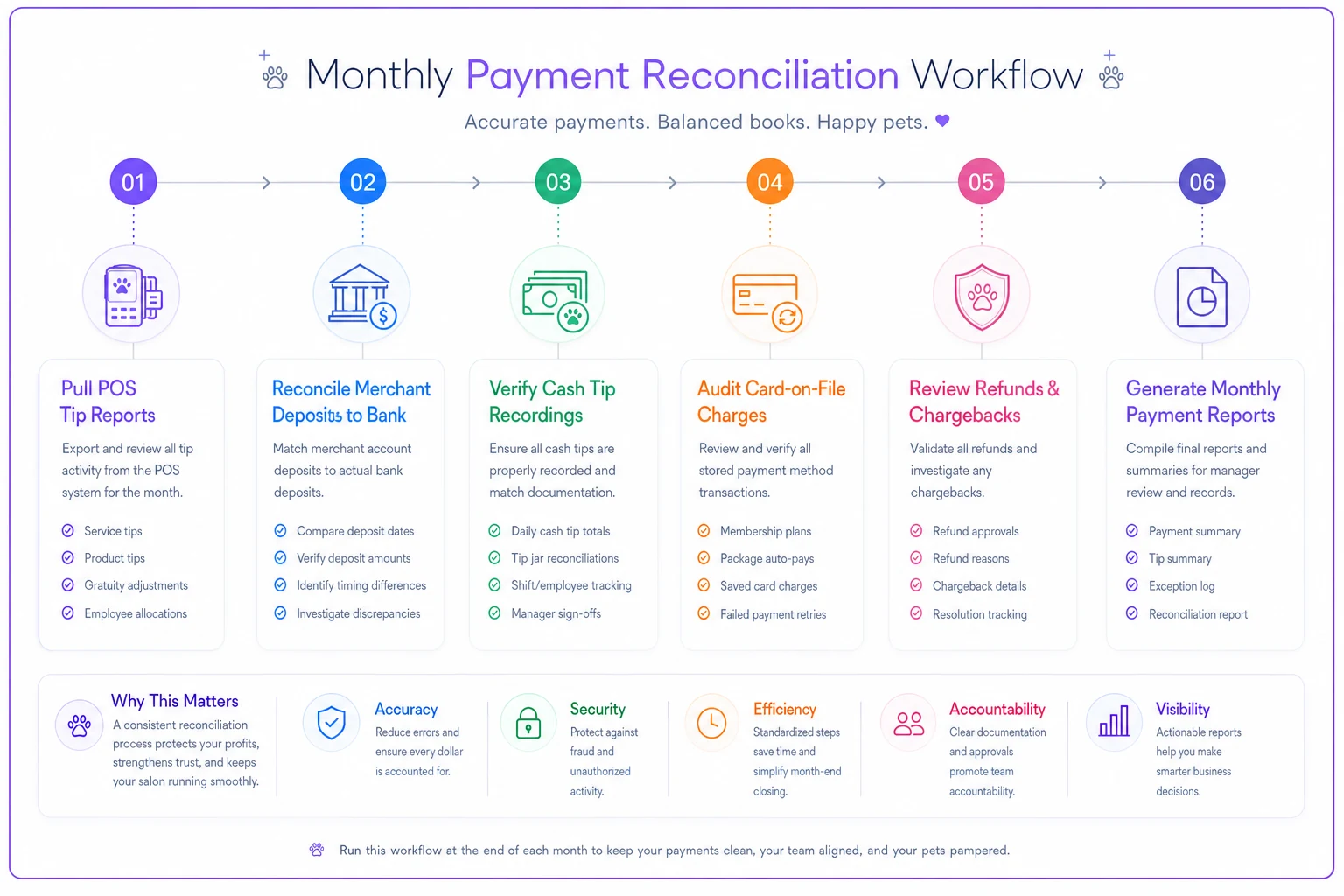
Pull your POS tip report before payroll runs so any $5+ variances are caught early.
Review these for patterns. Growing processing fees might mean it's time to renegotiate rates. Increasing refunds could point to service quality issues. Rising cash payments might indicate something worth investigating.
Connecting Payment Operations to Broader Salon Performance
Payment processing doesn't exist in isolation. The way you handle tips affects staff retention. Your refund policy influences client booking patterns and revenue forecasting. Your card-on-file rules determine how predictable your cash flow actually is.
Payment friction compounds across the business in ways that aren't always obvious. When groomers don't trust tip calculations, they spend mental energy tracking their own numbers instead of focusing on the dog in front of them. When clients get confused about payment policies, front desk staff waste time explaining instead of booking the next appointment. When reconciliation drags on, managers can't spot trends fast enough to act on them.
The relationship between payment policies and groomer compensation structures deserves real attention. If your tip distribution doesn't align with your commission model, you end up with competing incentives. A groomer on 50% commission might prefer cash tips to avoid higher tax withholding, while the salon needs accurate tip reporting for labor law compliance. Building coherent policies across both systems prevents those conflicts before they start—because once they start, they're annoying to unwind.
The AI Automation Opportunity in Payment Operations
Modern AI-powered operational software can turn a lot of this payment chaos into something actually manageable. Instead of manually calculating tip splits, these platforms handle distribution based on rules you define. Rather than chasing down refund documentation when a dispute lands, the system automatically compiles the required records.
The real value comes from connecting payment data to other parts of your operation. When a refund processes, automation can adjust inventory if retail items were involved, update a client's lifetime value calculation, and flag the appointment for a service quality review—without anyone manually coordinating any of it. That kind of cross-system awareness is difficult to replicate with spreadsheets and manual processes.
Payment reconciliation in particular benefits from this kind of setup. The platform continuously monitors for discrepancies between your POS, payment processor, and bank accounts. When variances exceed your thresholds, it alerts the right person with specific steps to investigate. That turns monthly fire drills into quick daily adjustments that take minutes, not hours.
For salons managing tips across multiple staff members, automated distribution calculations eliminate the most error-prone part of payroll. The system tracks service contributions, applies any multipliers, and generates distribution reports that feed directly into payroll processing. No more spreadsheet errors or manual calculations eating up a Friday afternoon before a holiday weekend.
Making Payment Operations a Competitive Advantage
Most grooming salons treat payment processing as a necessary evil—something to minimize and mostly ignore. Salons that actually nail their payment operations tend to build real advantages over time.
Transparent tip policies attract better groomers. Experienced professionals who know exactly how tips work and trust the distribution system are more likely to join and stay. That staffing stability shows up in service quality and client retention in ways that are hard to measure but easy to notice.
Smooth payment experiences keep clients coming back. Nobody wants to argue about charges or wait around while staff figure out refund procedures in real time. Salons with clear policies and efficient execution save clients time and frustration, and in a business built on repeat visits, those small improvements add up over months and years.
Strong payment operations also unlock pricing flexibility. When you understand your true processing costs and tip dynamics, you can experiment with service bundling, memberships, and pricing changes without accidentally destroying margins. You know how each change flows through to what actually lands in the bank.
The data from clean payment operations feeds better decisions across the business too. You can see which services generate the most tips—a useful proxy for client satisfaction—which payment methods cost the most to process, and which clients consistently create payment friction. That visibility is genuinely hard to get when you're running everything through scattered spreadsheets.
Your grooming salon tip policy isn't just about distributing money fairly—it's about building operational infrastructure that holds up as you grow.
Ready to streamline your grooming business?
Join 500+ pet groomers using Furlyly to save time, reduce scheduling conflicts, and deliver exceptional client experiences.