


Most grooming salons don't have a margin problem. They have a drift problem.
Pricing was set two years ago and never touched. Scheduling buffers got shaved down because someone wanted to squeeze in one more doodle before close. Labor cost crept up a point at a time through raises, new hires, and slower groomers. Retail sat there quietly returning less than the shelf space it occupied. None of these are disasters on their own — but added together over 8–12 months, they're the difference between a salon that pays the owner well and one that pays everyone but the owner.
The reason this goes unnoticed isn't laziness. It's that the four things that actually decide your margin — pricing, scheduling, labor, and retail — live in four different tools, four different heads, and four different review cycles. Nobody sits down once a month and looks at all four together against a threshold that says "act now."
That's what a margin governance process fixes. Not more reports. A repeatable monthly rhythm where the owner (or manager) checks the connections between these levers, decides go or no-go on adjustments, and logs what gets tested next. This article lays out the cadence, the roles, the pre-flight checks, the waterfall tables that tie the levers together, and the corrective-action playbook you run when a number trips.
Why margin drift is a coordination failure, not a math failure
Almost every salon repeats the same pattern. The owner knows margins feel tight, so they attack one lever hard — usually pricing. They raise the full-groom price $8 across the board, feel good for a month, then watch the schedule get lumpy because the bump pushed price-sensitive clients from 6-week to 8-week cycles. Fewer visits per client means the same groomer now has open gaps, so labor as a percent of revenue actually rises even though the ticket went up.
They fixed pricing and broke scheduling. Nobody connected the two.
This happens because each lever has a different owner and a different clock:
-
Pricing changes rarely and emotionally — usually after a bad month.
-
Scheduling changes constantly and tactically — whoever's at the front desk.
-
Labor changes through hiring and raises, reviewed almost never.
-
Retail gets ignored until inventory is either out of stock or gathering dust.
A governance process forces all four onto one clock. Once a month, same agenda, same numbers, same thresholds. The goal isn't to change everything monthly — it's to see everything monthly so you change the right thing deliberately instead of yanking one lever in a panic.
If you've already built the underlying number discipline — service-level profitability, a KPI dashboard, clean payroll — governance is the layer that makes those numbers do something on a schedule.
The monthly governance meeting: agenda, roles, and timing
This is a 60–75 minute meeting, once a month, ideally the first week after your monthly close so the numbers are final. If you close books mid-month, run it then. It should never go past 90 minutes. If it does, you're solving problems in the meeting instead of deciding — the actual solving happens afterward.
Never miss a grooming appointment again.
Furlyly helps you book, confirm, and manage every pet grooming appointment effortlessly.
- Unified appointment scheduling
- Automated client reminders
- Staff availability & shift management
No credit card required
Roles
-
Chair (usually the owner) runs the agenda, calls go/no-go, owns the final decision.
-
Numbers keeper pulls the pre-flight pack, presents the waterfall tables, flags threshold trips.
-
Floor voice (lead groomer or manager) speaks for what's actually happening at the tables — where buffers are unrealistic, which upsells clients resist, what's slowing throughput.
-
Retail voice (whoever owns the shelf) reports attach rate, dead SKUs, and what sold.
Solo or two-person shops: the owner is Chair and Numbers keeper, the lead groomer is Floor and Retail. The point is that someone is accountable for each perspective so no lever gets skipped because nobody was in the room to defend it.
The agenda (run it in this order)
-
Pre-flight margin check (10 min) — did any threshold trip last month? Green/yellow/red only. No discussion yet.
-
Waterfall review (20 min) — walk the pricing → scheduling → labor → retail waterfall for the month. This is where you see why margin landed where it did.
-
Threshold trips and go/no-go (20 min) — for each red or yellow, decide: corrective action now, watch another month, or accept.
-
Experiment register review (15 min) — what did we test last month, what were the results, what do we launch or kill this month.
-
Assignments and next check date (5 min) — who owns what, due when.
Keep steps 1 and 2 purely descriptive and step 3 decisive. When owners blur these, they spend an hour debating causes and never actually decide anything.
Pre-flight margin checks: the numbers you pull before you sit down
The pre-flight pack is the single most important habit in this whole process. If the Numbers keeper walks in without it, cancel and reschedule — a governance meeting without numbers is just a vent session.
Pull these for the closed month, each with a prior-month and same-month-last-year comparison so you can separate seasonality from real movement:
-
Overall gross margin % (revenue minus direct service + retail cost of goods and direct labor)
-
Labor as % of service revenue
-
Average ticket (service only, and service + retail separately)
-
Chair utilization % (booked productive hours ÷ available productive hours)
-
Retail attach rate and retail gross margin
-
Rebook rate at checkout — this is the leading indicator that predicts next month's schedule density
The mix matters. Some of these are lagging (margin, labor %) and some are leading (rebook rate, utilization trend). Governance that only watches lagging numbers is always reacting a month too late. A dip in rebook rate this month tells you utilization will sag next month — which lets you act before the gap shows up in labor cost.
If you don't have a clean, consistent way to pull these, that's the first thing to fix. A minimal KPI dashboard built around the metrics that actually trigger corrective action is the feeder for this whole process — governance is what you do with the dashboard once a month.
Waterfall tables: how the four levers actually connect
This is the part most owners have never seen, and it's what makes governance click. A waterfall table shows how you get from top-line revenue down to margin, one deduction at a time — so you can see which lever moved the number, not just that the number moved.
Here's a simplified monthly waterfall for a salon doing roughly 320 grooms a month:
| Line | This Month | Prior Month | Movement | Lever |
|---|---|---|---|---|
| Service revenue | $41,800 | $40,200 | +$1,600 | Pricing / volume |
| — Direct labor | –$16,720 | –$15,300 | worse by $1,420 | Labor |
| — Product cost (service) | –$2,900 | –$2,850 | flat | Supply |
| Service gross margin | $22,180 | $22,050 | +$130 | — |
| Service GM % | 53.1% | 54.9% | –1.8 pts | ⚠️ |
| Retail revenue | $3,400 | $4,100 | –$700 | Retail |
| — Retail COGS | –$1,870 | –$2,150 | — | Retail |
| Total contribution | $23,710 | $24,000 | –$290 | — |
Look at what this exposes. Service revenue went up $1,600 — looks like a win if you only check the top line. But labor jumped $1,420 and retail fell $700, so total contribution actually dropped $290. The price and volume gain got completely eaten.
Without the waterfall, the owner high-fives the revenue bump. With it, they immediately see the real question: why did labor climb faster than revenue? Was it overtime, a new slow hire still ramping, or utilization gaps from thin booking? That's the thread to pull in the go/no-go discussion.
Run one waterfall for service and treat retail as its own mini-line, because retail margin behaves nothing like service margin and blending them hides both.
Here's a quick visual of the monthly governance workflow tying data into the waterfall.
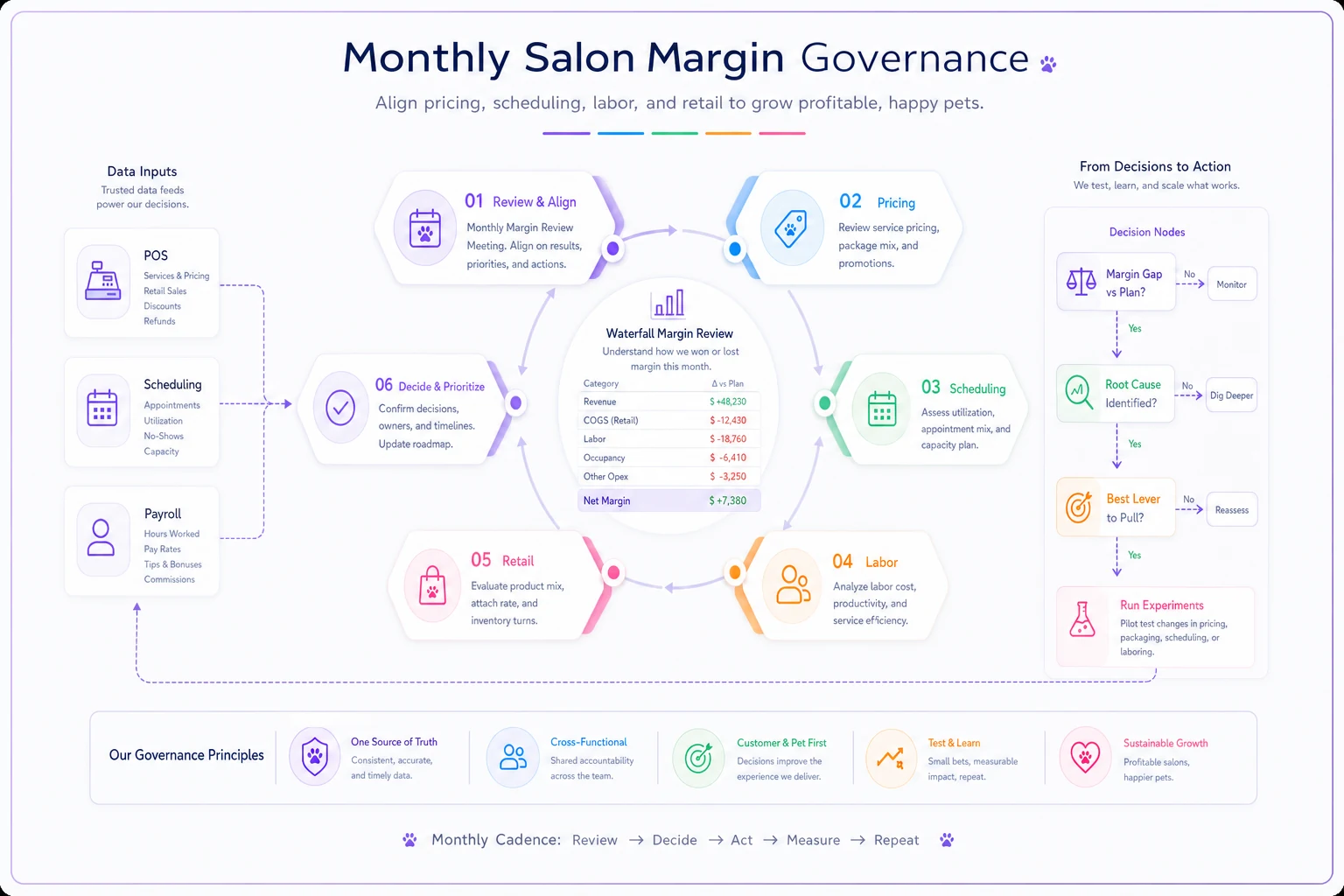
This diagram highlights the meeting as the decision hub where the waterfall turns data into actions.
Go/no-go thresholds: turning drift into decisions
Thresholds are what stop governance from being "let's look at numbers and feel things." Every metric gets three bands, set in advance so you're not negotiating with yourself in the moment.
A realistic starter set:
| Metric | Green (hold) | Yellow (watch) | Red (act) |
|---|---|---|---|
| Service GM % | ≥ 53% | 50–52.9% | < 50% |
| Labor % of service rev | ≤ 40% | 40.1–44% | > 44% |
| Chair utilization | ≥ 80% | 72–79% | < 72% |
| Rebook rate | ≥ 65% | 55–64% | < 55% |
| Retail attach rate | ≥ 25% | 18–24% | < 18% |
The rules that make this work:
-
One red trips a mandatory corrective action. No "let's give it another month" on a red.
-
Two consecutive yellows on the same metric = treat as red. Slow bleeds are how salons die; don't let a metric sit yellow for five months.
-
Green means hands off. This is the discipline owners struggle with most — resist tinkering with things that are working. A price you keep second-guessing is a price your front desk can't defend.
Set your own numbers based on your market and cost structure. The values matter less than the commitment to act when they trip. A threshold you routinely ignore is worse than no threshold — it just trains everyone that the process is theater.
The experiment register: where deliberate change lives
Governance would be pure defense if all it did was watch thresholds. The experiment register is the offense — a simple log, a spreadsheet tab works fine, where every deliberate change gets recorded before you launch it so you can measure it honestly instead of arguing about whether it worked.
Each entry has:
-
Hypothesis — "Adding a $6 teeth-brushing add-on at checkout lifts average ticket without slowing throughput."
-
Lever(s) touched — pricing, scheduling, labor, or retail.
-
Baseline — the metric before you start.
-
Success threshold — what result makes this a keeper.
-
Kill condition — what result makes you roll it back.
-
Owner and review date.
The kill condition is the part everyone skips and everyone regrets. Without it, failed experiments never actually die — they quietly become permanent because nobody wanted to admit they didn't work. Classic example: a salon adds a "premium hand-dry" upcharge, it barely sells, but it stays on the menu for a year cluttering the booking flow because there was no pre-agreed kill line.
Keep only 2–3 live experiments at once. More than that and you can't attribute results — if you change pricing, scheduling, and retail placement in the same month, you'll never know which one moved margin. For structured test designs to feed the register, running 30-day margin sprints across pricing, labor, and retail pairs naturally with a monthly governance clock — sprints generate the experiments, governance decides which ones survive.
The corrective-action playbook: what to run when a threshold trips
When a metric goes red, you don't want to improvise. A pre-built play means the response is fast and consistent.
If Service GM % goes red:
-
Check the waterfall — is it a labor problem or a price problem? Don't assume.
-
If labor-driven
look at utilization and overtime before touching pricing.
-
If price-driven (product cost up, price flat)
review your most-booked three services for a targeted increase, not a blanket one.
-
Log the change as an experiment with a rebook-rate kill condition, since a price move can quietly erode visit frequency.
If Labor % goes red:
-
Separate the cause
overtime, a ramping new hire, or genuine over-staffing against demand.
-
A new hire dragging the number for 60–90 days is expected — note it, don't overcorrect.
-
Genuine over-staffing against a soft schedule is a scheduling fix, not a firing decision. Tighten booking density before touching headcount.
-
Persistent labor drift with strong utilization usually means pricing hasn't kept pace with wage growth — that routes back to the pricing play.
If Utilization or Rebook goes red:
-
Rebook is the earlier signal — chase it first. Weak rebook today is weak utilization next month.
-
Audit the checkout moment
is anyone actually asking for the next appointment, or is the client walking out uncommitted?
-
Check scheduling fragmentation — scattered single slots that can't be filled tank utilization even when demand is otherwise fine.
If Retail attach goes red:
-
Separate "nobody's asking" from "we're out of stock."
-
Review top-selling SKUs and whether they're actually within reach at checkout.
-
Log any commission or placement change as an experiment, not a permanent shift.
Notice how often the plays route into each other. A labor problem turns out to be a pricing problem. A retail problem turns out to be a stock problem. That cross-routing is exactly why these four levers belong in one meeting — the corrective action for one is frequently hiding in another.
Labor issues especially tend to look like scheduling or pricing problems on the surface when the real driver is people: turnover, ramp time, or productivity spread across the team. When a labor threshold keeps tripping despite decent utilization, it's worth pulling that thread on the people and performance side of the salon before assuming the fix is a price hike.
A real scenario: catching the drift before it compounded
A two-groomer salon doing around 300–330 grooms a month kept posting "fine" revenue — roughly $38k–$41k depending on the month — but the owner noticed she was taking home less each quarter without knowing why. No single number looked alarming.
She started running a monthly governance meeting with a pre-flight pack. The first waterfall exposed it immediately: service revenue was flat-to-up, but labor had crept from around 39% to 43% of service revenue over roughly five months. Digging in, it wasn't overstaffing — it was utilization. Rebook rate had quietly slid into the mid-50s, so both groomers had four to six open slots a week they were still getting paid to be there for.
The waterfall pointed at rebook, not pricing. The corrective play was a checkout rebook script and tightening scattered single slots into denser blocks — no price change, no cuts. Rebook climbed back toward the mid-60s over about two months, utilization followed, and labor % settled back near 40%. The owner's monthly take recovered a few hundred dollars a week without touching a single price or losing a client.
The point isn't the tactic. It's that she saw the connection because all four levers were on one clock. A year earlier she'd have "fixed" this with a blanket price increase and made the rebook problem worse.
When a formal governance cadence makes sense — and when it doesn't
When it's worth it: You're doing enough volume that drift hides in the aggregate — roughly 200+ grooms a month, or two or more groomers. At that scale you can no longer feel every dollar, and small percentage shifts move real money. Multi-location owners need this because you can't be at every front desk.
When it's overkill: A true solo operator doing 60–80 grooms a month can usually run a lighter version — a 20-minute monthly check of three or four numbers, no formal roles. The full cadence would be more ceremony than the business justifies.
Who should hold off: If your books aren't closing cleanly each month, don't build governance on top of bad numbers. Fix the close first. Governance amplifies whatever data you feed it — garbage in, confident-but-wrong decisions out. Same goes if you have no consistent metric definitions; get everyone agreeing on what "utilization" and "attach rate" mean before setting thresholds against them.
Where software quietly earns its keep here
The governance process is fundamentally about seeing four levers together on one clock, and that's exactly where pulling numbers by hand tends to fall apart. If assembling the pre-flight pack takes three hours of exporting from your POS, booking tool, and payroll system, you'll skip the meeting the first busy month — and then every month after that.
Operational platforms that connect scheduling, pricing, labor, and retail data can let the pre-flight pack essentially build itself. The waterfall populates from live data, threshold trips flag automatically instead of waiting for someone to notice, and the experiment register lives next to the numbers it's measuring. None of that is the point of governance on its own — the decisions are still the point — but it's the difference between a cadence you actually sustain and one that dies by month three because the prep was too painful.
When the numbers are already assembled and the thresholds are already flagged, the meeting can spend its full 60 minutes on the only thing that matters: deciding what to change, and what to leave alone. That's a different kind of meeting than one where half the time disappears reconciling spreadsheets.
Bringing it together
Margin in a grooming salon isn't set by any one decision. It's the running total of hundreds of small choices across pricing, scheduling, labor, and retail — most of them made by different people on different days with no one watching the sum. Drift is the default. Governance is the deliberate act of pulling those four levers onto one monthly clock, checking them against thresholds you set in advance, and deciding — with the waterfall in front of you — which lever to move and which to leave alone.
Start small. Run one meeting next month with a rough pre-flight pack and a single waterfall table. You'll almost certainly find one connection you'd been missing — a price gain eaten by labor, a labor problem that was really a rebook problem, a retail line quietly bleeding. That first discovery is usually worth more than the whole process cost you to set up. Then run it again the month after, and the month after that, until watching all four levers together stops being a project and just becomes how you run the salon.
Margin in a grooming salon isn't set by any one decision. It's the running total of hundreds of small choices across pricing, scheduling, labor, and retail — most of them made by different people on different days with no one watching the sum. Drift is the default. Governance is the deliberate act of pulling those four levers onto one monthly clock, checking them against thresholds you set in advance, and deciding — with the waterfall in front of you — which lever to move and which to leave alone.
Start small. Run one meeting next month with a rough pre-flight pack and a single waterfall table. You'll almost certainly find one connection you'd been missing — a price gain eaten by labor, a labor problem that was really a rebook problem, a retail line quietly bleeding. That first discovery is usually worth more than the whole process cost you to set up. Then run it again the month after, and the month after that, until watching all four levers together stops being a project and just becomes how you run the salon.
Ready to streamline your grooming business?
Join 500+ pet groomers using Furlyly to save time, reduce scheduling conflicts, and deliver exceptional client experiences.