

Most grooming salons don't fail a chemical inspection because they're reckless. They fail because nobody can produce a piece of paper. The shampoo concentrate is stored fine, the flea dip is used correctly, the staff knows what they're doing — but when a county environmental inspector or a fire marshal walks in and asks for the safety data sheet on that gallon of degreaser under the tub, three people shrug and start opening cabinets.
That gap — knowing your operation is basically safe but not being able to prove it — is where salon chemical disposal compliance actually lives. This article is about closing that gap with a system small teams can realistically run: a real checklist, SDS handling templates, scripts for talking to your waste vendor, an audit-ready log, and a quarterly cadence that doesn't eat your week.
What actually trips up grooming salons
Groomers handle more regulated material than most owners realize. It's not just shampoo. It's flea and tick treatments, ear cleaners, enzymatic deodorizers, kennel disinfectants — quats, bleach, accelerated hydrogen peroxide — nail cautery powder, clipper lubricants, blade wash solvents, plus whatever hair, nail clippings, and biological waste go down your drains or into your dumpster.
The common failure points fall into four buckets:
-
No current SDS library. Products get reordered, formulas change, and the sheet on file is three versions old — or was never pulled at all.
-
Down-the-drain disposal of things that shouldn't go there. Flea dip rinse, solvent-based blade wash, and concentrated disinfectants poured into the mop sink or floor drain.
-
Dumpster disposal of partially full chemical containers. Half a jug of expired dip tossed in the regular trash.
-
No disposal record. Even when a salon does everything right, there's no log proving when, what, and how something was disposed.
The physical act is usually the easy part. Documentation is what gets cited. An inspector can't see your good intentions — they can only read your records.
Why the paperwork gap happens
In real operations, this usually happens because chemical handling is nobody's actual job. The groomer who opens a new product doesn't think to pull the SDS. The person who throws out the empty jug isn't the person who ordered it. There's no single owner of "chemical and waste," so it falls between everyone.
Never miss a grooming appointment again.
Furlyly helps you book, confirm, and manage every pet grooming appointment effortlessly.
- Unified appointment scheduling
- Automated client reminders
- Staff availability & shift management
No credit card required
It also happens because the rules feel abstract until they're not. OSHA's Hazard Communication Standard requires accessible safety data sheets for hazardous chemicals your staff is exposed to. Your local wastewater authority has rules about what can enter the sewer. Your state environmental agency — and sometimes your county — handles hazardous waste disposal. None of these agencies send you a friendly checklist. You find out the hard way, usually during an inspection triggered by a complaint, a neighboring business, or a routine fire department visit.
A typical example: a two-tub salon reorders their usual tick dip, but the manufacturer reformulated it and the new version carries a different hazard classification. The salon keeps disposing of the rinse the same way they always have. Nobody updated the SDS. Nothing happens for two years — until a sewer backup investigation leads an inspector to their drains.
The master compliance checklist
Run this as your baseline. If every box is checked and documented, you're in good shape for the vast majority of grooming operations.
Chemical inventory and storage
-
[ ] Complete list of every chemical product on site, including retail backstock
-
[ ] Current SDS on file for each product (matching the exact version/formula in use)
-
[ ] SDS library accessible to all staff (binder in a known spot, or a shared digital folder)
-
[ ] Chemicals stored per SDS guidance (temperature, ventilation, incompatibles separated)
-
[ ] Secondary containment for liquids over a certain volume (check local threshold)
-
[ ] All containers labeled — including any decanted or diluted working solutions
-
[ ] Flammables (some blade washes, aerosols) stored away from heat and ignition sources
Disposal practices
-
[ ] Written list of what may go down the drain vs. what may not
-
[ ] Flea/tick dip rinse handled per label and local sewer rules
-
[ ] Solvent-based products collected, not drained
-
[ ] Empty containers triple-rinsed or handled per SDS before disposal
-
[ ] Sharps/cautery materials in proper containers if applicable
-
[ ] Hair and nail waste bagged (not a chemical issue, but inspectors notice housekeeping)
Documentation
-
[ ] Disposal log maintained (template below)
-
[ ] Waste vendor contract/manifest on file
-
[ ] Staff training on chemical handling documented with dates and signatures
-
[ ] Spill response procedure posted and spill kit stocked
-
[ ] Quarterly audit records retained
This overlaps with the kind of operational safeguards covered in the operational insurance and risk-control checklist — a chemical incident is exactly the sort of event where your coverage and your records need to work together.
SDS handling: the template that keeps your library current
The SDS library isn't a one-time project. It drifts out of date the moment you reorder anything. The fix is tying SDS handling to the two moments where it's most natural: receiving a new product and changing suppliers or formulas.
Here's the handling template as a simple intake record. Keep one row per product.
| Field | What goes here |
|---|---|
| Product name | Exact name on the label |
| Manufacturer | Who makes it |
| SDS version/date | The revision date printed on the sheet |
| Date added to library | When you filed it |
| Location used | Which tub/station/area |
| Hazard class notes | Flammable, corrosive, aquatic-toxic, etc. |
| Disposal method | Drain OK / vendor pickup / special handling |
| Reorder trigger | Re-pull SDS on next reorder? (Y/N) |
The rule that makes this stick: no new chemical gets opened until its SDS is in the library. Tape it to the receiving clipboard if you have to. The person who checks in the delivery pulls the SDS — almost always a free download from the manufacturer's site — and drops it in the binder or shared folder. Two minutes. The alternative is an inspector finding a product with no sheet and you scrambling to find one.
One pattern worth watching: manufacturers quietly reformulate. The product name stays the same, the bottle looks identical, but the SDS revision date changed. That's why the "reorder trigger" field matters — on major products, re-check the SDS version at least once or twice a year.
Talking to your waste vendor: conversation scripts
A lot of owners never actually ask their waste hauler what they're allowed to put out. They assume. Then they find out their regular commercial trash contract doesn't cover chemical waste at all — and they've been technically violating it for years.
Have these conversations on the phone or by email, and save the answers in writing. That written response is part of your audit trail.
> "Hi, we're a pet grooming business and I want to confirm what our commercial waste contract covers. Specifically: can we dispose of small quantities of expired or leftover grooming chemicals — things like flea dip, disinfectant concentrate, or blade wash solvent — in our regular dumpster? If not, what's the correct process, and can you send me that in writing or point me to your policy?"
> "We need a quote for periodic pickup of small-quantity hazardous and chemical waste from a grooming salon. Typical items include solvent-based cleaners, expired pesticide-class products, and concentrated disinfectants. We'd want manifests for each pickup for our records. What's your minimum pickup, pricing, and how far out do we need to schedule?"
> "I run a grooming salon and want to confirm what we're permitted to discharge into the sanitary sewer. We rinse animals with shampoo and sometimes flea/tick products. Can you tell me your pretreatment or discharge rules for our type of business, and is there a permit or threshold I should know about?"
Worth being clear on: the waste hauler and the sewer authority are two separate conversations. The hauler handles what goes in the dumpster. The wastewater authority handles what goes down the drain. You need answers from both — in writing, on file.
When you're setting up a new vendor relationship, the same purchasing discipline from the purchasing and payment controls guide applies — get contract terms, pickup minimums, and manifest commitments documented before the first invoice, not after.
The audit-ready disposal log
This is the single document most likely to save you during an inspection. It proves disposal happened, correctly, and when. Keep it simple enough that a busy groomer will actually fill it in.
| Date | Product/material | Approx. quantity | Disposal method | Handled by | Manifest/ref # |
|---|---|---|---|---|---|
| 03/14 | Expired tick dip | ~½ gallon | Vendor pickup | J. Ramos | HW-2231 |
| 03/22 | Blade wash solvent | ~1 qt | Vendor pickup | J. Ramos | HW-2231 |
| 04/02 | Shampoo (diluted) rinse | ongoing | Sanitary sewer (permitted) | — | n/a |
| 04/18 | Empty disinfectant jugs (x3) | — | Triple-rinsed, recycled | M. Lee | n/a |
Keep at least a rolling two years of records. The "handled by" column matters more than owners expect — if there's ever a question, you can connect the disposal to a trained person, which supports both your compliance story and your insurance position.
A quarterly audit cadence a small team can run
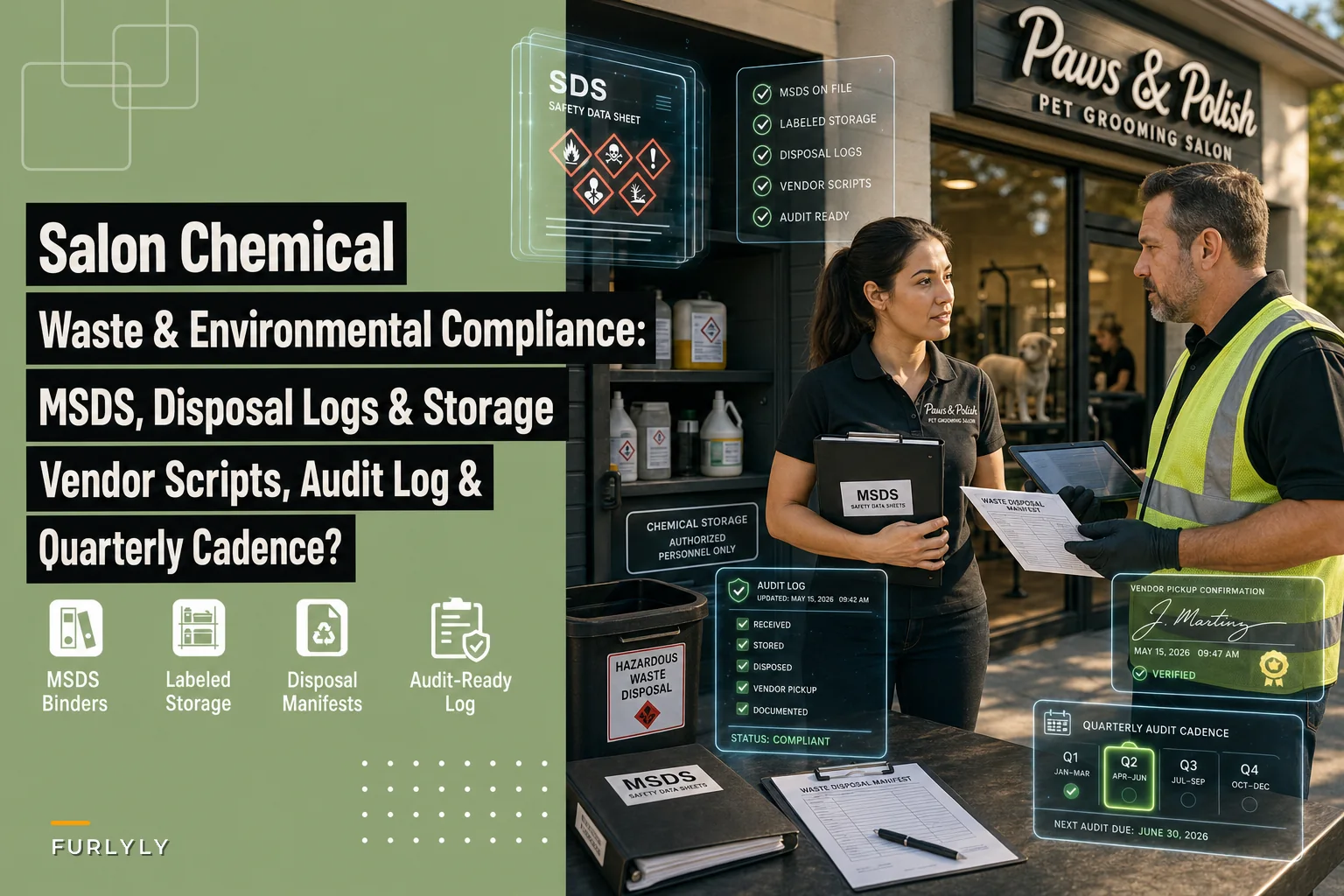
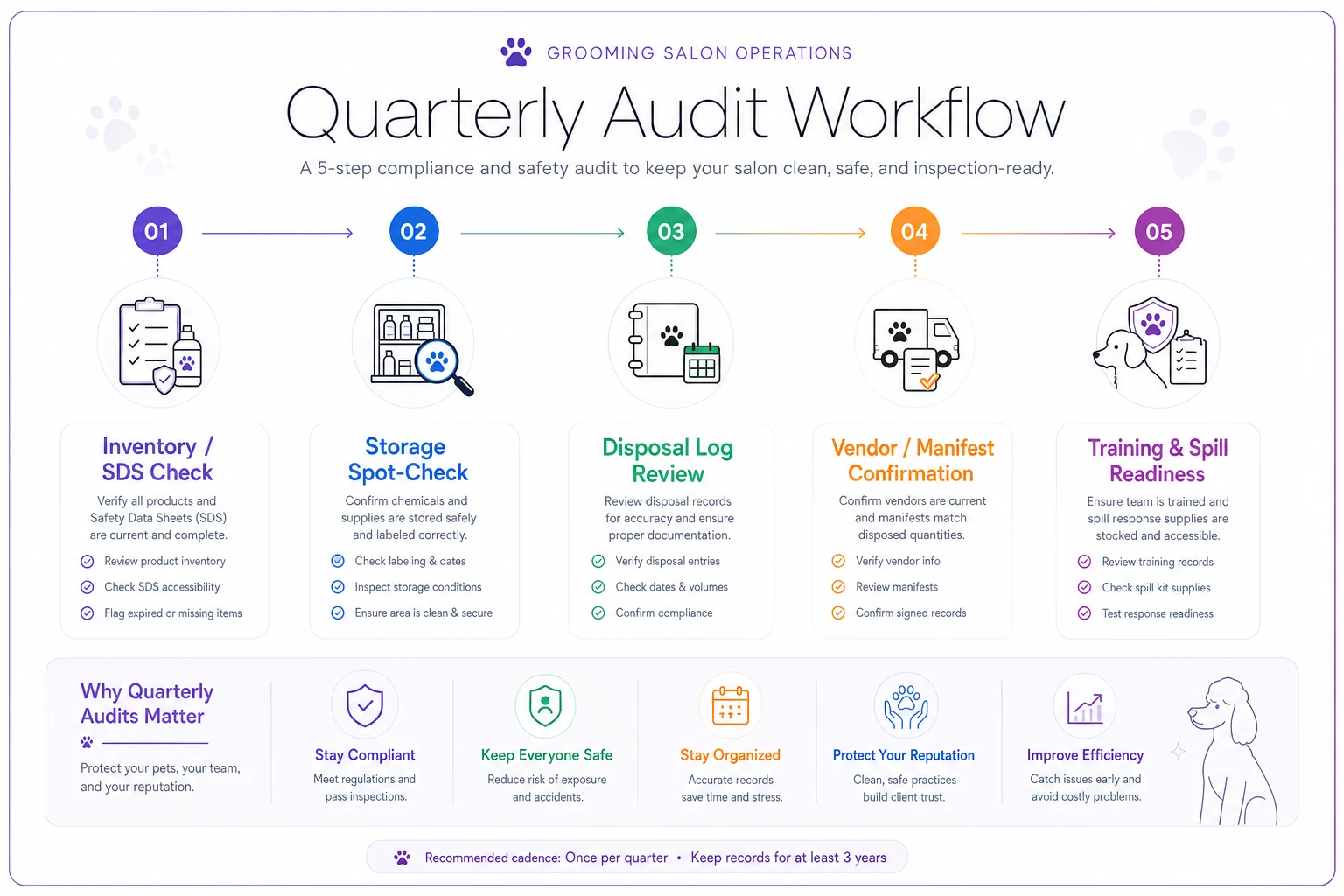
You don't need monthly chemical audits. Grooming chemical use is stable enough that quarterly works, as long as you actually do it. Block 45 minutes, put it on the calendar, and run the same five steps each time.
-
Reconcile inventory to SDS library. Walk the shop. Every chemical on a shelf should have a matching current SDS. Anything new or reformulated gets its sheet pulled on the spot.
-
Spot-check storage. Labels legible? Incompatibles separated? Flammables away from heat? Secondary containment intact?
-
Review the disposal log. Is it being filled in? Any gaps where chemicals were obviously used up but no disposal was recorded? That gap is your warning sign.
-
Confirm vendor status. Manifests on file for the quarter's pickups? Next pickup scheduled? Vendor contract current?
-
Refresh training and spill readiness. Any new staff who haven't been trained? Spill kit stocked and not expired? Log the training dates.
A quick visual of the quarterly audit steps can make it easy to train a backup and keep the process consistent.
Finish by signing and dating the audit itself. That signed quarterly record is what turns "we think we're compliant" into "here's the file." Pair it with your equipment routines — the same calendar discipline behind a maintenance schedule and spare-parts plan applies here too, because both fail the same way: not from a single bad decision, but from quiet drift over months.
A real scenario
A three-groomer salon in a mid-size suburb had been open about six years. Clean shop, good reviews, no incidents. During a routine fire department inspection, the marshal asked for SDS on a solvent-based blade wash and a quaternary disinfectant. Neither sheet was on file, and a half-full jug of discontinued flea dip was sitting in the regular trash bin.
No fine that day — just a correction notice and a follow-up visit in 30 days. But the owner spent that month in reactive mode: pulling SDS sheets, calling the hauler only to learn the standard contract didn't cover chemical waste, then arranging a small-quantity hazardous pickup. The pickup itself ran a few hundred dollars for the minimum. The real cost was somewhere around 10 to 12 hours of owner time scrambling, plus the stress of a return inspection.
After passing the follow-up, they built the system described here: SDS pulled at receiving, a disposal log on the supply-room clipboard, a scheduled quarterly audit, and a written drain-discharge confirmation from the local authority. The next unannounced visit, about a year later, took eight minutes. The inspector asked for a sheet, the owner pointed to the binder, and that was it. The before-and-after wasn't about doing new things — they were already handling chemicals reasonably. It was about being able to prove it in under ten minutes instead of thirty days.
When to bring in outside help — and when not to
When a DIY checklist is enough: Single-location salons with a stable product lineup and a handful of regulated chemicals. If your entire chemical inventory fits on one page, you don't need a consultant. You need the discipline above.
When to call in a professional: If you're using larger volumes of pesticide-class dips, running multiple locations, or operating in a jurisdiction with strict pretreatment rules, a one-time consultation with an environmental compliance specialist is worth it. They'll confirm your local thresholds and disposal pathways so you're not guessing.
Who should not over-engineer this: A small salon tempted to build an elaborate chemical management program with monthly audits and a dedicated binder for everything. You'll abandon it by month three. The system only works if it's light enough to actually run — quarterly, one page, one log.
Keeping it from drifting
The part no checklist can solve is ownership. Chemical and waste compliance drifts the moment it stops being someone's named responsibility. Assign it — ideally to whoever already handles receiving or supply orders, since the SDS step naturally attaches to their existing workflow. Centralizing your SDS library and disposal log in a shared location, even a simple shared drive or your salon management system if it stores documents, means records survive staff turnover and a lost binder.
Assign chemical and waste ownership to whoever handles receiving or supply orders.
The goal isn't a perfect program. It's a boring, repeatable one that produces paper on demand.
Get the SDS pulled at the door, log every disposal, keep the vendor manifests, and sign a quarterly audit. Do those four things consistently and salon chemical disposal compliance stops being what you dread during an inspection and becomes the folder you hand over in under ten minutes.
The goal isn't a perfect program. It's a boring, repeatable one that produces paper on demand.
Get the SDS pulled at the door, log every disposal, keep the vendor manifests, and sign a quarterly audit. Do those four things consistently and salon chemical disposal compliance stops being what you dread during an inspection and becomes the folder you hand over in under ten minutes.
Ready to streamline your grooming business?
Join 500+ pet groomers using Furlyly to save time, reduce scheduling conflicts, and deliver exceptional client experiences.