

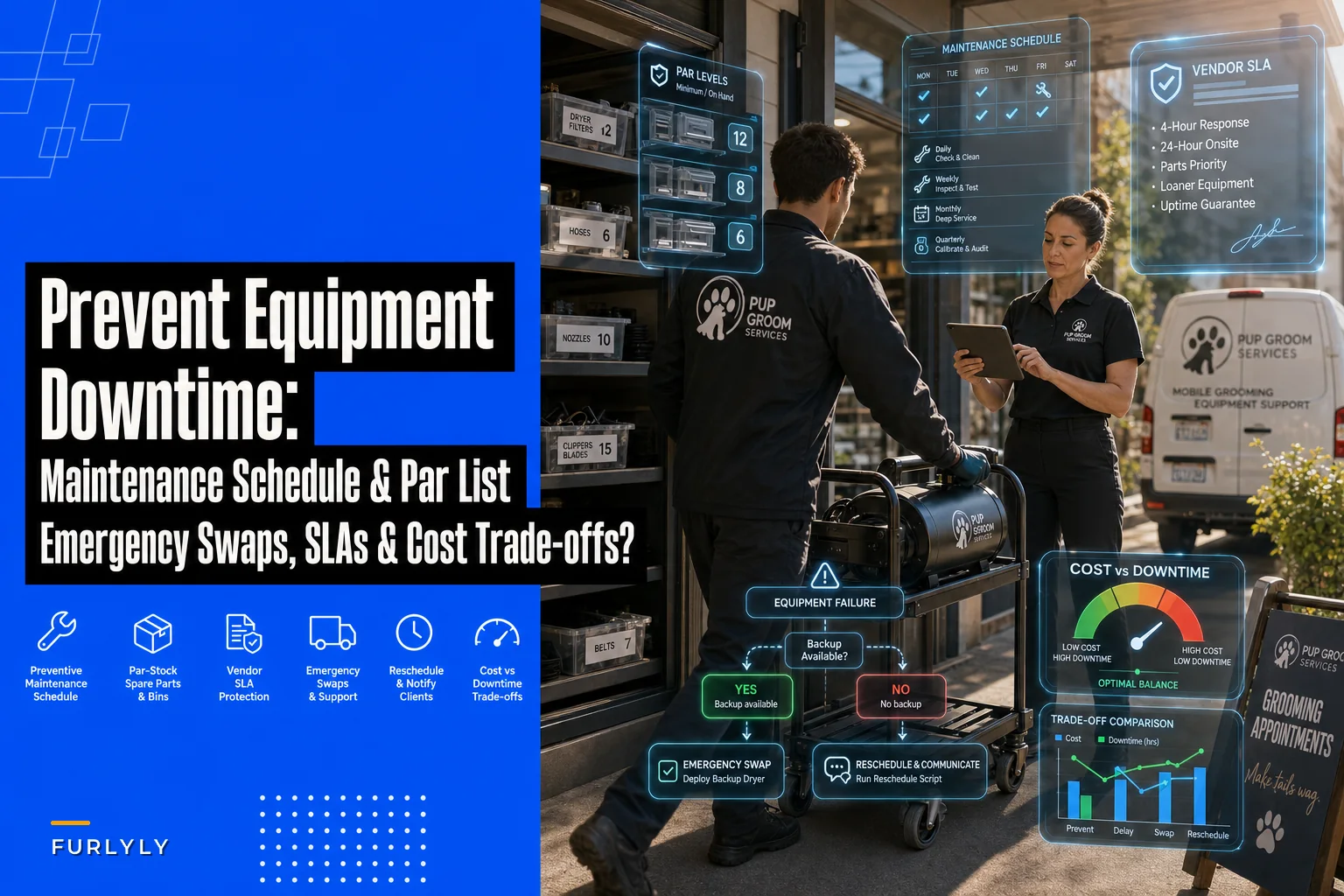

A HV dryer that stops mid-shift doesn't feel like an equipment problem in the moment. It feels like a scheduling emergency. You've got four dogs booked back-to-back, one of them a doodle that takes 40 minutes just to dry, and suddenly your whole afternoon is compressed onto one working dryer while two groomers take turns waiting.
That's what most salons miss about equipment maintenance. The cost isn't the repair bill — it's the cascade. Rebooked appointments, rushed jobs, a groomer standing around on commission, and the client who watched you scramble and quietly decided to try the place down the road next time.
This post is narrow on purpose. It covers the mechanical backbone of a grooming operation — dryers, clippers, tables, tubs, and the plumbing feeding them — and how to build a grooming equipment maintenance checklist, a spare-parts par list, vendor SLA terms that actually hold, and swap scripts your team can run without thinking when something dies at the worst possible moment.
Why grooming equipment fails at the worst time (and it's rarely random)
Equipment doesn't die randomly. It dies under load. That's why your dryer motor gives out on a Saturday and not a slow Tuesday — heat, run-time, and duty cycle all peak when you're busiest.
A few patterns show up repeatedly in busy salons:
-
Clipper blades and motors go from hair and heat, not age. A clipper run hot all day, packed with fine undercoat, and never properly cooled or oiled will burn out months early. The failure looks sudden but it's been building for weeks.
-
Dryer motors fail from clogged intake filters. Restricted airflow makes the motor work harder and run hotter. Nobody cleans the intake filter, so the motor slowly cooks itself.
-
Tub and table hydraulics leak before they fail. There's almost always a warning — a slow drift down, a puddle under the table, a pump that needs two strokes where it used to need one. Salons ignore it until the table won't hold a large dog.
-
Water heater recovery time. In a multi-station salon, a heater that's slightly undersized or scaling up internally means your last bath of the morning runs cold. Not a hard failure, but it slows every job.
Most salons run reactive maintenance — fix it when it breaks. That works fine right up until it doesn't, and the moment it doesn't is always expensive.
The real cost math: downtime vs. prevention
Say a mid-size salon does around 40 dogs a week across two dryers and three clippers. A single HV dryer dies on a Saturday. You lose roughly half your drying capacity for the day.
Never miss a grooming appointment again.
Furlyly helps you book, confirm, and manage every pet grooming appointment effortlessly.
- Unified appointment scheduling
- Automated client reminders
- Staff availability & shift management
No credit card required
| Item | Reactive (dryer dies, no plan) | Preventive (par + swap plan) |
|---|---|---|
| Same-day emergency repair call | $180–$260 rush fee | $0 (planned service) |
| Appointments rebooked / shortened | 4–6 dogs affected | 0 |
| Lost revenue that day | ~$300–$450 | 0 |
| Groomer idle time (commission staff waiting) | 1–2 hrs paid, no output | minimal |
| Client goodwill hit | 1–2 clients don't rebook | none |
| Backup dryer swapped in | none available | 3-minute swap |
The reactive column adds up to somewhere around $500–$700 in a single afternoon, before you count the client who never comes back. The preventive column costs you a spare dryer sitting in a closet — roughly $250–$400 for a solid backup unit — and maybe an hour a month of cleaning and inspection.
The spare pays for itself the first time it saves a Saturday.
Building the maintenance schedule
The trick with a maintenance schedule is tying tasks to run-time and usage, not just the calendar. A dryer used 30 hours a week needs more attention than one used 8. Here's a structure that works for most floor operations.
Daily (end of shift, 5–10 minutes)
-
Wipe and cool clippers; brush hair out of blade and motor vents
-
Oil clipper blades before storing
-
Clean dryer intake filters (this is the one everyone skips)
-
Wipe down tub drains, clear the hair catch
-
Quick visual on table hydraulics — any drift or leak?
Weekly
-
Deep-clean clipper blades (blade wash, dry, oil)
-
Check dryer hoses and nozzles for cracks
-
Test table lift under load — does it hold a large dog without drifting?
-
Descale kettle/heater area if you're in a hard-water region
-
Inspect power cords and plugs for fraying (a real fire and liability point)
Monthly
-
Rotate backup equipment into use to confirm it actually works (a backup you never test is not a backup)
-
Lubricate table and tub moving parts
-
Check water heater recovery time on a busy morning
-
Review spare-parts par levels and reorder anything below par
Quarterly
-
Professional service on dryers and hydraulics
-
Replace clipper drive parts showing wear
-
Full electrical inspection of high-draw equipment
One thing worth flagging: the daily list is where 80% of failure prevention actually happens, and it's the first list that gets abandoned when the salon gets slammed. If you only enforce one thing, enforce the end-of-shift five minutes. Blade oiling and filter cleaning prevent more emergencies than any quarterly service call.
The spare-parts par list
A par list for parts works exactly like a par list for shampoo or retail — you set the minimum quantity you always want on hand and reorder when you dip below it. If you've already set up retail and van pars, this will feel familiar; the same logic that keeps a mobile grooming route stocked with the right on-van inventory applies to the parts that keep your equipment running.
-
Clipper blades (your two most-used sizes)
2 spare each
-
Clipper blade drive / drive lever 2
-
Clipper cord or full backup clipper 1 backup unit
-
Dryer intake filters 4
-
Dryer motor brushes (if your model uses replaceable brushes)
1 set per dryer
-
Dryer hose + nozzle set 1
-
Table/tub hydraulic seals or repair kit 1
-
Grounding/GFCI outlet 1 (fast to fail, fast to replace, cheap)
-
Backup HV dryer 1 whole unit
The whole-unit backups — a spare dryer, a spare clipper — are what turn a disaster into a shrug. Small parts save you a service call; whole units save you the day.
A common mistake: buying spares for equipment that rarely fails and skipping spares for the parts that fail constantly. Track what actually breaks in your salon over a few months and let that drive the par list, not a generic template.
Vendor SLA templates: what to actually put in writing
Most salons don't have a service agreement with their equipment vendors. They just call whoever answers when something breaks, pay the rush fee, and wait. That's the most expensive possible approach.
-
Response window. "Non-emergency
service within 3 business days. Emergency (equipment down during operating hours): same-day or next-morning." Get the emergency definition explicit.
-
Priority status. Ask whether a small monthly or annual service retainer moves you ahead of one-off callers in the queue. Often it's a modest fee for a real bump in priority.
-
Loaner policy. For anything that takes more than a day to fix, does the vendor provide a loaner unit? This is negotiable and worth a lot.
-
Parts stocking. Does the vendor stock parts for your models locally, or do they order them? If they order, that's your cue to keep more spares yourself.
-
Flat vs. hourly labor. Know which it is before the invoice surprises you.
-
Preventive service credit. Some vendors discount emergency calls for salons already on a preventive plan. Worth asking.
A vendor who knows you're a repeat, on-plan customer treats your Saturday emergency very differently than one hearing from you for the first time. The SLA isn't really about the paperwork — it's about being the account they prioritize.
Emergency swap and rescheduling scripts
When something dies mid-shift, the difference between a controlled situation and chaos is whether your team knows exactly what to do without asking you. Write these down and post them near each station.
The equipment swap decision flow
-
Check for a backup unit. If one's available, swap it in, log the failure, and keep grooming. Done in a few minutes.
-
If no backup, assess remaining capacity. Can the day continue on working equipment with adjusted timing? If yes, redistribute dogs across stations, build in time buffers, and give affected clients a heads-up about a possible short delay.
-
If capacity can't absorb it, trigger the rescheduling script. Don't wait — the sooner clients are contacted, the better the reaction.
A quick visual of the decision flow.
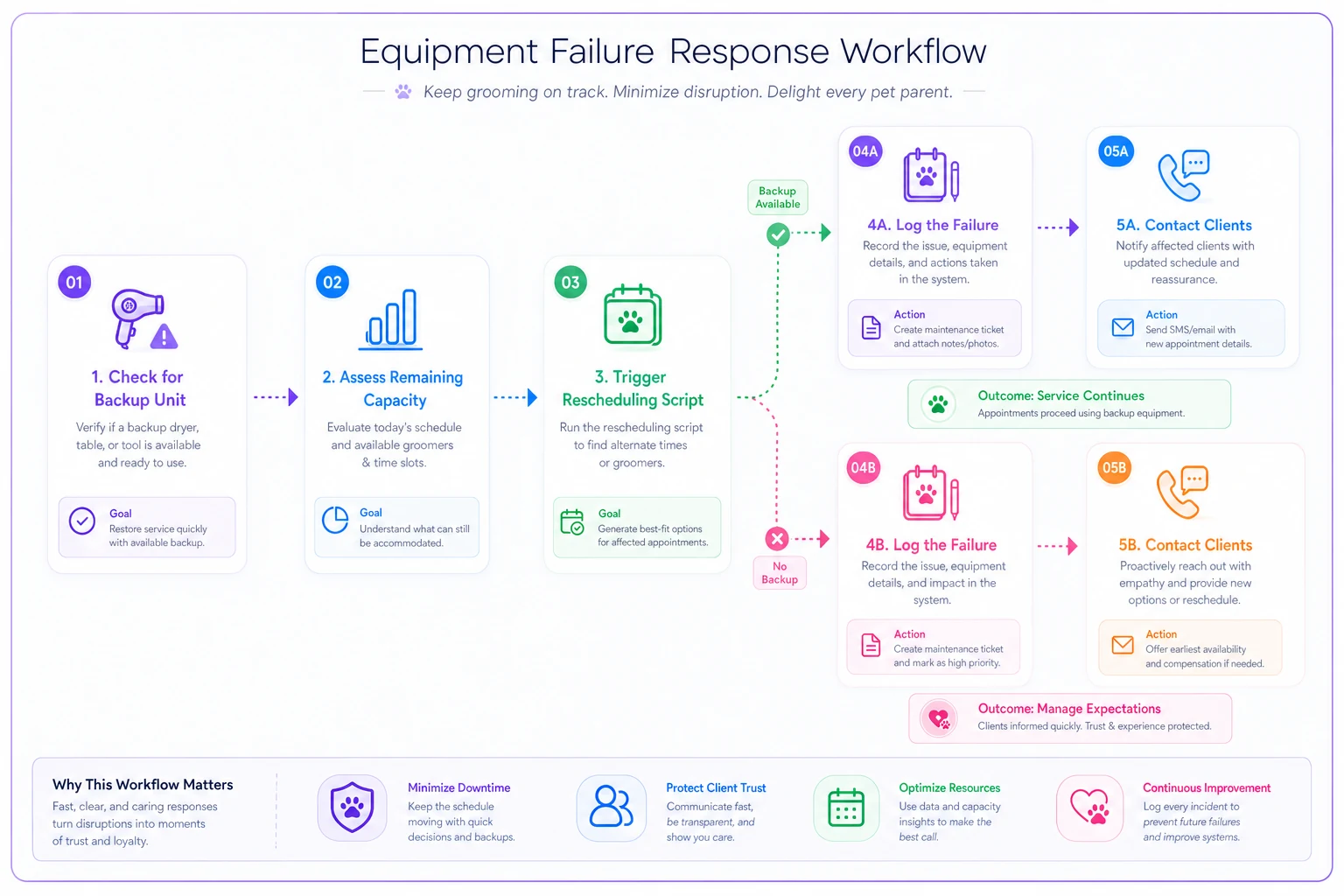
That sequence — backup first, redistribute second, reschedule third — keeps the team moving in the right direction instead of standing around waiting for a decision.
Client rescheduling script (equipment failure)
> "Hi [Name], this is [Salon]. One of our dryers went down this morning and we want to make sure [Pet]'s groom gets the full attention it deserves rather than a rushed job. Could we move [Pet] to [alternative time] today, or [next available day]? As a thank-you for the flexibility, we'll take [10–15%] off this visit."
The framing matters. You're not apologizing your way into looking incompetent — you're framing the reschedule as protecting the quality of their pet's groom. Most clients respect that. The small discount signals you take their time seriously.
Internal staff script
> "Equipment down: [item]. Backup available: [yes/no]. Affected dogs today: [list]. Reassign to: [stations]. Clients to contact: [list]. Log the failure in the equipment log before end of shift."
Having this written removes the panicked huddle. Everyone knows their next move.
A real scenario
A two-groomer suburban salon doing roughly 150–170 dogs a month ran entirely reactive on equipment. Over one summer they had two dryer failures and a hydraulic table that started drifting.
Each dryer failure cost them a rush repair fee plus a scrambled afternoon — around $500 each in lost bookings and idle commission time — and they lost a few regulars in the process.
They spent about $350 on a backup HV dryer, built the daily and weekly checklist above, stocked a small par of blades, filters, and drive parts (maybe $200 total), and got a loaner clause added to their dryer vendor agreement.
The following season, a dryer motor failed again — on a Saturday, naturally. The backup was swapped in inside five minutes. No rebookings, no idle groomer, no lost clients. The failure that would've cost $500 and a couple of regulars cost them nothing but a scheduled repair the following Tuesday.
One prevented bad Saturday paid for the whole system.
When this level of structure makes sense — and when it's overkill
This makes sense when: you're running two or more stations, your equipment sees heavy daily use, or you've had even one bad downtime day this year. If losing a dryer for an afternoon meaningfully dents your revenue, you need spares and swap scripts.
This is probably overkill when: you're a solo groomer doing a handful of dogs a day on a light schedule. A single backup clipper and a habit of oiling blades might be all you need. Don't build a quarterly service calendar for equipment that runs three hours a day.
Who should absolutely not skip this: multi-station salons and anyone scaling up. As you add stations and staff, equipment failures stop being a personal inconvenience and become a whole-team productivity hit. If you're growing, this belongs in your operational backbone alongside your roles, capacity math and SOP rollout planning — because a swap script is just an SOP for the moment things break.
Keeping it from falling apart in month three
The honest problem with any maintenance system is that it works great for six weeks and then the daily checklist quietly stops getting done. The fix is keeping it lightweight enough to survive a busy day and attaching it to someone specific.
A few things that help it stick:
-
Assign owners, not "the team." One person owns end-of-shift equipment checks. If it's everyone's job, it's no one's.
-
Log failures, not just fixes. A simple running log of what broke and when tells you where your real par list should focus. After a few months you'll see your actual failure patterns instead of guessing.
-
Tie the par reorder to your existing supply reorder habit. If you already reorder shampoo on a rhythm, fold spare parts into the same check. One less separate process to remember.
-
Test backups on a schedule. A backup dryer that hasn't been turned on in eight months is not a backup — it's a hope. Rotate it into real use monthly.
Make one staff member the owner of end-of-shift equipment checks so the task doesn't become nobody's responsibility.
The salons that never have a chaotic downtime day aren't lucky. They've quietly moved the cost of failure from the middle of a full Saturday to a slow Tuesday morning where it belongs. That shift — from reacting under pressure to handling it on your own schedule — is the whole point. Build the checklist, stock the spares, get the swap scripts on the wall, and the dead-dryer emergency becomes a three-minute non-event.
The salons that never have a chaotic downtime day aren't lucky. They've quietly moved the cost of failure from the middle of a full Saturday to a slow Tuesday morning where it belongs. That shift — from reacting under pressure to handling it on your own schedule — is the whole point. Build the checklist, stock the spares, get the swap scripts on the wall, and the dead-dryer emergency becomes a three-minute non-event.
Ready to streamline your grooming business?
Join 500+ pet groomers using Furlyly to save time, reduce scheduling conflicts, and deliver exceptional client experiences.