



Most grooming salons don't lose money on procurement because someone stole from them. They lose it in the gap between "we needed shampoo" and "somebody bought shampoo" — a gap where nobody wrote down the rules, three people had the same card number, and the receipts showed up sometime around the 20th of the following month, if at all.
That gap gets more expensive as you add staff, add a second van, or open a second location. When you're a one-groomer shop, purchasing control is basically you remembering what you spent. The second you have a bather who can "just grab" clipper oil on the company card, a manager ordering retail, and a mobile groomer filling up gas on the road — you now have a system. You just haven't designed it. It's running on default, and defaults are where margin leaks.
This is a walkthrough of how the purchasing-and-payment system actually works — and where it quietly breaks — so you can put real salon purchasing controls in place before the mess costs you real money.
Where procurement quietly falls apart
The failure almost never looks like fraud. It looks like friction and fog.
A typical pattern: the salon has one physical card and one card-on-file with the main supplier. Everyone knows the login. The owner assumes the manager is watching spend; the manager assumes the owner is. Supplies get ordered twice because two people saw the shampoo shelf looking low on the same Tuesday. A groomer buys a "better" dryer because it was on sale, and now there's a $340 charge nobody approved and no budget line for it.
None of that is theft. It's the absence of three things: a rule for who can buy, a rule for how much they can buy without asking, and a rule for how the purchase gets recorded. When those three are missing, every purchase becomes a judgment call — and judgment calls made by five different people don't reconcile.
The other thing that breaks is timing. Card-on-file arrangements with distributors are convenient right up until the statement doesn't match your bank feed because a backorder shipped in two parts, or a subscription auto-renewed, or someone got charged for shipping that was supposed to be free. If nobody owns the reconciliation, those small mismatches pile up until month-end becomes a two-hour archaeology dig.
Start with a controls matrix: who can buy what
The single most useful document in salon procurement is boring: a table that says who is allowed to spend money, on what, and up to how much before someone else has to sign off. This is your controls matrix. Everything else hangs off it.
Never miss a grooming appointment again.
Furlyly helps you book, confirm, and manage every pet grooming appointment effortlessly.
- Unified appointment scheduling
- Automated client reminders
- Staff availability & shift management
No credit card required
| Role | Can buy | Approval-free limit | Needs approval for | Payment method |
|---|---|---|---|---|
| Owner | Anything | No limit | Nothing (self-review at month-end) | Any |
| Manager | Consumables, retail restock, small equipment | Up to ~$300/order | Equipment over $300, new vendors, anything recurring | Card-on-file or card |
| Senior groomer | Consumables (shampoo, blades, oil) | Up to ~$100/order | Anything not on the standard supply list | Card-on-file only |
| Bather / support | Nothing, or pre-set list only | $0 (requests only) | Everything | N/A — submits request |
| Mobile groomer | Fuel, on-van consumables | Fuel + up to ~$75 consumables | Anything else | Fuel card + card-on-file |
A few things worth noticing about how this holds up in practice.
Set approval-free limits by role based on typical order sizes you see on the booking calendar so staff can act without constant approvals.
The approval-free limit is the release valve. Set it too low and you become the bottleneck — every $12 order waits on you and staff start working around the card entirely. Set it too high and you lose visibility. Most small salons land somewhere between $100 and $300, depending on how much they trust the role and how tight margins are.
The mobile groomer row is different by design. Route-based staff genuinely need more autonomy because they're not standing next to you. That autonomy has to be paired with tighter recording — which we'll get to — because you can't eyeball a purchase that happened 30 miles away.
Card-on-file rules that don't blow up your reconciliation
Card-on-file is where the actual money leaves, so it deserves its own set of rules separate from "who can buy." A controls matrix tells you who's allowed to spend. Card rules tell you how the card behaves so the statement is readable later.
The core problems with a shared card-on-file setup are predictable: nobody knows who made a charge, subscriptions renew invisibly, and one compromised login exposes everything. You fix most of that with structure, not software.
-
One card, one purpose. If you can, split cards by function — one for the main distributor's card-on-file, one physical card for local runs, one fuel card per van. When each card has a job, a weird charge on the "supplies" card is instantly obvious.
-
No shared logins on vendor accounts. Each buyer gets their own login where the vendor allows it. Shared credentials mean shared blame, which means no accountability.
-
Every card-on-file vendor gets documented. Keep a running list of every place that has your card stored — distributor, software subscriptions, insurance auto-pay, the towel service. This list is the thing that saves you when a card gets reissued and half your suppliers go silent because their charge failed.
-
Recurring charges get an owner and a review date. Every subscription and auto-renew should have a name next to it and a "confirm we still need this" date. Grooming salons accumulate small SaaS and supply subscriptions the way a junk drawer accumulates cables.
-
Photo the receipt at the point of purchase. The single most valuable habit. A charge without a receipt is a mystery you'll spend month-end solving. A receipt snapped in the parking lot is a two-second entry.
That last one connects to something covered in more depth in the card-on-file rules and monthly reconciliation checklist for payments and tips — the same discipline that keeps your client-facing payments clean keeps your vendor-facing payments clean. Money in and money out are the same reconciliation muscle.
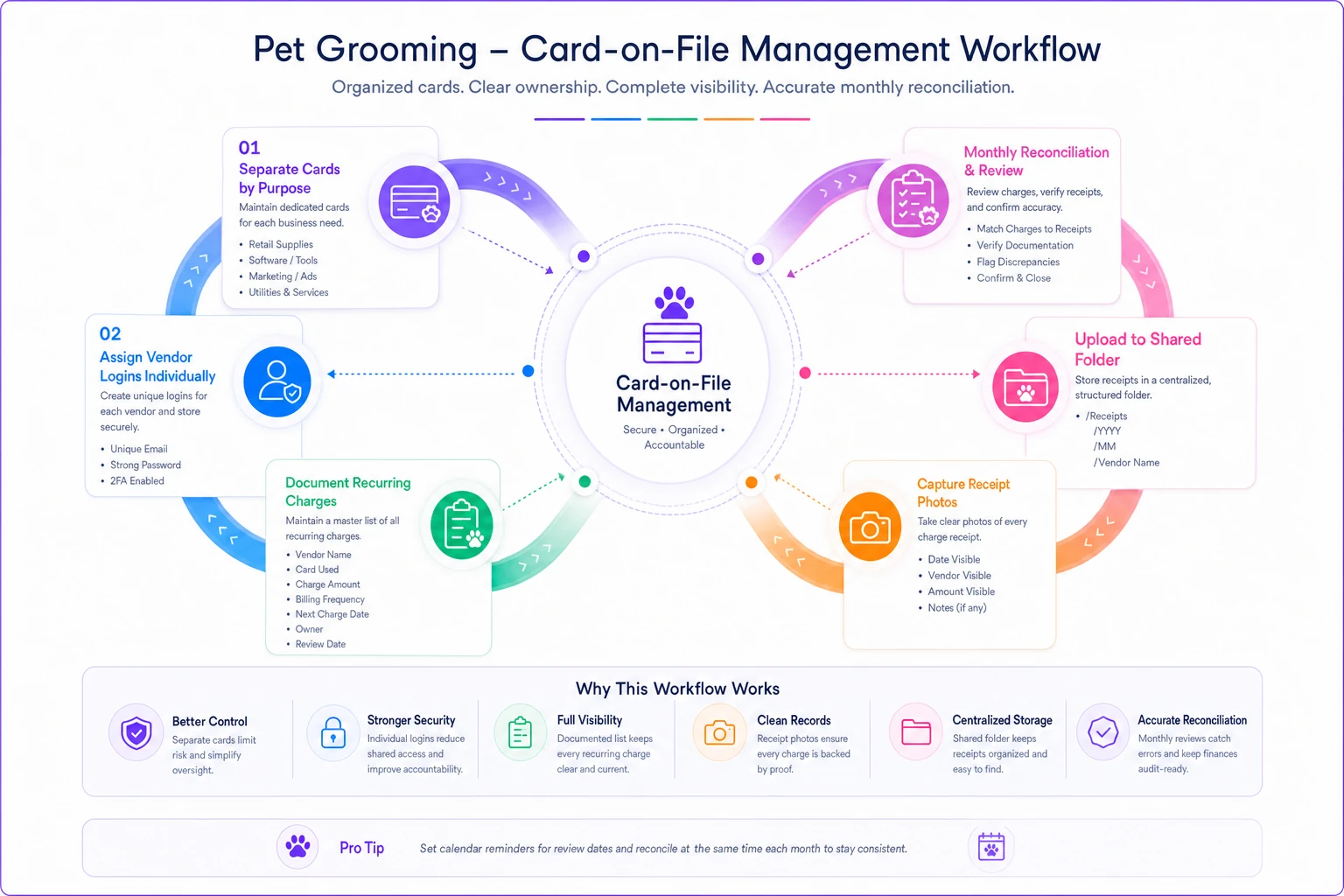
A simple visual of the flow — who owns each recurring charge, which card is used for which vendor, and where receipts are stored — makes monthly reconciliation much easier to teach and enforce.
The month-end reconciliation checklist
Reconciliation is where the whole system either proves itself or exposes itself. If your matrix and card rules are working, month-end is quick because there are no surprises. If they're not, month-end is where you discover the $340 dryer.
-
Pull the card statement and the bank feed side by side. Match transaction by transaction. Flag anything on one that isn't on the other.
-
Match each charge to a receipt. No receipt, no pass. Chase the buyer while they still remember — this is why point-of-purchase photos matter so much.
-
Confirm each charge sits under the right role in the matrix. A $250 charge from a bather is a policy violation even if the purchase was legitimate. The process failed, and that's worth catching.
-
Categorize into the right account. Consumables, retail (inventory, not expense), equipment (often capitalized, not expensed), fuel, subscriptions, other. Getting this wrong quietly distorts every margin report you run.
-
Reconcile card-on-file backorders and partial shipments. Match the total against what actually arrived. Split shipments are the most common cause of "the statement doesn't match the packing slip."
-
Review every recurring charge against your subscription list. Anything unexpected gets a decision: keep, downgrade, or cancel today.
-
Flag variances over a threshold — say, anything above $50 you can't explain — and resolve before closing the month.
-
Book the journal entries. Then the month is actually closed, not just "mostly done."
Teams that stay clean treat this as a 45-minute routine. Teams that dread it are usually the ones without a matrix — so every month they're inventing the rules retroactively.
Sample journal entries for salon purchases
Categorization is where most owners either freeze or hand it entirely to a bookkeeper who doesn't know grooming. You don't need to be an accountant, but you should recognize the handful of patterns that come up constantly so your P&L actually reflects the business.
Ordering consumables (shampoo, blades, oil) — $180 on card-on-file: Debit Grooming Supplies (expense) $180 Credit Card Payable / Cash $180 Simple — it's a cost, it hits the P&L now.
Restocking retail you'll resell — $420 of shampoo and brushes: Debit Inventory (asset) $420 Credit Card Payable / Cash $420 This is the one salons get wrong most often. Retail you're going to sell is inventory — an asset — not an expense, until it actually sells. Expensing it on purchase makes a big retail order look like a bad month, then makes the sale look like pure profit later. Both numbers lie.
Buying a new dryer — $340: Debit Equipment (asset) $340 Credit Card Payable / Cash $340 Depending on your threshold and your accountant's preference, larger equipment gets capitalized and depreciated rather than expensed all at once. The point isn't the accounting theory — it's that a $340 tool shouldn't tank one month's numbers.
Fuel on the van fuel card — $65: Debit Vehicle / Fuel Expense $65 Credit Fuel Card Payable $65
When you sell that retail shampoo for $70 (cost was, say, $38): Debit Cash / Card $70 Credit Retail Sales (revenue) $70 Debit Cost of Goods Sold $38 Credit Inventory (asset) $38 That second entry closes the loop on the inventory you booked earlier. Miss it and your inventory balance drifts until a physical count forces a painful correction.
You don't have to memorize this. You have to make sure whoever keeps your books is separating consumables, retail inventory, and equipment — because those three living in one bucket is the most common reason a "profitable" salon can't figure out where the money went.
A real scenario: the two-van mobile salon
A mobile grooming operation with two vans and four staff was running everything off one card-on-file with their distributor and one physical card that lived in whichever van needed it. Monthly spend on supplies and fuel ran somewhere in the $3k–$4k range.
The problems were ordinary ones. Duplicate orders because both van teams reordered the same consumables independently. A $290 heated dryer nobody remembered approving. Two software subscriptions still auto-renewing for tools they'd stopped using — around $60 a month bleeding out for the better part of a year. And every month-end took the owner most of a Sunday to untangle because receipts were scattered across two vans, a glovebox, and someone's texts.
They didn't buy anything fancy to fix it. They wrote a one-page controls matrix, gave each van its own fuel card and its own supply login, set a $75 approval-free consumables limit for the road, and made receipt photos non-negotiable — snapped and dropped into a shared folder at the point of purchase.
Within two months, month-end dropped from most of a Sunday to under an hour. Duplicate orders stopped almost immediately because each van now owned its own reorder list. They killed the dead subscriptions the first time they actually reviewed the recurring-charge list. The savings weren't dramatic on any single line — a few hundred a month in avoided duplicates and dead subscriptions — but the real win was that the owner stopped being the bottleneck and the books finally matched reality.
When tight controls make sense — and when they don't
Not every salon needs the full apparatus. Over-controlling a tiny shop just creates friction.
When this system is worth building:
-
You have three or more people who can spend money
-
You run mobile routes or more than one location
-
Supply spend regularly exceeds a couple thousand a month
-
Month-end already feels like detective work
-
You've been surprised by a charge in the last quarter
When it's overkill:
-
You're a solo groomer or owner-plus-one who sees every charge anyway
-
Total monthly procurement is small and stable
-
You're the only person touching the card
Even in the overkill case, two habits carry over: keep a list of every card-on-file vendor, and photo your receipts. Those two cost nothing and save you the moment you hire your second person or a card gets reissued.
One more thing worth saying: don't copy the matrix above and set the approval limits so tight that staff start working around them. A control everyone bypasses is worse than no control — now you have false confidence and a mess. Set limits your team can actually live inside.
How this connects to the rest of the salon
Purchasing controls don't sit in a corner by themselves. The categorization you enforce at reconciliation feeds accurate service-level margins and retail profitability — garbage-in-one-bucket bookkeeping makes every downstream number unreliable. Your card-on-file discipline overlaps directly with how you handle client payments and tips. And your list of recurring vendors and auto-pays is part of the same operational risk picture covered in an operational insurance and risk-control checklist — because an insurance auto-renewal lapsing over a failed card is exactly the kind of small gap that becomes a big problem at the worst moment.
That's the real reason to treat procurement as a system instead of a series of one-off purchases. Every buy touches spend limits, card behavior, categorization, and reconciliation at once. Fix one in isolation and the others still leak. Design the whole flow — who can buy, how the card works, how it gets recorded, how it ties out — and the individual purchases stop being decisions and start being routine. That's what makes it scale past the point where you can personally watch every dollar.
That's the real reason to treat procurement as a system instead of a series of one-off purchases. Every buy touches spend limits, card behavior, categorization, and reconciliation at once. Fix one in isolation and the others still leak. Design the whole flow — who can buy, how the card works, how it gets recorded, how it ties out — and the individual purchases stop being decisions and start being routine. That's what makes it scale past the point where you can personally watch every dollar.
Ready to streamline your grooming business?
Join 500+ pet groomers using Furlyly to save time, reduce scheduling conflicts, and deliver exceptional client experiences.