

Most mobile grooming operators don't get shut down because their service is bad. They get stopped because a code enforcement officer knocked on the van door mid-groom, asked for a document they didn't have, and the owner had no idea that document even existed. The route was profitable. The bookings were full. None of that mattered for the two weeks the van sat idle while the owner scrambled to retroactively file paperwork that should've been done before launch.
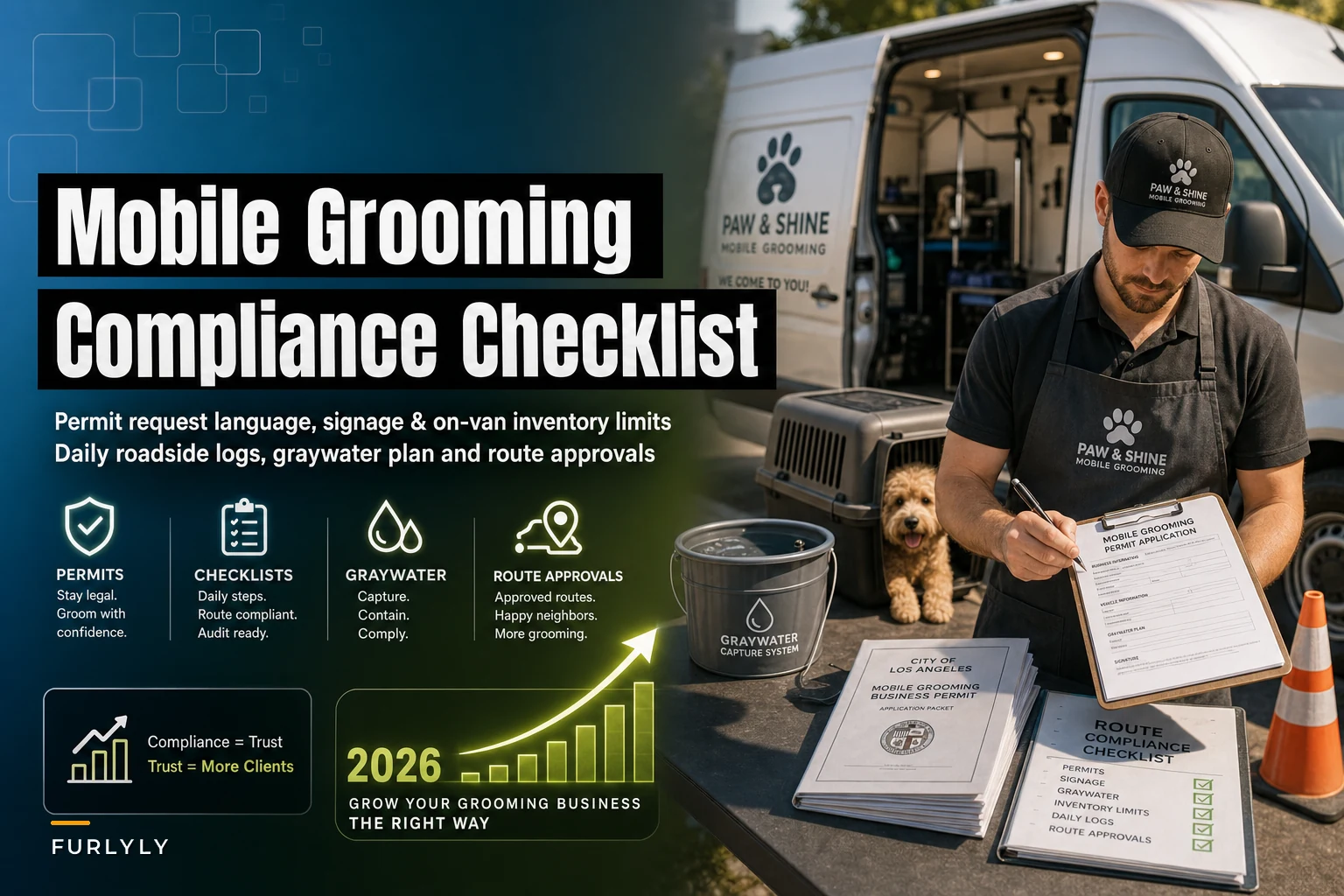
Permitting is the part of mobile grooming nobody warns you about — it's boring, inconsistent between towns, and genuinely annoying to research. But it's also the single most avoidable way to lose revenue in your first year. This checklist covers the stuff that actually trips people up: the exact language to put in a permit request, how to log your roadside stops, what signage keeps you compliant, and how much product you can legally carry before you accidentally cross into commercial hazmat territory.
If you've already nailed the profitability side with time-window rules, route clustering, and on-van inventory par levels, this is the compliance layer that sits underneath all of it.
Why municipal rules are so maddeningly inconsistent
There is no single "mobile grooming license." What you actually need is a stack of permissions that each come from a different office — and that stack changes by city, county, and sometimes by the specific zoning overlay you're parking in.
A typical permit stack looks like this:
-
A general business license (city or county)
-
A mobile vending or peddler permit (because technically you're operating a business on property that isn't yours)
-
A wastewater discharge permit or graywater plan (this one surprises everyone)
-
A commercial vehicle registration if your van exceeds a certain weight
-
Sometimes an animal services or kennel-adjacent permit, depending on how the municipality classifies pet handling
-
Fire marshal approval if you're carrying propane or a generator
Mobile grooming sits in a regulatory gap. Health departments regulate mobile food trucks with clear frameworks. Mobile grooming borrows pieces of those frameworks unevenly. One town treats you like a dog walker. The next treats you like a food truck. The one after that has literally never processed a mobile grooming application and the clerk will ask you what you need.
The owners who struggle most are the ones who call a single office, get a "you're fine," and treat that as full clearance. That one office almost never speaks for the other four.
The permit request language that actually gets approved
When you contact a municipal office — by email, usually — the fastest way to get stuck is asking something vague like "do I need a permit to groom dogs out of a van?" That question bounces between departments for weeks because nobody owns the answer.
Never miss a grooming appointment again.
Furlyly helps you book, confirm, and manage every pet grooming appointment effortlessly.
- Unified appointment scheduling
- Automated client reminders
- Staff availability & shift management
No credit card required
Describe your operation in concrete terms and ask for specific determinations. Here's language you can adapt directly.
For the business licensing office:
> "I operate a self-contained mobile pet grooming vehicle. I travel to clients' private residences by appointment, park in the client's driveway or on the adjacent public street, and perform grooming services inside the vehicle. The vehicle carries its own fresh water tank and captures all graywater in a sealed holding tank for proper disposal. No services are performed on public property without a scheduled client. Please advise which business license classification applies and whether a mobile vending permit is required for this model."
That paragraph does three things at once: it establishes you're appointment-based rather than a roaming vendor, it pre-answers the wastewater question, and it forces them to classify you rather than pass you off to another department.
For the wastewater / environmental office:
> "My mobile grooming vehicle captures all wash water, shampoo residue, and rinse water in an onboard sealed graywater tank. I am requesting guidance on approved disposal locations and whether a discharge permit or disposal manifest is required. I do not discharge any water to storm drains, streets, or client property."
The graywater documentation is non-negotiable. If you handle salon chemical and waste disposal correctly in a fixed location, the mobile version is stricter — not looser. The same discipline from a salon chemical, waste, and environmental compliance checklist applies, except now you're hauling the evidence around with you.
For the fire marshal (if you carry propane or a generator):
> "My mobile grooming vehicle operates a [propane water heater / gasoline generator] rated at [X]. I am requesting information on inspection requirements, fire extinguisher specifications, and any ventilation or storage standards applicable to this equipment in a commercial mobile vehicle."
Ask these as written requests whenever possible. A written determination is a document you can show a code officer later. A phone call is not.
The daily roadside log nobody tells you to keep (until you need it)
A code enforcement officer's favorite question is "how long have you been parked here?" If your answer is a shrug, you've lost the conversation. If your answer is a timestamped log, you've essentially won it before it started.
Most municipalities with vending restrictions have a maximum parking duration at a single location — often somewhere between 2 and 4 hours. Mobile groomers rarely exceed that per client, but on a tight route with back-to-back stops on the same block, it adds up fast and can look suspicious from the outside.
| Field | Example Entry |
|---|---|
| Date | 04/18 |
| Client name / address | R. Alvarez, 112 Oak St |
| Arrival time | 9:05 AM |
| Departure time | 10:40 AM |
| Parking location | Client driveway |
| Graywater status | Captured, tank ~40% |
| Permit visible? | Yes |
| Notes / incidents | None |
The "graywater status" column seems trivial until someone photographs water running from under your van and files a complaint. Your log showing the tank was captured and emptied at an approved site is the difference between a warning and a fine.
Worth noting: operators who log departure times consistently almost never get duration violations, because the act of writing it down keeps them aware of the clock. The log isn't just evidence — it changes behavior.
Signage: easy to get right, still gets missed
Signage requirements fall into two buckets, and owners tend to nail one and completely forget the other.
Bucket one — DOT/commercial vehicle signage. If your van is registered commercially, most jurisdictions require your business name and sometimes a USDOT number or contact info displayed on the vehicle. This is the one people remember because it doubles as marketing.
Bucket two — operational and safety signage. This is the one that gets missed. Depending on your municipality, you may need:
-
A visible permit or license placard in the windshield or on the door (some vending permits require the permit number be displayed while operating)
-
Propane or "flammable" placarding if you carry pressurized fuel
-
Contact signage so a neighbor can reach you instead of calling code enforcement
-
Water/no-discharge signage in some water-sensitive jurisdictions
Quick signage checklist to run before launch:
-
[ ] Business name visible on at least two sides of the vehicle
-
[ ] Commercial registration / DOT number displayed if required
-
[ ] Current permit placard visible from outside while operating
-
[ ] Propane/flammable placard if applicable
-
[ ] Emergency contact number legible from the street
-
[ ] No expired or outdated signage left on the van
That last point is sneaky. An expired permit sticker still stuck to the windshield is worse than no sticker at all — it's documented evidence that you had a permit and let it lapse.
On-van inventory limits: the line between supplies and regulated quantities
This is the part most owners never think about. There's a point where the shampoo, conditioner, flea treatment, propane, and generator fuel you carry crosses from normal business supplies into quantities that trigger commercial hazardous material or fire-code thresholds.
You're almost certainly not hauling hazmat-level chemical volumes. Fuel is a different story. A few five-gallon gas cans for a generator, plus a propane tank, plus aerosol products can quietly add up to a quantity a fire marshal would take issue with.
-
Flammable liquids (generator fuel) Keep spare fuel to the minimum your route genuinely requires. Two spare gallons for a full day is defensible; a case of gas cans "just in case" is not. Approved, sealed containers only.
-
Propane One properly secured, inspected tank sized to your water heater. A second spare should be transported and stored per your fire marshal's guidance — not just tossed in the back.
-
Aerosols (finishing sprays, etc.) Reasonable working quantities. A bulk stockpile of pressurized cans is both a fire risk and a compliance flag.
-
Grooming chemicals (shampoo, conditioner, dilutions) Carry a working day's par, not a month's inventory. This is the same inventory logic that keeps a route profitable — it also keeps you under volume thresholds without extra effort.
-
Flea/tick and medicated products These sometimes carry their own storage and labeling rules. Keep original labeled containers; never decant into unlabeled bottles.
The underlying principle: carry a day, not a warehouse. Operators who treat the van like rolling storage are the ones who accidentally cross thresholds. Operators who restock from a home base daily almost never do.
A real scenario: the two-week shutdown
A single-van operator in a mid-sized suburb launched with roughly 30–35 weekly appointments, pulling somewhere around $7k–$8k a month. He had a general business license and assumed that covered everything. What he didn't have was a mobile vending permit or any graywater documentation.
A neighbor on one of his regular streets complained about a van parked there week after week. Code enforcement showed up, asked for the vending permit, and he didn't have one. The van was ordered off the road until he filed properly. Between application processing time and a required inspection, he lost close to two weeks of routes — somewhere in the range of $3k–$4k in missed revenue, plus the clients who rebooked elsewhere and didn't come back.
The fix cost him a couple hundred dollars in permit fees and an afternoon of paperwork. Done before launch, it would've been a line item. Done reactively, it was two weeks of a dead van and a dented reputation on a street he used to own.
The lesson wasn't that permits are expensive. It's that the cost of a permit is trivial; the cost of operating without one is your whole route.
When to over-prepare, and when it's overkill
When full compliance prep makes sense: If you're operating in multiple municipalities, carrying propane or a generator, or planning to scale past one van, do the full stack before launch. Multi-jurisdiction operators get burned constantly because they assume one town's clearance carries over. It doesn't.
When you can move faster: A single-van operator working entirely within one city, parking only in client driveways, with electric equipment and no onboard fuel has a much simpler path. You still need the licenses — but the fire-code and graywater complexity drops significantly.
Who should not wing this:
-
Anyone carrying propane.
-
Anyone parking on public streets for extended durations.
-
Anyone operating across county lines.
The failure modes in those situations aren't warnings — they're fines, impounds, and in some jurisdictions, the kind of enforcement record that complicates future licensing.
If a sale or succession plan is anywhere on your horizon, clean permit history is an asset. A buyer inheriting a van with lapsed permits and no logs is inheriting liability. A buyer inheriting a documented, compliant operation has something they can actually run on day one.
Your pre-launch compliance checklist
Run through this before the van takes a single paying appointment:
A quick visual workflow to run through before launch.
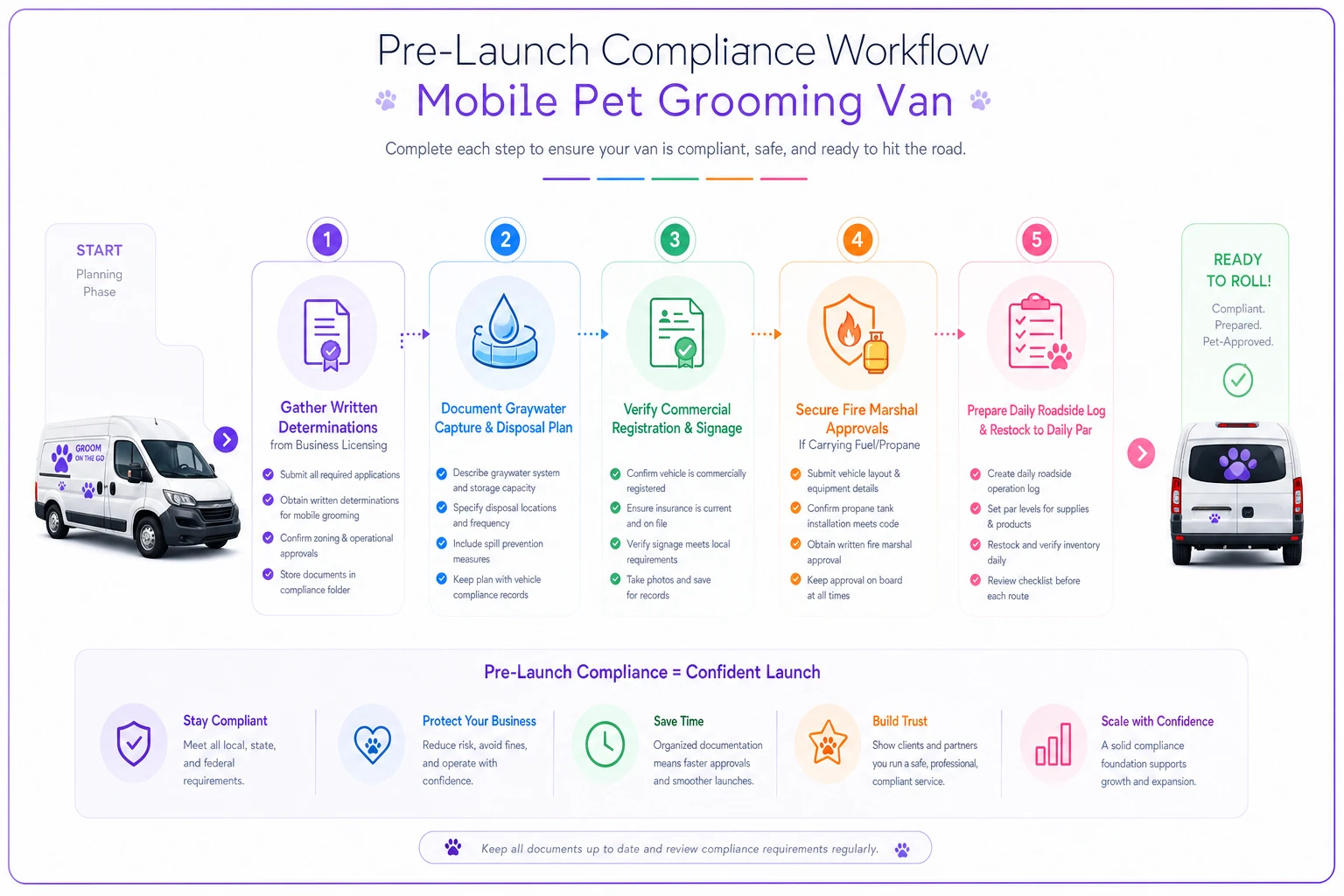
That last line matters more than it looks. Most permit problems in year two aren't missing permits — they're expired ones. Set calendar reminders 45 days before every renewal, because processing isn't always instant and you don't want a gap between an expired permit and the new one coming through.
-
[ ] General business license filed (city and/or county)
-
[ ] Mobile vending / peddler permit obtained or confirmed not required (in writing)
-
[ ] Graywater capture and disposal plan documented; discharge permit secured if required
-
[ ] Commercial vehicle registration verified against weight thresholds
-
[ ] Fire marshal determination obtained if carrying propane or a generator
-
[ ] Fire extinguisher(s) onboard and rated correctly
-
[ ] All required signage installed; no expired placards
-
[ ] Permit placard visible from outside while operating
-
[ ] Daily roadside log template printed or loaded on phone/tablet
-
[ ] On-van fuel, propane, and chemical quantities set to daily par, not bulk
-
[ ] Written determinations stored somewhere accessible from the van
-
[ ] Renewal dates for every permit tracked with reminders
That last line matters more than it looks.
Mobile grooming compliance isn't hard — it's just scattered across offices that don't talk to each other. The operators who stay out of trouble aren't the ones with the most paperwork; they're the ones who got specific up front, asked for written determinations, kept a boring little log, and resisted the urge to treat the van like a rolling storage unit. Do the stack once, document it, track the renewals, and compliance stops being a threat and becomes background noise — which is exactly where it belongs while you focus on actually grooming dogs.
Ready to streamline your grooming business?
Join 500+ pet groomers using Furlyly to save time, reduce scheduling conflicts, and deliver exceptional client experiences.