



Three weeks ago, I mapped out a mobile groomer's actual route data from their scheduling software. Twenty-two stops scheduled across town. Seven hours of driving. Four appointments completed. The groomer texted me around 3pm: "Ran out of shampoo after the second dog. Had to drive back to storage unit. Traffic killed the rest of my day."
This wasn't unusual. Mobile grooming route planning looks deceptively simple until you're sitting in traffic at 2:47pm, watching your 3:00pm appointment window slip away while your fuel gauge drops and your phone buzzes with cancellations.
The difference between mobile groomers who clear $800+ daily and those barely breaking $300 comes down to route density, time-window management, and van inventory systems. Not motivation. Not marketing. Pure operational execution.
Why Mobile Routes Fail Before Noon
Mobile grooming operates on razor-thin margins between profit and loss. Your van burns fuel whether you're grooming or sitting in traffic. Equipment takes up space whether it's being used or collecting dust. Every mile between appointments costs money.
Most mobile groomers schedule appointments like brick-and-mortar salons - first come, first served, wherever the client lives. Mrs. Johnson books Tuesday at 10am in the north suburbs. Mr. Chen wants 2pm downtown. The Smiths need their three dogs done by noon on the east side.
Your Tuesday route becomes a triangle of inefficiency across the entire metro area.
Mobile grooming means carrying your entire operation with you. Run out of ear cleaner after dog number three? That's either compromised service quality or a detour to resupply. Forget the right blade attachment? Cancel the appointment or attempt a workaround that damages your reputation.
Time-window complexity makes this worse. Unlike salon grooming where clients drop off, mobile grooming requires someone to be home. That 45-minute window you promised becomes a hard constraint. Hit traffic, run long on a matted dog, or need to refuel - you're calling ahead to reschedule while calculating lost revenue.
A typical mobile groomer loses 2-3 appointments daily to logistics failures. At $75-120 per groom, that's roughly $200-350 in daily revenue evaporating into poor route planning.
Route Clustering That Actually Works
Effective mobile grooming route planning starts with geographic clustering, not appointment times. The goal is minimum distance between stops, not accommodating every scheduling request.
Never miss a grooming appointment again.
Furlyly helps you book, confirm, and manage every pet grooming appointment effortlessly.
- Unified appointment scheduling
- Automated client reminders
- Staff availability & shift management
No credit card required
Zone Definition
Divide your service area into 4-6 zones based on drive time from your home base or storage location. Each zone should represent no more than 20 minutes of travel from its center point to its edges. Label them simply - North, South, Downtown, Westside, whatever makes sense for your area.
Day Assignment
Assign specific days to specific zones. Monday and Thursday: North zone. Tuesday and Friday: South zone. Wednesday: Downtown. This immediately eliminates cross-town routing chaos.
Density Requirements
Set a minimum appointment density before committing to a zone for that day. For most operations, that's 4-5 appointments within a 3-mile radius. Below that threshold, the fuel and time cost destroys profitability.
The 15-Minute Rule
No appointment should be more than 15 minutes drive time from the previous one. This accounts for traffic variables while maintaining route efficiency. If a booking request breaks this rule, it goes on a waitlist for when you have adjacent appointments.
A groomer in Phoenix implemented this exact system. Previously averaging 4-5 appointments across the entire valley, burning through $60-80 in fuel daily. After zone clustering: 6-7 appointments within specific zones, fuel costs dropped to $25-35. Tighter routes mean more grooms per gallon.
Time-Window Management Without Chaos
Time windows in mobile grooming create unique operational pressure. You're promising to arrive within a specific timeframe while dealing with variables you can't control - traffic, difficult dogs, equipment issues.
The standard approach of giving exact appointment times ("I'll be there at 2:00pm") sets you up for failure and frustrated clients. Instead, use a wave scheduling system with buffer zones.
Wave Scheduling Structure:
-
Morning Wave
8:00am - 12:00pm
-
3-4 appointments maximum
-
Text clients the night before with a 2-hour arrival window
-
"We'll arrive between 8-10am" for first two appointments
-
"We'll arrive between 10am-noon" for next two
-
Afternoon Wave
1:00pm - 5:00pm
-
3 appointments maximum (accounting for fatigue)
-
Same 2-hour window communication
-
Built-in lunch/reset buffer between waves
The Running Update System:
As you complete each appointment, text the next two clients with a refined arrival estimate. Finishing the 8:30am appointment? Text the 10am window client: "On schedule, expecting arrival around 10:15am." This maintains communication without overcommitting to exact times.
Critical rule: Never schedule more than 7 appointments per day, regardless of how efficient your route looks. Grooming quality degrades after 6-7 dogs. Better to maintain service standards than squeeze in one more appointment that results in rushed work and unhappy clients.
Buffer time isn't waste - it's insurance. Every route needs 20-30 minutes of buffer per wave for unexpected delays. Matted dogs, nervous pets, chatty clients, bathroom breaks - these aren't exceptions, they're operational reality.
Here's a visual of the wave scheduling workflow.
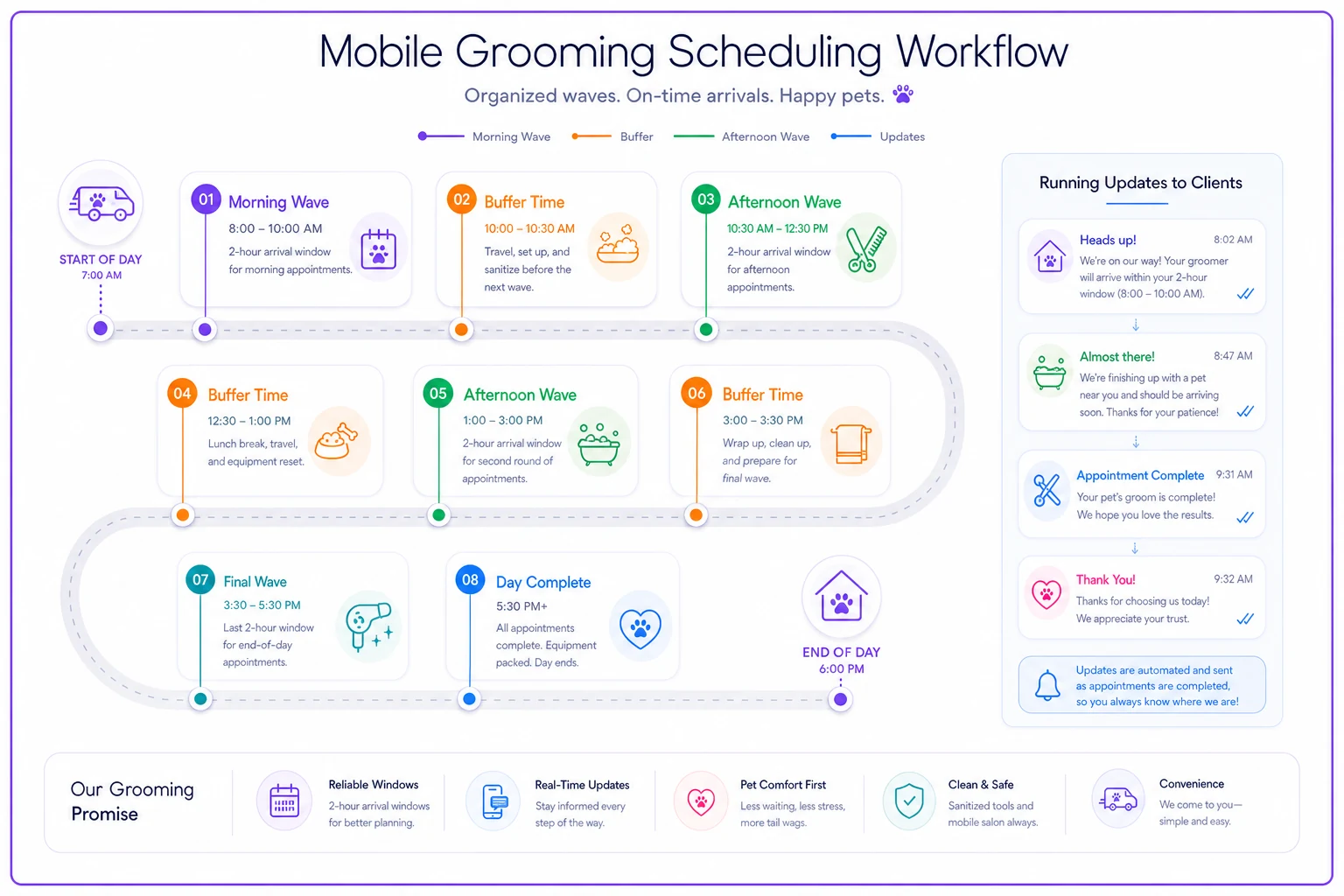
This shows how wave scheduling and running updates keep routes on track without promising exact times.
Van Inventory Par Levels and Packing Systems
Running out of supplies mid-route kills profitability faster than almost any other operational failure. The solution isn't carrying everything you own - it's establishing par levels based on actual usage patterns.
Establishing Par Levels:
Track your supply usage for two weeks. Count everything - cotton balls, ear cleaner pumps, towels used, blade coolant sprays. This gives you actual consumption data instead of guesswork.
For consumables, your van par level should be:
-
Daily average usage × 1.5
-
Plus one emergency unit
Example: You average 8 ear cleaning cotton balls daily. Van par level: 12 balls plus one backup pack.
The Three-Tier Inventory System:
Tier 1 - Daily Use Items (accessible without leaving driver's seat):
-
Appointment schedule/tablet
-
Client contact information
-
Common blade attachments (10, 7F, 5F, 4F)
-
Slicker brush, comb, nail clippers
-
Towels for current appointment
Tier 2 - Regular Rotation (main storage area):
-
Shampoo/conditioner (2-day supply)
-
Ear cleaner, eye wipes
-
Backup blade attachments
-
Cooling spray, blade oil
-
Backup towels
-
Common medication/flea treatments
Tier 3 - Emergency/Specialty (secured storage):
-
Medical kit
-
Backup clippers
-
Specialty shampoos (medicated, whitening)
-
Rarely-used blade sizes
-
Equipment repair kit
-
Extra cash for emergencies
The Night-Before Checklist:
-
Equipment Check
-
- [ ] Clippers charged and tested
-
- [ ] Backup clipper ready
-
- [ ] All common blades sharp and oiled
-
- [ ] Dryer functioning
-
- [ ] Table hydraulics working
-
Consumables Check
-
- [ ] Shampoo levels above 50%
-
- [ ] Ear cleaner above 30%
-
- [ ] 12+ clean towels loaded
-
- [ ] Cotton balls/swabs restocked
-
- [ ] Spray bottles filled
-
Client Prep
-
- [ ] Route printed/downloaded offline
-
- [ ] Client files accessible
-
- [ ] Payment processing tested
-
- [ ] Phone fully charged
Recheck par levels monthly to account for seasonal changes in usage.
This systematic approach means never canceling appointments due to missing supplies. One groomer in Denver tracked a $4,200 monthly revenue increase after implementing par levels - entirely from appointments previously lost to supply run disruptions.
Contingency Planning for Common Failures
Mobile grooming operates with zero backup. Your salon is your van. When something breaks, there's no spare room or extra table. Contingency planning isn't pessimistic - it's profitable.
Equipment Failure Protocols:
-
Primary Clipper Dies
-
- Immediate switch to backup clipper (mandatory equipment)
-
- Complete current dog with backup
-
- Assess if repair possible in van
-
- If not, modify remaining appointments to bath-only at 50% rate
-
- Schedule full grooms for next zone visit
-
Van Won't Start
-
- Triple-A or commercial roadside assistance (pre-enrolled)
-
- Contact next two appointments immediately
-
- Offer
reschedule, mobile mechanic wait, or transport to backup location
-
- Never wait more than 45 minutes for assistance
-
- Document everything for insurance/tax purposes
The Go/No-Go Decision Matrix:
-
Running Late Scenarios
-
- 15 minutes behind
Continue route, text next appointment
-
- 30 minutes behind
Call next appointment, offer 20% discount
-
- 45+ minutes behind
Reschedule last appointment of day
-
- 60+ minutes behind
Convert to next-day emergency route
-
Supply Depletion
-
- One product out
Substitute or offer discount
-
- Multiple basics out
Stop accepting new appointments that day
-
- Critical tools broken
Bath-only services remainder of route
-
Weather/Traffic Events
-
- Rain/snow starting
Reduce appointment times by 10-15%
-
- Accident ahead
Reroute if adds <10 minutes
-
- Major traffic
Contact all remaining clients with updates
-
- Severe weather
Cancel route if travel time doubles
These happen weekly in mobile grooming operations. Having clear protocols removes decision paralysis when you're stressed and behind schedule.
Daily Route Optimization Tactics
Small daily optimizations compound into significant profitability gains.
Appointment Sequencing:
Start with your most difficult or longest appointments. Energy and patience peak in the morning. That severely matted Goldendoodle should be your 8am, not your 3pm when you're exhausted.
Sequence by size when possible: Large dogs early (when you have maximum physical energy), small dogs later (less physically demanding). This natural energy management extends your effective working hours.
Fuel Optimization:
Fill up the night before, never during routes. Every gas station stop costs 15-20 minutes when you factor in pulling off route, pumping, and returning to traffic. That's $30-40 in lost productivity.
Track fuel consumption by zone. Some zones require more idling (running generator/AC), others more highway driving. Adjust pricing by zone to account for these real cost differences - typically $5-10 per appointment variance.
Communication Efficiency:
Batch all confirmations the night before via text, not calls. One groomer switched from calling to texting confirmations and saved 45 minutes daily - that's one extra appointment worth of time.
Use voice-to-text while driving between appointments for notes. "Just finished Max. More matted than expected. Recommend 6-week schedule not 8." These real-time notes improve next visit efficiency.
Payment Processing:
Mobile payment only. No cash, no checks. The time spent making change or waiting for check-writing eliminates any profit from that efficiency. Square, Stripe, or specialized pet business platforms - whatever processes immediately.
Pre-authorize cards when booking. This eliminates the awkward payment discussion after service and prevents the "Oh, I forgot my wallet" scenario that destroys route timing.
Building Routes That Scale
The difference between a struggling mobile groomer and one clearing $120k+ annually isn't talent or marketing - it's route density and operational discipline.
| Benchmark |
|---|
| 6-7 appointments per day minimum |
| Less than 90 minutes total drive time |
| Under $35 daily fuel cost |
| 85%+ on-time arrival rate |
| Zero supply-related cancellations |
The path to these numbers requires saying no to bad appointments. That client 45 minutes away who "really needs you"? They're costing you two closer appointments. The person who wants a specific 2:15pm time slot? They're breaking your wave schedule.
Start with zone discipline. Pick your profitable zones and stick to them. Build density through focused marketing in those specific areas rather than accepting scattered appointments across the entire city. Use Facebook community groups, neighborhood apps, and local word-of-mouth in your target zones.
Track everything for two weeks. Miles driven, fuel cost, time between appointments, supply usage, appointment duration by breed. This data reveals your actual operational costs versus what you assume they are. Most mobile groomers discover they're losing money on certain routes they thought were profitable.
Manual route planning across sticky notes and phone calendars creates chaos. AI-powered scheduling platforms can automatically cluster appointments by zone, calculate optimal route sequences, and flag when proposed bookings break profitability rules. They track your par levels, send automated confirmation texts, and predict when you'll need supply restocks based on upcoming appointments.
This isn't about replacing your expertise - it's about automating the repetitive logistics so you can focus on actual grooming. The same way good clippers make better grooms possible, good operational software makes profitable routes achievable.
Mobile grooming profitability isn't about working harder or grooming faster. It's about route density, time-window discipline, and systematic inventory management. Get these three elements right, and you'll wonder why you ever drove across town for a single appointment.
The math is unforgiving but straightforward. Every mile between appointments costs money. Every supply run breaks your rhythm. Every confused time window creates cancellations. Fix the operational foundation, and the business thrives.
Tomorrow morning, before you start your route, ask yourself: Am I driving a profitable circuit, or am I just driving in circles? The answer determines whether mobile grooming becomes a sustainable business or an expensive hobby with dogs.
Ready to streamline your grooming business?
Join 500+ pet groomers using Furlyly to save time, reduce scheduling conflicts, and deliver exceptional client experiences.