

Most attach‑rate problems aren't script problems. The scripts already exist. Half the salons I've looked at have a laminated card taped near the register with three "recommended add‑ons" on it, and nobody reads it. The gap is almost always training — specifically, the lack of repeated, manager‑led practice that turns an awkward add‑on suggestion into a normal part of the groom conversation.
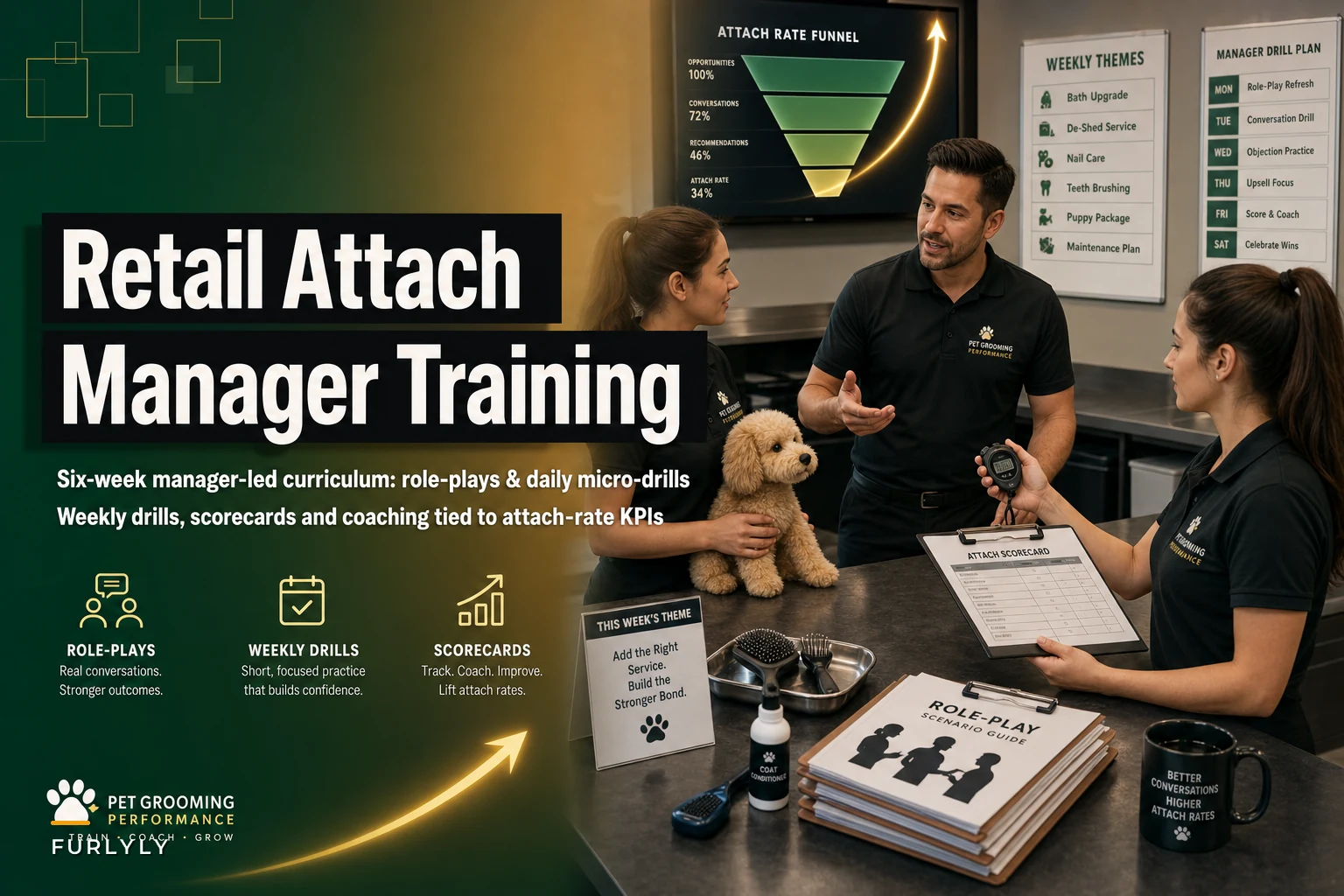
That's the whole premise of this post. Not another set of cross‑sell lines (we've covered those in Cross‑Sell Scripts and Triggers That Lift Attach Rates Without Slowing Service), but the actual coaching engine behind making those lines stick. Six weeks, manager‑run, built around short role‑plays, daily micro‑challenges, and a scorecard tied to KPIs your team can actually see.
If you've ever rolled out a retail push that worked for nine days and then quietly died, this is for you.
Why most attach training dies in two weeks
There's a pattern that keeps showing up. An owner gets fired up about retail margin, buys some new shampoo SKUs, runs a 45‑minute team meeting on upselling, maybe prints a commission sheet, and expects numbers to climb.
Week one, attach rate jumps. Groomers are self‑conscious, they're trying, the manager is watching. Week two, it slips. By week three it's back to baseline and the owner concludes "my team just isn't salesy."
The problem isn't the team. It's that a single training event has basically zero retention. People forget specifics fast, and without repetition the new behavior never crosses from "thing I'm supposed to do" to "thing I just do." A one‑off meeting can't build a habit. Only a cadence can.
The second reason it dies: nobody owns it day‑to‑day. The owner can't be on the floor coaching every shift. So manager retail attach training in a salon only works when the manager becomes the engine — running the short drills, logging the scorecard, keeping the pressure light but constant. If the manager isn't bought in, the whole thing is theater.
The three things that actually move the needle
-
Reps, not lectures. Short, frequent practice beats long infrequent training every time.
-
Visibility. People change behavior faster when they can see their own number next to a target.
-
A manager cadence. Someone checks in on a predictable rhythm, not randomly.
Pull any one of these out and the program sags. The six‑week structure below bakes in all three.
The six‑week structure at a glance
The curriculum runs six weeks because that's roughly how long it takes a new behavior to feel normal under real floor pressure. Shorter and it doesn't stick. Longer and managers burn out running drills.
Never miss a grooming appointment again.
Furlyly helps you book, confirm, and manage every pet grooming appointment effortlessly.
- Unified appointment scheduling
- Automated client reminders
- Staff availability & shift management
No credit card required
Here's a quick visual of the six‑week workflow.
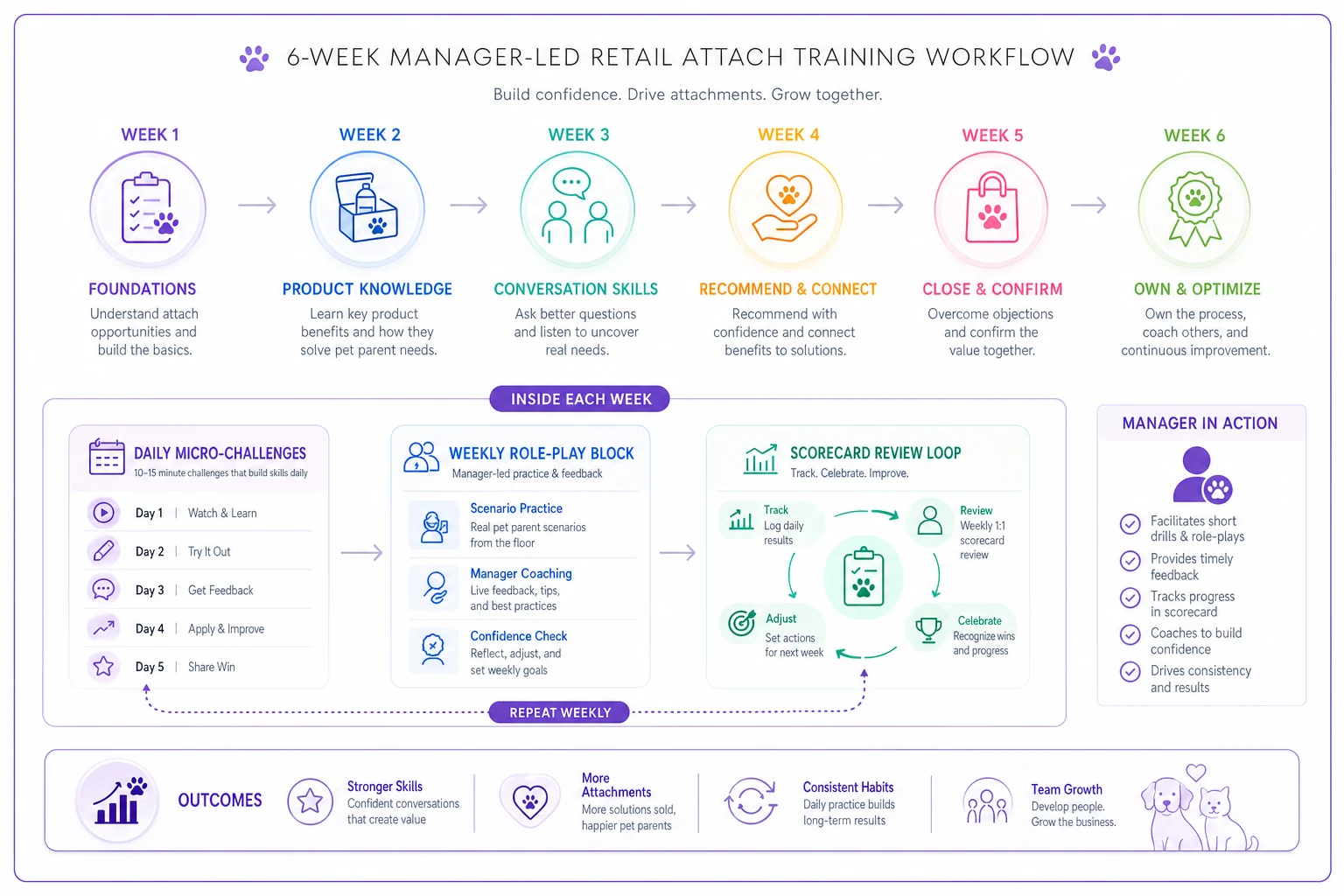
| Week | Theme | Daily micro‑challenge | Weekly role‑play focus |
|---|---|---|---|
| 1 | The natural moment | Name one add‑on moment per dog you groomed | Handoff at check‑out, zero pressure |
| 2 | Tying to the pet | Reference one coat/skin observation per client | Recommending from the groom, not the shelf |
| 3 | Handling "no" | Log how you responded to one decline | The graceful decline + plant‑a‑seed line |
| 4 | Bundles & timing | Offer one bundle instead of a single SKU | Package framing without slowing the line |
| 5 | Speed under load | Hit attach line within the normal check‑out | Busy‑Saturday role‑play, time‑boxed |
| 6 | Make it automatic | Self‑score your own attach moments | Full run‑through, manager scores live |
The progression matters. You don't start with objection handling in week one — that terrifies people. You start with just noticing the moment. Difficulty ramps as confidence builds.
The daily micro‑challenge (this is the real secret)
If you only take one thing from this post, take this: the daily micro‑challenge does more work than the weekly role‑play.
A micro‑challenge is a single, tiny, specific action tied to that week's theme. Not "sell more." Something like: "Today, for every dog you finish, say out loud one thing you noticed about the coat that connects to a product." That's it. It takes seconds and it trains the observation muscle that makes recommendations feel honest instead of pushy.
Groomers resist "selling" but happily do "noticing." Reframing the daily action around the pet's needs rather than the sale removes almost all the resistance. A groomer who hates upselling will cheerfully tell a client "his undercoat's packing in, a deshedding spray between grooms would help" — because that's just being a good groomer.
How the manager runs it
-
At the start of shift, the manager states the day's micro‑challenge in one sentence.
-
Mid‑shift, a quick verbal nudge in passing — "how's the coat‑observation thing going?"
-
End of shift, a 30‑second check
did everyone do it at least a few times? Log a simple yes/partial/no.
Keep the log to one line per person per day so the manager doesn't over‑engineer the process.
No forms, no meetings. The log is one line per person per day. If your manager is spending more than five minutes total on this, it's over‑engineered and it'll get abandoned.
Role‑plays that don't make everyone cringe
Role‑plays have a bad reputation because most are run badly — two people standing awkwardly in front of the group while everyone else stares. Keep them short, keep them in pairs, and have the manager model it first.
The format that works:
-
Manager demos once. Shows exactly what good looks like, including a natural, low‑key delivery. People copy what they see more than what they're told.
-
Pairs practice, 90 seconds each way. One plays groomer, one plays client. Swap.
-
One specific thing to fix. Not a full critique. "Try pausing after you mention the product instead of rushing to the price."
Keep the whole block under 15 minutes. You're not training actors. You're building one repeatable interaction.
Something that gets missed: give the "client" a role card with a personality — the price‑sensitive one, the chatty one who derails, the one who's clearly in a hurry. Practicing against difficult clients in a safe setting is where the real confidence comes from. By the time it happens on the floor, the awkward moment has already been rehearsed.
When role‑plays are a bad idea
If your team is tiny — one or two groomers — formal role‑plays feel forced and silly. Drop the paired format and just do live coaching instead: the manager watches a couple of real check‑outs, then gives one note afterward. Same principle (reps + feedback), less theater. Also, don't role‑play during a crush. Scheduling a drill in the middle of a packed Saturday will make everyone hate the program. Put role‑plays in slow slots — the quiet Tuesday morning, the dead hour after lunch.
The scorecard: what to measure and what to ignore
Owners over‑complicate this. You do not need fifteen metrics. You need two or three that the team can actually see and influence.
Core scorecard fields per groomer, tracked weekly:
-
Attach rate — % of grooms that included at least one retail item. The headline number.
-
Items per attached ticket — are they adding one thing or building a small basket?
-
Role‑play participation — simple did‑it / didn't‑it.
-
Micro‑challenge consistency — rough count of days completed.
Two of those four aren't sales numbers. That's deliberate. Early on, you reward effort and reps, because that's what you can control. Sales results follow. If you only score the outcome, people who are slow to improve get demoralized and check out.
A clean definition of attach rate avoids most arguments. If you're still fuzzy on how to define and pull these numbers consistently, the thinking in Make Retail Pay: SKU Rationalization, Par‑Setting and Commission Nudges for Grooming Salons pairs well with this — you want the right SKUs and the trained behavior, not one without the other.
A pattern worth watching on the scorecard
Watch the gap between participation and results. A groomer doing all the drills but whose attach rate isn't moving usually has a delivery problem — the words are coming out, but something in tone or timing kills it. That's a coachable, specific fix, and the scorecard is what surfaces it. Without the two‑axis view you'd just see "low attach" and assume they weren't trying.
Tying incentives in without creating pushy behavior
Incentives are a double‑edged thing. Tie them purely to attach rate and you risk groomers pushing products clients don't need, which tanks trust and generates returns. For this program, keep it simple and behavior‑aligned:
-
Small weekly bonus or prize for participation + consistency, not just raw sales — especially in weeks 1–3.
-
Shift the weight toward results in weeks 4–6, once the behavior is established.
-
Watch return rates — if a groomer's attach is high but returns spike, that's a red flag, not a win.
The goal is a team that recommends genuinely useful products at a natural moment. A client who gets talked into a $34 shampoo they didn't want doesn't come back, and that's a far more expensive loss than the retail margin you gained.
A real scenario
A three‑groomer salon doing roughly 330–360 grooms a month had an attach rate sitting around 14%. The owner had tried the usual: new products, a commission sheet, one big meeting. Numbers barely twitched.
They ran the six‑week version above with the lead groomer acting as manager. The first two weeks were purely about noticing — the coat‑observation micro‑challenge, no pressure to close anything. Role‑plays stayed short, scheduled only in slow slots. The scorecard tracked participation as heavily as attach rate early on.
By week three, attach rate was around 19%. By the end of week six it settled near 24–26% and — this was the part that mattered — it held through the following two months because the behavior had become normal. Return rate didn't climb, which told them the recommendations were landing honestly. On that volume, the lift worked out to a few hundred extra dollars a week in retail, without adding a single appointment or slowing check‑out.
The owner's take afterward was pretty blunt: the products and scripts had always been there. What changed was running the practice on a cadence instead of as a one‑time event.
Keeping it alive after week six
The program ends; the cadence shouldn't. Once the six weeks are done, scale the manager's involvement way down but don't drop it entirely. A reasonable maintenance rhythm:
-
Weekly scorecard glance. Two minutes. Flag anyone drifting back toward baseline.
-
Monthly refresher role‑play. Fifteen minutes, usually focused on whatever add‑on is underperforming.
-
Rotate the micro‑challenge quarterly. New products, new seasons — deshedding in spring, paw balm in winter — keep it from going stale.
The thing that quietly erodes attach rate over time is drift. Nobody's doing anything wrong; the habit just softens. A light recurring check catches that before it becomes a real slide.
One more thing that compounds well with this training: before/after photos. A groomer already trained to notice the coat is perfectly positioned to turn that observation into both a recommendation and a shareable result — the workflow in Turn Before/After Photos into Sales stacks neatly on top of an attach program like this one.
Where software quietly helps
None of this requires fancy tools — a whiteboard and a notebook can run the whole program. The part that gets tedious by hand is the scorecard: pulling each groomer's attach rate every week, splitting items per ticket, tracking return rates. That's where an operational platform that already connects your POS and booking data earns its keep. Instead of a manager manually tallying tickets, the attach numbers surface automatically, so the manager spends their time coaching rather than counting.
That's the right role for automation here — it removes the clerical drag so the human coaching cadence actually happens. The behavior change still comes from the manager running reps. The software just makes sure the scorecard is never the reason the program stalls.
The takeaway
Lifting retail attach isn't about finding better lines or hiring "salesy" people. It's about running structured, manager‑led practice long enough for the behavior to stick — short daily reps, quick weekly role‑plays, and a visible scorecard that rewards effort before it rewards results. Six weeks is enough to install it. A light ongoing cadence keeps it from fading. Start small, keep the daily challenge under five minutes, protect the role‑plays from busy shifts, and measure participation as seriously as sales in the early weeks. Do that consistently, and you'll lift attach without ever making your check‑out counter feel like a sales floor.
Ready to streamline your grooming business?
Join 500+ pet groomers using Furlyly to save time, reduce scheduling conflicts, and deliver exceptional client experiences.