


Most grooming salons generate somewhere around 8-12% of total revenue from retail when they could realistically be hitting 20-25%. The shampoo bottles gather dust, seasonal items expire, and groomers treat retail like an annoying afterthought instead of easy money.
The frustrating part? Most salons already have what they need to make retail work. The traffic's there. The trust exists. Clients literally ask for product recommendations during checkout. But without a real salon retail merchandising grooming system in place, those conversations turn into dead inventory and missed sales.
The same retail problems come up again and again. Too many SKUs creating decision paralysis. No clear restocking triggers. Zero connection between groomer pay and retail performance. Products chosen based on what the distributor pushed hardest rather than what clients actually want.
The Real Cost of Broken Retail Operations
A salon running 12 stations might see somewhere around 1,200-1,500 dogs monthly. If even half those clients bought a moderately priced product every third visit, the revenue impact would be significant — think several thousand dollars monthly that most salons simply leave on the table. Instead, many salons move maybe $2,500-3,000 in retail while tying up a similar amount in slow-moving inventory that never quite sells through.
The operational drag goes beyond lost revenue. Staff waste time explaining products nobody ends up buying. Reception handles special orders that arrive wrong or late. Groomers recommend something, then have to backpedal because you're out of stock. Every retail interaction becomes friction instead of an easy win.
Smart salon retail merchandising grooming isn't about pushing products harder. It's about selecting the right items, maintaining reasonable stock levels, and giving staff a natural reason to mention relevant products during appointments.
SKU Rationalization: Stop Drowning in Product Choices
Walk into most grooming salons and count the retail SKUs. You'll usually find 60 to 80 different items spread across shelves, creating a confusing mess that overwhelms clients and staff alike. When someone's faced with twelve shampoo options, they often just... choose nothing.
Never miss a grooming appointment again.
Furlyly helps you book, confirm, and manage every pet grooming appointment effortlessly.
- Unified appointment scheduling
- Automated client reminders
- Staff availability & shift management
No credit card required
The 20-SKU Rule for Grooming Retail
Profitable grooming retail usually runs on a tight SKU count — around 20 core items, with seasonal rotation slots for another 5-8. That constraint forces smarter selection while keeping inventory manageable.
-
4 shampoos (hypoallergenic, moisturizing, flea/tick, whitening)
-
3 conditioners (detangling, moisturizing, leave-in spray)
-
3 dental items (toothpaste, water additive, chews)
-
2 ear care products
-
2 paw/nose balms
-
3 brushes/combs (slicker, undercoat rake, finishing comb)
-
3 treats or supplements
Each SKU needs to solve a specific problem your clients actually have. That organic quinoa-infused aromatherapy spray might sound premium, but if nobody's asking for it, it's just dead weight.
Product Selection Criteria That Actually Work
Velocity potential: Can this realistically sell 10-12+ units monthly? If not, skip it. Slow movers kill cash flow and shelf space.
Margin threshold: Minimum 50% markup, ideally 60-70%. Anything below 50% isn't worth the operational overhead.
Problem-solution fit: Does this solve something groomers actually observe during appointments? Matted fur, dry skin, tear stains — products that address visible issues basically sell themselves.
Reorder simplicity: Can you restock within 3-5 business days from a reliable supplier? Special-order items create disappointed clients.
The criteria aren't complicated. The hard part is sticking to them when a distributor shows up with a great pitch on a product that doesn't actually fit.
Par-Setting Templates: Never Stock Out, Never Overstock
Most salons order retail based on gut feeling or when shelves start looking bare. This reactive approach guarantees stockouts on popular items while overstocking slow movers.
Par levels create systematic reordering that keeps inventory balanced without tying up too much cash. The math isn't complicated — it just takes consistency to stick with.
Basic Par Level Formula
-
Minimum par
2 weeks of average sales
-
Maximum par
6 weeks of average sales
-
Reorder trigger
When stock hits minimum par
-
Reorder quantity
Maximum par minus current stock
A shampoo selling roughly 8 bottles weekly needs a minimum of 16 bottles, a maximum of 48, with reorders placed at 16 and sized at 32. That keeps enough stock on hand without the cash flow hit of excessive inventory sitting on shelves.
Adjusting Pars for Seasonality
Flea and tick products spike April through September. Paw balm flies off shelves November through February. Static par levels ignore these patterns entirely, creating problems year-round.
| Product Category | Winter Multiplier | Summer Multiplier |
|---|---|---|
| Flea/Tick | 0.4x | 2.2x |
| Paw Protection | 2.5x | 0.6x |
| Moisturizing | 1.8x | 0.8x |
| Cooling Sprays | 0.3x | 2.0x |
| General Shampoo | 1.0x | 1.2x |
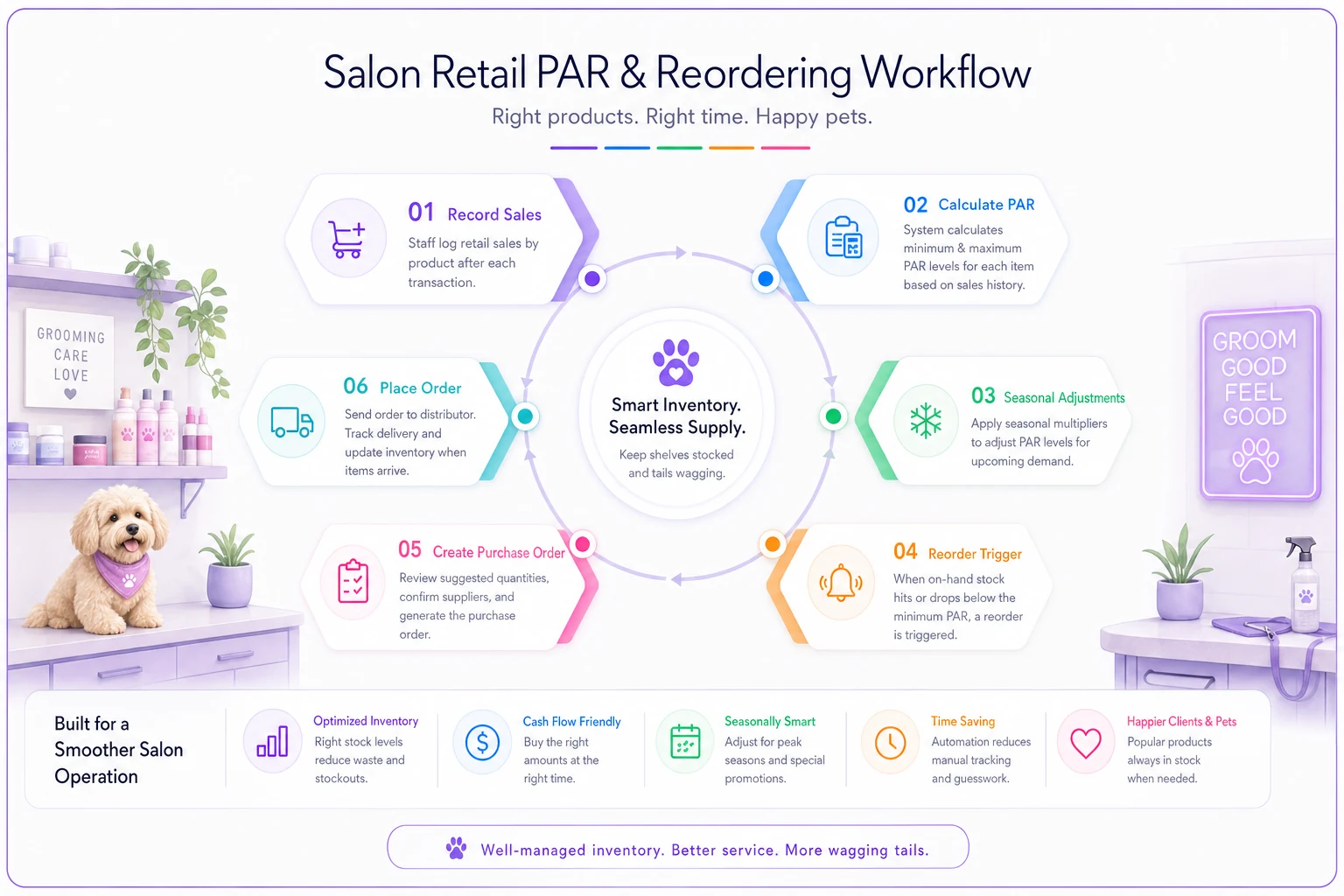
Here's a simple visual of that workflow in practice.
Start with conservative pars and adjust weekly for the first month to avoid overstocking after rationalization.
Apply these multipliers quarterly. A flea shampoo with a base par of 20 units becomes roughly 8 units in January and closer to 44 in July. The adjustments feel overly precise until you've run out of flea shampoo in May for the third time.
Five Promotion Playbooks That Drive Retail Velocity
Generic "20% off everything" sales train clients to wait for discounts. Strategic promotions tied to service patterns and seasonal needs are what actually build sustainable retail habits.
Playbook 1: New Client Starter Kits
Bundle three complementary products at 25% off for first-time clients only. A basic kit — shampoo, conditioner, slicker brush — might land around $38 instead of $51. The discount gets them started on your retail while establishing the habit early.
Position it as "maintaining your groom at home" rather than a product push. Reception can mention it during booking confirmation, and the groomer can reinforce it at checkout.
Playbook 2: Breed-Specific Bundles
Certain breeds have predictable grooming needs, which makes pre-selected bundles an easy sell:
-
Doodle Kit
Detangling spray, slicker brush, mat preventative conditioner
-
Short-Coat Kit
Rubber curry brush, shed-control shampoo, finishing spray
-
Senior Dog Kit
Gentle shampoo, paw balm, dental water additive
Price these about 15% below individual items. The bundle simplifies the decision while increasing average transaction value.
Playbook 3: Buy-3-Get-4th Frequency Program
Rather than discounting by percentage, offer the fourth bottle free after purchasing three over any timeframe. Track it through your booking system or a simple punch card.
This creates steady repurchase patterns without training clients to expect discounts. Works especially well for consumables like shampoo and dental chews.
Playbook 4: Service Add-On Discounts
-
Teeth cleaning appointment
30% off dental products today only
-
Deshedding treatment
25% off undercoat rakes and shed-control shampoo
-
Flea bath
Flea prevention at cost plus 20%
The immediacy and direct relevance drive conversion better than almost anything else. Clients can see exactly why they need the product.
Playbook 5: Seasonal Transition Offers
Two weeks before seasonal changes, push relevant products through targeted outreach:
-
Late March
"Flea season starts April 1 — stock up now and save 20%"
-
Early October
"Winter paw protection — buy 2 balms, get one free"
-
December
"New Year fresh start — dental care bundles 25% off"
Time these before peak demand hits, not during. You're helping clients prepare, not capitalizing on desperation.
Commission Structures That Turn Groomers Into Retail Champions
Traditional grooming pay focuses entirely on service revenue, which makes retail feel like unpaid extra work. When groomers earn the same whether they mention products or not, most just don't bother.
The pay models that actually drive performance need to include retail incentives — but generic commission on all sales creates the wrong behavior. You want relevant recommendations, not groomers pushing products on clients who have no use for them.
Attach Rate Metrics That Matter
Instead of rewarding total retail dollars, focus on attach rate — the percentage of grooming appointments that include a retail purchase. This encourages natural product mentions without tipping into pushy sales behavior.
-
Baseline
around 15% of appointments include retail
-
Good performance
25% attach rate
-
Strong performance
35%+
Track individual groomer attach rates monthly. A simple leaderboard showing top performers works well — no need to shame anyone sitting below target.
Tiered Commission Structure
| Monthly Attach Rate | Commission Rate | Example on $2,000 Retail |
|---|---|---|
| Under 15% | 0% | $0 |
| 15-24% | 3% | $60 |
| 25-34% | 5% | $100 |
| 35%+ | 8% | $160 |
This rewards consistency over one-off big sales. A groomer maintaining 30% attach rate across moderate transactions will often outearn someone with sporadic high-value sales and inconsistent follow-through.
Product Category Bonuses
-
Dental products
Extra 2% (preventative care emphasis)
-
House-brand items
Extra 3% (highest margins)
-
Seasonal priorities
Extra 2% (moving time-sensitive inventory)
-
Subscription sign-ups
Flat $5 bonus (recurring revenue)
A groomer selling a house-brand dental chew subscription at 35% attach rate earns: 8% base + 3% house brand + 2% dental + $5 flat. Strong incentive without getting overly complicated.
Making Commission Visible and Immediate
Most salons calculate retail commission monthly, which puts way too much distance between behavior and reward. Show daily retail earnings through a simple end-of-day report or dashboard instead.
"Yesterday you earned $12 in retail commission" creates immediate feedback. Groomers start noticing which product mentions actually convert and naturally adjust their approach over time.
What the Shift Actually Looks Like in Practice
Rather than a tidy before-and-after case study with suspiciously round numbers, it's more useful to describe what the change actually feels like on the ground.
Salons that go through SKU rationalization often expect the change to hurt revenue at first. Fewer products should mean fewer sales, right? But the opposite happens more often than not. When a groomer goes from mentally juggling 70+ SKUs to a focused shelf of 20 or so items they actually know well, recommendations become more confident and more natural. Clients respond differently to "you really need this one for her coat type" versus a vague gesture toward a wall of options.
The par-setting piece tends to be the least exciting change but often the most impactful. Stockouts are quietly devastating to retail momentum — a client who gets turned away once rarely asks again. Getting reorder triggers right means the right products are almost always available when the conversation happens at checkout.
Commission changes are where things get interesting. One salon manager described rolling out attach-rate tracking as "the moment groomers stopped treating the retail shelf like furniture." The leaderboard didn't humiliate anyone; it just made the opportunity visible. Within a couple of months, groomers were comparing approaches, sharing what worked, and genuinely engaged with something they'd previously ignored.
Inventory investment tends to drop meaningfully when SKUs get rationalized — sometimes by half or more — while revenue climbs. That's the operational discipline piece paying off.
Technology's Role in Retail Operations
Manual tracking of par levels, attach rates, and commissions gets overwhelming fast, especially as appointment volume grows. This is where the right operational software genuinely changes things.
Modern platforms can automatically track inventory against preset pars and alert when reorder points hit. They calculate attach rates by groomer in real-time and push daily commission updates. Some integrate directly with distributors for streamlined reordering at negotiated prices.
The data these systems surface can be surprising. That premium organic line you assumed was popular? Dragging down margins and sitting on shelves for weeks. The boring dental chews? Highest-velocity SKU with solid margin and consistent demand. You don't always know what's actually moving until the numbers are in front of you.
AI-assisted platforms also help identify which products to surface to which client segments. Dogs with recurring ear issues get targeted ear care recommendations. Clients who haven't purchased in 60+ days receive personalized offers based on their pet's actual history rather than a generic blast.
Without getting lost in feature comparisons — the right platform simply makes the micro-system sustainable. Spreadsheets work for a few weeks, then things slide back to chaos.
Take a look at how revenue forecasting tools can complement your retail tracking for a more complete picture of salon performance.
Common Retail Mistakes Worth Avoiding
Letting distributors dictate inventory: Sales reps push high-commission products that may not match your clientele at all. Every SKU should earn its shelf space through velocity and margin, nothing else.
Discounting to move dead stock: If something isn't selling at full price, a discount rarely fixes the underlying problem. Donate it, write it off, and free up that shelf space for products that actually move.
Ignoring expiration dates: Nothing kills retail credibility faster than selling expired products. Build expiration tracking into your par system with 60-day warning alerts before things get close.
Making retail optional for staff: When only some team members engage with retail, clients get inconsistent experiences. Everyone from reception to groomers needs basic product knowledge and a genuine reason to participate.
Overcomplicating the system: Fancy loyalty programs, elaborate bundling rules, and complex displays don't drive sales. Focused selection, consistent availability, and a natural recommendation at point of service — that's what actually moves product.
Getting the Foundation Right
The shift from dead retail space to reliable profit center doesn't require massive investment or aggressive sales tactics. It needs operational discipline applied consistently over time.
Start with SKU rationalization. Cut your product selection roughly in half, keeping items that solve real, visible problems. Set par levels that prevent both stockouts and overstock. Build promotion playbooks tied to service patterns and seasonal timing rather than arbitrary discounts.
Most importantly, align groomer compensation with retail performance through attach-rate metrics rather than raw sales volume. That encourages natural product mentions without pushy tactics that damage client relationships.
The operational foundation matters more than product selection. You could stock excellent products, but without par levels, targeted promotions, and commission alignment, they'll still sit there gathering dust. Get the system right, and even average products generate solid, predictable returns.
Stop treating retail like an afterthought. With the right operational approach, it becomes as predictable as your grooming services — just with better margins and less labor.
Stop treating retail like an afterthought. With the right operational approach, it becomes as predictable as your grooming services — just with better margins and less labor.
Ready to streamline your grooming business?
Join 500+ pet groomers using Furlyly to save time, reduce scheduling conflicts, and deliver exceptional client experiences.