

Every grooming salon has the same frustrating math problem. Your average ticket sits somewhere around $65–75 per dog. Your groomers handle maybe 6–8 dogs a day. The numbers just don't move unless something fundamental changes about how each transaction flows.
The standard advice is always the same—train your team to suggest add-ons, create bundles, display retail prominently. Except that advice ignores the operational reality of grooming salons. Your checkout isn't like retail. You're juggling a wet dog, an impatient owner checking their phone, another client walking in, and a groomer who needs to prep for the next appointment. A lengthy upsell conversation blows your schedule.
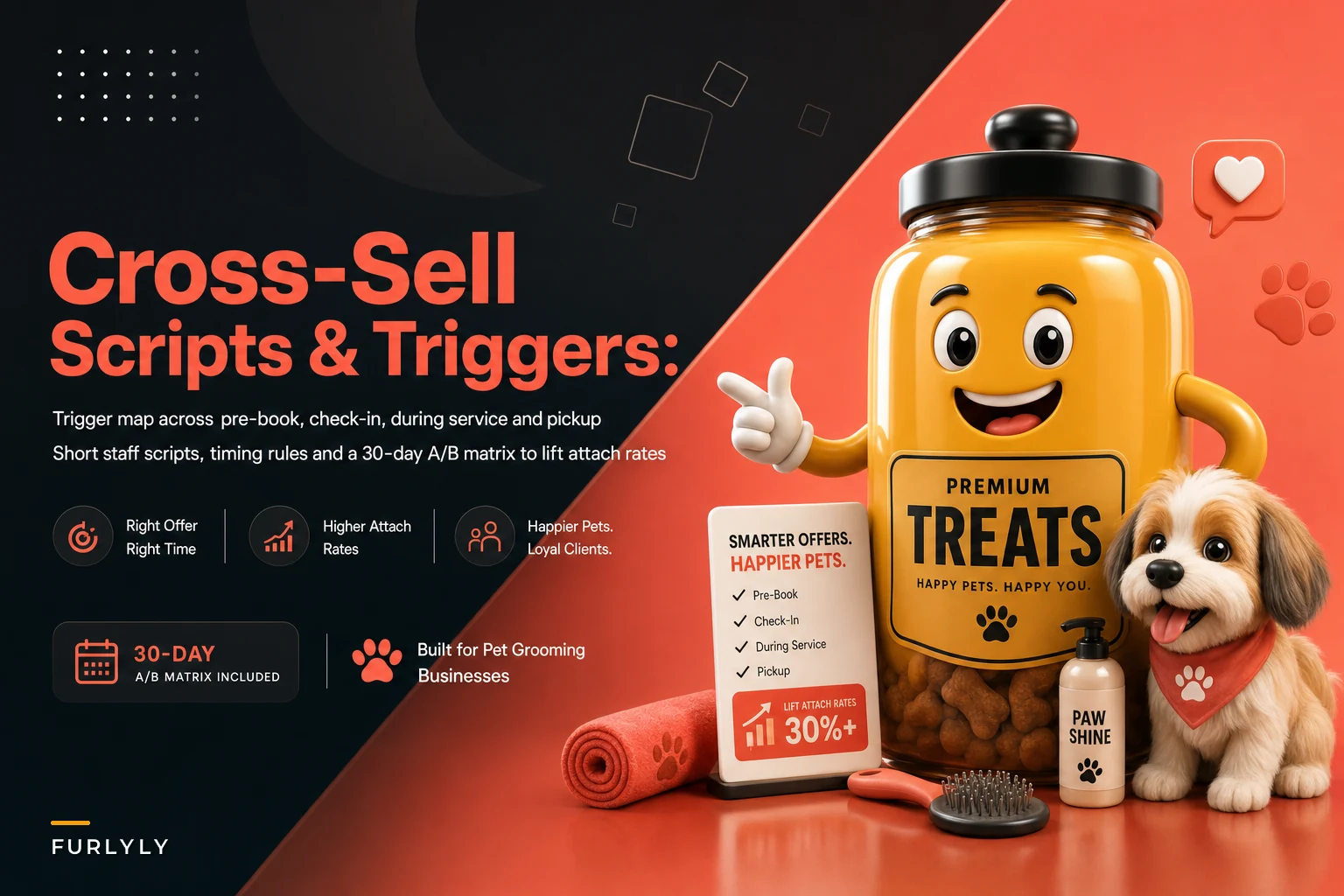
What works is understanding the four distinct trigger points where cross-sells naturally fit into your existing workflow without adding friction. Not every moment is equal, and timing beats technique every single time.
The Pre-Book Window: Setting Expectations Before They Arrive
Most salons completely waste their booking confirmation calls or texts. They confirm the time, remind about policies, maybe mention parking. But this touchpoint happens when clients are relaxed, not rushed, and actually thinking about their pet.
A booking confirmation that casually mentions "We have teeth cleaning gel available if Max needs freshening between visits" plants a seed without pressure. The client isn't standing at your counter with keys in hand. They're sitting on their couch, maybe noticing their dog's breath while reading your message.
The operational trick is segmentation. Not every client gets every message. Your booking software should track what each client has purchased before. Someone who's never bought retail gets a different pre-appointment message than your regulars. A first-time teeth cleaning mention goes to dogs over age 5. Seasonal shedding treatment reminders go to double-coated breeds in March and September.
Here's what this actually looks like:
Standard confirmation: "See you tomorrow at 2pm for Bella's grooming!"
Optimized confirmation: "See you tomorrow at 2pm for Bella's grooming! Since she's due for nail grinding (last done 8 weeks ago), we'll have that ready if you'd like to add it—takes just 5 extra minutes."
The difference seems small until you multiply it across 300 appointments monthly. Even a 15% take rate on a $12 add-on generates an extra $540 a month without touching your service times.
Check-In Choreography: The 90-Second Handoff
Check-in is where most grooming checkout upsell scripts fall apart. Your front desk is processing payment from the last client, answering phones, and trying to get basic intake done. Adding a sales pitch here feels forced and usually gets skipped when things get busy.
Never miss a grooming appointment again.
Furlyly helps you book, confirm, and manage every pet grooming appointment effortlessly.
- Unified appointment scheduling
- Automated client reminders
- Staff availability & shift management
No credit card required
The solution isn't better sales training—it's better intake forms and visual cues.
Your intake form should naturally surface add-on opportunities through required questions:
-
"When were nails last trimmed?" (not "Do you want nail service?")
-
"Any areas of concern?" (which opens discussion for specialized treatments)
-
"Preferred finishing spray
Original, Lavender, or Seasonal?" (assumes the add-on)
Forms alone don't drive attach rates, though. You need environmental triggers too. A small "Today's Special: Teeth Cleaning $8 with any full groom" sign at eye level beside your check-in iPad does more than any script. Clients read while waiting. No pressure, no time added.
The most effective check-in add-on across the salons I've worked with is the sanitary trim for dogs not on a full-service package. It takes 3 minutes, runs about $15, and a solid 40% of medium and long-haired dogs need it between full grooms. Yet most salons never mention it unless the client specifically asks.
Your check-in script becomes: "I see Buddy's here for his bath today. His sanitary area looks like it could use a quick trim—should we take care of that while he's here?" Natural. Observational. Service-focused, not sales-focused.
During Service: The Text That Changes Everything
While the dog is being groomed, you have a captive audience who's thinking about their pet and not physically rushed. Most salons send a "ready for pickup" text and nothing else. But that 90-minute service window is actually ideal for soft suggestions based on what the groomer observes.
A groomer notices matting behind the ears. Instead of mentioning it at pickup when the owner just wants to leave, your system sends: "Quick update on Max: He's doing great! We noticed some matting starting behind his ears. We can add a de-matting treatment today for $18, or you might want to grab our detangling spray ($12) for maintenance at home. Reply Y for treatment, S for spray, or N for neither."
This does three things:
-
Zero confrontation at pickup
-
Client has time to consider without pressure
-
Creates documentation of the recommendation
Limit these to one suggestion per visit. More than that feels spammy, and the suggestion needs to be genuinely based on observation—not randomly generated.
From tracking this across dozens of salons, the mid-service text has the highest conversion rate of any touchpoint—usually 35–45% for relevant suggestions. Compare that to pickup conversations, which convert somewhere around 8–12%.
Pickup Precision: The 17-Second Close
Pickup is your last shot, but ironically your worst opportunity. Everyone's in a hurry. The dog is excited. Often another client is already waiting. This is where lengthy retail upsell strategies fail completely.
The only thing that works at pickup is the assumed add-on with visual reinforcement.
Place three small products directly on your checkout counter—not on shelves behind it. These should be your highest-margin, most grooming-relevant items: paw balm, breath spray, and detangling spray, each under $15.
Your pickup script isn't a question, it's a statement: "Max looks amazing! His coat came out beautifully with the oatmeal shampoo. This detangling spray is what we used today to get those tough spots—want me to add one?"
While saying this, physically touch the product. The client sees it, processes the price (clearly marked), and makes a snap decision. Yes or no, you've used less than 17 seconds.
If they say yes—extra revenue. If no, they've still registered that you carry that product. Next time they need it, they'll think of you before the pet store.
The Testing Framework That Actually Gets Used
Most A/B testing advice for salons is ridiculously complex. You don't need statistical significance calculators or control groups. You need simple tracking your team will actually maintain.
Here's a 30-day testing matrix that works:
Week 1–2: Baseline Track current attach rate with no changes. Just count: how many full grooms, how many bought anything extra.
Week 3–4: Single Variable Test Pick ONE trigger point. Change ONE thing.
-
Pre-book
Add segmented confirmation messages
-
Check-in
Add a single "Today's Special" sign
-
During
Implement the observation-based text
-
Pickup
Place the three counter products
Week 5–6: Combination Test If the single variable worked, keep it and add ONE more. If it didn't, replace it with a different trigger point.
Week 7–8: Script Refinement Keep the trigger points that showed improvement. Now test different wording for the same trigger.
Instead of "Would you like to add nail grinding?" try "Should we take care of nail grinding while Max is here?" Instead of "This detangling spray is what we used" try "I'm going to grab you this detangling spray we used on Max today" (assumptive close).
Track everything in a basic spreadsheet:
| Week | Test Type | Dogs Groomed | Add-Ons Sold | Attach Rate | Notes |
|---|---|---|---|---|---|
| 1–2 | Baseline | 127 | 31 | 24% | No changes |
| 3–4 | Pre-book message | 134 | 46 | 34% | Breed-specific |
| 5–6 | Pre-book + counter products | 129 | 52 | 40% | Combined approach |
This isn't sophisticated data science. It's basic experimentation that any salon can run. The constraint isn't complexity—it's consistency. Most salons try something for three days, don't see a dramatic shift, and quit.
Here's a simple visual to keep teams aligned during the 8-week cycle.
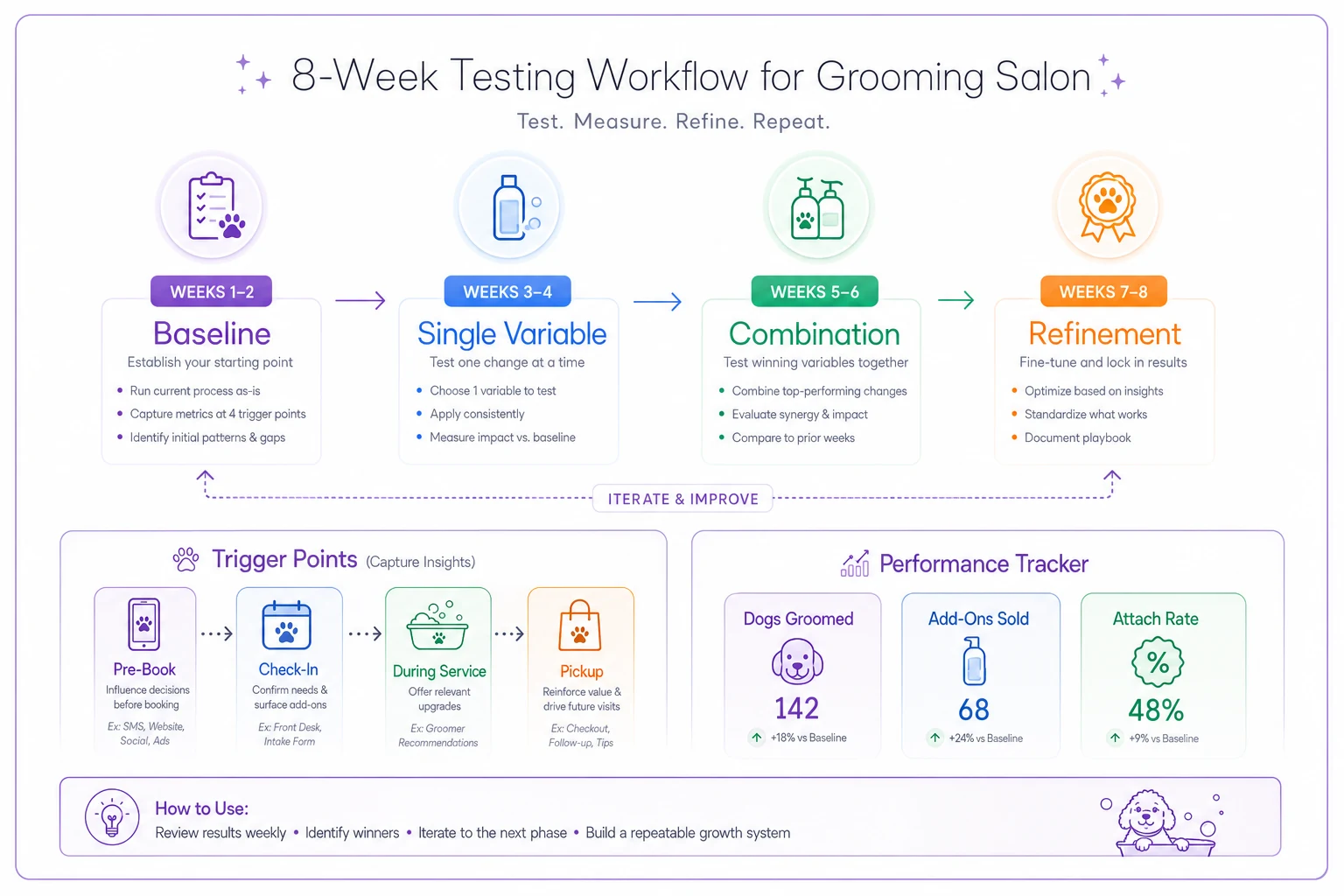
Use this workflow graphic in staff meetings to keep everyone on the same page.
The Service Time Protection Rule
Every extra service risks extending appointment time. Extended appointments cascade into delays, stressed groomers, and unhappy clients. The math is unforgiving: if every dog takes 10 extra minutes and you groom 8 dogs, you're 80 minutes behind by day's end.
This is why successful grooming checkout upsell scripts focus on services that either happen in parallel, replace existing steps, or batch efficiently. Your add-on menu should be categorized by time impact:
Zero time add-ons:
-
Shampoo upgrades
-
Cologne selection
-
Photo packages (if automated)
Minimal time add-ons (under 5 minutes):
-
Nail grinding or painting
-
Teeth cleaning
-
Paw balm application
Batch-only add-ons:
-
Flea treatments (do all at once)
-
De-shedding treatments (requires specific equipment setup)
Train your team to only suggest zero or minimal-time add-ons during busy periods. Save batch services for slower days when you can group them efficiently.
The Commission Structure That Drives Behavior
Your team ignores upsells because they're focused on getting through their queue. Speed equals more dogs equals more base commission. Why slow down for a $12 add-on?
The fix isn't motivation—it's compensation structure. Instead of percentage commission on add-ons, try threshold bonuses:
-
5+ add-ons in a day
Extra $10
-
10+ add-ons in a day
Extra $25
-
20+ add-ons in a week
Extra $50
This rewards volume, not value. A groomer can hit their daily bonus with five simple nail trims instead of pushing one expensive spa package. It aligns with operational reality—quick add-ons that don't disrupt flow.
Track it publicly on a simple whiteboard. Monday: Sarah ⚡⚡⚡⚡⚡ ($10 bonus). Tuesday: Sarah ⚡⚡⚡. The visual element works better than any sales meeting. Groomers start suggesting add-ons not because you lectured them about revenue, but because they want to hit their daily five.
The Seasonal Calendar Nobody Follows (But Should)
Add-on success isn't random. Specific services spike at predictable times, yet most salons push the same services year-round.
Map your add-on focus to actual demand patterns:
| Month | Recommended Focus |
|---|---|
| January–February | Paw protection (salt damage), moisturizing treatments |
| March–April | De-shedding, flea prevention prep |
| May–June | Flea/tick treatments, sanitary trims |
| July–August | Cooling sprays, paw balm (hot pavement) |
| September–October | De-shedding again, coat conditioning |
| November–December | Holiday photo packages, cologne, bow add-ons |
Your pre-book messages, counter products, and daily specials should rotate with these patterns. A "Holiday Portrait Package" in December converts at roughly 3x the rate of the same offer in July. De-shedding in March practically sells itself to anyone with a lab or husky.
This seems obvious, yet walk into most salons and they're pushing teeth cleaning in March—when owners are stressed about taxes—instead of de-shedding, which is a visible problem owners are actually motivated to solve.
Technology That Removes Friction
The biggest operational constraint when implementing grooming checkout upsell scripts isn't training or motivation—it's information flow. Your receptionist doesn't know the dog's full history. Your groomer doesn't know what products the owner bought last time. Everyone operates in silos.
AI-powered grooming management software addresses this by centralizing client data and automating trigger points. When Mrs. Johnson checks in with Bailey, the system immediately surfaces:
-
Last nail trim
9 weeks ago (suggest it)
-
Previous purchases
Buys oatmeal shampoo (upsell to sensitive skin package)
-
Breed
Golden retriever (flag de-shedding in spring and fall)
-
Age
8 years (teeth cleaning becomes a priority)
Platforms built with AI automation can also trigger the mid-service text based on groomer notes—no manual step needed. The groomer marks "matting observed" and the de-matting treatment message goes out automatically.
This isn't about replacing human judgment. It's about giving your team the right information at the right moment. A receptionist can confidently suggest relevant add-ons when they can see the full picture, not just today's appointment slot.
Real-World Implementation: A 90-Day Case Study
Here's what this looks like when properly executed. A salon in suburban Denver with 4 groomers, averaging around 24 dogs daily, implemented this exact system.
Baseline month:
-
Average ticket
$67
-
Attach rate
22%
-
Monthly revenue
~$38,000
Month 1 changes: Added breed-specific pre-appointment texts, placed three products on the counter, and implemented the threshold bonus system.
Month 1 results:
-
Average ticket
$71
-
Attach rate
31%
-
Monthly revenue
~$40,500
Month 2 changes: Added mid-service observation texts, refined scripts based on what worked, and introduced a seasonal focus around spring de-shedding.
Month 2 results:
-
Average ticket
$74
-
Attach rate
37%
-
Monthly revenue
~$42,000
Month 3 changes: Full system running, staff comfortable with scripts, most touchpoints automated through software.
Month 3 results:
-
Average ticket
$76
-
Attach rate
41%
-
Monthly revenue
~$43,200
That's roughly $5,200 more per month without adding a single appointment slot. No overtime. No rushed services. No stressed staff.
One detail worth noting: service times actually dropped by about 3 minutes on average because the team stopped having long sales conversations at pickup. Decisions were made earlier, when clients had time to think.
When This Doesn't Work (And What to Do Instead)
Not every salon should implement aggressive upselling. If you're in a price-sensitive market, constantly pushing add-ons erodes trust. If you're already booked solid with a waitlist, you're better off raising base prices than complicating service flow.
The wrong environment for grooming checkout upsell scripts:
-
Mobile grooming (limited product storage)
-
Luxury salons (inclusive pricing is expected)
-
Corporate chains (standardized pricing models)
-
Single-groomer operations (no bandwidth for complexity)
For these situations, focus on package deals that bundle common add-ons, membership programs with included services, retail-only follow-up campaigns, or partnership referrals with vets and trainers.
The goal isn't maximum revenue per dog—it's sustainable revenue per month. Sometimes that means fewer, simpler transactions your team can execute consistently.
Building Your Custom Script Library
Generic scripts fail because they don't match your salon's voice or clientele. Build a library of tested phrases that work for your specific situation. Document what actually converts, then train your team to adapt rather than recite.
For check-in add-ons:
-
"I notice Bella's nails are getting long—should we take care of those today?"
-
"Since you're here, want us to freshen up Max's teeth? Takes just 5 minutes."
-
"Cooper's coat would really benefit from our de-shedding treatment—it's $15 today."
For pickup product suggestions:
-
"This is the paw balm we applied today—want to take one home?"
-
"I used this detangler on Daisy's ears—works great for preventing mats."
-
"Here's that breath spray we discussed—should I ring this up with today's service?"
For pre-appointment messages:
-
"Looking forward to seeing Duke tomorrow! Quick question—he's due for nail grinding. Should we add that to tomorrow's appointment?"
-
"Reminder
Molly's appointment is tomorrow at 2pm. BTW, our spring de-shedding treatment is available if her coat needs it!"
These scripts share a few common elements: a specific observation, a casual assumption, and a clear value statement. The script is a starting point, not a straightjacket.
The Monthly Audit That Keeps You Honest
Implementing grooming checkout upsell scripts isn't a one-time project. Without regular audits, your team reverts to old habits within weeks.
Run this simple monthly check:
-
Mystery shop yourself
Have a friend bring their dog. Do they get offered relevant add-ons at each trigger point?
-
Review the numbers
Compare attach rates by employee, by day, by service type. Where are the gaps?
-
Update scripts
What objections are you hearing? What services aren't moving? Refine based on actual feedback.
-
Refresh products
Those three counter items shouldn't be permanent. Rotate based on season and sales data.
-
Celebrate wins
Public recognition for attachment rate improvements works better than any training program.
Salons that sustain 40%+ attach rates aren't necessarily better at selling. They're better at systematically reviewing and refining their approach. Small adjustments compound over months.
The Compound Effect of Marginal Gains
Lifting attach rates without disrupting service isn't about revolutionary changes. It's about identifying every marginal opportunity in your existing workflow and improving each one slightly.
A 2% improvement from better pre-book messaging. Another 3% from check-in visuals. 5% from mid-service texts. 4% from pickup product placement. Suddenly you're looking at 14% total improvement—which on a base of $40,000 monthly revenue adds up to roughly $5,600 extra per month, or around $67,000 per year.
The math works because you're not adding time, stress, or complexity. You're redirecting existing touchpoints toward revenue generation. Your receptionist is already sending confirmations—might as well make them useful. Your groomer is already observing the dog's condition—might as well communicate those observations before pickup. Your client is already standing at checkout—might as well show them something relevant.
The salons struggling with revenue usually aren't doing anything dramatically wrong. They're just not doing these small things consistently. The difference between a 20% attach rate and a 40% attach rate isn't skill or scripts or software—it's systematic execution of simple triggers at the right moments.
Stop looking for the perfect grooming checkout upsell script. Build a system of micro-conversions that compound into meaningful revenue without compromising your core service delivery. That's how you grow without the chaos.
Stop looking for the perfect grooming checkout upsell script. Build a system of micro-conversions that compound into meaningful revenue without compromising your core service delivery. That's how you grow without the chaos.
Ready to streamline your grooming business?
Join 500+ pet groomers using Furlyly to save time, reduce scheduling conflicts, and deliver exceptional client experiences.