


Most grooming owners who open a second location don't struggle because of money or demand. They struggle because everything still runs through them. The schedule questions, the angry-client calls, the "we're out of shampoo again" texts, the staff drama — all of it lands on the owner's phone, no matter which building it came from.
That works fine at one salon. You're physically there. You catch problems before they grow. But the moment you split your attention across two or three locations, the thing that made you successful — being hands-on everywhere — becomes the exact thing holding the business back.
This is a leadership transition problem, not an operations problem. And it's the single hardest shift in salon owner leadership multi-unit growth. You're not learning how to groom better or sell more. You're learning how to build people and systems that make decisions without you in the room.
Below is how that transition actually works, where it breaks, and the concrete tools that pull the owner out of the daily grind.
Why the owner stays the bottleneck (even when they don't want to)
Owners say they want to delegate, but they've often built a business where delegation is technically impossible. Nobody else knows the vendor passwords. Nobody else knows which clients get the "handle with care" treatment. Nobody else can issue a refund over $40 without a text first.
So of course everything comes back to you.
In real operations, this usually comes from three things stacked on top of each other:
-
Knowledge lives in the owner's head, not in any document or system. The "how we do things here" is tribal, not written.
-
No one has clear authority. Managers exist on the org chart but can't decide anything meaningful without looping in the owner.
-
There's no feedback loop telling the owner whether a location is healthy, so they compensate by checking everything manually.
The first location hides all three problems because you're the manager, the owner, and the emergency backup simultaneously. Scale exposes them fast. A manager who was told "use your judgment" but got punished the first time it cost $200 will simply stop making decisions. Now you've got two salons funneling into one brain.
What actually breaks at the second and third location
The failure points aren't dramatic. They're small, repeated frictions that compound over months.
Never miss a grooming appointment again.
Furlyly helps you book, confirm, and manage every pet grooming appointment effortlessly.
- Unified appointment scheduling
- Automated client reminders
- Staff availability & shift management
No credit card required
Decision latency. At one shop, a client issue gets resolved in two minutes because you walk over. At three shops, a manager waits 40 minutes for your text back while an irritated client sits in the lobby. Multiply that by dozens of small decisions a week and your locations run slower than your single shop ever did.
Inconsistent standards. Location A gives loyal clients a free nail trim. Location B charges for it. Neither manager is wrong — nobody told them the rule. Clients notice, Yelp notices, and suddenly you're refereeing a policy dispute between two people who both think they're following your intent.
Manager burnout. The manager with responsibility but no real authority is in the worst job in the company. They absorb stress from staff and clients but can't fix anything structurally. These are the people who quit nine months in, right after you finally got them trained.
Owner burnout — the quieter kind. You stop being a strategist and become a human help desk spread across multiple buildings. Growth that was supposed to buy you freedom bought you a longer workday.
If you've already thought through SOP bundles and QA templates — which you'll need for consistency — the companion piece is your location-readiness gates for multi-location grooming. That handles can this location replicate service standards. This article handles can this location run without you.
The four tools that remove the owner from the loop
A real leadership transition kit isn't motivational. It's four fairly boring documents that, together, let a manager run a location at the standard you'd run it yourself.
1. The delegation matrix
This is the backbone. A delegation matrix is a simple grid that answers one question for every recurring decision: who decides, and up to what limit?
Most owners skip this and just say "use your judgment," which is how you get the two-salon nail-trim disagreement above. Judgment needs boundaries.
A basic version looks like this:
| Decision type | Groomer | Location manager | Owner |
|---|---|---|---|
| Refund / service redo | Up to $25 | Up to $150 | Over $150 |
| Comp a service for a complaint | No | Up to one full groom | Multiple / recurring |
| Reschedule or waive a late fee | No | Yes, per fee tiers | Policy changes |
| Approve staff schedule swap | No | Yes | — |
| Hire a new groomer | No | Recommend only | Final approval |
| Order supplies off the par list | No | Up to $400/order | Over $400 |
| Discipline / write-up | No | First write-up | Terminations |
Start a little looser than feels comfortable and tighten only if the data says to.
The exact dollar amounts matter less than the fact that they exist. A manager who knows they can approve a $150 redo without calling you will fix a client problem on the spot. That's the whole point — pushing decisions down to where the problem actually happens.
One thing worth noting: owners almost always set the limits too low at first. Fear drives that. Then they realize their managers were more careful with comps than they themselves were. Start a little looser than feels comfortable and tighten only if the data says to.
2. Manager scorecards
If the delegation matrix gives managers authority, the scorecard tells you whether they're using it well — without you hovering over their shoulder.
A scorecard is a short, fixed set of numbers each location manager owns and reviews with you on a regular rhythm. The mistake here is tracking 15 metrics. Managers can't move 15 things at once. Pick five or six that actually reflect a healthy location:
-
Rebooking rate — did clients book their next appointment before leaving?
-
Average ticket — are add-ons and upsells happening?
-
Schedule utilization — are groomers' days full without being overbooked?
-
Complaint / redo rate — quality signal
-
Staff retention / unplanned absences — team health signal
-
Labor as a percent of location revenue — the number that keeps the location profitable
The scorecard does something subtle but important: it shifts the relationship. Instead of you watching the manager, the manager watches the numbers and reports to you. You move from inspector to coach. When a manager walks into the monthly review already knowing their rebooking rate dipped and has a plan for it, you've successfully transferred ownership.
Scorecards also tie directly into how you evaluate people over time. If your performance review process is shaky to begin with, fix that foundation first — the people and performance system for cutting turnover pairs naturally here, because a scorecard is only fair if the underlying review process is solid.
3. A 90-day manager onboarding plan
Promoting your best groomer to manager and hoping they figure it out is the most common and most expensive multi-unit mistake. Grooming skill and management skill are unrelated. A great groomer who can't delegate just becomes an overworked groomer with a title.
A structured 90-day plan turns a new manager into someone who can run a location without you shadowing them. Here's a workable sequence:
-
Days 1–15 — Learn the systems, not the people. The new manager masters the scorecard, the delegation matrix, the daily open/close routine, and where every SOP lives. They shouldn't be managing anyone yet. They need to know exactly what "good" looks like in numbers before they touch anything else.
-
Days 16–45 — Shadow and co-decide. They handle real client issues and scheduling calls, but run decisions by you first — not for permission, but for feedback. You're calibrating their judgment against yours. This is where you find out whether their instincts on comps and conflict match the standard.
-
Days 46–75 — Decide, then report. The matrix limits go live. They make real decisions within their authority and tell you afterward what they did and why. Fewer check-ins, more autonomy. Mistakes here are cheap and expected.
-
Days 76–90 — Run it. They own the scorecard, the schedule, and frontline decisions. Your involvement drops to the regular review rhythm. By day 90, you should be able to skip visiting that location for a week and have it run normally.
Owners who skip the middle two phases are the ones calling a brand-new manager at 7pm because a dog came back with an uneven trim. The onboarding plan isn't about being slow — it's about front-loading the judgment transfer so you're not doing it reactively for the next two years.
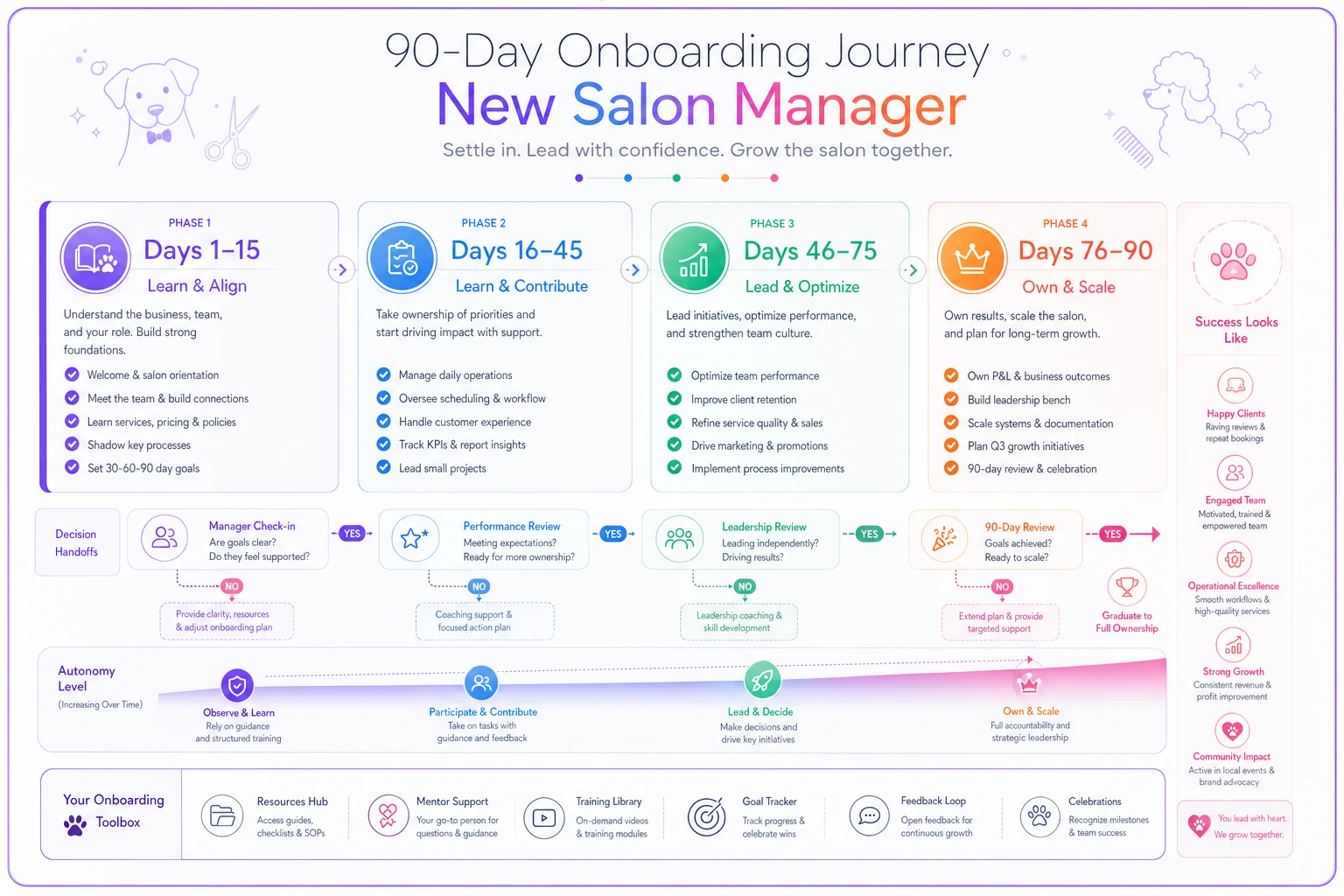
A simple visual like this clarifies the judgment transfer for owners and managers.
4. Escalation rules
The final piece is a clear rule for what climbs the ladder and what doesn't. Without it, two things happen: managers escalate everything and you're the bottleneck again, or they escalate nothing and you hear about the walkout after two groomers already quit.
A clean escalation framework has three tiers:
-
Handle it — anything inside the delegation matrix. Don't notify, just log it.
-
Notify, don't wait — things you should know about but that shouldn't block the manager: a comp outside the normal range, a client threatening a public review, a no-show covered by shuffling the schedule.
-
Escalate immediately — safety incidents, pet or person injuries, anything legal, suspected theft, or a staffing emergency that can't be internally covered. These get a phone call — not a text — within the hour.
Write it down and post it. The clarity alone kills most of the "should I bother the owner with this?" anxiety that makes managers either over-communicate or go silent.
A real scenario: two locations, one exhausted owner
A grooming business with two locations — a flagship doing roughly $42k–$46k a month and a second shop about a year old doing around $28k — had a classic bottleneck problem. The owner was physically splitting her week between buildings and still fielding 20–30 operational texts a day. The second location's manager had the title but escalated nearly everything because she'd been criticized early on for comping a groom she shouldn't have.
The fix wasn't complicated. They built a delegation matrix with real dollar limits, trimmed the monthly report down to six scorecard metrics, and ran the 90-day plan retroactively — basically restarting the manager's authority ramp with clear feedback instead of surprise criticism.
Within about two months, the owner's daily operational texts dropped to a handful. The newer location's rebooking rate improved because the manager could finally resolve client friction on the spot without a 40-minute delay. The owner started taking one full day off a week for the first time since opening the second shop. Nothing about the grooming changed. The decision-making structure did.
When this transition makes sense — and when it doesn't
This makes sense when you have a genuine second location (or are weeks from opening one), consistent enough volume to support a real manager salary, and you've already written down your core SOPs. You can't delegate decisions against standards that don't exist on paper.
This is a bad idea when your single location isn't profitable yet, or still requires constant firefighting to stay functional. Delegating chaos just spreads chaos. Fix the one-shop operation first.
Who should not rush this: owners who are actually planning to sell rather than scale. If your goal is an exit in the next year or two, the systems overlap but the priorities shift — tightening financials and transferability matters more than building a management layer. The grooming salon exit and succession preparation walkthrough is the better starting point for that path.
Where software quietly does the heavy lifting
None of this requires fancy tools — you can run a delegation matrix in a shared Google Doc. But as locations multiply, the manual version starts to leak. Scorecard numbers get pulled by hand and are already a week stale. Escalations live in text threads nobody can audit. You can't see at a glance which location is quietly drifting.
This is where an operational platform earns its keep. When your booking, POS, and payroll data feed into a shared dashboard, each manager's scorecard updates on its own instead of waiting for someone to tally it manually. Comp approvals and escalations get logged against set rules, so patterns become visible — like one location comping twice as often as the other — without you reading through every message thread. AI-assisted alerts can flag what actually needs your attention (a utilization drop, a spike in redos) and stay quiet about the rest. That's really the whole goal: being pulled in only when you're genuinely needed.
The tooling doesn't replace the four documents. It keeps them alive and current across buildings so the structure doesn't quietly rot the way manual systems tend to over time.
The real shift
Scaling to multiple locations isn't about cloning yourself. It's about accepting that you can't be in two buildings at once and building the structure that makes that okay. A delegation matrix gives people real authority. Scorecards give you visibility without surveillance. A 90-day onboarding plan transfers your judgment deliberately instead of by accident. Escalation rules draw the line between "handle it" and "call me."
Owners who make this transition stop being the busiest person in a growing company and start being the person the company doesn't fall apart without. That's the actual destination of salon owner leadership multi-unit growth — a business that runs at your standard even in rooms you're not standing in.
Ready to streamline your grooming business?
Join 500+ pet groomers using Furlyly to save time, reduce scheduling conflicts, and deliver exceptional client experiences.