

The gap between running one great salon and running four consistent ones isn't talent. It's replication. Most owners who open a second location assume the hard part is finding groomers and signing a lease. The actual hard part shows up three months later, when the new shop has quietly developed its own version of everything — different intake habits, different upsell language, different rules about when a dog gets a mat release fee — and you realize you didn't open a second salon. You opened a second business that happens to share your logo.
This is the core failure in almost every multi location grooming replication framework attempt: people replicate the look (paint, branding, service menu) and skip replicating the operating system — how decisions get made, how quality gets checked, how a location proves it's actually ready to open. Location readiness isn't a launch date on a calendar. It's a set of gates a shop has to pass before it earns the right to book real clients.
Here's how the whole system works when it's built right — and where it quietly breaks when it isn't.
Why "just clone what I do" falls apart
The founder-owned salon runs on invisible knowledge. You know the doodle at 2pm always needs an extra 20 minutes. You know which retail products actually move. You know that when a client is upset about a nail trim, you comp the next bath and it's fine. None of that is written down anywhere. It lives in your head and in the muscle memory of the two people who've worked beside you for years.
When you open location two, you can't be there. So the new manager improvises. They're not bad — they're just filling gaps with their own judgment. Multiply that across intake, scheduling, safety calls, refunds, and closing procedures, and within a quarter the two shops diverge in dozens of small ways. Each one is minor. Together they mean a client who loved Location A gets a noticeably different experience at Location B, and your brand promise quietly cracks.
Divergence doesn't announce itself. There's no single disaster. Instead you get a slow accumulation of "well, that's just how we do it here." By the time you notice, retraining costs more than getting it right up front would have. The fix isn't a 200-page manual nobody reads. It's a small number of tightly-scoped systems that make the right behavior the easy behavior. Four pieces do most of the work:
-
Role matrices — who owns what decision, at every location
-
SOP bundles — grouped procedures tied to a job, not a binder
-
QA templates — the checks that prove work meets standard
-
Location-readiness gates — the pass/fail milestones before a shop goes live
Before you write a single SOP, you have to answer a boring question that owners skip constantly: who is allowed to decide this?
Role matrices: ownership before procedures
In a single salon, the answer is always "you." At scale, ambiguity here is where things rot. A groomer at Location C wants to waive a de-shed surcharge for a regular. Can they? If the answer is unclear, one of two bad things happens — either everyone waives fees to avoid conflict and margin bleeds, or nobody does and clients get inconsistent treatment across your shops.
Never miss a grooming appointment again.
Furlyly helps you book, confirm, and manage every pet grooming appointment effortlessly.
- Unified appointment scheduling
- Automated client reminders
- Staff availability & shift management
No credit card required
A role matrix maps decisions to roles, not people. That distinction matters because people quit. If "Maria approves refunds" is your policy, you have a crisis the day Maria leaves. If "the on-shift lead approves refunds up to $40, GM approves above that" is your policy, the role survives turnover.
Here's a stripped-down version of what a decision matrix looks like across roles:
| Decision / Action | Groomer | Shift Lead | Location GM | Owner / Multi-Unit |
|---|---|---|---|---|
| Waive add-on surcharge (< $25) | No | Yes | Yes | Yes |
| Comp a service (recovery) | No | Up to $40 | Up to $150 | Any |
| Approve schedule overtime | No | No | Yes | Yes |
| Change local pricing | No | No | No | Yes |
| Hire / terminate | No | No | Recommend | Approve |
| Open/close checklist sign-off | No | Yes | Yes | — |
| Flag safety incident escalation | Yes | Yes | Yes | Yes |
The point isn't to centralize everything — it's the opposite. You want as many decisions as possible pushed down to the location, with clear ceilings. Owners who keep every judgment call routed to themselves become the bottleneck that caps growth at two or three shops. If you're building out roles for the first time, our breakdown on scaling a grooming salon without chaos walks through the capacity math and role definitions that feed directly into a matrix like this. One pattern worth naming: the most common role-matrix mistake is writing it and then never enforcing the ceilings. If your GM approves a $300 comp and nothing happens, the matrix is decoration. The ceilings only mean something if crossing them triggers a conversation.
SOP bundles: package procedures around jobs, not topics
This is where most documentation efforts die. Owners write SOPs by topic — a document on refunds, a document on nail trims, a document on retail restocking. Then they hand a new hire twelve unrelated documents and wonder why nothing sticks.
Real work doesn't happen by topic. It happens by role and moment. So bundle your SOPs the way the day actually flows.
A bundle is a small kit of procedures a specific person needs for a specific chunk of their job. An "Opening Shift Lead" bundle might contain:
-
Unlock and safety walkthrough steps
-
Till count and float confirmation
-
Reviewing the day's book for double-bookings and breed-time mismatches
-
Equipment power-on and clipper blade check
-
Staff huddle script (three lines, not a speech)
That's it. Five things, one laminated card or one screen. The bath tech has a different bundle. The closing lead has another. Nobody reads all of them — they read theirs.
Why this works better: a bundle is completable. A person can look at it and know when they're done. A topic-based manual is never done — it's a reference you're supposed to have absorbed somehow. Bundles convert "know the manual" into "run the checklist," and checklists are what actually replicate across locations.
One two-location operator had a 40-page SOP binder that new hires signed off on and never opened again. When they rebuilt it as seven role-bundles totaling maybe six pages, the time to get a groomer to "billable and unsupervised" dropped by around a week and a half — mostly because trainees stopped guessing what they were supposed to do next.
-
One bundle = one role at one moment (opening, mid-shift, closing, intake).
-
No bundle longer than a single screen or card. If it's longer, it's two bundles.
-
Every step is observable. "Confirm blades are sharp" is checkable. "Maintain quality" is not.
Getting this right upfront saves a significant amount of retraining time down the road, and it's one of the few things that actually transfers cleanly when you open a third or fourth location.
QA templates: proving the standard, not hoping for it
SOPs tell people what to do. QA templates verify they did it — and this is the piece owners most often skip, because in the founding salon you were the QA. You saw every dog. At three locations you see almost none.
A QA template is a short, structured check applied on a schedule. The trick is making it fast enough that it actually gets done. A 30-item groom audit will be ignored by week two. A six-item one gets done daily.
Keep per-groom QA under a minute—six clear items tends to be the sweet spot for daily completion.
Per-groom checks (fast, done by the groomer or lead before pickup): coat finish, nail length, ear cleanliness, no visible nicks, matching the requested style, photo captured. Six things, 30 seconds.
Per-shift checks (done by the lead at close): sanitation walkthrough, cage dryer settings logged, incident log reviewed, retail count spot-check. This is where consistency between shifts within one shop gets protected.
Cross-location audits (done monthly by the GM or a floating quality lead): pull 8–10 recent grooms per location, score them against the same rubric, and — critically — compare scores across locations. Divergence between shops is the number you're actually managing.
A realistic scoring rubric keeps it simple: each item is pass / needs-coaching / fail. Any "fail" on a safety item is an automatic escalation regardless of everything else. What you're watching over time isn't a single shop's average — it's the spread. If Location A averages 94 and Location D averages 78, you don't have a Location D problem. You have a replication problem, and the fix lives in bundles and training, not in pressuring Location D to do better.
One mistake worth avoiding: turning QA into a punishment tool. The moment staff believe the audit exists to catch them, they'll game it — the photo gets taken at the best angle, the log gets filled in retroactively. QA has to be framed as "how we keep every shop worthy of the brand," and coaching has to visibly follow low scores, or the whole thing becomes theater. A lot of that is a people-systems question; if turnover is eating your quality, the people and performance system for cutting turnover pairs naturally with QA, because you can't hold a standard with a revolving door.
Location-readiness gates: earning the right to open
Now the piece that ties it all together — and the one almost nobody builds.
A readiness gate is a checkpoint a new location must pass before it moves to the next phase. Without gates, "opening" is just a date, and you'll open a shop that isn't ready because the lease started and the pressure's on. Gates replace "it's time" with "it's proven."
Gate 1 — Infrastructure ready. Space built out, equipment installed and tested, POS and booking system live and mirrored to your other locations' settings, licenses and insurance confirmed. Fail = you don't hire yet.
Gate 2 — People ready. GM hired and trained on the role matrix. Core team hired. Every hire has completed their SOP bundles and passed a supervised skills check. Fail = you don't book paying clients yet.
Gate 3 — Dry-run ready. The shop runs a soft week on friends, family, staff pets, and discounted volunteers. QA templates run live. This is where you catch the stuff that never shows on paper — the dryer that's too loud for anxious dogs, the intake flow that jams at the front desk during a rush. Fail = you extend the soft period, you don't rush the grand opening.
Gate 4 — Live-ready. Soft-week QA scores hit your threshold (within a few points of your flagship's average). Role ceilings tested with a real refund and a real overtime call. Full book opens.
Here's a compact readiness checklist you can lift and adapt:
-
- [ ] Booking system settings mirror the flagship (service times, buffers, breed matrices)
-
- [ ] Role matrix posted, GM can recite their ceilings from memory
-
- [ ] Every staff member has completed and signed off on their SOP bundle
-
- [ ] At least one supervised skills check passed per groomer
-
- [ ] Safety and incident escalation path tested with a mock incident
-
- [ ] Soft-week completed with QA audits run on every groom
-
- [ ] Cross-location QA spread within target vs. flagship
-
- [ ] Till, retail, and reconciliation routines run cleanly for five consecutive days
-
- [ ] Emergency equipment swap plan in place and parts stocked
-
- [ ] Client recovery script tested on at least one real complaint
Visualizing the gates can make it easier for teams to track progress and know what's blocking the open.
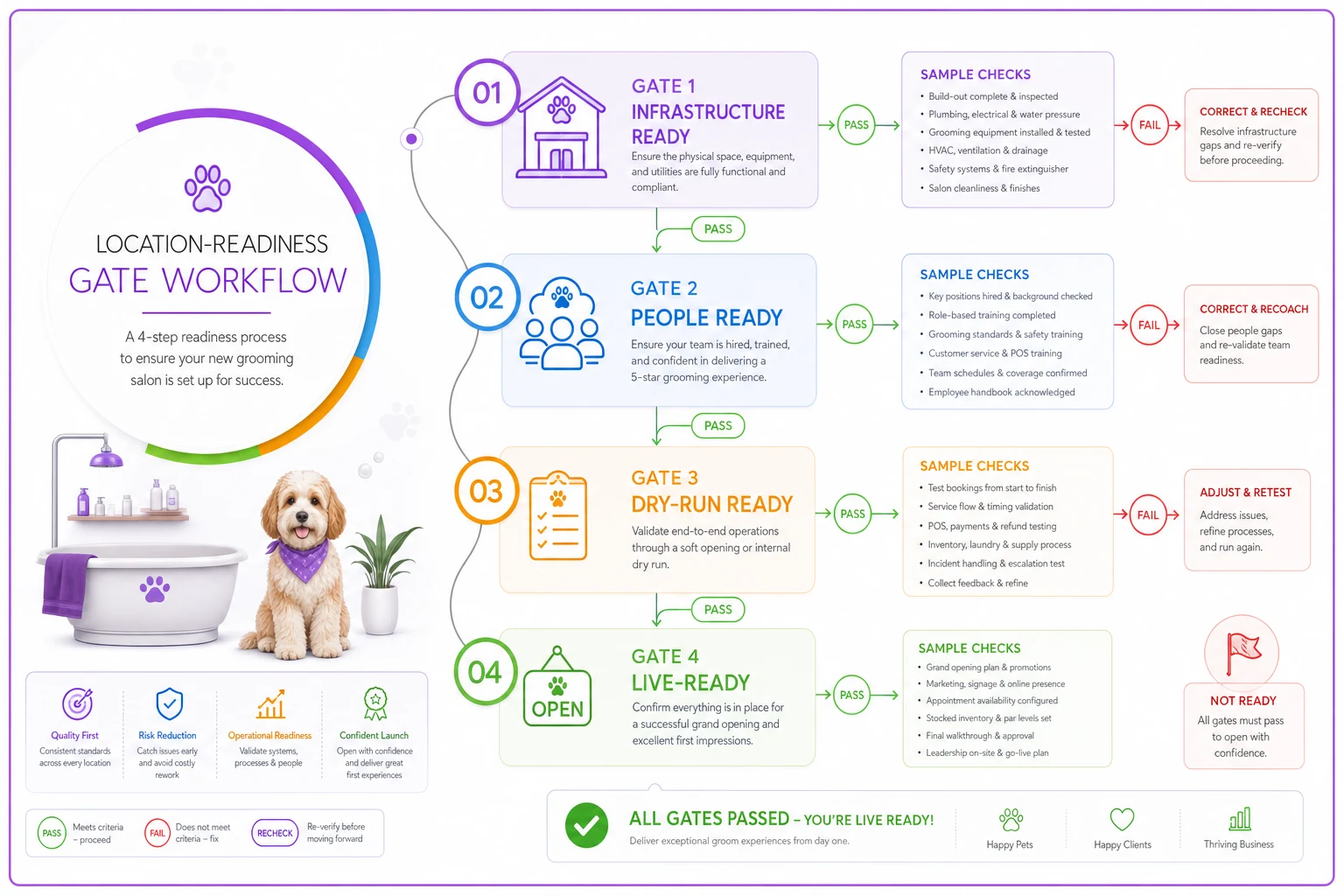
The gate you're most tempted to skip is Gate 3 — the dry run — because it costs a week of discounted revenue. That week is the cheapest insurance you'll buy. Problems caught during a soft week cost coaching time. The same problems caught during a fully-booked grand opening cost refunds, one-star reviews, and a reputation that follows the location for a year. Running the gates in order, without skipping, is what separates a clean launch from a damage-control situation.
A quick real scenario
A two-shop grooming operator was planning location three. Their first expansion had gone rough — the second shop took close to five months to feel "on brand," bled comps because nobody knew the fee rules, and its Google rating sat almost a full star below the flagship for the better part of a year.
For the third location, they built the four pieces above before signing anyone. A one-page role matrix. Seven SOP bundles instead of a binder. A six-item groom QA and a monthly cross-location audit. And four readiness gates with a real one-week soft launch on staff pets and discounted regulars.
The soft week caught three things that would've been painful live: intake was double-entering breed data, the closing till count was off every night because of an unclear tip-out step, and one bath tech hadn't actually passed the skills check but had been rostered anyway. All fixable in days. The shop opened its full book with QA scores within a few points of the flagship. Comps in the first two months ran a fraction of what location two had burned, because the fee ceilings were clear from day one. It wasn't magic — it was just that the divergence never got a chance to start.
When this framework makes sense — and when it doesn't
This level of structure is overkill for a single owner-operated salon with no expansion plans. If it's you and one part-timer forever, you don't need role matrices and readiness gates. You are the system.
It starts paying off the moment you can't personally be in every location every day. That's usually location two, sometimes a large single location running multiple shifts where you're no longer on the floor for every one. The signal that you needed this yesterday: you find yourself answering the same operational question by text from a manager who should already know the answer.
It's also a bad idea to build all four pieces at once from a cold start while simultaneously opening a new shop. Sequence it. Build the role matrix and bundles in your existing location first, prove they hold, then use the proven versions to open the new one. Trying to design and test the framework at the same time as a launch is how you get a beautiful binder and a chaotic opening. And who genuinely shouldn't bother: anyone using "franchisable framework" as a way to avoid the harder work of actually training people. Documents don't replace coaching. Gates don't replace judgment. The framework makes good management scalable — it does not manufacture management where none exists.
The through-line
Replicating a grooming business isn't about copying what you do. It's about making the decisions, the procedures, the checks, and the readiness bar explicit enough that someone who isn't you can run them at the same standard. Role matrices decide who acts. Bundles tell them how. QA templates prove it worked. Gates make sure a location earns its opening instead of just arriving at it.
Get those four connected and your locations stop being separate businesses that share a name — they start being the same business, running in four places. The paint on the walls was never the point.
The paint on the walls was never the point.
Ready to streamline your grooming business?
Join 500+ pet groomers using Furlyly to save time, reduce scheduling conflicts, and deliver exceptional client experiences.