

Most SOP rollouts in small salons don't fail because the SOP was bad. They fail in the first 10 days — usually on a Tuesday morning when the senior groomer quietly decides the new intake form is slowing her down and just... reverts. Without telling anyone. Within three weeks, half the team is "doing it the new way" and half isn't, and nobody can tell you which is which.
That's what nobody warns you about with small teams. You don't have a training department or a middle manager to enforce anything. It's you, maybe a lead groomer, and a handful of people who've been doing it their own way for years. So a salon change management playbook can't look like the corporate version — it has to be something you can actually run between grooms without needing a project manager.
This post is specifically about rollout mechanics: how to pilot a new SOP or tool with one or two people, refine it based on what breaks, and then scale it across the team without the whole thing quietly dying. If you want the broader framework for which SOPs to build as you grow, that's covered in scaling a grooming salon without chaos. This is the adoption layer that sits on top of it.
Why rollouts stall in micro-teams specifically
Big companies have the opposite problem from you. They over-communicate, over-document, and still get resistance because people feel like a number. You have a team small enough that everyone talks to everyone — which should make change easier, but actually creates a different failure mode.
In a 4-person salon, one skeptical senior groomer is the culture. If she rolls her eyes at the new checkout process, that opinion reaches everyone by lunch. There's no critical mass of early adopters to drown out the holdout. So the single biggest determinant of whether your rollout works isn't the tool or the SOP — it's whether your most influential groomer is bought in before day one.
The second reason micro-team rollouts stall: there's no slack in the schedule to absorb a learning curve. When a 40-person operation rolls out new software, they can pull people off the floor for training. You can't. Your groomer is learning the new booking flow while a soaked golden retriever is shaking water everywhere and the next client is already early. The new process competes directly with live work, and live work always wins. If your rollout plan ignores this, it's already dead.
A typical pattern looks like this: owner announces the change in a group text Sunday night, does a quick demo Monday morning, and expects it to stick. By Thursday, two people have questions they didn't want to ask in front of everyone, one person forgot entirely, and the owner is frustrated that "nobody follows instructions." The instructions were fine. The rollout had no pilot, no feedback loop, and no one accountable for the first week.
The pilot → refine → scale sequence
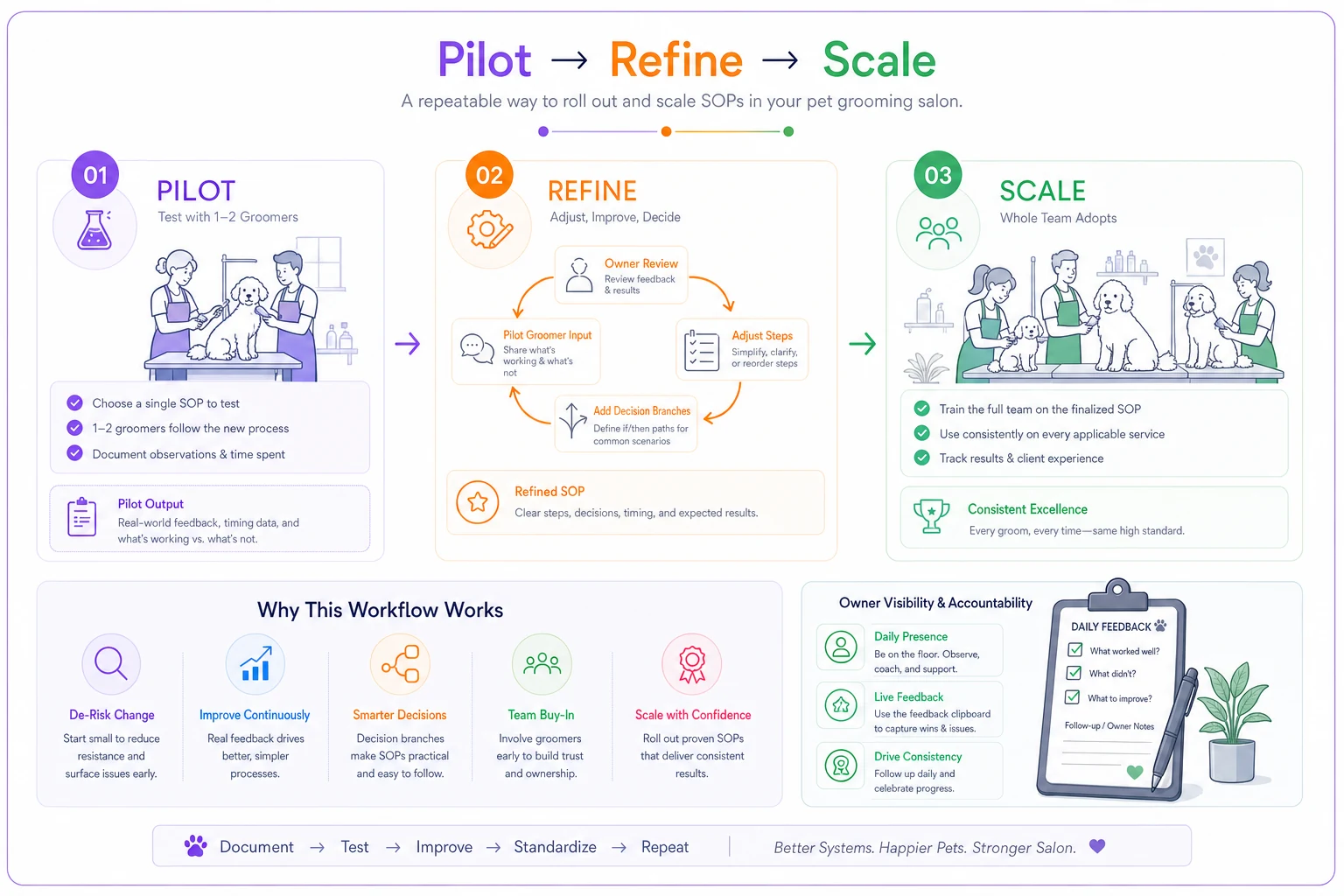
The whole point of piloting in a small salon is that you can't afford a full-team failure. If you roll a broken process out to everyone at once, you've now trained four people in something you'll have to un-train. Piloting with one or two people means your mistakes are cheap and fixable.
Never miss a grooming appointment again.
Furlyly helps you book, confirm, and manage every pet grooming appointment effortlessly.
- Unified appointment scheduling
- Automated client reminders
- Staff availability & shift management
No credit card required
| Phase | Who's involved | Duration | Goal | Exit criteria |
|---|---|---|---|---|
| Pilot | 1–2 groomers (your most capable, not most senior) | 1–2 weeks | Find what breaks in real conditions | Process survives a full busy day without workarounds |
| Refine | Same pilot group + you | 3–5 days | Fix friction, rewrite unclear steps | Pilot users stop asking clarifying questions |
| Scale | Whole team | 2–3 weeks | Full adoption with monitoring | 80%+ compliance for two consecutive weeks |
A simple visual of the pilot→refine→scale workflow.
The mistake owners make here is picking the most senior person for the pilot instead of the most capable and open one. Your longest-tenured groomer often has the most ingrained habits and the most to lose from change. Pilot with someone who's fast, adaptable, and respected — their endorsement during the scale phase does more than any instruction you give.
Pilot phase: what you're actually testing
You're not testing whether the SOP works in theory. You're testing whether it survives a real Saturday. A new client-intake checklist might look perfect on paper and completely fall apart when you've got back-to-back nervous dogs and a walk-in asking about nail trims.
Give your pilot groomer explicit permission to break the process and tell you where. That framing matters. If they think you want it to succeed, they'll quietly force it through and hide the friction — and you'll scale a broken thing. Tell them their job is to find every place it slows them down.
-
Steps that get skipped under pressure. If a step gets dropped every busy afternoon, it's either unnecessary or badly placed in the workflow.
-
Steps that require a judgment call the SOP doesn't cover. "What do I do when the client doesn't have their vaccination record?" If the SOP has a hole, it shows up here.
-
Points where the new way is objectively slower with no payoff the groomer can feel. This is the resistance you'll get during scale, previewed cheaply now.
Refine phase: close the gaps before anyone else sees them
Refinement is short and specific. Sit with the pilot groomer, go through what broke, and fix it. Rewrite the vague step. Delete the one that keeps getting skipped for good reason. Add the decision branch for the missing-vaccination-record scenario.
The signal that you're done refining is quiet: the pilot users stop asking you questions. When someone can run the new process through a full day without pinging you, it's ready to scale. If they're still asking on day five, it's not the groomer — the SOP still has holes.
The communication that makes or breaks adoption
How you announce a change in a micro-team matters more than in any big company, because there's nowhere to hide and no committee to blame. If the team senses you're not fully committed, they'll wait you out. Groomers have seen owners announce "new systems" that quietly disappeared within a month. Your first job is signaling this one isn't that.
Three communication templates do most of the work. Keep them short — this is a small team, not a town hall.
The pre-pilot heads-up (to the pilot groomer, in person): > "I want to try a new way of handling [X]. I'm starting with just you because you're fast and you'll tell me straight where it's annoying. For the next two weeks, your job is to use it and tell me every place it slows you down. Nothing's final until you and I are happy with it."
The team announcement (after refinement, before scaling): > "Starting Monday we're moving to [new process]. [Pilot groomer] has been running it for two weeks and we fixed the rough spots together. Here's the one-page version. For the first two weeks I'll be checking in daily — not to catch anyone out, but to fix anything that's still clunky. Ask me anything, no dumb questions."
The reinforcement note (end of week one of scaling): > "Quick update — most of the new [process] is sticking well. Two things I'm seeing: [specific thing going well] and [specific friction point]. I've adjusted [X]. Keep flagging what's annoying. We're keeping this."
Notice what these do. They name a credible peer who already vetted it. They promise daily presence instead of a one-time demo. And the reinforcement note proves you're still paying attention a week later — which is exactly when most rollouts get abandoned and the team is watching to see if you'll do the same.
Feedback loops that actually surface problems
The reason problems stay hidden in small salons is social, not logistical. Nobody wants to be the person who "can't figure out the new thing" in front of the owner and three coworkers. So the feedback has to have a low-shame, low-friction channel.
What works in practice is a single visible spot — a clipboard by the back sink, or a pinned note in whatever group chat you use — where anyone can drop a one-liner like "this step is slowing me down" without needing a meeting. No form, no justification required. The owner reviews it daily during the scale phase and responds fast. Speed matters here: the first time someone flags a problem and you fix it within a day, the whole team learns the channel is real. The first time a flag sits ignored for a week, the channel dies.
Pro-tip: Review the feedback clipboard first thing each morning so you can respond within 24 hours and keep the channel alive.
This is also where having your operational data in one place pays off, because some adoption problems don't show up in conversation — they show up in the numbers. If average checkout time crept up after you rolled out a new payment flow, nobody's going to volunteer that out loud. Keeping the team aligned on shared metric definitions and a morning snapshot lets you spot adoption friction the feedback clipboard misses — like a step that's technically being followed but quietly costing four minutes per groom.
The 6-week manager checklist
This is the part owners skip and then wonder why things fade. Adoption isn't an event, it's six weeks of light, consistent attention. Here's the week-by-week checklist you can run yourself or hand to a lead groomer.
-
Week 1 — Pilot launch. Brief the pilot groomer. Confirm they understand their job is to break it and report back. Check in end-of-day, at least twice this week. Write down every friction point verbatim.
-
Week 2 — Pilot stress test. Make sure the pilot ran through at least one fully booked day. Sit down at the end of the week, go through the friction list, and decide what to fix, cut, or keep. Don't scale yet.
-
Week 3 — Refine and announce. Finalize the one-page version. Send the team announcement. Do a short live demo — but demo the refined version and have the pilot groomer co-present, not just you. Set up the feedback clipboard or channel.
-
Week 4 — Scale with daily presence. Be on the floor or checking the feedback channel every day. Respond to every flag within 24 hours. Send the end-of-week reinforcement note. Expect compliance to be messy — 50–70% is normal this week.
-
Week 5 — Tighten. Compliance should climb toward 80%. Have individual quiet conversations with anyone still reverting — one-on-one, never in front of the team. Usually it's one unresolved friction point, not defiance. Fix it.
-
Week 6 — Lock it in. Stop announcing. The new way should now be "just how we do it." Do a final check: is anyone still asking questions? Is the metric you cared about moving the right direction? If yes on both, the rollout is done. Fold the SOP into your standard onboarding so new hires learn it as the default.
The uncomfortable part of that checklist: weeks 4 and 5 are where owners drop off. The novelty is gone, you're busy, and it's tempting to assume it's handled. It isn't handled until week 6. A process that's 80% adopted at week 4 and then left alone will drift back toward 40% by week 8. The daily presence feels like overkill right up until it's the only reason the change survives.
When a formal rollout is overkill
Not every change needs this. If you're swapping one shampoo brand for another, just tell people. The pilot-refine-scale sequence is for changes that alter how people work — new intake forms, a new checkout flow, new booking software, a new photo-documentation step, anything that touches muscle memory during live work.
The rough line:
-
Skip the formal rollout when the change is a one-step swap, doesn't change timing or sequence, and has no judgment calls. Just announce and move on.
-
Run the full rollout when the change adds steps to a busy workflow, requires new software the team has to learn, or depends on consistency across people to work at all.
Automated systems that run quietly in the background — like appointment confirmations and reminder cadences — are actually easier to roll out than people expect, precisely because they don't compete with live work. If you're introducing something like event-driven appointment automation, the adoption burden falls mostly on you configuring it correctly once, not on the team changing daily habits. Those still deserve a short pilot so you catch bad timing or duplicate messages before clients see them — but they skip the heavy 6-week human-adoption curve.
A real rollout, start to finish
A two-location grooming salon — one with 4 groomers, the other with 3 — wanted to standardize intake so both locations flagged anxious dogs and matting the same way. The owner had tried announcing a new intake form twice before. Both times it stuck for about three weeks, then each location drifted back to its own habits.
The third attempt used the pilot sequence. She started with one groomer at the smaller location — fast, well-liked, not the most senior. Two weeks of piloting surfaced two real problems: the form asked for behavior history at a point that interrupted the greeting flow, and there was no field for "owner declined matting fee," which was causing checkout disputes. Both got fixed before anyone else touched the form.
When she scaled, she had the pilot groomer walk the others through it — not herself. She ran the full 6-week checklist, did daily feedback checks in weeks 4 and 5, and had two quiet one-on-ones with holdouts who turned out to share the same single complaint, which she then fixed.
The outcome wasn't dramatic in a put-it-on-a-billboard way. But it was the first version that actually held. By week 6, intake was consistent across both locations, checkout disputes over surprise matting fees basically stopped, and three months later nobody had drifted back. The first two attempts had better-designed forms, arguably. They just had no real rollout underneath them.
The thing most owners get wrong
The instinct in a small salon is to treat a new SOP as information to be transmitted: tell people the new way, trust that competent adults will follow it. But adoption in a micro-team isn't an information problem. Your groomers almost always understood the new process. What killed the previous attempts was the absence of a pilot to catch friction early, a credible peer to endorse it, a feedback channel that felt safe to use, and six weeks of someone actually caring whether it stuck.
Build those four things and almost any reasonable change will hold. Skip them, and even a well-written SOP becomes another thing the team quietly stopped doing somewhere around week three — and you'll be left thinking the problem was your people, when it was the rollout all along.
Build those four things and almost any reasonable change will hold. Skip them, and even a well-written SOP becomes another thing the team quietly stopped doing somewhere around week three — and you'll be left thinking the problem was your people, when it was the rollout all along.
Ready to streamline your grooming business?
Join 500+ pet groomers using Furlyly to save time, reduce scheduling conflicts, and deliver exceptional client experiences.