



Opening a second grooming salon location feels like the natural next step when your first shop runs at capacity. You've got steady bookings, loyal clients, and decent profit margins. The math looks simple enough—double the locations, double the revenue.
Then reality hits somewhere around week three of your expansion.
Your lead groomer at the new location quits because they weren't clear on their responsibilities versus the shop manager. The original location starts hemorrhaging clients because your best staff got pulled to train the new team. Inventory costs spike because nobody coordinated ordering between shops. And suddenly you're working 14-hour days bouncing between locations, wondering how one business became harder to run than two. The difference between grooming salons that successfully scale to multiple locations and those that implode during expansion isn't luck or market timing. It's having an operational framework that defines exactly how work gets done, who does it, and what happens when things change.
Why Multi-Location Grooming Operations Break Down
Most grooming salon owners run their first location through a mix of personal oversight and informal systems. You know which groomer handles difficult dogs best. You recognize when the schedule needs adjusting before appointments back up. You catch inventory shortages because you're physically there watching supplies dwindle.
This hands-on management style works brilliantly for a single location. It falls apart completely when you're trying to oversee multiple shops.
The breakdown happens in predictable stages. First, you try to replicate yourself by promoting your best groomer to manage the new location. But they don't know how to handle scheduling conflicts or deal with upset clients—they know how to groom dogs. Next, you start driving between locations, trying to be everywhere at once. Quality drops at both shops because neither gets your full attention. Finally, you hire managers for each location but give them vague instructions like "run it like I would," which means nothing without documented processes.
What makes this particularly painful for grooming businesses is the skill gap problem. Finding qualified groomers is already challenging. Finding groomers who can also manage inventory, handle customer service issues, train new staff, and maintain quality standards? Nearly impossible. Yet that's exactly what most owners expect when they promote someone to run a new location.
Building Your Role Architecture
The foundation of scaling any grooming operation starts with clearly defining who does what. Not job titles on paper, but actual task ownership that everyone understands.
Never miss a grooming appointment again.
Furlyly helps you book, confirm, and manage every pet grooming appointment effortlessly.
- Unified appointment scheduling
- Automated client reminders
- Staff availability & shift management
No credit card required
Start by mapping your current operation into five core functions:
| Function | Description |
|---|---|
| Service Delivery | includes all hands-on grooming work, from basic baths to breed-specific cuts. This is where most of your staff hours go, typically consuming 65-75% of total labor costs. |
| Client Management | covers appointment scheduling, intake procedures, pickup coordination, and handling special requests or complaints. In a single location, this often gets split between whoever's available. In multiple locations, it needs dedicated ownership. |
| Operations Management | encompasses inventory ordering, equipment maintenance, cleaning protocols, and safety compliance. These tasks often get neglected during busy periods, leading to equipment failures and supply shortages at the worst possible times. |
| Financial Operations | includes daily cash reconciliation, deposit preparation, expense tracking, and payment processing. Small mistakes here compound quickly across multiple locations. |
| Training and Quality Control | covers onboarding new staff, maintaining grooming standards, and ensuring consistent service across all groomers. This function typically doesn't exist formally in single-location shops but becomes critical for multi-location success. |
For each function, document exactly which roles handle which tasks. A lead groomer might own service delivery quality but not scheduling. A shop manager might handle client complaints but not inventory ordering. The specificity matters because overlap creates confusion and gaps create failures.
In practical terms, this usually means creating three to four distinct roles for each location:
The Shop Manager owns client management and daily financial operations. They're the face of the location for customers and the person who ensures the shop runs smoothly day-to-day. They don't need to be expert groomers, but they need strong customer service and basic business skills.
The Lead Groomer maintains service quality and handles complex grooming cases. They train junior groomers on technique and ensure consistency in cuts and handling procedures. They report to the shop manager for scheduling but own all decisions about grooming standards.
The Grooming Staff focus entirely on service delivery, following the standards set by the lead groomer. They shouldn't be pulled into customer service or operational tasks during their shift.
The Operations Coordinator (who might cover multiple locations) handles inventory, maintenance, and compliance across shops. This role prevents the duplicate ordering and equipment neglect that plague multi-location operations.
Calculating Real Capacity
Every grooming salon owner knows their theoretical capacity—number of grooming stations times hours open times services per hour. A shop with 4 stations open 9 hours should handle 36 dogs at one per hour, right?
Actual capacity runs closer to 60-70% of theoretical maximum. Here's why.
Grooming times vary wildly based on breed, coat condition, and temperament. A matted Goldendoodle takes three times longer than a short-haired Chihuahua. Aggressive or anxious dogs slow everything down. No-shows and late arrivals create gaps you can't fill.
The real capacity calculation looks like this:
Start with your stations and hours, then subtract 20% for setup, cleanup, and breaks. That 36-dog theoretical capacity drops to about 29.
Factor in service mix reality. If 30% of your appointments are full grooms (90 minutes), 40% are bath and tidy (45 minutes), and 30% are basic baths (30 minutes), your actual capacity drops to around 22-24 dogs per day.
Add staff skill variations. A seasoned groomer might handle 6-7 dogs daily while a junior groomer manages 3-4. Your capacity depends on who's working, not just how many stations you have.
This matters enormously for expansion planning. Most owners look at their booked-solid first location and assume they need double the capacity for expected demand. They open a second location with 6 stations and staff for maximum throughput.
Then reality hits. The new location operates at 40% capacity for months while building clientele. Labor costs eat up any revenue. The original location, meanwhile, lost capacity when experienced staff moved to train the new team.
Better approach: Open new locations at 70% of your current shop's capacity. Start with 3 stations instead of 4. Staff for 60% utilization initially. Build up as demand actually materializes rather than hoping it appears.
Creating SOPs That Actually Get Followed
Standard operating procedures for grooming salons usually fail because they try to document everything in excruciating detail. Nobody reads 50-page manuals. Nobody remembers 47-step processes.
Effective SOPs for multi-location grooming operations focus on critical handoffs and decision points. Document the moments where things typically go wrong, not every obvious task.
Your intake procedure SOP shouldn't explain how to greet a customer. It should clarify exactly what information gets collected, where it's recorded, and what triggers special handling protocols. Does a dog with a bite history go to a specific groomer? Who makes that decision? What if that groomer is unavailable?
Your closing procedure SOP should specify who counts cash, who prepares deposits, and what happens when the register doesn't balance. Does the shop manager stay late to reconcile? Is there a threshold for reporting discrepancies? Who gets notified?
Break your SOPs into three categories:
-
Daily Operations covers opening procedures, appointment flow, service handoffs, payment processing, and closing tasks. These should be short checklists, not novels. A groomer should be able to review the entire daily operation flow in under 5 minutes.
-
Exception Handling documents what to do when things go wrong. Aggressive dog protocols. No-show policies. Equipment failure procedures. Staff no-call no-show responses. These SOPs matter most because exceptions create chaos without clear protocols.
-
Quality Standards defines what "good" looks like for each service type. Include photo references for standard cuts. Specify acceptable time ranges for different services. Document when to refuse service or refer to another groomer.
Digital checklists accessible on phones beat printed manuals.
The format matters as much as the content. Wall-mounted laminated cards beat binders every time. Digital checklists accessible on phones beat printed manuals. Visual guides beat text descriptions.
Test your SOPs by having someone unfamiliar with your operation try to follow them. If they can't execute the procedure without asking questions, the SOP needs revision.
The Multi-Location Rollout Framework
Launching a second grooming location requires more than finding space and hiring staff. The sequence and timing of your rollout determines whether you scale successfully or create operational chaos.
Start your expansion 90 days before opening the new location. This seems excessive until you map out everything that needs to happen.
Days 90-60: Foundation Building Lock in your location and begin buildout, but more importantly, start developing your expansion team. Identify which current staff members will help launch the new location. Begin recruiting for both locations—you'll need to backfill positions at your original shop when staff moves to train the new team. Document your current operations if you haven't already. You can't replicate what you haven't defined. Create those SOPs, but also map out your scheduling patterns, pricing structures, and service standards.
Days 60-30: Systems and Training Set up operational systems for both locations. This means separate appointment books that you can view together, inventory tracking that shows both shops, and financial reporting that breaks out each location while showing consolidated numbers. Begin training your new location's leadership team at your existing shop. They need to see how things actually run, not just read about procedures. Have them shadow different roles, handle real situations under supervision, and gradually take ownership of specific functions. Start marketing the new location but don't take bookings yet. Build awareness and collect a waitlist. This prevents the awkward situation of opening with empty appointment books or being overwhelmed on day one.
Days 30-0: Operational Testing Run soft-opening days where you bring in staff pets, friends' dogs, or offer free services to test operations. These trial runs reveal problems with everything from water pressure to scheduling software before paying customers arrive. Staff both locations at 120% for the first two weeks after opening. Yes, this destroys profitability temporarily. But having extra hands prevents service failures that damage reputation permanently. You can always reduce staffing. You can't easily recover from a disastrous launch. Create communication protocols between locations. Daily manager check-ins. Weekly inventory reconciliation. Shared staffing calendars. These touchpoints prevent locations from drifting into different operational styles.
Post-Launch Reality Week one of your new location will be slow. Week two might be dead. Week three, you'll wonder if you made a terrible mistake. This is normal. Most grooming locations take 3-4 months to reach 50% capacity and 6-8 months to become profitable. Plan your cash flow accordingly. Budget for covering losses while maintaining service quality and full staffing. The original location will also struggle initially. Regulars notice their favorite groomer is gone. Wait times might increase. Some operational things you used to handle personally now fall through cracks. Expect a 10-15% revenue dip at your first location during the first quarter of expansion.
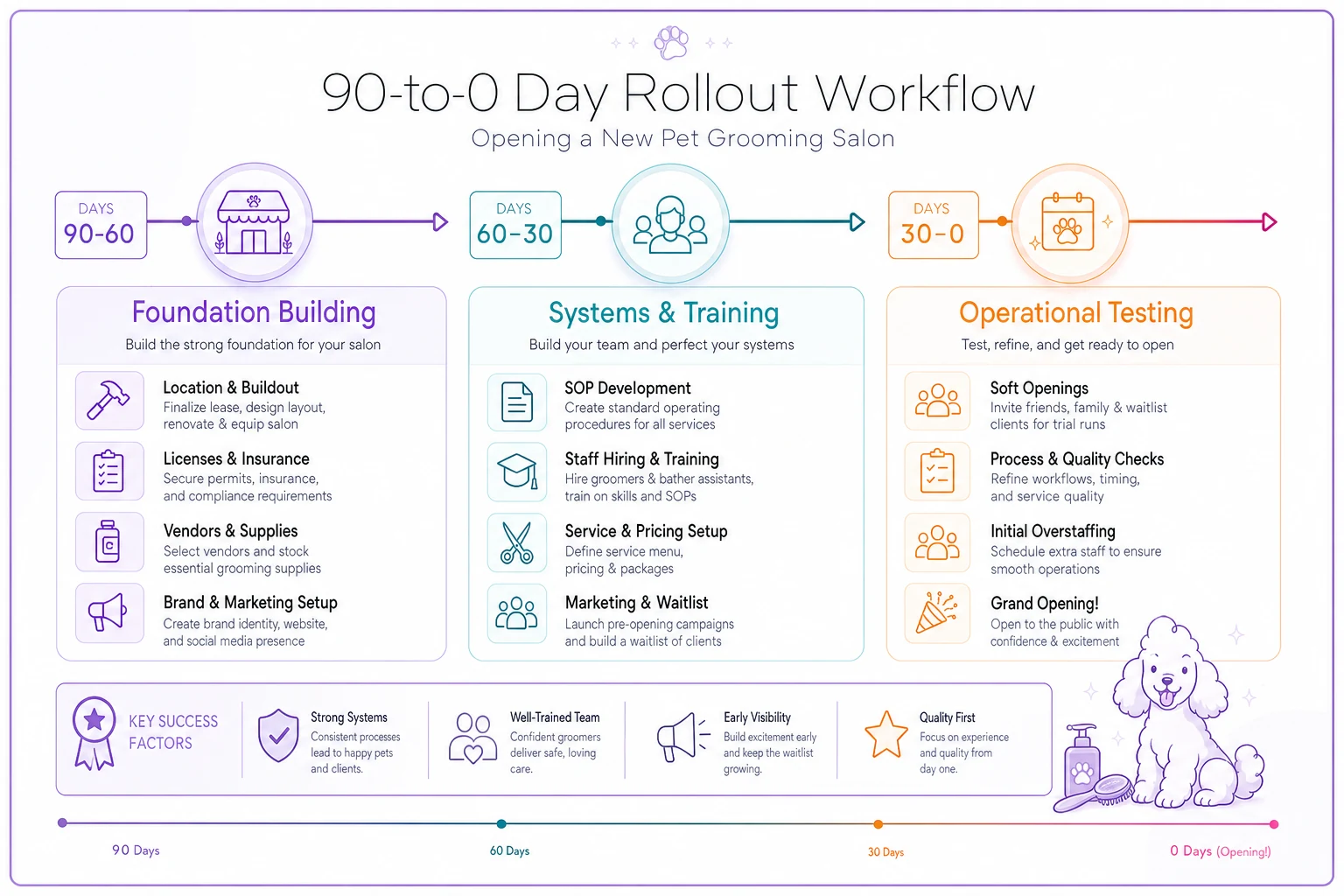
A simple visual of the rollout timeline helps keep everyone aligned.
Tracking What Actually Matters
Multi-location grooming businesses generate tons of data. Most of it is noise. Focus on the metrics that predict problems before they become crises.
Utilization Rate by Location shows whether each shop operates efficiently. Calculate it as (actual services rendered) divided by (theoretical capacity based on staffing). If one location consistently runs at 40% utilization while another hits 85%, you've got a staffing imbalance or demand problem to solve.
Service Time Variance tracks how long different groomers take for standard services. Large variances indicate training needs or process problems. If basic baths take 25 minutes at one location and 45 minutes at another, you're not running the same business.
Client Retention by Location reveals quality or service issues. Track what percentage of clients return within 60 days. Significant differences between locations suggest inconsistent experiences.
Revenue per Square Foot helps evaluate location performance relative to overhead. A smaller location generating more revenue per square foot might be more profitable than a larger shop with higher gross sales.
Staff Productivity Patterns show whether your role definitions and capacity calculations reflect reality. Track services per groomer per day, but segment by experience level and service type.
Create a simple weekly dashboard that shows these metrics for each location side by side. Trends matter more than absolute numbers. A gradual decline in utilization suggests scheduling problems. Sudden drops indicate staff or quality issues.
Common Expansion Pitfalls
Some mistakes happen so frequently in grooming salon expansion that they're almost inevitable without deliberate prevention.
The Superman Syndrome occurs when owners try to maintain the same level of involvement in daily operations across multiple locations. You physically cannot be in two places at once. More importantly, your constant presence prevents managers from developing decision-making skills.
The Clone Wars happen when you try to make every location identical. Different neighborhoods have different client needs. A shop in a young professional area might need early morning and evening hours. A suburban location might peak midday with stay-at-home pet parents. Force-fitting the same operational model everywhere limits each location's potential.
The Talent Drain devastates your original location when you move all your best people to launch the new shop. Customers built relationships with those groomers. Service quality drops. Regulars leave. Meanwhile, the new location has a dream team but no clients yet.
The Inventory Multiplication effect makes owners order supplies like they're still running one location, just twice. But minimum orders, bulk discounts, and storage limitations don't scale linearly. You end up with too much inventory at one location, shortages at another, and cash tied up in supplies gathering dust.
Building Coordinated Operations
The difference between two separate grooming shops and a multi-location grooming business lies in coordination. Separate shops compete with each other. A real multi-location operation leverages shared resources and accumulated knowledge.
Start with shared scheduling visibility. Managers should see availability across all locations. When one shop is booked solid, they can offer appointments at another location. This requires explaining the benefit to customers—emphasizing that they can get in sooner, not that you're pushing them elsewhere.
Implement rotating staff programs where groomers work at different locations periodically. This cross-trains everyone on slightly different procedures, prevents locations from developing incompatible cultures, and provides natural backup when someone calls out sick.
Create centralized purchasing for supplies but distributed delivery. One person researches products, negotiates prices, and places orders. But supplies ship directly to each location based on their usage patterns. This captures bulk pricing without creating inventory management nightmares.
Most importantly, establish regular communication rhythms between locations. Daily five-minute manager check-ins prevent small problems from festering. Weekly operations calls let locations share what's working and what's not. Monthly full-team meetings (virtual or rotating locations) maintain unified culture.
This coordination framework naturally points toward where operational software becomes invaluable. When you're tracking appointments across multiple locations, monitoring inventory at different shops, and coordinating staff schedules between sites, manual systems break down quickly. AI-powered platforms can automatically flag scheduling conflicts, predict inventory needs based on booking patterns, and even identify when service times at one location drift from standards.
The operational load of running multiple locations doesn't double—it typically triples or quadruples due to coordination overhead. Smart automation handles the routine coordination tasks so managers can focus on service quality and customer relationships rather than juggling spreadsheets and phone calls between shops.
Making Multi-Location Work
Scaling a grooming salon to multiple locations isn't about duplicating what works at one shop. It's about building operational systems that function without your constant presence while maintaining the service quality that made your first location successful.
The framework outlined here—from role definitions through capacity planning to coordinated operations—provides the structure needed for sustainable growth. But structure alone doesn't guarantee success.
The shops that thrive with multiple locations share three characteristics beyond good systems. First, they maintain obsessive focus on service consistency. Customers should get the same quality whether they visit your original location or your newest shop. Second, they invest in developing managers who can make decisions, not just follow rules. Third, they view locations as part of an integrated business rather than independent shops that happen to share ownership.
Getting these pieces right takes months of planning and years of refinement. But the payoff—a scalable business that generates reliable profit without consuming every waking hour—makes the effort worthwhile.
Your first location proved you can run a successful grooming shop. Your second location proves you can build a real business. The framework and systems that get you there determine whether you'll stop at two locations or build something larger.
The path from one shop to multiple locations isn't smooth. Expect setbacks, surprises, and moments where you question the entire expansion. But with clear roles, realistic capacity planning, documented procedures, and coordinated operations, you can scale your grooming salon beyond what one pair of hands can manage.
That's when you transition from being a groomer who owns a business to a business owner who happens to run grooming salons. The difference changes everything about how you work, how much you earn, and what becomes possible for your future.
Ready to streamline your grooming business?
Join 500+ pet groomers using Furlyly to save time, reduce scheduling conflicts, and deliver exceptional client experiences.