



Stop letting vague definitions quietly undermine every operational decision you make
Ask three people in your salon what "rebook rate" means and you'll probably get three different answers. One counts anyone who books before leaving. One counts anyone who returns within 90 days. One quietly assumes it means regulars who come every six weeks. None of them are technically wrong — they're just measuring different things and calling it the same word.
That's the failure mode that quietly eats most salons alive once they grow past a single location or a handful of groomers. Not bad data. Not missing data. Inconsistent understanding of the data. Everyone's looking at the dashboard, but there's no shared truth underneath it — so the numbers stop driving decisions and start driving arguments.
Getting your team aligned on grooming salon metrics governance isn't about buying a fancier reporting tool. It's about agreeing on definitions, setting thresholds that trigger action, building a repeatable way to check the pulse every morning, and making it clear who owns what when a number goes sideways.
Numbers without governance are just opinions with decimal points
In the early days, the owner is the reporting system. Revenue feels soft this week because they felt it. They know which groomer is slammed because they walked past the tub. Everything lives in their head, and it works because there's only one head.
Then you add a second location, or a lead groomer, or a manager who runs the floor on your days off. Suddenly multiple people are making calls, and they're all working from slightly different mental models. The manager thinks a "no-show" only counts if the client never reschedules. You think it counts the moment they miss the slot. So when you ask how bad no-shows were last month, the number feels wrong, you stop trusting it, and the whole reporting habit quietly dies.
Reporting doesn't fail because the math is hard — it fails because nobody wrote down what the words mean. A metric without a definition is a rumor. A metric without a threshold is trivia. A metric without an owner is just something everybody complains about and nobody fixes.
Start with a metric dictionary (yes, an actual document)
Before you touch thresholds or dashboards, you need a plain-language dictionary that defines every metric you care about. This sounds bureaucratic. It takes maybe two hours and prevents about a hundred future arguments.
Never miss a grooming appointment again.
Furlyly helps you book, confirm, and manage every pet grooming appointment effortlessly.
- Unified appointment scheduling
- Automated client reminders
- Staff availability & shift management
No credit card required
-
The exact definition — what counts, what doesn't, edge cases included
-
The time window — rolling 30 days? Calendar month? Week ending Sunday?
-
The data source — where the number actually comes from
-
The owner — the single person accountable for that number
Here's what a few core entries look like once you get specific. The "gotchas" column is where the real value hides.
| Metric | Definition | Common gotcha |
|---|---|---|
| Rebook rate | % of completed appointments where the client's next appointment is booked before they leave | People confuse this with return rate (returned within X days). They're not the same. |
| No-show rate | Appointments marked no-show ÷ total scheduled, per calendar month | Late cancels within the fee window often get miscounted here. Decide where they live. |
| Average ticket | Total service + retail revenue ÷ number of completed tickets | Tips inflate this if you don't strip them out. Decide once. |
| Chair utilization | Booked groom hours ÷ available groom hours per groomer | "Available" is the trap. Does lunch count? Cleanup? Buffer time? |
| Retail attach rate | Tickets with at least one retail item ÷ total tickets | Some count units sold instead of tickets. Wildly different numbers. |
The goal isn't to craft the perfect definition. It's to pick one and make everyone use it. A slightly imperfect definition that the whole team shares beats a technically perfect one that only you understand.
The metric that causes the most confusion is almost always average ticket, because tips and retail muddy it in different directions.
One thing worth flagging: the metric that causes the most confusion is almost always average ticket, because tips and retail muddy it in different directions. If you do nothing else, nail that one down first.
Thresholds: turning numbers into "do something now"
A number on a screen is passive. A threshold is what makes it act like an alarm. Without thresholds, your team stares at the dashboard, nods, and changes nothing — functionally the same as not having a dashboard at all.
For each metric that matters, define three zones:
-
Green — normal, no action needed
-
Yellow — watch it, note it, mention it in the morning check
-
Red — someone owns a specific corrective action, today
The mistake most people make is setting thresholds based on gut feel instead of actual history. If your no-show rate has bounced between 6% and 9% for the past year, then 10% isn't a catastrophe — it's a rough week. But if you set your red line at 5%, you'll be crying wolf every Monday and the team learns to ignore the color.
Pull six months of actuals and set thresholds relative to your own baseline, not some generic industry benchmark. A reasonable starting point:
-
Rebook rate
green above 55%, yellow 45–55%, red below 45%
-
No-show rate
green under 7%, yellow 7–10%, red above 10%
-
Chair utilization
green 75–90%, yellow 65–75% or above 90%, red below 65%
Notice utilization has a red zone on both ends. Under 65% means you're overstaffed or under-booked. Above 90% means groomers are rushing, there's no buffer, and quality complaints are probably coming. Governance means catching problems in both directions, not just the obvious one.
If you want a tighter starting set of numbers to build thresholds around, the minimal KPI dashboard for grooming salons covers the six that actually trigger corrective action.
The morning snapshot: a five-minute ritual that keeps everyone honest
Dashboards fail because checking them is optional. The fix is a fixed, boring, repeatable morning routine — five minutes, happens every day, whether or not anyone feels like it.
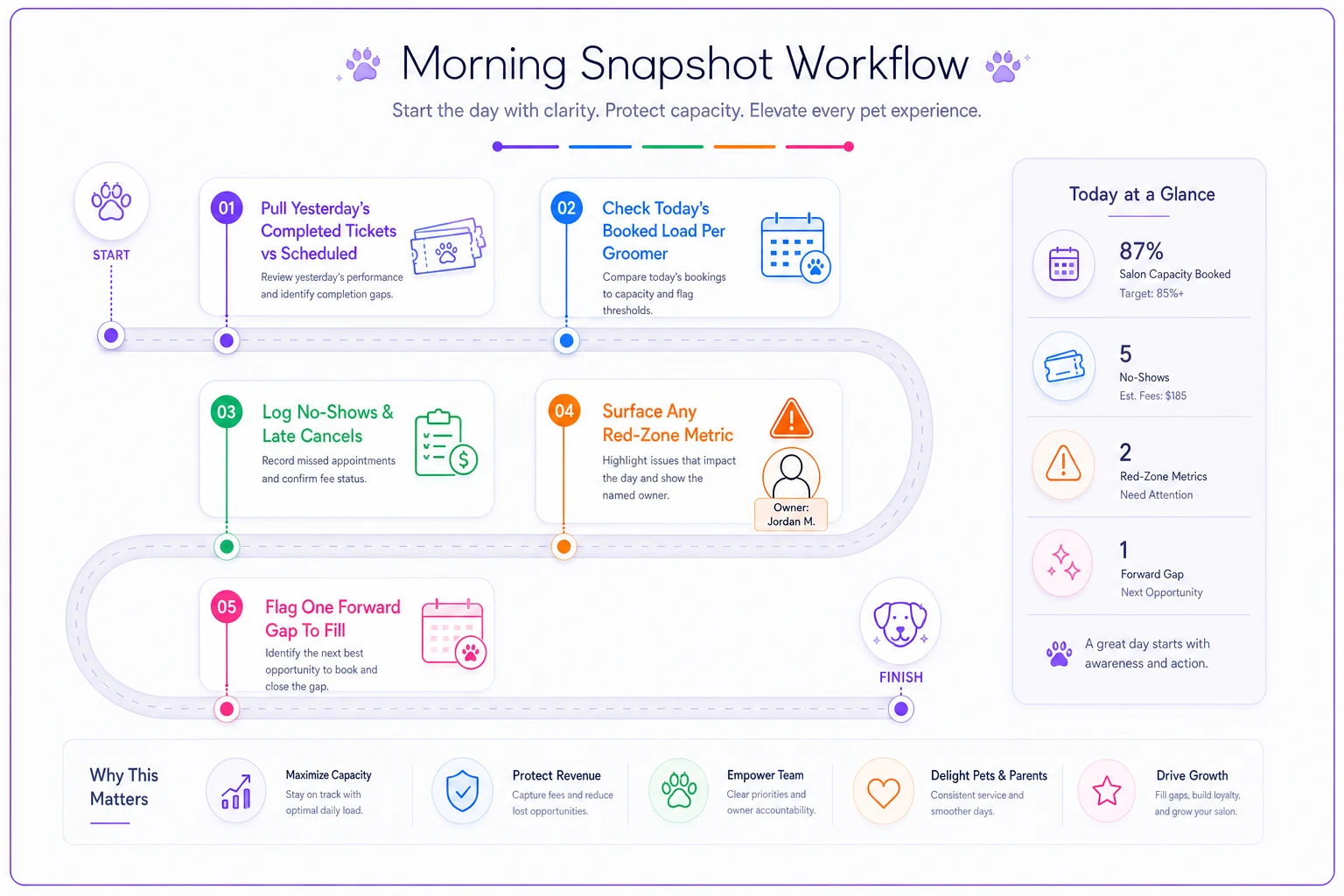
The morning snapshot is a short, standardized read of yesterday plus a couple of forward-looking numbers. Same format every day. Same person reads it out or posts it. Same order. The consistency is the whole point — when the format never changes, the brain starts catching anomalies immediately.
-
Step 1
Pull yesterday's completed tickets vs. scheduled
-
Step 2
Check today's booked load per groomer (flag over 90% or under 65%)
-
Step 3
Log no-shows and late cancels with fee status
-
Step 4
Surface any red-zone metric, name the owner out loud
-
Step 5
Flag one forward gap — a tomorrow slot to fill or a slammed day needing prep
Visual workflow of the morning snapshot:
That's it. Five items. Resist the urge to add more. The moment the snapshot balloons to fifteen numbers, people start skimming — and skimming kills the habit.
The real value shows up on the days something's off. When completed tickets come in noticeably below scheduled and it's not a holiday, that gap demands a reason — a groomer called out, a walk-in policy that got loose, a booking glitch. The snapshot doesn't solve it. It just makes sure the question gets asked that morning instead of three weeks later when you're staring at the P&L wondering where the revenue went.
The ownership matrix: killing "someone should look into that"
Shared ownership is no ownership. Every metric needs exactly one name attached to it — not a committee, not "the front desk." One person. That person isn't necessarily the one who fixes the underlying problem; they're the one accountable for noticing the red zone and kicking off the response.
| Metric | Owner | Escalates to | Response when red |
|---|---|---|---|
| No-show rate | Front desk lead | Manager | Review confirmation cadence, tighten fee enforcement |
| Rebook rate | Each groomer (their own) | Lead groomer | Coaching on rebook-at-checkout script |
| Retail attach rate | Retail lead | Manager | Restock check, refresh recommendation prompts |
| Chair utilization | Manager | Owner | Adjust schedule template, review buffer rules |
| Average ticket | Manager | Owner | Service mix review, pricing check |
One design choice worth highlighting: make rebook rate each groomer's own number, not a salon-wide average. When it's shared, nobody feels responsible. When Maria can see her rebook rate sitting at 41% while the salon average is 58%, that's a conversation that goes somewhere. Individual ownership tends to be more motivating than punitive — most groomers genuinely didn't know they were low until someone showed them their own line.
A monthly experiment pipeline
Once definitions, thresholds, snapshots, and owners are in place, you have a stable measurement system. That stability is what makes experiments readable. If your definitions keep shifting, you can never tell whether a change actually worked or whether you just measured differently this month.
The last piece is a lightweight experiment queue — one or two things per month, each tied to a specific metric with a specific threshold you're trying to cross.
Structure each experiment with:
-
The metric it targets
-
The current baseline and the target
-
The one change you're making
-
The owner running it
-
The read date — when you'll judge it and stop
A realistic example: rebook rate sitting around 48%, yellow zone. The experiment is a scripted rebook prompt at checkout — the groomer walks the client to the desk and the front desk offers the same-day next booking. Owner is the front desk lead. Read date is 30 days out. If rebook rate climbs into green and holds, the script becomes standard. If it doesn't move, you kill it and try something else — instead of quietly letting the initiative linger forever.
The discipline that separates real experimenting from busywork is having a read date and actually honoring it. Salons are good at starting initiatives. Almost nobody schedules the moment they'll decide whether it worked.
If you want a fuller framework for running these as focused sprints across pricing, labor, and retail, the repeatable profitability system built on 30-day margin sprints pairs naturally with this measurement layer.
A real scenario: two locations, one confused number
Take a two-location grooming business — around 620 combined appointments a month, five groomers across both sites. The owner kept getting frustrated because location A "always looked less profitable" and she couldn't figure out why.
Turned out the two locations were calculating average ticket differently. Location A stripped tips out. Location B left them in. So A looked like it had a lower ticket and B looked like the star — except B's groomers averaged higher tips because of a wealthier neighborhood, which had nothing to do with actual service revenue. The owner had spent months planning to copy "B's approach" based on a number that was measuring two different things.
After writing a one-page metric dictionary and standardizing both locations on the same definitions, the picture flipped entirely. A was running a higher service ticket; B just tipped better. Nothing about the business changed that month — but the decisions changed completely. Instead of overhauling A's service mix, they focused on lifting A's retail attach rate, which was genuinely low. Over the next quarter, combined average ticket moved up a few dollars per head. On 620 appointments a month, that's a meaningful swing that had been hiding behind a definitions mismatch.
When this system makes sense — and when it's overkill
Worth building: the moment more than one person makes operational decisions. Two locations, a floor manager, even a single lead groomer who runs things on your days off. The second there's more than one brain interpreting numbers, you need shared definitions or those brains will drift.
Overkill: a solo mobile groomer or a one-person shop. If you're the only decision-maker, you already have a single source of truth — it's you. Keep a simple metric dictionary for your own consistency and skip the rest until you hire.
Who should hold off: anyone who hasn't cleaned up where the data comes from. If appointments get logged inconsistently or retail sales don't always hit the system, you're just governing garbage with nicer formatting. Fix the capture problem before building measurement rituals on top of it.
Where software helps (and where it doesn't)
None of this requires fancy tools. Plenty of salons run a solid metric dictionary in a shared doc and a morning snapshot in a group text. The system is what matters, not the platform.
That said, the manual version has real friction. Someone has to pull yesterday's numbers every morning. Someone has to remember to check thresholds. Someone has to notice a red zone and flag it. And that "someone" is usually the busiest person in the building, which is exactly why the routine slips.
Operational platforms with built-in reporting and threshold alerts earn their keep not by making decisions for you, but by handling the mechanical part. When the system automatically flags a metric crossing into red and routes it to the right owner, the morning snapshot practically writes itself — and the habit survives your busy weeks instead of collapsing under them. The judgment stays human. The remembering-to-look part gets automated. That's the right division of labor.
The takeaway
Getting a salon team aligned on numbers isn't a reporting problem — it's an agreement problem. Definitions that everyone shares. Thresholds that trigger real action. A morning routine that never changes format. Owners who can't hide behind "we." And a small experiment pipeline that actually reads its own results and stops what isn't working.
Build those layers in order, keep each one deliberately small, and the arguments about what a number even means mostly disappear. Your team stops debating the dashboard and starts acting on it — which is the only reason to have a dashboard at all.
Ready to streamline your grooming business?
Join 500+ pet groomers using Furlyly to save time, reduce scheduling conflicts, and deliver exceptional client experiences.