

Most grooming salons don't have a messaging strategy. They have a pile of messages. A confirmation here, a reminder there, a "we miss you" campaign someone turned on eighteen months ago and forgot about, a review request that fires the same day as the rebooking nudge. Each one looked reasonable when it was set up. Stacked together, they produce a client who mutes your number.
The problem isn't any single message. It's the absence of an architecture — a set of rules that decides what fires, when, and what gets held back. A grooming appointment automation architecture is really a coordination system: it sits between the events happening in your business (a booking, a cancellation, a no‑show, a completed groom) and the messages your clients receive, and it keeps those two things aligned instead of letting them collide.
This is the part almost nobody designs on purpose. So let's actually design it.
Why message stacking happens — and why it gets worse as you grow
At a single‑location salon with one calendar and two groomers, message overlap is usually survivable. You send a booking confirmation, a day‑before reminder, and maybe a post‑groom thank you. Three touches per visit. If two of them land on the same busy day, nobody notices much.
The trouble starts when you add layers over time, and each layer gets built independently:
-
Someone sets up confirmation texts.
-
Later, a reminder sequence gets added because no‑shows crept up.
-
Then a rebooking campaign to hit retention goals.
-
Then review requests because online reviews stalled.
-
Then a seasonal promo blast for the pre‑holiday rush.
-
Then a lapsed‑client win‑back flow.
None of those systems know the others exist. That's the core defect. Each was designed to solve one metric in isolation, and the messages were scheduled by calendar time ("send 7 days after last visit") instead of being aware of everything else the client already received that week.
At scale, this compounds fast. A client who books two dogs, reschedules once, and completes the groom can easily trigger nine or ten separate messages inside a ten‑day window across those disconnected flows. Multiply that across a few hundred active clients and you've built a system that trains people to stop reading.
What tends to happen is that the fatigue point isn't one dramatic moment — it's gradual. Confirmation response rates quietly slide from the high 80s down into the 60s. Rebooking‑nudge clicks die off. Nobody connects the dots because each flow is measured separately and each one looks "fine enough."
Event‑driven design: think in triggers, not schedules
The fix starts with changing how you think about messages. Stop thinking "send this on day X." Start thinking "this message is a response to an event."
Never miss a grooming appointment again.
Furlyly helps you book, confirm, and manage every pet grooming appointment effortlessly.
- Unified appointment scheduling
- Automated client reminders
- Staff availability & shift management
No credit card required
An event is something concrete that happened in your booking system:
-
Appointment booked
-
Appointment confirmed
-
Appointment rescheduled
-
Appointment cancelled
-
No‑show recorded
-
Groom completed
-
Payment captured
-
A defined period of inactivity reached
Every outbound message should be tied to one of these, plus a set of conditions. The difference sounds subtle but it changes everything practically. A schedule‑based reminder fires blindly. An event‑based reminder can check state: Has this appointment already been confirmed? Then skip the reminder entirely.
That single conditional — suppress the reminder if the client already confirmed — often cuts total message volume more than any promo you'll ever turn off. Because in a schedule‑based world, the confirmed client and the silent client get treated identically.
A well‑formed automation rule looks like this:
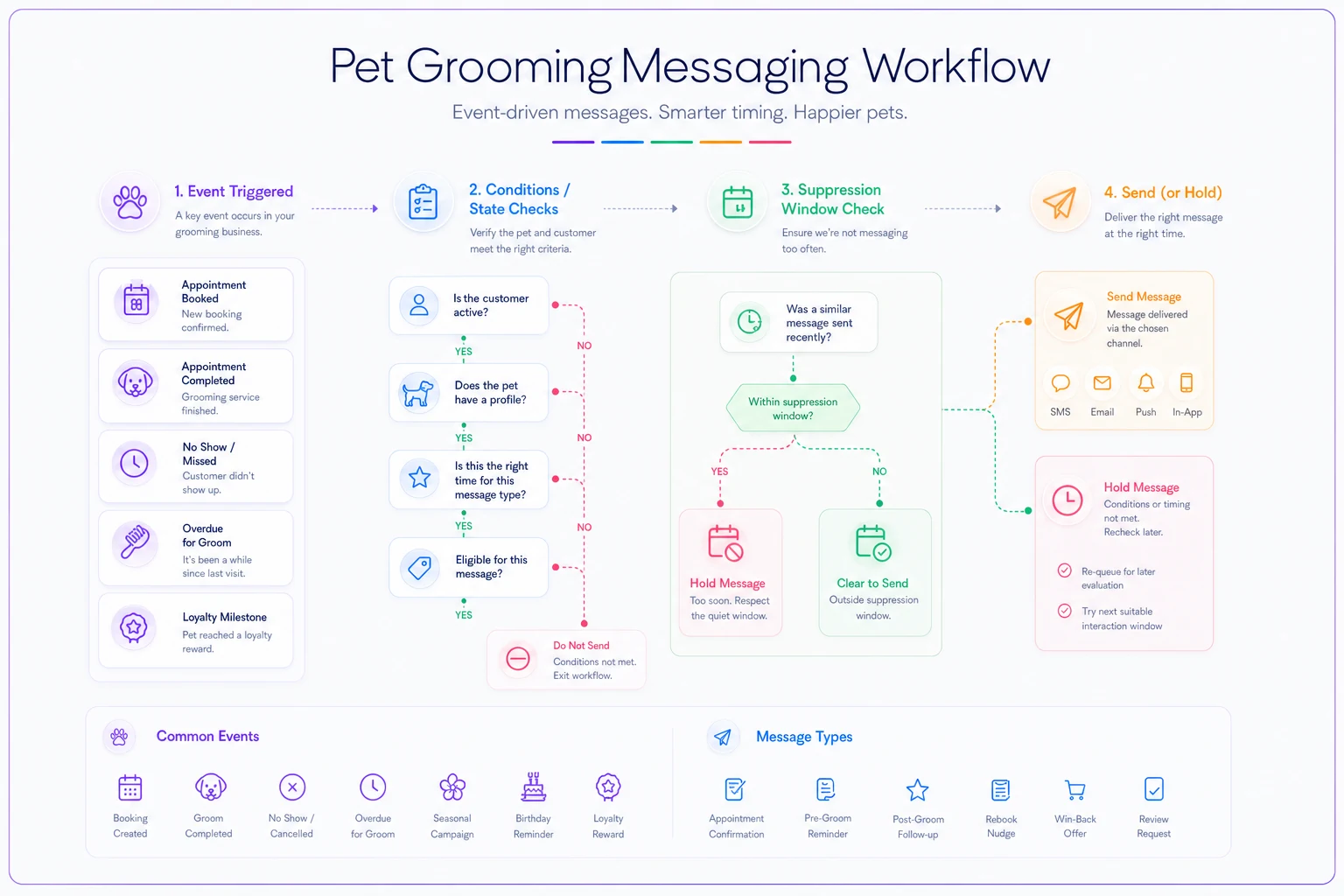
Here's a compact visual of that flow to make the decision gates obvious.
That third box is the one salons skip. It's where fatigue actually gets prevented.
Suppression windows: the rules that decide what NOT to send
Suppression is the discipline of holding a message back even though its trigger fired. This is the most underused concept in salon communication, and it's what separates an architecture from a pile of flows.
A few types worth building in:
1. Global frequency cap. A hard ceiling on how many messages any client can receive in a rolling window. A reasonable starting point for grooming: no more than 3–4 messages in any 7‑day period, excluding true transactional messages the client would want (like a same‑day "your dog is ready for pickup"). Everything else queues behind that cap.
2. Category cooldowns. Marketing and lifecycle messages get their own longer cooldown. If a client just got a rebooking nudge, they shouldn't also get a promo blast three days later. A 10–14 day cooldown on non‑transactional messages prevents most of the drip‑fatigue people complain about.
Centralize suppression rules in one place so every flow references the same caps and cooldowns.
3. Recent‑interaction suppression. If someone booked, rescheduled, or completed a groom in the last few days, the win‑back and "we miss you" flows should suppress automatically. Sending a "we haven't seen you in a while" text to someone who was in your chair on Tuesday is the fastest way to look broken. It happens constantly and it's entirely preventable with a single state check.
4. Quiet hours and channel windows. No SMS before roughly 9am or after 8pm. Sounds obvious. Plenty of automations violate it because they were scheduled off appointment times and nobody adjusted for early or late slots.
5. Do‑not‑contact and consent state. Suppression also enforces the boundaries from your consent records — this is where your messaging architecture connects to the permission rules you should already be running.
The key point: suppression rules should be global and centralized, not built into each individual flow. If every flow has its own idea of "too soon," they'll never agree. There needs to be one gatekeeper that every outbound message passes through before it goes anywhere.
Cadence design by lifecycle stage
Once suppression is handling the over‑messaging problem, cadence handles the "right message at the right moment" problem. Cadence should follow the client's lifecycle stage, not a fixed schedule.
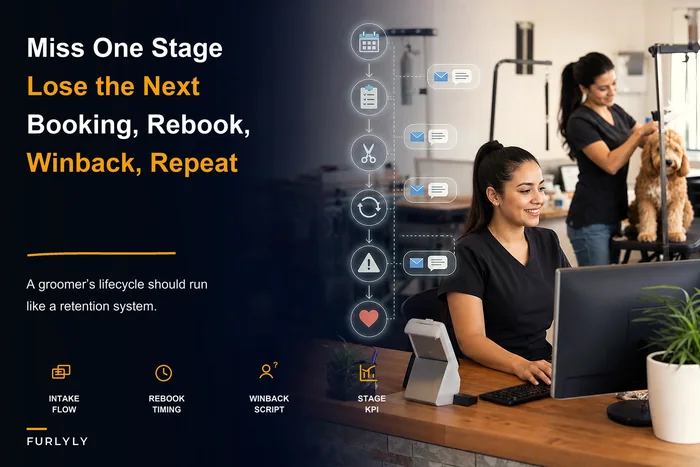
This ties directly into your broader retention system — if you haven't mapped your stages yet, the framework in the customer lifecycle system for groomers is worth reading first, because cadence rules are meaningless without stages to attach them to.
| Lifecycle stage | Primary goal | Message types | Sensible frequency |
|---|---|---|---|
| New client (visits 1–2) | Build the habit, set expectations | Confirmation, prep instructions, post‑groom check‑in | Higher touch, but tightly transactional |
| Active/regular | Maintain rebooking rhythm | Confirmation, reminder, gentle rebook prompt | Low — mostly transactional |
| At‑risk (approaching lapse) | Re‑engage before they're gone | Personalized rebook offer, "your dog is due" | 1 touch, then wait |
| Lapsed | Win back | Single strong win‑back, then stop | 1–2 touches max, then long cooldown |
| High‑value/frequent | Reward, protect loyalty | Priority booking, occasional perks | Deliberately restrained |
Notice the pattern: active regulars get fewer marketing messages, not more. That's counterintuitive to a lot of owners, who figure their best clients can handle more contact. In practice, over‑messaging loyal clients is exactly how you erode the relationships you most want to protect. Your regulars already book. Talking at them constantly just adds risk.
The other thing worth calling out: at‑risk and lapsed stages should have hard stops. A win‑back flow that keeps pinging someone who clearly isn't coming back isn't retention — it's noise that lowers your deliverability and gets your number reported.
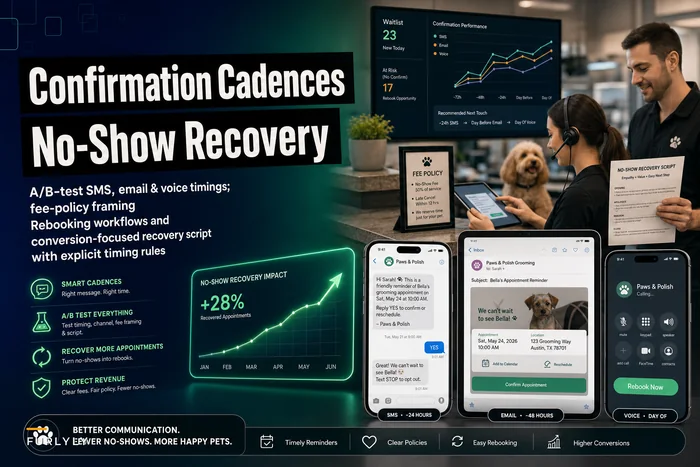
Your confirmation and reminder timing deserves its own careful tuning, and the specifics of confirmation cadences and no‑show recovery timing go much deeper on the transactional side than this piece will, since this one is about the architecture holding all of it together.
A worked example: two dogs, one reschedule, ten days
A realistic sequence run through both a broken system and a well‑architected one makes the difference concrete.
The situation: A client books two dogs for Saturday. On Thursday they reschedule to the following Wednesday. The groom completes Wednesday. This client last visited about six weeks ago and is flagged "active."
In a stacked, schedule‑based system:
-
Booking confirmation (Sat appt)
-
Two‑day reminder (fires Thursday morning, before the reschedule)
-
Cancellation notice
-
New booking confirmation (Wed appt)
-
Reminder for Wednesday
-
Post‑groom thank you
-
Review request (auto, day after)
-
Rebooking nudge (fires because "6 weeks since prior visit" hit its calendar trigger)
-
Seasonal promo (unrelated campaign, fired mid‑window)
Nine messages in about ten days, several contradictory or pointless. The two‑day reminder for an appointment that already got moved is especially bad — it makes your salon look like the left hand doesn't know what the right is doing.
In an event‑driven system with suppression:
-
Booking confirmation
-
Reschedule handled — reminder for the old slot suppressed, new confirmation sent for Wednesday
-
Wednesday reminder
-
Post‑groom message that carries the rebook prompt (combined, not two separate sends)
-
Review request — held because the global cap and category cooldown say the client already hit their non‑transactional limit this week; it queues and fires a few days later
-
Seasonal promo — suppressed entirely for this client this cycle
Four messages instead of nine. All relevant, none of them stepping on each other. The client's experience is that your salon feels organized — and organized salons get more replies.
The measurement framework: how you know it's working
Message volume is the wrong thing to optimize. You want effect per message while keeping fatigue signals low. That means measuring both sides.
-
Confirmation response rate — the health‑check metric. If it's sliding, fatigue is building somewhere upstream.
-
Rebooking rate within X days of last groom — the real business outcome.
-
No‑show rate — your reminders are earning their keep or they aren't.
-
Opt‑out / unsubscribe rate per campaign — the clearest fatigue signal you have. A spike here means a flow is over‑firing.
-
Messages per client per rolling 30 days — your volume governor. Watch the trend, not just the absolute number.
-
Win‑back conversion — separate lapsed clients into a clean cohort; blended numbers hide whether that flow actually works.
The mistake to avoid: judging each flow only by its own conversion and never looking at the aggregate load on the client. A rebooking nudge with a decent click rate can still be a net negative if it's the message that pushed a client over their fatigue threshold and cost you the next confirmation. You can only catch that by watching opt‑outs and confirmation response as system‑level metrics, not per‑flow ones.
A simple monthly review process:
-
Pull opt‑out rate by message category. Anything trending up gets flagged.
-
Check average messages per active client. If it's climbing, find which flow added volume.
-
Compare confirmation response this month vs. the prior three. Slippage means check for fatigue.
-
Review any flow that hits a hard cap frequently — that's a sign the trigger is too loose.
-
Kill or merge the lowest‑value flow each quarter. Something always earns removal.
Doing this consistently takes maybe an hour a month. Not doing it means you're flying blind while your opt‑out rate quietly climbs.
When a full automation architecture makes sense — and when it doesn't
Not every salon needs all of this on day one.
When it makes sense:
-
You're running more than a couple of automated flows and they were built at different times.
-
Response rates are drifting down or opt‑outs are creeping up.
-
You have multiple groomers or locations sharing a client base, so overlap is likely.
-
You're actively working retention and lifecycle goals, not just reminders.
When it's overkill:
-
A small operation sending only confirmations and reminders. Adding suppression logic to three clean transactional messages is solving a problem you don't have yet.
-
A brand‑new salon still building its client base — get the basics right first, layer in architecture as volume grows.
Anyone tempted to add "just one more campaign" without a central gatekeeper already in place should pause. That's the exact habit that produces the stacked mess in the first place. Once you have four or more flows running, a single suppression layer stops being optional.
Where the software actually earns its place
You can sketch this whole architecture on paper — and you should, because the rules matter more than the tool. But enforcing suppression windows and global frequency caps by hand is impossible past a handful of clients. It requires knowing, in real time, every message each client received across every flow before deciding whether to send the next one.
That's the practical case for running your booking and messaging on a connected operational platform rather than a bundle of disconnected apps. When the calendar, the client history, and the messaging engine share one source of truth, suppression checks and event triggers can actually reference each other — the reminder knows the appointment was confirmed, the win‑back knows the client visited last Tuesday, the global cap knows how many messages went out this week. Stitched‑together tools can't do that reliably, which is why message stacking keeps happening no matter how carefully each individual flow was configured.
The point isn't the software. The point is that coordination is the whole game, and coordination requires a shared state to work against.
Bringing it together
A grooming appointment automation architecture isn't a bigger pile of messages — it's fewer, better‑timed ones, governed by rules that respect what the client already received. Build it in this order: define your events, put a single suppression layer in front of every send, map cadence to lifecycle stage, and measure fatigue signals at the system level rather than trusting each flow's own numbers.
The salons that win here aren't the ones automating the most. They're the ones who decided, on purpose, what not to send.
A grooming appointment automation architecture isn't a bigger pile of messages — it's fewer, better‑timed ones, governed by rules that respect what the client already received. Build it in this order: define your events, put a single suppression layer in front of every send, map cadence to lifecycle stage, and measure fatigue signals at the system level rather than trusting each flow's own numbers.
Ready to streamline your grooming business?
Join 500+ pet groomers using Furlyly to save time, reduce scheduling conflicts, and deliver exceptional client experiences.