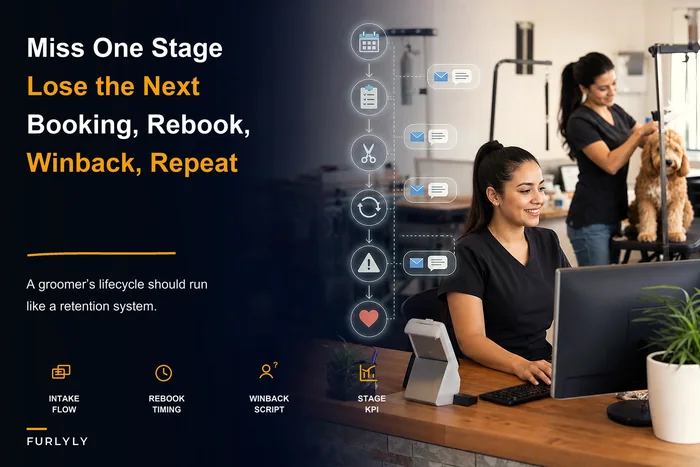


Most grooming salons treat monetization as one big lump. Raise prices, push retail, hope the average ticket goes up. The problem with that approach is it ignores where the client is in their relationship with you. A first-time client who just met your bather doesn't respond to the same offer as someone who's been coming every six weeks for two years. Push the wrong lever at the wrong stage and you either leave money sitting there or you annoy someone into churning.
The way I think about groomer customer lifecycle monetization is pretty straightforward: each stage of the client's journey has one or two levers that actually move revenue at that moment. Everything else is noise. And the only way to know if a lever is working is to run it as a real experiment with a target attached — not "let's try upselling more" but "we expect this rebook script to lift 6-week return rate by 8-12 points, and here's how we'll measure it."
This is a system article. If you want the foundational version of why lifecycle stages matter at all, the earlier breakdown on how ignoring lifecycle stages costs groomers repeat business is the prerequisite. This one goes further: it maps each stage to a specific revenue move, gives you uplift targets, and hands you a test register so your monetization stops being guesswork.
Why lump-sum monetization quietly bleeds money
Here's the pattern you see across salons that plateau. They're busy. The books look full. But revenue per client is flat and nobody can explain why the "loyal" clients aren't spending more than the new ones.
What's happening is that every monetization effort gets applied uniformly. The front desk offers nail trims to everyone. Retail gets pushed at checkout regardless of who's standing there. Membership gets mentioned once, badly, and then forgotten. When you spray the same offer across every client type, attach rates stay mediocre because half those offers land at the wrong moment.
The other failure is that nobody's measuring by cohort. A salon will say "our average ticket went up $4 this quarter" without knowing whether that came from new clients or repeat clients — which matters enormously. A new-client ticket bump might just be a price increase. A repeat-client bump usually means your lifecycle levers are actually working. Lump-sum thinking hides that distinction completely.
At small scale you can get away with it. When you're doing 40 grooms a week and you know every dog by name, your instincts fill the gaps. But once you cross two or three groomers and start relying on a front desk you're not standing behind all day — instinct doesn't scale, and the lump-sum approach starts leaking in ways nobody notices for months.
The five lifecycle stages and the lever that fits each
Here are the stages as they actually behave operationally, not the textbook version. Each one has a dominant lever — the thing that produces most of the revenue lift at that specific moment.
Never miss a grooming appointment again.
Furlyly helps you book, confirm, and manage every pet grooming appointment effortlessly.
- Unified appointment scheduling
- Automated client reminders
- Staff availability & shift management
No credit card required
| Lifecycle Stage | Client State | Primary Lever | Secondary Lever | LTV Uplift Target |
|---|---|---|---|---|
| First groom (0-1 visits) | Uncertain, evaluating you | Rebook-before-they-leave script | Photo-led follow-up | +15-25% return rate |
| Second groom / activation | Deciding if you're "their" salon | Cadence lock-in | Add-on trial | +10-15% on 90-day retention |
| Established repeat (3-8 visits) | Comfortable, habitual | Photo-led attach | Retail attach | +$6-12 per ticket |
| Loyal / high-frequency | Committed, price-tolerant | Membership / package | Multi-pet expansion | +20-30% annual value |
| At-risk / lapsing | Drifting, missed a cycle | Win-back with reason-to-return | Referral ask | Recover 25-40% of lapsers |
The point of this table isn't the exact numbers — it's the matching. The rebook script belongs at the first groom because that's when return rate is most fragile. Membership belongs at the loyal stage because that's the only point where the client already believes the value. Try to sell membership at the first groom and you'll convert almost nobody. Try to rely on a rebook prompt with a five-year loyal client and you've wasted a moment that could've sold a package.
Stage 1: The first groom — rebook before they walk out
The single most valuable monetization move in the entire lifecycle happens in roughly ninety seconds at checkout on the first visit. Not a price increase. A rebook.
A first-time client who books their next appointment before leaving returns at a dramatically higher rate than one who says "I'll call you." In practice, the gap is significant — the "I'll call you" group might come back 30-40% of the time, while the booked-before-leaving group lands closer to 70-80%. That single behavior shift is worth more than any retail push you'll ever run.
The lever is a rebook script, and the mistake almost everyone makes is phrasing it as a question. "Would you like to book your next appointment?" invites a no. The version that works assumes the return and offers a specific slot:
> "Bella's coat will be back to this length in about six weeks — that puts us around the week of the 14th. I've got a Thursday morning that works well for the drying time she needs. Want me to hold it?"
Train front-desk to use the assumed-slot phrasing exactly as written to avoid the default "I'll call" outcome.
That anchors on the dog's actual coat cycle, names a real date, gives an operational reason, and ends with a low-commitment "hold it" rather than "pay now." That's your primary lever for this stage.
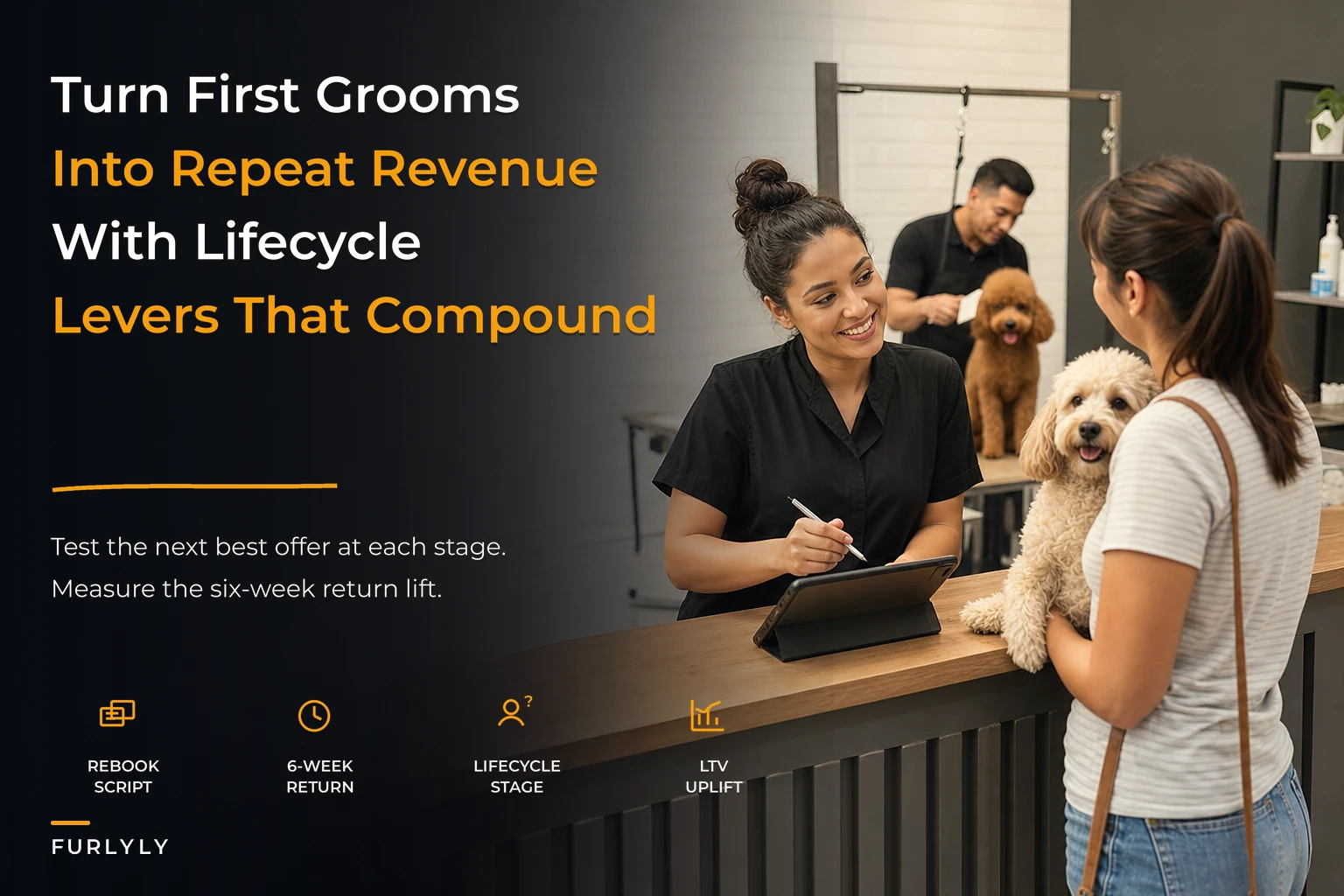
Test to run: Split first-time checkouts between the old open-ended ask and the assumed-slot script. Target a 15-25% lift in the 6-week return rate for the scripted group. Track it as a cohort, not blended.
Stage 2: Activation — locking the cadence
The second groom is where a client decides, mostly without realizing it, whether you're their salon or just a place they went twice. The lever here isn't upsell — it's cadence.
Getting a client onto a predictable rhythm — every six weeks, every eight weeks, whatever the coat actually needs — roughly doubles their lifetime value compared to someone who books randomly. Random bookers drift. Cadence clients build a habit, and habits are what you're really monetizing long-term.
The move at this stage is to make the second appointment establish the pattern openly. "Most dogs with Bella's coat do best on a six-week schedule — do you want me to just keep that Thursday slot going, and you can always shift it if needed?" You're not selling anything. You're removing the decision friction that causes drift.
The secondary lever here is a trial add-on — offering a single low-risk upgrade like a de-shed treatment or teeth brushing, framed as "want to try it this once and see the difference?" You're not trying to make money on the trial. You're seeding the attach that pays off in stage three.
Stage 3: Established repeat — photo-led attach
Now the client trusts you. This is where attach revenue lives, and the highest-converting attach mechanism isn't a script at all — it's a photo.
The pattern: a groomer sends the client a photo of the dog mid-groom or right after, with one honest observation — "Bella's ears were pretty waxy today, we did a gentle clean and she's much more comfortable, want us to make that a regular add-on?" Attach rates on that offer run far higher than a checkout upsell, because it's tied to a visible, specific reason the client can see themselves.
Photo-led attach works because it removes the "are you just trying to sell me something" suspicion. The dog's dirty ears are right there in the picture. This is meaningfully different from a scripted checkout upsell — the earlier work on experiment templates to lift your grooming average ticket covers checkout mechanics, but photo-led attach is a distinct lever that works mid-service, before the client is in checkout mode and mentally closing out the visit.
One discipline required: the observation has to be true. If you invent problems to sell add-ons, this backfires fast and destroys the trust that makes it work. Photo-led attach only compounds when clients believe every flag is real.
Test to run: For established clients, compare photo-led add-on offers against standard checkout offers on the same services. Target +$6-12 per ticket on the photo-led group, and watch complaint rates to make sure you're not overselling.
Stage 4: Loyal clients — membership and packages
Only now does membership make sense. A loyal, high-frequency client already comes every six weeks and already believes the value. A membership doesn't convince them to spend more — it locks in spending they were already going to do, smooths your cash flow, and raises the switching cost so they don't drift to a cheaper place down the road.
A structure that tends to work: a monthly membership priced around the cost of one groom, that includes the regular groom plus a standing discount on add-ons and retail. The client feels like an insider. You get predictable revenue and a client who's now financially anchored to you.
The mistake is offering membership too broadly. Offer it to a stage-one client and you'll convert almost nobody while cheapening the offer. Offer it to the client who's been in eight times this year and it feels like a natural upgrade. Gate it to the right stage.
Multi-pet expansion is the secondary lever here — loyal single-pet households are your best source of second-pet bookings, because the trust is already built. "We've got room to do both dogs same-visit, saves you a trip" lands far better with a loyal client than with someone new.
Stage 5: At-risk clients — win-back and the referral moment
A client who missed their expected cycle is drifting. Most salons do nothing until the client is fully gone. The lever is a win-back with a specific reason to return — not a generic "we miss you" blast.
The version that works references the actual gap and the dog: "It's been about ten weeks since we saw Bella — her coat's probably getting close to matting territory by now. Want me to get her in this week before it gets uncomfortable?" A concrete, dog-specific reason recovers lapsers far better than a discount, and it doesn't train clients to wait for coupons.
The under-used lever hiding at the loyal and post-recovery stages is referrals. The best moment to ask isn't random — it's right after a client expresses satisfaction, or right after a successful win-back when they're reminded why they liked you. A simple "if you know anyone with a dog who needs a good groomer, send them our way and we'll take care of them" placed at that peak converts far better than a permanent referral banner nobody reads.
The A/B test register: how you actually know any of this works
None of these levers matter if you can't tell whether they moved the needle. The register is what turns lifecycle monetization from theory into a system.
-
Pick one lever per stage per cycle. Don't test five things at once. Test the rebook script this month, the photo-led attach next month. Overlapping tests contaminate each other.
-
Define the cohort. Every test is measured on the specific stage it targets — first-time clients for the rebook script, established clients for photo attach. Blended numbers lie.
-
Set the target before you start. Write down the uplift you expect
"+15% return rate," "+$8 per ticket." A test without a pre-declared target turns into a debate about whether the results were "good enough."
-
Run it long enough to matter. For return-rate tests, you need at least one full cycle plus the return window — often 8-12 weeks before you have real numbers. Attach tests move faster.
-
Log it and decide. Keep or kill. If it hit target, standardize the script. If it missed, note why and move on.
A simple register entry looks like this:
-
Test name First-groom assumed-slot rebook
-
Stage First visit
-
Lever Rebook script
-
Target +15-25% 6-week return rate vs. control
-
Start / end cohort dates
-
Result kept / killed / iterate
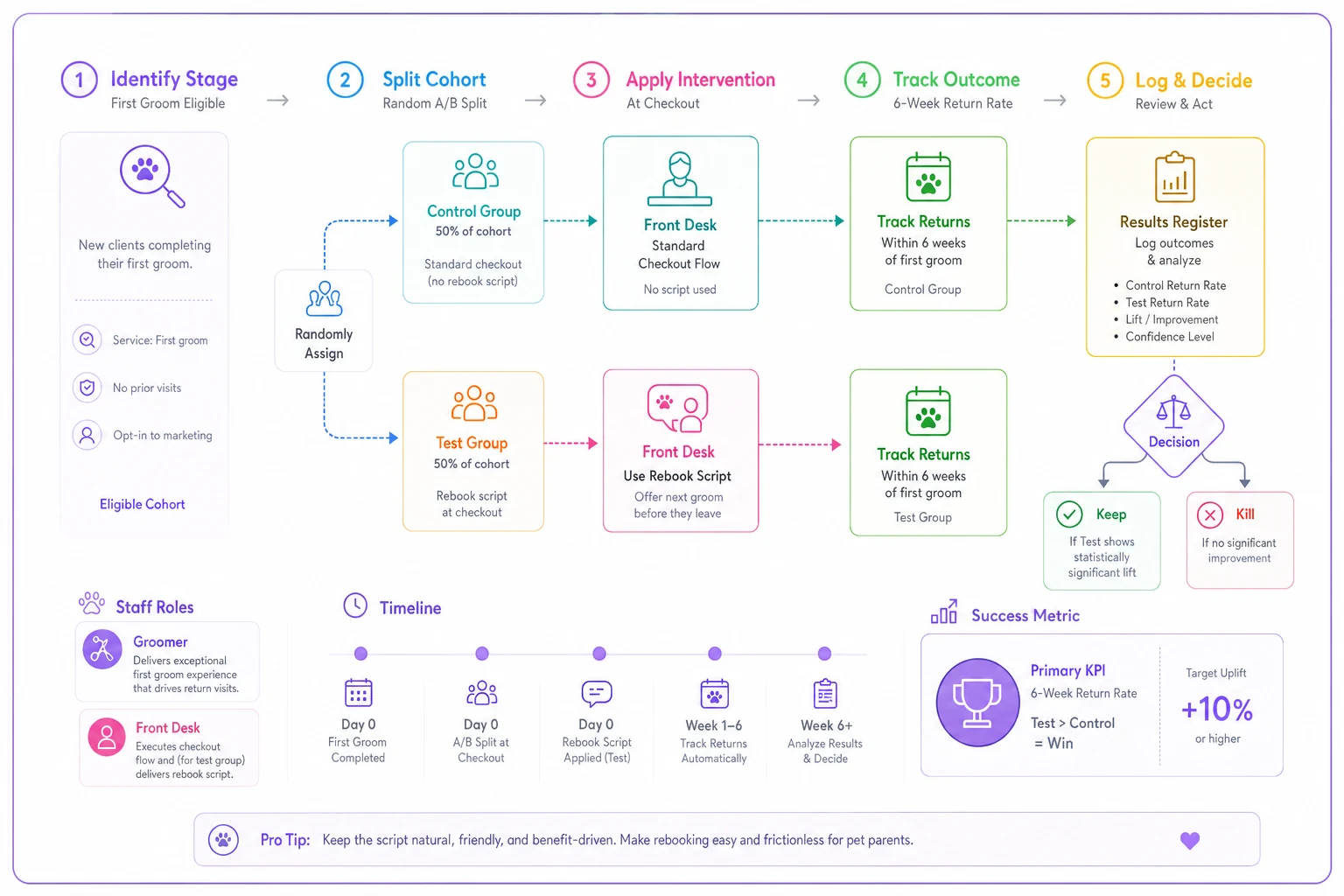
The reason to keep this written down is that a year from now, when someone new joins the front desk, the register is your monetization playbook. It's the difference between "we tried some stuff" and "here's exactly which scripts move which numbers at which stage, proven on our own clients."
Where the workflow breaks as you grow
Everything above works cleanly when it's you and one other person. The system breaks in predictable places once you scale.
The first break is stage visibility. When you personally know every client, you know instinctively who's a first-timer and who's been coming for three years. Add a third groomer and a rotating front desk, and suddenly nobody knows what stage the client in the lobby is at. The rebook script gets used on loyal clients and the membership offer gets skipped for the perfect candidate. Levers land at the wrong stages, and attach rates slide back to lump-sum mediocrity.
The second break is script consistency. One groomer nails the photo-led attach; another forgets to send photos entirely. Without a defined trigger and somewhere for the scripts to live, the whole system becomes dependent on which person happens to be working that day.
The third break is measurement. Cohort tracking by hand in a spreadsheet works for a while, but once you're doing hundreds of grooms a month across multiple staff, you lose the thread of which client is in which cohort and whether your test results are even valid.
This is where the operational data has to live somewhere the whole team sees it. A platform that tags each client's lifecycle stage automatically — based on visit count and cadence — and surfaces the right lever at checkout, so the front desk sees "loyal client: offer membership" instead of guessing, is what keeps the system intact past the scale where instinct fails. The same platform quietly tracks cohorts so your A/B register runs on real numbers instead of memory. That's the difference between a playbook that works when you're standing there and one that works when you're not.
A real scenario: a two-location salon fixing stage mismatch
A salon running two locations — roughly 320-360 grooms a month combined — had a plateau problem. Revenue was steady but flat. Their retail push was aggressive and their average ticket had barely moved in over a year.
When they broke revenue down by cohort for the first time, the issue was obvious: attach efforts were spread evenly, but their loyal clients were getting the exact same generic checkout upsell as nervous first-timers. Meanwhile, first-timers were getting hit with retail pitches instead of a rebook, so return rate was mediocre.
They restructured around stages. First-timers got the assumed-slot rebook script and nothing else. Established clients got photo-led attach. Loyal clients got a membership offer that hadn't previously existed. Each lever ran as a logged test with targets.
Over about two quarters, the first-groom return rate climbed by roughly 18 points. Membership pulled a solid chunk of the loyal base onto predictable monthly revenue. Average ticket among established clients rose somewhere in the $7-10 range from photo-led attach. Nothing dramatic in any single number — but stacked across the lifecycle, annual value per client moved up meaningfully, and it came from better matching, not from working harder.
When this system is worth building — and when it isn't
Build it when you've got enough volume that instinct is failing — usually two or more groomers and a front desk you're not personally supervising every hour. That's when stage mismatch starts costing real money and the register earns its keep.
Skip the heavy version when you're a solo groomer with 30-40 loyal clients you know cold. Your instinct is already doing what this system does. Building a formal test register at that scale is over-engineering. Just run the assumed-slot rebook, lock the cadence, and revisit the rest when you add staff.
Who should not do this: anyone whose service quality is inconsistent. Lifecycle monetization compounds trust — and if a meaningful share of your grooms come out wrong, every lever amplifies a problem instead of revenue. Fix delivery first. A photo-led attach on a bad groom just documents the bad groom.
The takeaway
Monetization isn't one lever you pull harder — it's a set of moves matched to where each client actually is. Rebook scripts belong at the first visit. Cadence locks in at the second. Photo-led attach runs mid-service with established clients. Membership and packages fit the loyal base. Win-backs and referral asks catch the drifters and the newly delighted.
The register is what makes it real — pre-declared targets, cohort-level measurement, keep-or-kill decisions. That's what turns a pile of good instincts into a system that survives your own absence and keeps producing recurring revenue from clients who otherwise would've come in once and disappeared.
Ready to streamline your grooming business?
Join 500+ pet groomers using Furlyly to save time, reduce scheduling conflicts, and deliver exceptional client experiences.