

Every grooming salon owner knows this feeling: You're booked solid on weekends, dead on Tuesday afternoons, and somehow still struggling to hit revenue goals. You watch competitors with half your skill somehow stay busier. You're constantly hunting for new clients while regulars quietly disappear.
The problem isn't your grooming quality or your prices or even your location. It's that you're running your business like a series of random appointments instead of managing customer lifecycles.
Think about your last month of appointments. How many were truly new clients versus people you hadn't seen in four months? How many regulars slipped from every six weeks to every twelve without you noticing? How many first-time clients never came back, and you have no idea why?
Most groomers treat each appointment as a standalone transaction. Book it, groom it, collect payment, next. But that golden retriever who just left? They represent somewhere between $600 and $2,400 in potential revenue over the next two years, depending entirely on whether you manage their lifecycle or just hope they remember to call back.
The difference between salons that scale successfully and those that plateau comes down to one thing: understanding that every client moves through predictable stages, and each stage requires completely different operational approaches.
The five stages every grooming client goes through (and where you're losing them)
Picture a typical new client journey at most salons. Someone calls asking about availability. The receptionist checks the book, finds an opening, takes basic info. Client shows up with a matted mess that takes twice the scheduled time. They leave happy enough but never rebook. Three months later they're at a different groomer because they drove past it on the way to Target.
That's not bad luck. That's bad lifecycle management.
-
Discovery & Intake - They find you and book that first appointment
-
First Experience - The make-or-break initial groom
-
Active Client - Regular appointments, building trust
-
At-Risk - Starting to stretch appointments or go quiet
-
Lost or Loyal - Either gone forever or lifetime advocates
The operational requirements for each stage are completely different. A new client needs education and expectation setting. An active client needs consistency and relationship building. An at-risk client needs intervention before they're gone.
Most salons use the same approach for everyone: take the booking, do the groom, hope for the best. That's where the money walks out the door.
Intake operations: Why your first conversation determines the next two years
Two different intake experiences:
Never miss a grooming appointment again.
Furlyly helps you book, confirm, and manage every pet grooming appointment effortlessly.
- Unified appointment scheduling
- Automated client reminders
- Staff availability & shift management
No credit card required
Salon A: "Thanks for calling Fluffy Cuts, when would you like to come in?" They take a name, phone number, and breed. Book the appointment. Done.
Salon B: "Thanks for calling! Before we schedule, let me ask a few questions to make sure we match you with the right groomer and time slot. What kind of coat does your dog have, and when was their last professional groom?"
Salon B's approach takes an extra three minutes. But that three minutes prevents the "lab mix" surprise that turns out to be a labradoodle who hasn't been groomed in five months. They book extra time. They set proper expectations about dematting. They explain their recommended grooming frequency. They position themselves as professionals, not just available appointment slots.
The power move happens at the end of that intake call. Instead of "See you Tuesday," they say: "Based on what you've told me about Max's coat, he'll need grooming every six to eight weeks to prevent matting. While I have you, let's get that second appointment on the books — most of our regulars pre-book to keep their preferred time slots."
You've just shifted from hoping they'll rebook to assuming they will.
Your intake process should capture detailed coat and breed info, grooming history and frequency, behavior concerns or special needs, preferred style (with photos if possible), health issues or sensitivities, their ideal ongoing schedule, and best communication preferences.
The intake conversation itself is your first retention tool. How you handle that first phone call literally determines whether they become a two-year client or a one-time visitor.
The first groom: Your one shot at creating a regular
New clients are evaluating everything during that first appointment. Not just the haircut — the entire experience from parking to payment. Most salons focus entirely on the technical grooming and completely blow the operational side.
Start before they arrive. A simple confirmation text the day before that includes parking instructions and what to bring eliminates first-visit anxiety. Something like: "Hi Sarah! Confirming Max tomorrow at 2pm. Park in the lot behind our building. Please bring his vaccination records and any photos of styles you like. Takes about 2 hours for a standard groom. Reply Y to confirm."
During drop-off, don't just take the leash and disappear. Have a structured intake conversation with the groomer present when possible. Let the client explain their preferences directly. Take a photo of the dog before grooming. Note any existing issues. This prevents the "you gave my dog that scratch" conversations later.
The pickup is where you lock in the relationship or lose it. The groomer should personally hand off the dog when possible, mentioning something specific: "Max was a little nervous with the dryer at first but settled down quickly. His back legs had some pretty tight mats — keeping him on a six-week schedule will prevent those."
Then the critical moment: the receptionist immediately pulls up the calendar. "Let's get Max's next appointment scheduled while you're here. Six weeks puts us at March 15th. Morning or afternoon?"
Don't ask IF they want to book. Ask WHEN they want to book.
If less than 60% of first-time clients are rebooking on the spot, you have an experience problem, not a marketing problem.
Active client management: The boring middle that makes or breaks your business
Most salons completely fall apart managing the space between appointments. Once someone becomes a regular, shops go into autopilot. Send a reminder, groom the dog, see you in six weeks. Repeat until they stop showing up.
But "regular" clients are constantly being poached. Every time they drive past another groomer, see a mobile van in their neighborhood, or get a coupon in the mail, they're making a choice to stay with you or try something new.
The salons that keep clients for years instead of months maintain presence between appointments without being annoying.
Week 1 after grooming: Send a photo from the appointment they might not have seen. "Thought you'd love this shot of Bella right after her groom! 📸"
Week 3: Share something useful. "Quick tip for doodle parents: Those eye boogers that form daily? A damp washcloth with warm water each morning prevents staining."
Week 5: Soft reminder with an out. "Hi! Max's appointment is next Thursday at 2pm. If anything's changed with your schedule, just text back and we'll find a better time."
Notice what's NOT in these messages: sales pitches, generic newsletters, or desperate "we miss you" vibes. Just value and connection.
Communication is only half of active client management. The other half is operational consistency. Same groomer when possible. Same quality every time. Same friendly face at the desk. Predictability builds trust, and trust builds lifetime value.
The at-risk client recovery system nobody talks about
Every salon has them — clients who used to come every six weeks, then eight, then twelve, then... gone. Most shops don't even notice until it's too late.
At-risk clients rarely announce they're leaving. They just gradually fade away. Maybe they had a slightly bad experience. Maybe their schedule changed. Maybe they're testing another groomer. The reason matters less than the recognition and response.
First, you need to actually identify who's at risk. This requires tracking normal appointment intervals for each client. If someone typically books every six weeks and it's been nine, they're at risk. If someone always pre-books and didn't last time, they're at risk.
The intervention can't be generic. "We miss you!" emails get deleted instantly. Instead, make it operational and specific:
"Hi Janet, noticed we haven't seen Charlie since his August appointment. Everything okay with how we handled his groom last time? If something wasn't quite right, I'd really appreciate knowing so we can fix it. Sarah (his regular groomer) has some openings next week if you'd like to get him back on schedule."
This message works because it acknowledges the specific gap, takes responsibility for potential issues, references their specific groomer, and makes rebooking easy.
For clients who've passed the 90-day mark, you need a different approach. They've probably already found another groomer. Your only shot is giving them a reason to come back that overcomes the switching friction.
"Hi Mark, I know it's been a while since we've seen Rusty (looks like early summer?). We've restructured our scheduling to guarantee same-groomer consistency — I can lock in every third Saturday at 10am if that works for your routine. Plus, we'll waive the extended-coat fee for his first visit back. Would January 18th work?"
You're not begging. You're solving the problem that made them leave (inconsistency) and removing the cost barrier of returning with an overgrown coat.
Building the machine: Automation that doesn't feel automated
Running all these lifecycle stages manually would be a full-time job. You'd need someone doing nothing but tracking intervals, sending messages, and managing sequences. Not realistic for most salons.
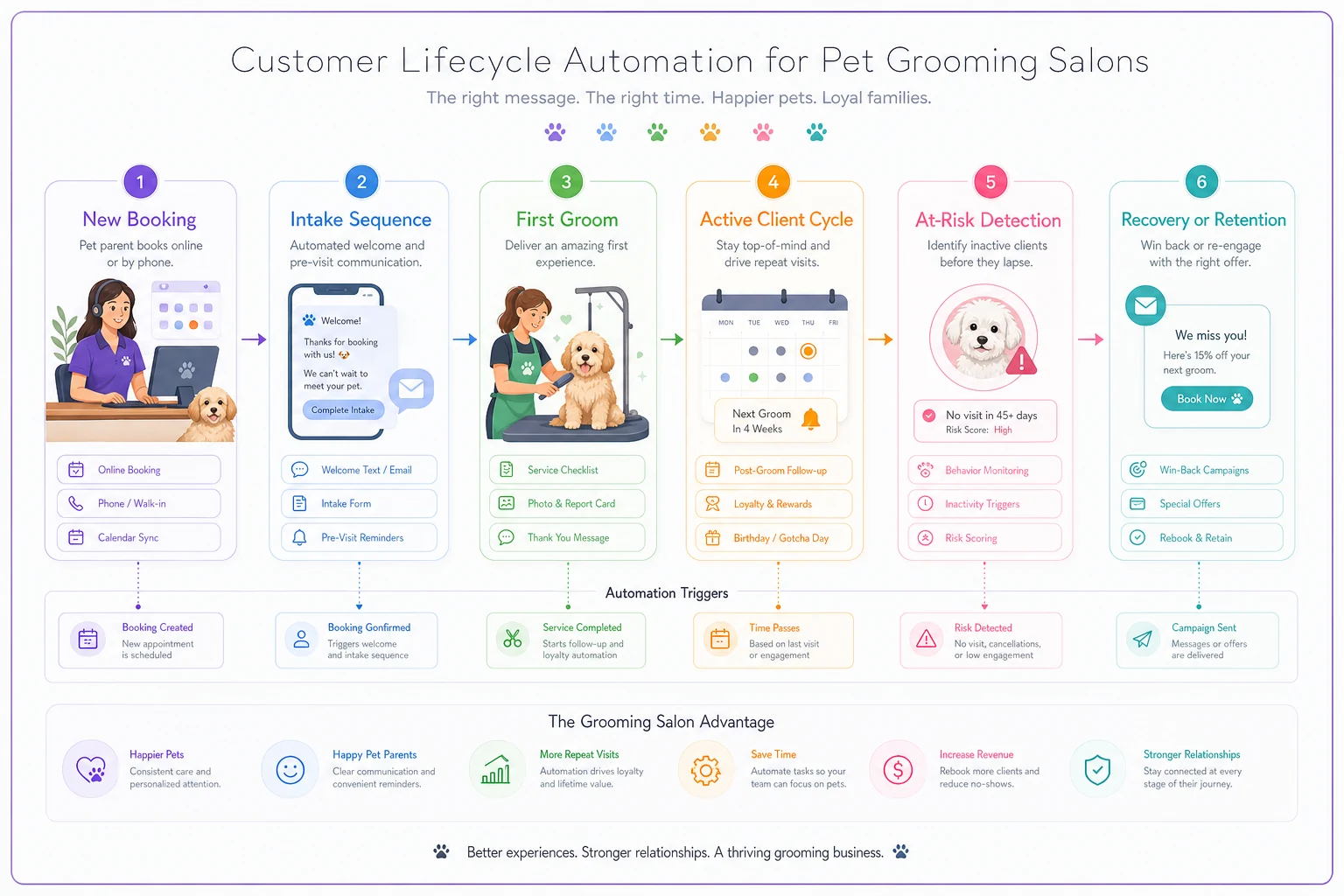
The automation handles timing and delivery. You handle the voice and value.
-
New booking triggers the intake sequence
-
First groom completion starts new client nurture series
-
Regular appointment completion begins standard retention cycle
-
Appointment interval exceeded activates at-risk protocol
-
90 days inactive launches winback sequence
Keep a short library of real, practical tips (like grooming aftercare) so automated messages feel useful, not promotional.
For example, that Week 3 tip about eye boogers? Write twelve of them, load them into your system, and let it rotate through them automatically. Feels personal and thoughtful, but happens without you thinking about it.
The dangerous trap is over-automating. Nobody wants fifteen messages between appointments. They don't want to feel like they're in a marketing funnel. The automation should feel like a thoughtful groomer who happens to have perfect memory and timing.
Real numbers from a real transformation
Mid-sized salon, college town, five groomers plus owner working part-time. Their starting point wasn't pretty.
| Metric | Before | After 6 Months | Change |
|---|---|---|---|
| Monthly appointments | 650 | 820 | +26% |
| New clients needed monthly | 45-50 | ~30 | -40% |
| Second appointment booking rate | ~35% | ~65% | +86% |
| Average weeks between visits | 10 weeks | 7.5 weeks | -25% |
| Monthly revenue | Baseline | +25% | +25% |
We mapped out their actual client lifecycle and found massive gaps everywhere. New clients were booking but only about 35% returned for a second appointment. Regular clients were stretching appointments from 6-7 weeks to 10-12 weeks average. Nobody was tracking who stopped coming.
Started with fixing intake. Created a simple questionnaire, trained the desk on better phone skills, and most importantly — started asking for that second appointment during the first booking call.
Within thirty days, second-appointment booking jumped to around 55%.
We tackled the first-appointment experience next. Standardized the handoff process, created talking points for groomers, and made immediate rebooking standard procedure instead of optional.
After sixty days, about 65% of first-time clients were leaving with their next appointment booked.
Then we built the retention system. Nothing fancy — just consistent touchpoints between appointments. A photo here, a tip there, a friendly reminder. Started tracking intervals and flagging at-risk clients.
The at-risk recovery kicked in around month three. They identified roughly 120 clients who'd gone dark. Sent personalized messages from their regular groomers. Brought back about 25 — not amazing, but that's 25 clients they'd written off as gone forever.
Six months in, the numbers spoke for themselves. Monthly appointments up to ~820. New client needs dropped to about 30 per month. Average weeks between appointments down from 10 to about 7.5. Revenue up roughly 25% with same staff and hours.
Once the systems were built, it basically ran itself. The desk followed the intake script. The AI-powered system handled the messages. The groomers did the handoffs. Everyone knew their role in the lifecycle.
The three moves you can make tomorrow morning
Move 1: Change your booking question
Stop asking "When would you like to come in?" Start asking "What's your target grooming schedule for [pet name]?" Then immediately suggest booking the next appointment after this one.
Move 2: Create a handoff card
Give groomers a simple card to fill out during each groom. One behavior note, one coat/health observation, and recommended next appointment timing. The receptionist uses this for the pickup conversation.
Move 3: Set up a simple at-risk alert
Whether it's a spreadsheet or sticky note system, start flagging clients who've passed their normal interval by two weeks. Have someone call or text them personally.
These aren't revolutionary changes. But they start shifting your operation from random transactions to managed lifecycles.
Why this creates an unfair competitive advantage
While other salons scramble for new clients every month, you're maximizing the value of every client you already have. While they're paying for Facebook ads and Groupon deals, you're building systematic retention. While they're dealing with empty Tuesday afternoons, you've got regulars locked into consistent schedules.
The math becomes undeniable over time. Reduce client loss by just 20%, and you need 20% fewer new clients to maintain revenue. Increase appointment frequency by just one visit per year per client, and you've added 15-20% to your topline without a single new customer.
But the real advantage is predictability. When 70% of your book is pre-booked regulars, you can staff appropriately, order supplies accurately, and plan for growth strategically. You're running a business, not riding a rollercoaster.
Once you build these systems, they become a moat competitors can't cross. They can copy your prices, match your hours, even poach your groomers. But they can't replicate years of systematically managed client relationships.
Your clients aren't just choosing you for convenience or price anymore. They're locked into a relationship, a routine, a system that works for them. That's when you stop being a service provider and become an essential part of their pet care team.
The groomer customer lifecycle isn't about perfection
You don't need sophisticated software to start (though AI-powered operational platforms help tremendously as you scale). You don't need perfect scripts or beautiful email templates. You just need to recognize that every client goes through stages, and each stage needs different operational attention.
Most salons will never do this. They'll keep treating every appointment as a surprise, every no-show as bad luck, every lost client as inevitable. They'll stay stuck in the chaos of constant client churn, unpredictable revenue, and operational firefighting.
But for the shops that commit to lifecycle thinking, that build the systems, that track the metrics — they'll find themselves in a completely different business. One where growth is predictable, clients stay for years, and the team can focus on what they actually love: grooming dogs, not desperately hunting for the next appointment.
Start with one stage. Pick the biggest gap in your current operation. Build a simple system. Track what happens. Then expand from there.
The groomer customer lifecycle isn't about complex marketing funnels or aggressive sales tactics. It's about operational excellence applied consistently across every client interaction. Get that right, and the business transforms itself.
Ready to streamline your grooming business?
Join 500+ pet groomers using Furlyly to save time, reduce scheduling conflicts, and deliver exceptional client experiences.