

Every grooming salon has that one groomer who consistently rings up $85 tickets while everyone else hovers around $55. The difference isn't skill or speed. They've figured out the packaging game while your other groomers default to basic grooms every single time.
The frustrating part? Most salon owners try to fix this with vague coaching sessions about "upselling more" or commission structures nobody fully understands. Meanwhile, your average ticket stays flat month after month because nobody's running controlled experiments to figure out what actually moves the needle.
Why Traditional Upselling Training Falls Apart
Your front desk staff and groomers face a brutal combination of constraints that make traditional sales approaches basically useless. They're juggling anxious dogs, impatient owners checking their phones, and a waiting room already running 20 minutes behind. Asking them to memorize a sales script on top of all that is setting them up to fail.
The real issue runs deeper than motivation. When you dig into why certain packaging approaches work at some salons but flop at others, it almost always comes down to three operational realities.
First, groomers need packaging options that fit their actual workflow. If suggesting an add-on means stopping mid-groom, looking up pricing, or recalculating timing, it won't happen. The mental overhead is too high when they're already managing multiple dogs.
Second, front desk staff need clear decision trees, not judgment calls. They're coordinating schedules, handling walk-ins, answering phones—and now you want them to analyze which upgrade makes sense for each client? That's a recipe for inconsistency.
Third, your scheduling system probably can't handle variable service times. Adding a teeth cleaning throws off your entire afternoon unless you've built in the right buffers.
The Package Experiment Framework That Actually Works
Running grooming service packaging experiments doesn't mean randomly testing prices or throwing new services at the wall. You need structured A/B tests with clear success criteria and rollback triggers.
Never miss a grooming appointment again.
Furlyly helps you book, confirm, and manage every pet grooming appointment effortlessly.
- Unified appointment scheduling
- Automated client reminders
- Staff availability & shift management
No credit card required
The framework starts with segmenting your client base into test groups—not by demographics or dog breed, but by booking patterns and price sensitivity. Your weekly regulars respond differently to packaging than your quarterly seasonal clients. Your large breed owners have different pain points than small dog specialists.
Most salons get this wrong: they test new packages on everyone at once, making it impossible to isolate what actually worked. Or they only test on new clients and miss the revenue sitting in their existing base.
A proper experiment runs for 30 days with specific tracking metrics:
-
Uptake rate by groomer
-
Average ticket lift
-
Service time impact
-
Rebooking rate changes
-
Staff resistance patterns
You're not just measuring revenue. You're measuring operational impact. A package that lifts tickets 20% but consistently causes 15-minute delays will hurt your business over time.
Template 1: Tiered Service Packages
Tiered packages work because they shift the conversation from "do you want this add-on?" to "which level makes sense for your dog?" It reduces decision fatigue for both staff and clients.
The Three-Tier Structure
Essential Grooming ($45–55)
-
Bath, dry, basic trim
-
Nail clip
-
Ear cleaning
Premium Care ($70–85)
-
Everything in Essential
-
Teeth cleaning
-
Paw pad treatment
-
Cologne finish
-
Extended brushing for mat prevention
Luxury Experience ($95–115)
-
Everything in Premium
-
Facial scrub
-
Shed-reduction treatment
-
Nail grinding (not just clipping)
-
Photo session
-
Priority booking status
Implementation Script for Front Desk
"For Bentley's appointment today, we have three service levels. Most dogs his size do great with our Premium Care at $75, which includes the teeth cleaning and paw treatments that really help between visits. Would that work, or would you prefer our Essential service?"
Notice what this script does: it anchors on the middle tier, gives a specific reason, and still leaves a downsell option. Your staff isn't pushing—they're guiding.
Tracking Sheet Structure
| Week | Essential Count | Premium Count | Luxury Count | Total Revenue | Avg Ticket | Staff Notes |
|---|---|---|---|---|---|---|
| 1 | 67 | 34 | 8 | $5,890 | $54.03 | "Confusing at first" |
| 2 | 54 | 48 | 12 | $6,780 | $59.47 | "Getting smoother" |
| 3 | 51 | 52 | 14 | $7,125 | $60.90 | "Premium becoming default" |
| 4 | 49 | 56 | 16 | $7,420 | $61.32 | "Ready to continue" |
Success Criteria
-
40% or more customers choosing Premium or Luxury after 30 days
-
Average ticket increase of at least 15%
-
No increase in appointment duration beyond 5 minutes
-
Staff comfort rating of 7/10 or higher
Rollback Rules
-
Kill the experiment immediately if
-
Premium/Luxury uptake stays below 20% after week 2
-
Appointment delays exceed 10 minutes consistently
-
Three or more complaint escalations about pricing
-
Staff actively defaults everyone to Essential to avoid the conversation
These aren't arbitrary thresholds. They're early warning signs that something in the execution is broken, whether that's the pricing, the scripts, or the scheduling buffers you built around the new tiers.
Template 2: Add-On Bundle Experiments
Bundles solve a different problem than tiers. They let you test specific service combinations without overhauling your entire menu—which works especially well when you're trying to move slow-selling services or increase adoption of higher-margin add-ons.
Bundle Construction Method
Start by pulling last quarter's add-on data and identifying three things:
-
High-margin services with low attachment rates (usually teeth cleaning, de-shedding)
-
Natural pairs that make operational sense together (nail grinding + paw balm)
-
Seasonal opportunities worth testing (flea treatment + yard spray discount)
Then build two or three test bundles priced at roughly 20% less than buying individual services:
Healthy Paws Bundle ($18, saves $7)
-
Nail grinding
-
Paw balm treatment
-
Nail polish (optional)
Fresh Breath Bundle ($22, saves $8)
-
Teeth cleaning
-
Breath spray
-
Dental photo for owner
Shed-Less Bundle ($28, saves $12)
-
De-shedding treatment
-
Furminator brushing
-
Take-home shed control spray
The Presentation Framework
Train your team to suggest bundles based on something they actually observed—not random pushing:
"I noticed Max has pretty long nails today. Would you like to add our Healthy Paws bundle? It's $18 and includes the grinding plus paw balm that helps prevent cracking."
This works because it ties the bundle to something visible, making it feel like professional advice rather than a sales pitch.
Measurement Grid
| Bundle | Week 1 Sales | Week 2 Sales | Week 3 Sales | Week 4 Sales | Repeat Rate | Time Impact |
|---|---|---|---|---|---|---|
| Healthy Paws | 12 | 19 | 24 | 28 | 62% | +3 min |
| Fresh Breath | 8 | 14 | 18 | 22 | 71% | +5 min |
| Shed-Less | 15 | 21 | 26 | 31 | 43% | +8 min |
Track both immediate uptake and downstream effects—repeat rate matters just as much as first-time sales.
Decision Triggers
-
Keep bundles that hit these benchmarks
-
25% attachment rate by week 4
-
50%+ repeat purchase rate
-
Time impact under 7 minutes
-
No increase in product waste or inventory issues
-
Drop bundles when
-
Attachment stays below 15% after two weeks
-
Groomers report consistent timing problems
-
Inventory costs eat into margin
-
Clients complain about feeling pressured
The Shed-Less bundle in that example grid is borderline—good sales growth but an 8-minute time impact that'll compound across a full day. That's the kind of nuance you miss without tracking it properly.
Template 3: Limited-Time Premium Upgrades
This template uses urgency and exclusivity without being pushy. The key is making upgrades feel like a genuine opportunity rather than a discount scramble.
The Upgrade Calendar System
Week 1–7: "Spa Week" — Premium spa treatments at introductory pricing Week 8–14: Normal pricing Week 15–21: "Dental Health Focus" — Teeth cleaning upgrades Week 22–28: Normal pricing
This rotation gives you four experiments per quarter while avoiding the kind of promotion fatigue that makes clients tune everything out.
Messaging That Converts Without Pressure
Bad approach: "We're running a special on teeth cleaning this week!"
Better approach: "This week we're featuring our dental care service since we just got new enzymatic cleaning tools. If you've been thinking about trying it, this is a good time—it's $8 instead of the usual $15."
You're explaining why this week matters, not just announcing a discount. Small difference in framing, big difference in how it lands.
Staff Behavior Tracking
| Date | Groomer | Client | Upgrade Offered? | Accepted? | Reason Given | Time Impact |
|---|---|---|---|---|---|---|
| 3/1 | Sarah | Johnson | Yes | Yes | "New tools" | +4 min |
| 3/1 | Sarah | Miller | No | — | "Running late" | — |
| 3/1 | Tom | Davis | Yes | No | "Maybe next time" | 0 |
This level of detail surfaces patterns fast. Maybe Sarah only offers upgrades when she's ahead of schedule. Maybe Tom needs different talking points. Maybe afternoon appointments convert better than morning ones. You won't know without tracking it this way.
Rollback Triggers
-
Uptake drops below 10% for two consecutive days
-
Your best performers stop offering (usually a sign of burnout)
-
Scheduling delays exceed 15 minutes
-
Any complaints about "constant promotions"
When your top groomers quietly stop mentioning upgrades, that's usually the clearest signal something needs to change—whether it's the timing, the incentive structure, or the messaging itself.
Adapting to Front-Line Staff Reality
The best experiment design means nothing if your team can't execute it. Salons that succeed build their experiments around staff constraints, not despite them.
Start with your scheduling blocks. If your team runs back-to-back small dogs from 8–11am, don't launch a time-intensive shed treatment bundle during those hours. If your newest groomer is still building confidence, don't make them the primary tester for luxury packages.
Different situations call for different scripts:
Rushed morning: "We have our Essential or Premium service today—which works better?"
Relaxed afternoon: "I noticed Bella's coat could really benefit from our Premium Care package. It includes the deep conditioning that helps with her type of fur. Should we do that today?"
Nervous new client: "For the first visit, most people start with our Essential service to see how their dog does, then consider Premium next time."
Your tracking system should also capture context, not just outcomes. A 20% conversion rate during busy Saturday mornings tells a completely different story than 20% on quiet Tuesday afternoons. Context is what makes the data actually useful.
The Tracking Infrastructure You Need
Forget complicated CRM systems or dashboards that take three weeks to set up. You need a simple Google Sheet your entire team will actually update. Here's the minimum viable setup:
Daily Snapshot Tab:
-
Number of each package/bundle sold
-
Which staff member made the sale
-
Time of day
-
Any incidents or complaints
Weekly Rollup Tab:
-
Total revenue by package type
-
Conversion rate by staff member
-
Average ticket change from baseline
-
Schedule impact (average delay)
Experiment Notes Tab:
-
What's working, with specific examples
-
What's failing, with specific problems
-
Staff feedback, quoted directly when possible
-
Client reactions, both positive and negative
The goal isn't perfect data—it's good enough data captured consistently. A simple system your team actually uses beats a complex one they ignore.
Here's a quick visual to help your team understand the workflow.
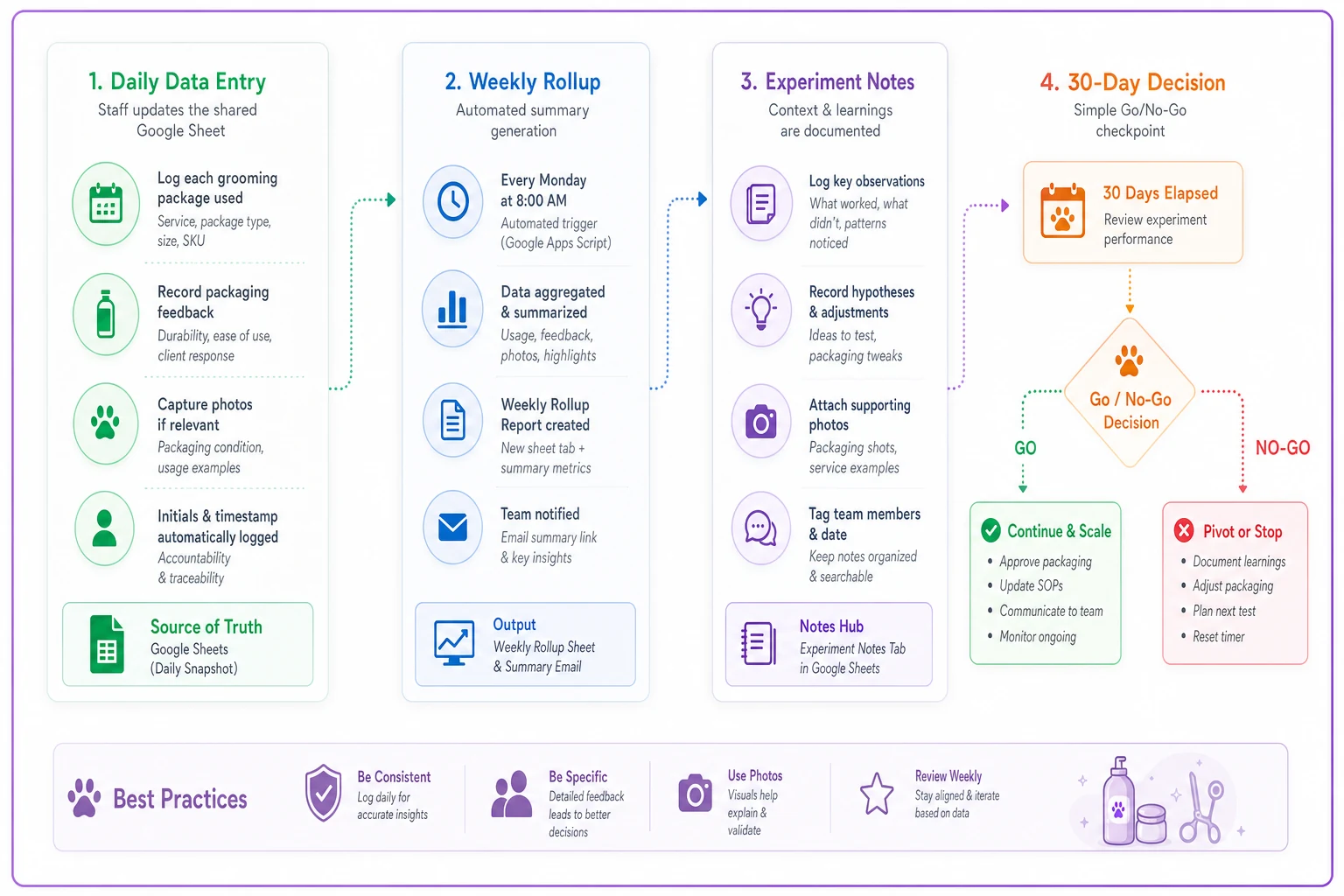
A simple illustrated workflow helps non-technical staff see where their updates go and how the data gets used.
Making the Go/No-Go Decision
After 30 days, you need a clear decision framework. Don't let experiments drag on hoping they'll magically improve.
Green Light Criteria (Full Rollout)
-
Average ticket increased by target amount (usually 15–20%)
-
Majority of staff comfortable with the system
-
No systematic scheduling problems
-
Client complaints under 2% of participants
-
Rebooking rates stable or improved
Yellow Light Criteria (Modify and Retest)
-
Positive revenue impact but operational issues
-
Good uptake but staff resistance
-
Works for some client segments but not others
-
Close to targets but not quite there
Red Light Criteria (Kill Immediately)
-
Revenue impact below 10%
-
Staff actively avoiding the system
-
Client complaints exceeding 5%
-
Scheduling chaos
-
Inventory or cost problems
Most owners sit in yellow-light territory and don't know what to do with it. The answer is usually to narrow the experiment—test it on one groomer or one booking window, figure out where the friction actually is, then adjust before relaunching wider.
Common Failure Points and Fixes
Problem: Groomers cherry-pick which clients to offer upgrades
This usually happens when they're trying to protect their tips or avoid difficult conversations. Fix it by randomizing test groups and making it clear that offering—not closing—is what's being measured.
Problem: Front desk forgets during busy periods
Build prompts directly into your booking system. Even a sticky note on the monitor beats relying on memory when the phone's ringing and three dogs are barking.
Problem: Packages work initially then fade
You probably launched with enthusiasm and stopped reinforcing. Schedule weekly 5-minute check-ins to review numbers and celebrate wins. Momentum requires maintenance.
Problem: Different locations show wildly different results
Your locations probably serve different client bases or have genuinely different team dynamics. Run separate experiments with adjusted parameters rather than forcing one model everywhere.
Building Your Experimentation Rhythm
Salons that consistently grow their average tickets don't just run one experiment and call it done. They build a testing rhythm into their operations:
-
Quarter 1
Test tiered packages
-
Quarter 2
Test targeted bundles
-
Quarter 3
Test limited-time upgrades
-
Quarter 4
Test combination approaches
Between experiments, consolidate what worked and cut what didn't. Document everything in a simple playbook—what you tested, what the numbers showed, what you kept and why, and what you learned about your clients and team. This institutional knowledge compounds over time. New managers can see what's already been tried. You stop repeating failed experiments from two years ago.
The salons that do this well aren't running fancy analytics. They're just keeping decent records and actually reading them.
The Operational Software Advantage
Running these experiments manually works, but it's exhausting. You're tracking everything in spreadsheets, reminding staff about scripts, calculating conversion rates on Sunday nights.
AI-powered operational software changes the day-to-day reality significantly. Instead of manually tracking which groomer offered which package, the system logs it automatically. Instead of calculating conversion rates in Excel, you see them in real time. Instead of hoping staff remember the right script, the platform can surface prompts based on the client's history and booking context.
The real value beyond cleaner tracking is pattern recognition. A good system can surface that your Tuesday afternoon crowd converts at 40% for premium packages while Saturday mornings only hit 15%. It can flag when a particular bundle consistently causes scheduling delays before it becomes a bigger problem. It can notice when a groomer's conversion rate drops after being scheduled back-to-back too many times.
You also get cleaner A/B testing without the manual effort. The system can alternate which offer gets presented, keeping test data clean without your team managing rotation schedules themselves. When a limited-time upgrade period ends, prompts update automatically. When someone books a premium package, the appointment duration adjusts accordingly.
None of that is magic. It's just removing the operational friction that causes these experiments to fall apart in the first place—and that friction is usually why good ideas die before they have a chance to work.
Beyond the Experiments
The templates in this guide will lift your average tickets if you execute them properly. But the bigger win is building an experimentation mindset into how your salon actually runs.
Stop treating pricing and packaging as fixed decisions made once a year. Start treating them as ongoing experiments that evolve with your business, your team, and your clients.
Your seasonal demand patterns affect which packages work when. Your client lifecycle stages determine which offers actually resonate. Everything connects.
The salons doing well aren't necessarily more skilled or in better locations. They're just willing to test systematically, measure honestly, and adapt based on what the data actually shows. They treat their average ticket as something they actively manage, not something that just happens to them.
Start with one template. Run it for 30 days. Learn what works for your specific situation. Then build from there. Within a few months, you'll have a packaging strategy tuned to your salon's reality—and an average ticket that finally reflects the value you're already delivering. The revenue is already there, sitting in your existing client base—you just need the right framework to capture it.
Ready to streamline your grooming business?
Join 500+ pet groomers using Furlyly to save time, reduce scheduling conflicts, and deliver exceptional client experiences.