



Most grooming salons don't have a scheduling problem. They have a scheduling governance problem. The difference matters more than it sounds.
A scheduling problem is "we're double-booked on Saturday." A governance problem is "every front-desk person, every groomer, and the owner all make booking decisions using their own private rules, and none of those rules are written down anywhere." One of those you fix in an afternoon. The other one quietly bleeds you for years.
What happens in practice is that decisions get made tactically — one appointment at a time, based on whoever's answering the phone and how they feel about squeezing in a doodle at 4pm. Each individual decision seems fine. Stacked together across a few hundred appointments a month, they fragment your calendar into something with no shape, no protected capacity, and no logic anyone can explain. That's what this handbook is about: putting a governing structure over booking decisions so the calendar stops being an accident.
Why tactical scheduling quietly wrecks the calendar
Here's the pattern almost every growing salon hits. In the early days, the owner books everything. There's one brain, one set of instincts, and the calendar reflects it. Bathers go in the morning, the difficult senior dog gets the quiet 8am slot, and the owner instinctively leaves a gap before the aggressive shepherd. It works because it all lives in one head.
Then you add a second groomer. Then a front-desk hire. Then online booking. Suddenly there are four or five decision-makers, and the "rules" are still living in the owner's head — never transferred. So each person invents their own. The new receptionist books back-to-back doubles because nobody told her the shepherd needs a buffer. The online form lets a client grab a same-day slot that should've been held for a loyal monthly customer.
None of these people are wrong. They just don't share a policy. And that's the core insight: fragmented calendars are almost never caused by bad staff — they're caused by the absence of governance. When there's no written booking policy, everyone defaults to "say yes to whatever's in front of me," which is the single most expensive habit in the industry.
-
Your best clients can't get their usual Saturday slot because a new walk-in grabbed it three weeks out
-
Groomers finish wildly uneven — one slammed, one idle — on the same day
-
Same-day requests either all get squeezed in (destroying the schedule) or all get turned away (losing easy revenue)
-
Nobody can tell you why any given slot is booked the way it is
If you've already done the groundwork on capacity — and if you haven't, the breed time matrices and buffer rules from the data-driven scheduling piece are the prerequisite for everything below — governance is the layer that decides who gets to fill that capacity, and when.
The four pillars of scheduling governance
Governance isn't a giant rulebook. It's four connected policies that answer four different questions. Get these written down and enforced, and the tactical chaos mostly disappears on its own.
Never miss a grooming appointment again.
Furlyly helps you book, confirm, and manage every pet grooming appointment effortlessly.
- Unified appointment scheduling
- Automated client reminders
- Staff availability & shift management
No credit card required
-
Booking-window tiers — how far out can each type of booking be made?
-
Lead-time cohort templates — what does a "normal" week look like before anyone touches it?
-
Same-day priority ladder — when demand exceeds today's capacity, who wins?
-
Slot economics — what is each slot actually worth, and are we filling it accordingly?
These have to work together because a decision in one pillar constrains the others. If your booking window lets anyone book 60 days out, your same-day ladder has almost nothing to work with because the calendar's already full. Change one dial, the others move.
Pillar 1: Booking-window tiers
The booking window is how far in advance a client can secure a slot. Most salons run a single window — usually "as far out as the calendar's open" — which is the root of half the fragmentation. When everyone can book 8 weeks ahead, your calendar fills with low-commitment bookings that displace the clients you actually want to protect.
Tiering fixes this. You give different client types different windows based on how much you value locking them in early.
| Client tier | Booking window | Rationale |
|---|---|---|
| Recurring / standing appointment | Open (auto-rebooked) | These are your revenue backbone — protect their slot permanently |
| Loyal / high-frequency (6+ visits/yr) | Up to 8 weeks | Reward loyalty with first access to prime slots |
| Standard returning | Up to 4 weeks | Enough runway to plan, not enough to hoard prime slots |
| New client | Up to 2 weeks | Reduces no-show exposure on unproven relationships |
| Same-day / walk-in | Day-of only | Handled entirely by the priority ladder (Pillar 3) |
The insight most owners miss: your booking window is a demand-shaping tool, not just a policy. A shorter window for new clients isn't about being unfriendly — it's that unproven relationships no-show at meaningfully higher rates, and a no-show booked 6 weeks out costs you a slot you could've sold ten times over. Keeping them in a 2-week window means a cancellation lands close enough to fill.
Standing appointments deserve special mention. A client on a strict 4-week rebook cycle who auto-reserves the same Saturday 10am indefinitely is worth far more than the individual ticket suggests — they're predictable capacity you can build the rest of the week around. Protect those slots ruthlessly. The salons with the healthiest calendars usually have 30–40% of their week locked in standing appointments before the month even starts.
Protect those slots ruthlessly.
The salons with the healthiest calendars usually have 30–40% of their week locked in standing appointments before the month even starts.
Pillar 2: Lead-time cohort templates
This is the pillar people skip, and it's the one that makes the others work. A lead-time cohort template is a pre-shaped week — you decide ahead of time what mix of appointment types each day should hold, then release slots into those shapes instead of letting the calendar fill first-come-first-served.
Think of it as zoning your week before anyone books.
-
Early block (8–10am) senior dogs, anxious pets, anything needing a calm environment and buffer time
-
Mid-morning (10am–1pm) standing appointments and high-value full grooms — your prime, protected slots
-
Early afternoon (1–3pm) bath-and-tidy, express services, faster-turnaround work to keep throughput up
-
Late afternoon (3–5pm) flexible block — where same-day and new-client bookings land
Without this, here's what breaks: your two most time-intensive dogs both get booked at 4:30 because that's when two different clients called, and now both groomers are running 40 minutes late into close. With cohort templates, the demanding work is deliberately distributed and the whole day flows.
The pattern worth internalizing: a calendar that fills randomly always trends toward its worst-case shape. Left alone, appointments cluster around convenient human times — mornings and after-work — leaving your midday dead and your edges overloaded. Templates counteract that gravity. You're not eliminating flexibility; the late block is intentionally loose. You're protecting the parts of the day that can't absorb chaos.
When cohort templates are a bad idea
If you're a solo groomer doing 6–8 dogs a day, this is overkill. You already hold the whole day in your head, and rigid zoning just adds friction. Cohort templates start paying off around the point where you have two or more groomers and a separate person handling bookings — that's when the "one brain" system collapses and you need the structure to replace it.
Pillar 3: The same-day priority ladder
Same-day demand is where governance gets tested, because it's emotional and fast. A regular calls at 9am — their dog rolled in something — they need in today. Meanwhile you've got two open afternoon slots and three requests competing for them. Without a rule, whoever's loudest or nicest on the phone wins, which means your decisions are being made by phone volume, not business logic.
-
Standing-appointment clients with an emergency — highest priority, they're your backbone
-
Loyal clients (6+ visits/yr) requesting same-day
-
Standard returning clients
-
New clients — filled only if capacity remains
-
Add-on / retail-driven walk-ins — lowest, take only genuine surplus
The subtle part is how much same-day capacity you leave open in the first place. This is where Pillar 2 pays off — that flexible late block is your same-day reservoir. If you've held roughly one slot per groomer per day for day-of requests, your ladder has room to operate. If your calendar's booked solid three weeks out, the ladder is theoretical; there's nothing to rank.
A mistake worth flagging: salons that swing between extremes. One week they cram every same-day request in and blow up the schedule; the next week, burned out, they reject everything and lose easy money. The ladder plus a fixed reservoir removes the swing — you have a known amount of same-day capacity and a known order for filling it. Consistency beats heroics.
Pillar 4: Slot economics tied to capacity math
Every slot on your calendar has a value, and they are not equal. A Saturday 10am full groom on a large breed is worth multiples of a Tuesday 2pm nail trim. If your booking rules treat all slots the same, you're systematically letting low-value bookings occupy high-value real estate.
Slot value = expected ticket × probability of showing × strategic weight
That last term — strategic weight — is what people forget. A new client's first full groom might be an $85 ticket, but if they convert to a standing appointment, the relationship is worth well over a thousand dollars a year. So a new-client booking in your onboarding-friendly window carries strategic weight beyond its face ticket. Meanwhile a one-off holiday walk-in is worth exactly its ticket and nothing more.
Put concretely: if your prime Saturday mid-morning slots average a $95 ticket at a 95% show rate, and your Tuesday afternoon slots average $45 at 85%, those are not interchangeable. A same-day nail-trim request should never displace a prime-slot booking, and your governance rules should make that impossible rather than leaving it to a judgment call.
This is also where your reporting closes the loop. If you're already tracking the six metrics in the minimal KPI dashboard, slot economics slots right in beside utilization and revenue-per-hour — it tells you not just how full you are but how well you filled.
How the four pillars connect in a live week
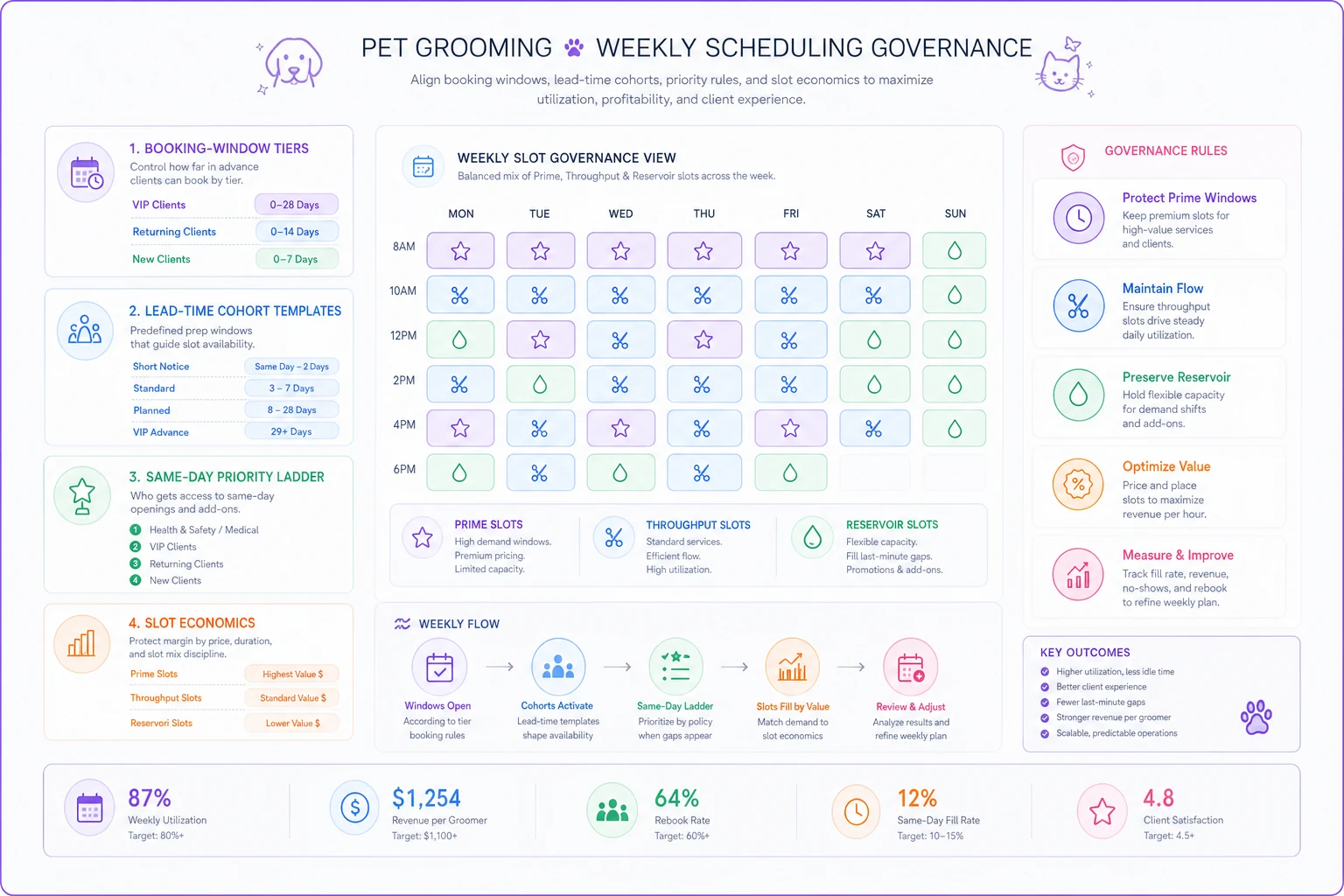
Governance only works when the pillars operate as one system. Before the week opens, your cohort templates shape the calendar — prime blocks zoned, flexible reservoir held. As bookings come in, booking-window tiers control who can reach which slots and how far out, so recurring and loyal clients lock their prime spots first and new clients fill the edges. When the week arrives and same-day demand hits, the priority ladder decides who claims the reservoir capacity. And running underneath all of it, slot economics ensures that at every decision point, the higher-value use of a slot wins over the lower-value one.
Pull any pillar out and the system leaks. No tiers, and low-commitment bookings hoard prime slots. No templates, and the calendar collapses into its worst-case shape. No ladder, and same-day chaos rules the day. No economics, and you fill up busy but broke.
A visual of the weekly governance flow helps make the interactions obvious.
The manual-enforcement problem
Here's the honest catch: a governance policy written on paper doesn't enforce itself. Someone still has to remember that this caller is a loyal-tier client with an 8-week window, that this slot is a protected prime block, and that today's reservoir has one opening left. At 200+ appointments a month across multiple staff, human memory can't hold all that reliably — which is exactly why fragmentation creeps back even after you've written good rules.
This is where the calendar tooling earns its keep. Scheduling platforms that let you encode tiers, zone your templates, and flag slot value directly in the booking flow turn policy into something the system enforces automatically. The receptionist doesn't have to remember a client's tier — the platform surfaces it. Modern systems with a bit of automation can even hold the same-day reservoir open until a cutoff, then release it, so nobody's manually juggling it mid-shift. The point isn't the software; it's that governance you have to remember manually degrades, and governance the system enforces holds.
A real scenario: a three-groomer suburban salon
A three-groomer salon doing somewhere around 320–360 grooms a month had classic fragmentation. Online booking was open 60 days out, no tiers, no templates. On paper they were busy. In reality, revenue-per-groomer-hour was mediocre and their best clients were complaining they couldn't get regular slots.
When they mapped it out, the problem was obvious: new and one-off clients had booked up most of the prime Saturday and mid-morning slots weeks ahead, pushing standing clients into odd times. Groomers ran uneven — one buried in back-to-back big dogs while another had gaps.
They installed the four pillars over about a month. Tiered windows (recurring open, loyal 8 weeks, new 2 weeks), cohort templates zoning prime blocks for high-value grooms, a same-day ladder with one reservoir slot per groomer, and slot tagging so the front desk stopped filling prime spots with express work.
Volume barely changed — still in the low-to-mid 300s monthly. But revenue-per-groomer-hour climbed noticeably because prime slots now held prime work, and the loyal-client complaints basically stopped once their standing slots were protected. Same-day requests, previously either chaos or rejection, settled into a predictable rhythm. Nothing dramatic on the top line — the win was that the same capacity finally produced more, and the calendar stopped being an argument.
A rollout checklist
Don't try to install all four pillars in one week. Sequence it:
-
[ ] Write down your current implicit rules — whatever the owner does by instinct. You can't govern what you haven't named.
-
[ ] Define 3–4 client tiers and assign booking windows to each
-
[ ] Build a cohort template for a typical day (prime blocks, throughput blocks, flexible reservoir)
-
[ ] Set your same-day reservoir size and write the priority ladder
-
[ ] Tag your slots by rough value so prime real estate is visibly different
-
[ ] Brief every person who touches the calendar — one shared policy, not five private ones
-
[ ] Review after 30 days
did prime slots hold prime work? Did loyal-client friction drop?
The 30-day review is non-negotiable. Governance isn't set-and-forget — demand patterns shift seasonally, and your templates should shift with them.
Where this fits in the bigger picture
Scheduling governance sits on top of capacity math, not instead of it. You need the underlying numbers — accurate service times, realistic buffers, honest utilization targets — before governance has anything solid to govern. But once those fundamentals are in place, governance is what stops all that careful capacity planning from being undone by a hundred well-intentioned tactical decisions at the front desk.
The salons that scale cleanly aren't the ones with the smartest owner. They're the ones who managed to get the owner's scheduling instincts out of their head and into a policy everyone shares. That transfer — from private judgment to written, enforceable governance — is the real unlock. Do it, and the calendar stops fragmenting no matter how many people touch it or how fast you grow.
The salons that scale cleanly aren't the ones with the smartest owner. They're the ones who managed to get the owner's scheduling instincts out of their head and into a policy everyone shares. That transfer — from private judgment to written, enforceable governance — is the real unlock. Do it, and the calendar stops fragmenting no matter how many people touch it or how fast you grow.
Ready to streamline your grooming business?
Join 500+ pet groomers using Furlyly to save time, reduce scheduling conflicts, and deliver exceptional client experiences.