



Most grooming salons schedule appointments like it's still 1995 – sticky notes, gut feelings, and a lot of hoping for the best. This works fine when you're handling maybe 10 dogs a day. But once you hit 15-20 appointments with multiple groomers, the whole system starts cracking.
The real damage isn't just running late or the occasional double-booking. It's the money walking out the door because you allocated 45 minutes for a dog that actually needs 90, or you're giving your most skilled groomer the same timeline as someone who just graduated. Every miscalculation ripples through the day until you're still apologizing to clients at closing time.
The capacity math nobody teaches in grooming school
Here's what's interesting – salon owners consistently overestimate their capacity by about 30%. They look at chairs and groomers, do quick multiplication, and call it done. But real capacity is messier.
True Daily Capacity = (Groomer Hours × Efficiency Rate) - Transition Time - Break Coverage
Three groomers working 8-hour shifts should equal 24 productive hours, right? Not even close.
-
Sarah
8 hours × 0.85 = 6.8 hours
-
Mike
8 hours × 0.70 = 5.6 hours
-
New groomer
8 hours × 0.60 = 4.8 hours
That's 17.2 productive hours, not 24. And we haven't counted the 5-7 minutes between each dog for cleanup, or covering lunch breaks.
Building your breed-service duration matrix
You need to know exactly how long each service takes for each breed type. Not approximate – exactly.
Never miss a grooming appointment again.
Furlyly helps you book, confirm, and manage every pet grooming appointment effortlessly.
- Unified appointment scheduling
- Automated client reminders
- Staff availability & shift management
No credit card required
| Breed Category | Bath Only | Bath & Trim | Full Groom | Add Dematting |
|---|---|---|---|---|
| Small Short Hair (Chihuahua) | 25-30 min | 35-40 min | 45-50 min | +15-20 min |
| Small Long Hair (Yorkie) | 30-35 min | 45-50 min | 60-70 min | +20-30 min |
| Medium Short Hair (Beagle) | 35-40 min | 45-50 min | 55-65 min | +15-20 min |
| Medium Long Hair (Cocker) | 40-45 min | 55-65 min | 75-85 min | +25-35 min |
| Large Short Hair (Lab) | 45-50 min | 55-60 min | 65-75 min | +20-25 min |
| Large Long Hair (Golden) | 50-60 min | 70-80 min | 90-110 min | +30-45 min |
| Giant Breeds (Newfie) | 70-80 min | 90-100 min | 120-150 min | +45-60 min |
But here's the key part – these times need adjustment for your specific groomers. Track every appointment for two weeks. Note breed, service, groomer, actual time. Patterns emerge fast.
Track every appointment for two weeks to capture how each groomer performs on each breed-service combination.
Mike takes 15% longer on doodles but blazes through short-haired breeds. Sarah handles matted dogs 25% faster than anyone else. Your new groomer needs extra time on scissor work.
The buffer formula that prevents chaos
Raw service times aren't enough. Buffers need to be calculated, not guessed.
Buffer Time = Base Transition (5 min) + (Difficulty Factor × 5 min) + (Revenue Impact × 2 min)
Take a difficult German Shepherd for a full groom. High-difficulty appointment (factor of 2) with high revenue impact (factor of 2 because it's $120+).
Buffer = 5 + (2 × 5) + (2 × 2) = 19 minutes
Compare that to a regular bath for a calm Beagle. Low difficulty (factor of 0), lower revenue (factor of 1):
Buffer = 5 + (0 × 5) + (1 × 2) = 7 minutes
The flow below shows how to compute buffer time for each appointment.
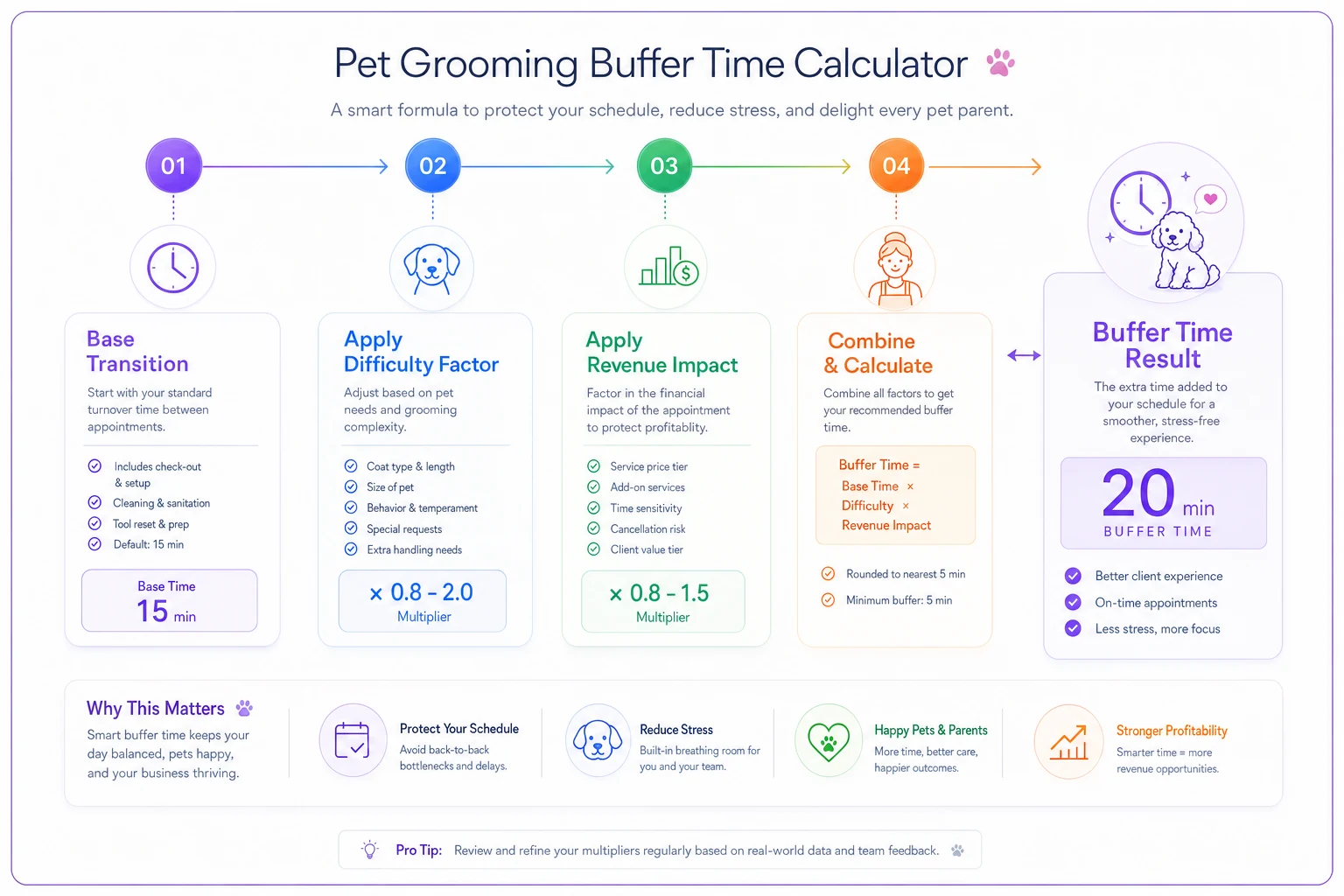
You're not padding every appointment randomly. You're protecting high-value slots and managing risk where it exists.
Reading patterns from your appointment history
After about a month of tracking, obvious patterns emerge. Tuesday and Wednesday afternoons run 20% faster because you're seeing well-maintained regular clients. Friday afternoons slow down 30% because everyone wants weekend perfection and hasn't been in for two months.
Certain combinations create problems. Two matted doodles back-to-back destroys momentum. But alternating difficult grooms with simple baths gives natural recovery time.
Some groomers handle disruption better than others. Sarah adapts when walk-ins show up. Mike needs his planned schedule to stay productive. This isn't weakness – it's operational reality you plan around.
Sample optimized schedules that actually work
Sarah (Lead Groomer)
-
8
00 - Golden Retriever full groom (90 min)
-
9
35 - Yorkie bath & trim (45 min)
-
10
25 - Difficult Husky full groom (85 min + 15 buffer)
-
12
05 - Lunch
-
1
00 - Standard Poodle full groom (95 min)
-
2
40 - Shih Tzu full groom (65 min)
-
3
50 - Lab bath only (45 min)
-
4
40 - Small dog nail trims (3 × 10 min)
Mike (Steady Groomer)
-
8
00 - Cocker Spaniel full groom (80 min)
-
9
25 - Beagle bath & trim (50 min)
-
10
20 - Maltese full groom (70 min)
-
11
35 - Lunch
-
12
30 - Lab full groom (70 min)
-
1
45 - Schnauzer full groom (75 min)
-
3
05 - Two cat grooms (45 min each)
New Groomer
-
8
30 - Small dog bath only (35 min)
-
9
10 - Beagle bath only (45 min)
-
10
00 - Assisted groom with Sarah (learning time)
-
11
00 - Shih Tzu bath & trim (60 min)
-
12
05 - Lunch
-
1
00 - Two small dog baths (35 min each)
-
2
15 - Medium dog bath & trim (60 min)
-
3
20 - Nail trims and simple services
Starts 30 minutes later (less pressure), gets learning time, handles simpler services with built-in buffers.
Tuning your system week by week
First week using structured scheduling feels tight. You've probably been overestimating daily capacity. But tracking actual versus scheduled times makes adjustments obvious.
Week 1-2: Track everything. Every appointment duration, every delay, every surprise. Note which groomers run over or under allocated times.
Week 3-4: Adjust base times. If Mike needs 85 minutes for Standard Poodles instead of 75, update the matrix. If Sarah does Goldens in 80 minutes, capture that efficiency.
Week 5-6: Refine buffers. Maybe Friday afternoons need 25% more buffer time. Maybe your newest groomer doesn't need buffer on nail trims.
By week 8, you have a system reflecting your actual operation, not theoretical timeframes.
When the schedule meets reality
Perfect math crashes into reality. Dogs arrive matted when owners swore they brushed daily. Someone calls in sick. Nervous dogs take 20 minutes just to calm down.
Data-driven scheduling gives you flexibility within structure. When that matted dog shows up, you know exactly how much time to add. When someone's sick, you can quickly identify which appointments to move based on actual capacity.
Buffer calculations mean delays don't cascade all day. The breed-time matrix means accurate upfront pricing instead of surprise charges.
Common scheduling mistakes that kill profit
Biggest mistake: treating all appointment slots as equal. A 2 PM Saturday slot is worth significantly more than 10 AM Tuesday, but most shops price them the same.
Another profit killer: not accounting for groomer skill differences in pricing. If Sarah handles difficult dogs that take others twice as long, those appointments should be priced accordingly. You're paying for capability, not just time.
Many salons underestimate setup and cleanup time. That 5-7 minutes between dogs? Over a full day, that's nearly an hour of unbilled time. Build it into pricing or schedule, but don't pretend it doesn't exist.
The technology factor in modern scheduling
AI-powered operational software makes a real difference here. Instead of manually tracking times and calculating buffers, modern scheduling platforms learn your patterns automatically. They track actual versus planned times, identify bottlenecks, suggest optimizations based on historical data.
The best systems understand relationships between groomer skills, dog requirements, and optimal sequencing. They automatically apply correct buffers, warn when you're overloading time slots, even predict when you need extra hands based on booking patterns.
Whether you're using software or spreadsheets, principles stay the same. You need real data, not estimates. Account for variation in dogs and groomers. Use buffers that reflect actual risk, not arbitrary padding.
Making the numbers work for your salon
Start simple. Pick one groomer and track their next 20 appointments. Note breed, service, scheduled time, actual time. Calculate variance. That single data set tells you more about your operation than years of guessing.
Expand gradually. Add other groomers. Categorize appointments by difficulty. Build your breed-service matrix based on your actual times, not industry averages.
Within a month, you'll have enough data for schedules that reflect your salon's reality. Groomers stop feeling rushed. Clients stop waiting. You'll probably discover you can handle 15-20% more appointments without adding stress – just by scheduling smarter.
The math isn't complicated once you have the right numbers. The challenge is being disciplined enough to collect those numbers first. For salons making this shift, payoff is immediate: better flow, happier staff, more satisfied clients, measurably higher revenue per day.
Most importantly, you stop treating scheduling like guesswork and start treating it like the operational foundation it actually is. When every appointment lands in the right slot with the right groomer and the right amount of time, everything else in your salon starts working better too.
Ready to streamline your grooming business?
Join 500+ pet groomers using Furlyly to save time, reduce scheduling conflicts, and deliver exceptional client experiences.