

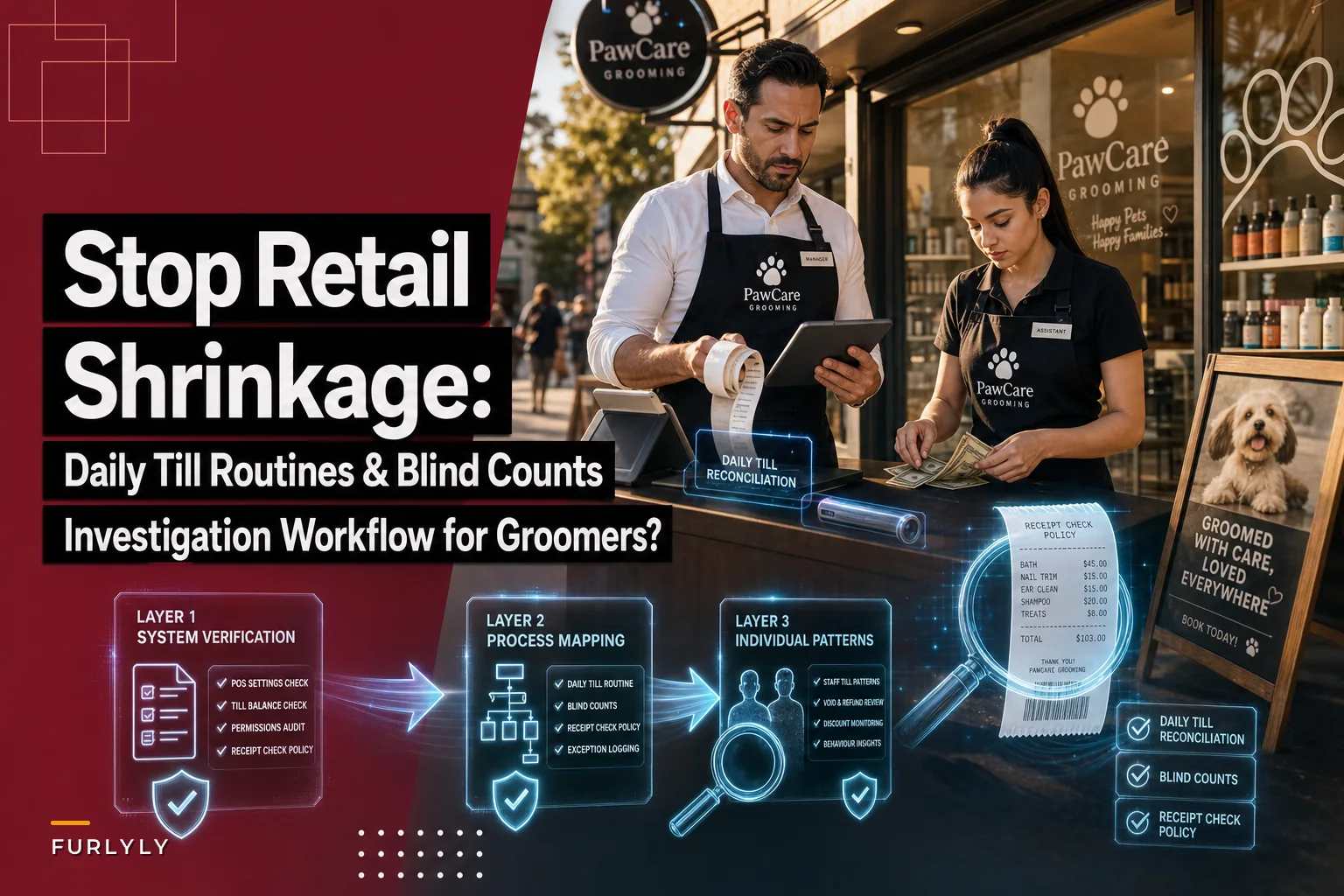

Your retail numbers don't match. Again. The shampoo count is off by three bottles, someone's cash drawer is short $47, and that expensive de-shedding tool vanished without a sale record. Most grooming salon owners just write it off as "the cost of doing business" — but salon retail shrinkage prevention isn't about catching thieves. It's about fixing the broken processes that make theft, errors, and waste inevitable.
The average grooming salon loses 2–4% of retail revenue to shrinkage. On $8,000 monthly retail sales, that's $160–320 disappearing every month. Over a year, you're looking at somewhere between $2,000 and $4,000 gone. That's payroll for a part-time bather, new grooming equipment, or pure margin you actually needed.
What makes this worse is that grooming salons have unique shrinkage challenges. Your team is handling wet dogs, sharp tools, and stressed customers all day — retail feels like an afterthought. Products get used for grooming services without being logged. Staff "borrows" something to test on their own pet. Customers grab items while waiting and forget to mention them at checkout. None of this is malicious most of the time, but it adds up fast.
Why traditional retail controls fail in grooming environments
Standard retail shrinkage solutions assume a dedicated cashier, consistent foot traffic, and staff focused purely on sales. Your reality? The same person checking out a customer is simultaneously answering phones, watching a nervous Yorkie, and trying to remember if they already charged for the nail grinding add-on.
Mixed responsibilities destroy accuracy. Your receptionist processes a retail sale while coordinating three drop-offs, two phone calls, and a groomer asking about a special handling note. They forget to scan the dental chews because the golden retriever just had an accident in the lobby.
Product boundaries blur. That bottle of oatmeal shampoo on the retail shelf? A groomer grabs it when they run out mid-groom. They mean to log it later but three dogs deep, it's gone from memory. Now your inventory shows product that doesn't exist.
Cash handling happens everywhere. Tips get mixed with retail payments. Groomers collect payment for add-ons. The owner takes cash for a quick sale on their way out. Nobody tracks who touched what money when.
End-of-day reconciliation gets rushed. After eight hours of controlled chaos, your closer just wants to go home. They do a quick drawer count, assume the $23 shortage is a mistake they'll figure out tomorrow, and leave. Tomorrow becomes next week. The shortage becomes permanent.
The daily till discipline that actually works
Forget complex POS systems and surveillance cameras as a starting point. Effective salon retail shrinkage prevention starts with a simple morning routine that takes about twelve minutes but saves thousands annually.
Never miss a grooming appointment again.
Furlyly helps you book, confirm, and manage every pet grooming appointment effortlessly.
- Unified appointment scheduling
- Automated client reminders
- Staff availability & shift management
No credit card required
The Blind Count Protocol
Every morning, before anyone touches the register, your opener performs a blind count. They don't know yesterday's closing amount. They count cash, record it, then compare to the previous close. This immediate variance detection stops small discrepancies from compounding into big ones.
The actual sequence: Count all bills twice, organizing by denomination. Count rolled coins once, loose change twice. Record the total on a dated till sheet. Only then check yesterday's closing amount. Any variance over $5 triggers a note in the log.
Keep a laminated till sheet and use a dry-erase marker for faster, repeatable morning counts.
The psychological impact matters more than the counting itself. When staff knows every shift starts with verification, casual borrowing from the till stops. The "I'll put it back later" mentality dies because later now has accountability attached.
Mid-day spot checks change behavior
Random drawer counts during peak hours seem disruptive, but they work. Not full counts — just quick bill counts that take 90 seconds. Pick different times each day. Sometimes 11 AM, sometimes 2:30 PM, sometimes right after the lunch rush.
Spot checks catch problems while they're still fixable. That $20 accidentally given as change instead of a $10? You'll find it before the customer is gone for a week. The groomer who pocketed a cash tip meant for someone else? They'll remember when you ask two hours later, not two days.
The closing sequence that eliminates next-day surprises
-
Remove all bills larger than $20 for the safe
-
Count remaining drawer cash three times
-
Record each denomination separately
-
Calculate expected amount based on POS reports
-
Note any variance with an explanation attempt
-
Seal deposit in a tamper-evident bag
-
Initial and date the deposit slip
-
Leave opening till at exactly $200 (or your set amount)
Do this consistently and patterns start showing up fast. Maybe Tuesday closers consistently show shortages because they're rushing to a second job. Maybe Saturdays always run over because someone's not ringing up small items during the rush. Patterns point to process failures, not people failures.
Receipt policies that close the shrinkage loop
Most grooming salons treat receipts as optional. Customer doesn't want one? Don't print it. This creates a shrinkage superhighway. Without receipt discipline, sales vanish from records, inventory walks out untracked, and staff can pocket cash with zero paper trail.
The Two-Receipt Rule
Every transaction produces two receipts. One for the customer — even if they don't want it, it goes in the trash — and one stays taped to the daily log. This seems wasteful until you realize those receipts are your audit trail. When inventory doesn't match sales, you can trace exactly what was supposedly sold.
A groomer charges $15 cash for a de-matting add-on but doesn't ring it up? The missing receipt stands out during reconciliation. A customer claims they were overcharged? Pull the copy and resolve it on the spot.
The "Receipt Check" rewards program
Turn receipt compliance into a game. Once a week, randomly select three customers from your appointment book. Call them and ask if they have their receipt from their last visit. If they do, they get 15% off their next retail purchase.
This trains customers to expect and keep receipts, gives staff a reason to hand them out, and creates natural audit points in your transaction records. It sounds gimmicky but it works surprisingly well.
Digital receipt backups
Modern POS systems can email receipts automatically. Set this as the default for every transaction — yes, even the $3 dog treat. Email receipts can't be thrown away or forgotten, and they create a permanent record both you and the customer can pull up later.
When Mrs. Peterson claims she was charged twice for flea shampoo, you have the answer in seconds. When quarterly inventory is off, search receipt records for specific products to spot transaction patterns.
Staff accountability without the interrogation room
Traditional shrinkage prevention treats staff like suspects. That approach destroys morale and, honestly, tends to increase theft — people figure if they're being treated like criminals anyway, they might as well get something out of it. Build accountability through transparency and shared ownership instead.
The Open Book Morning Meeting
Share yesterday's retail numbers with the whole team every morning. Not accusations, just facts: "We sold $340 in retail, drawer was $3 over, shampoo inventory is down two bottles that weren't recorded as sold."
Transparency creates peer accountability. When everyone knows the numbers, the person quietly pocketing cash or giving away products feels the social pressure. And honest staff start noticing and reporting suspicious behavior because they understand what's actually at stake.
Individual till accountability
Shared cash drawers are shrinkage breeding grounds. Assign each staff member their own till bag with a specific starting amount. When they clock in, they count and sign for their bag. When they leave, they count and reconcile. Any variance is tied to one person, one shift.
-
Buy colored bank bags (red for Sara, blue for Mike, etc.)
-
Each bag starts with exactly $150 in specific denominations
-
Staff counts their bag at the start of shift and initials the count sheet
-
All their transactions run through their bag only
-
End of shift, they count out, note any variance, seal the bag
-
Manager verifies counts each morning before redistributing
The "Variance Conversation" script
"Hey Sarah, your drawer was short $18 yesterday. Walk me through your shift — were there any confusing transactions? Any times you got pulled away mid-sale? Any customers who seemed unhappy with their change?" This assumes confusion, not theft. Most shrinkage really is confusion — miscounted change, forgotten sales, products given without being charged. This approach helps staff remember and admit mistakes without feeling attacked.
If patterns emerge with one person, escalate gradually: "This is the third shortage this month. Show me exactly how you count change back." Often you'll find a process problem — they're counting change incorrectly, they don't understand how to ring up discounts, or they're simply too overwhelmed to focus on accuracy.
The investigation workflow that finds the real problem
When shrinkage exceeds normal variance — anything over 2% monthly — you need a systematic approach that uncovers process failures, not just individual mistakes.
The 48-Hour Evidence Window
Shrinkage investigations have a short shelf life. After 48 hours, memories fade, evidence disappears, and stories solidify. When you discover significant shrinkage, start immediately.
-
Who worked what hours
-
Which products are missing
-
Transaction logs for the period
-
Any unusual events (new customer complaints, system issues, staffing problems)
-
Video footage if available
-
Staff statements while memories are fresh
The Three-Layer Investigation Process
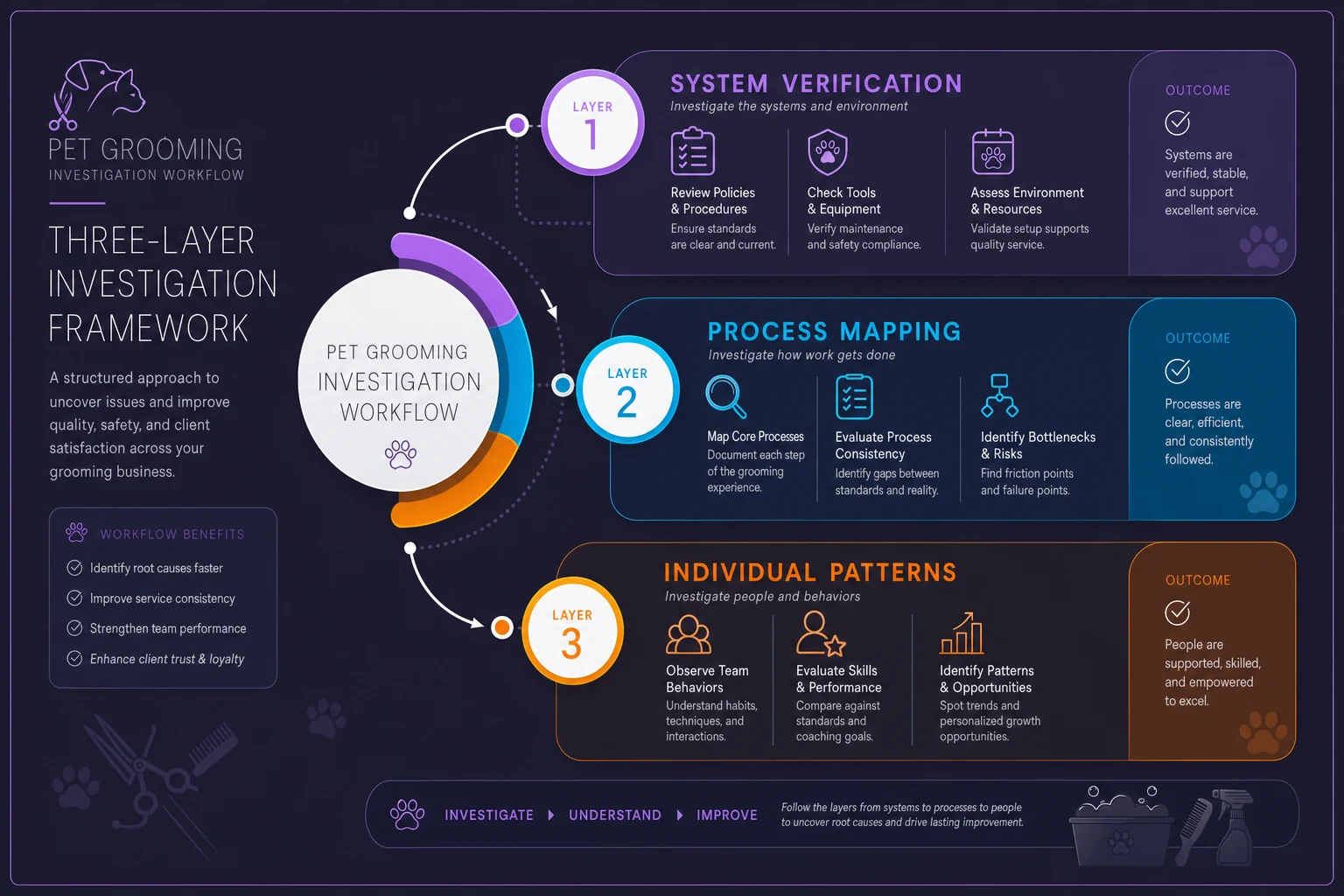
Use this flow to check systems before people, moving from technical verification to process mapping to individual patterns.
Layer 1: System Verification
-
Is the POS calculating correctly?
-
Are all products entered with correct prices?
-
Do barcode scans match price displays?
-
Are discounts applying properly?
Layer 2: Process Mapping
-
Where do verbal processes replace written ones?
-
Are products received but not entered immediately?
-
Are groomers grabbing retail products for services without any tracking?
-
Are returns being processed incorrectly?
Layer 3: Individual Patterns
-
Shift patterns — does shrinkage follow specific people?
-
Transaction patterns — lots of voids, frequent no-sale drawer opens?
-
Behavioral changes — signs of financial stress, attitude shifts?
The table below summarizes what to look for at each investigation layer:
| Investigation Layer | What You're Checking | Common Finding |
|---|---|---|
| System Verification | POS prices, scan accuracy, discounts | Wrong price entry creating phantom shrinkage |
| Process Mapping | Product flow, handoff points, documentation gaps | Groomers pulling retail stock without logging it |
| Individual Patterns | Shift timing, transaction anomalies, behavior changes | Recurring voids tied to one staff member |
The "Process Fix First" rule Even when you catch someone stealing, fix the process that allowed it before anything else. If a groomer could pocket cash because you had no receipt requirement, implement receipts first. Otherwise the next person exploits the same gap.
Building anti-shrinkage into your operational DNA
The best salon retail shrinkage prevention isn't a one-time system implementation. It's baked into how you run every day. That requires embedding anti-shrinkage thinking into your culture, your training, and your daily routines.
Inventory counts that actually happen
Monthly full inventory counts sound great but rarely get done. Rolling counts work better: count one product category each week. Week 1: shampoos. Week 2: treats. Week 3: toys. Week 4: tools and accessories.
This spreads the work, maintains accuracy, and catches problems faster. When flea shampoo is off by six bottles, you're reviewing one week of transactions, not an entire month.
The "Retail Captain" rotation
Assign one team member each month as the Retail Captain. They own retail performance, including shrinkage prevention — spot counts, receipt compliance, small variance investigation.
Rotating monthly prevents burnout and builds team investment. When everyone takes a turn being responsible, everyone understands the importance. Fresh eyes also catch patterns that others stop noticing.
Shrinkage metrics on the daily board
Post your shrinkage percentage where everyone sees it. Update it weekly. Celebrate improvements. When shrinkage drops from 3.5% to 2%, acknowledge it publicly.
One salon owner told me their shrinkage dropped around 40% just from posting the number daily — no other changes. Teams self-police when they can see what they're protecting.
Technology integration without the enterprise price tag
You don't need a $50,000 loss prevention system. Modern operational software can automate the routine parts of shrinkage prevention while keeping human judgment where it actually matters.
The right platform connects your POS data, inventory counts, and staff schedules automatically. When shrinkage spikes, you immediately see who worked, what sold, and where variances occurred — instead of spending hours cross-referencing paper logs. This kind of systematic retail management prevents shrinkage before it compounds.
The investigation workflow particularly benefits from digital tools. Searchable transaction logs, digital receipt records, and automated variance reports turn a day-long investigation into a 30-minute review.
End-of-day reconciliation alerts if someone skips it. Inventory variances trigger immediate notifications. The routine checks that humans forget under pressure get handled automatically.
The compound effect of shrinkage prevention
Most salon owners miss this part: shrinkage prevention pays compound dividends. Save 2% on retail shrinkage, and you're not just keeping that money. You're also:
-
Improving cash flow for inventory purchases
-
Building real staff trust and accountability
-
Creating better customer experiences through accuracy
-
Establishing operational discipline that bleeds into everything else
One grooming salon implemented these protocols and dropped shrinkage from 3.8% to 1.2% over four months. That saved them roughly $200 monthly on $8,000 in retail sales. But the actual win was broader — appointment booking errors dropped, service add-ons got charged correctly, tips distributed properly. Tightening one area of operations tightened everything.
When staff sees you take shrinkage seriously, they take their jobs seriously. They understand that every dollar matters, every transaction counts, and every process exists for a reason.
Making it stick when everything else is chaos
The hardest part isn't designing these systems — it's maintaining them when three dogs are barking, two groomers called in sick, and your biggest client is upset about their poodle's haircut.
Start with just the morning blind count. Do only that for two weeks until it's automatic. Then add the closing routine. Then receipt policies. Building gradually creates lasting habits instead of overwhelming people with a new system they'll abandon by week two.
Make processes visible and physical. Laminated checklists beat digital reminders in a grooming environment. A physical till log beats spreadsheets. When people can touch and see the process, they're more likely to actually follow it.
Tie shrinkage prevention to something the team cares about. When monthly shrinkage stays under 2%, everyone gets a $25 bonus. Or the savings go toward the break room upgrade everyone's been asking about. When the team benefits from the win, they'll protect it.
Your retail products shouldn't be a source of stress and loss. They should be straightforward add-on revenue that boosts margins and serves customers better. The protocols here aren't complicated — they just require consistency. Start with the blind count tomorrow morning and build from there.
The money you save from proper margin management isn't abstract. It's the difference between scrambling to make payroll and having cash reserves. Between stressed operations and confident growth. Between hoping nothing goes wrong and knowing you'll catch it when it does.
Ready to streamline your grooming business?
Join 500+ pet groomers using Furlyly to save time, reduce scheduling conflicts, and deliver exceptional client experiences.