

Most grooming salons don't have a staffing problem. They have a staffing governance problem.
The difference matters. A staffing problem is "I need one more bather for Saturdays." A governance problem is "every time demand shifts, I'm rebuilding the schedule from scratch, my best groomer is quietly resentful, and I have no idea whether I'm over-paying for capacity I'm not using." One is a gap. The other is a system that never got built.
What usually happens is owners react to symptoms. Slow Tuesday? Send someone home. Slammed Saturday? Beg someone to stay late. It works, sort of, until you scale past two or three groomers and the whole thing starts eating your margin and your team's patience at the same time. This piece is about building the connective tissue — demand bands, cross-training priorities, float scheduling, and pay reviews tied to utilization — so grooming salon workforce planning stops being a weekly fire drill and becomes something the business actually runs on.
Why staffing decisions quietly become the most expensive thing you get wrong
Labor is usually 45–55% of a grooming salon's revenue. That's not a line item you eyeball. And yet the two most common failure modes both come from the same root cause: no framework for deciding how much capacity you need before the week starts.
Overstaffing is the sneaky one. Nobody notices it in the moment because the salon feels calm. But if you've got three groomers scheduled on a day that only fills 60% of the chairs, you're paying full labor for a fraction of the output. Do that two or three days a week and you've bled several thousand dollars a quarter into idle hours. It doesn't show up as a crisis. It shows up as "why is payroll so high when we're not even that busy?"
Understaffing is louder but people misdiagnose it too. When you're short, you don't just lose the appointments you couldn't book — you compress your existing groomers, quality slips, incident risk goes up, and your senior people start eyeing the door. Turnover in this industry is brutal, and burnout is one of the biggest drivers. A single experienced groomer walking out can cost you months of client relationships they personally held.
The pattern underneath both: staffing gets treated as a scheduling task instead of a planning discipline. Scheduling is who works Thursday. Planning is how much capacity does this business need across a typical month, and how do we flex around it without breaking anyone. Almost every salon that feels chronically stressed is missing the second layer.
Start with demand bands, not headcount
The first thing to fix is how you think about a "busy day." Owners describe demand in vibes — "Saturdays are crazy, Mondays are dead." Fine for conversation, useless for planning. You need demand bands: a small number of defined tiers that map to actual staffing levels.
Never miss a grooming appointment again.
Furlyly helps you book, confirm, and manage every pet grooming appointment effortlessly.
- Unified appointment scheduling
- Automated client reminders
- Staff availability & shift management
No credit card required
| Demand Band | Typical Fill | Base Groomers | Bathers/Support | Float Coverage |
|---|---|---|---|---|
| A — Peak | 90%+ chairs | 4 | 2 | Float on-call |
| B — Normal | 70–85% | 3 | 1 | None |
| C — Light | 50–65% | 2 | 1 | Cross-trained covers bath |
| D — Slow | Under 50% | 2 | 0 | Consolidate/close early |
Once demand is banded, most weeks build themselves. A typical week might land as A-B-B-C-D-A-C, and your base schedule flows straight from the recipe. You're no longer negotiating headcount seven times a week — you're just reading which band the day falls into.
The mistake people make here is building bands off their best weeks. December volume is not your planning baseline. Build bands off a normal stretch, then treat peak season as a known deviation you staff up for deliberately, not as the standard you feel constantly behind on.
Cross-training is what makes the bands actually work
Bands tell you how many people you need. Cross-training is what lets you move people between roles when reality doesn't match the plan — which is most days.
A rigid team is a fragile team. If your bathers can only bathe and your groomers won't touch a bath, then a slow morning strands your groomers with nothing to do while a suddenly-busy afternoon leaves your bathers slammed. You're paying for capacity you can't reallocate. Cross-training turns fixed roles into flexible ones, and flexibility is the whole game in a demand-driven business.
-
Bathers who can do finish work on low-complexity breeds — this alone smooths most mid-day surges
-
Front-desk staff who can handle intake, consent flags, and basic bathing prep — covers your most common no-show-of-staff scenario
-
At least two groomers comfortable with anxious/senior pet handling — so that skill isn't held by one person who can then never take a day off
-
One person besides you who can run open or close procedures — removes the single biggest owner bottleneck
The theme: you're cross-training to eliminate single points of failure, not to make everyone identical. No revenue-critical skill should live with only one person. If your entire "handles the difficult German Shepherd" capability is one groomer, you don't have a skill — you have a hostage situation. This connects directly to how you structure roles and capacity as you grow, which is worth reading alongside the deeper breakdown in Scaling a Grooming Salon Without Chaos.
A simple way to prioritize who learns what
Prioritize high-frequency, low-difficulty cross-training targets first (teach bathers finish work on easy coats before tackling full breed styling).
Rank cross-training targets by two factors: how often the coverage gap actually hurts you, and how hard the skill is to teach. High-frequency, low-difficulty combinations come first. Teaching a bather to blow-dry and prep finish on easy coats is a few weeks of supervised reps. Teaching full breed-specific styling is months. Do the cheap, high-leverage stuff first and you'll close the majority of your coverage gaps before touching the hard training.
Float scheduling: the shock absorber for a demand-driven salon
Even with good bands and cross-training, real weeks are messy. Someone calls in sick, a Band B day surprises you and behaves like Band A, three anxious-dog appointments land in the same afternoon. This is what float scheduling is for.
A float is a person (or a defined block of hours) not assigned to a fixed station, held deliberately in reserve to absorb variance. The trap salons fall into is either having no float at all — so every disruption becomes a crisis — or floating people so loosely that the float hours become disguised overstaffing. The fix is a template, not improvisation.
-
Identify your variance days. Look at which bands historically swing hardest. Usually it's the shoulder days around your peaks — the Friday before a busy Saturday, or the first warm week of spring.
-
Assign a named float role on those days, drawn from your cross-trained pool, not a new hire.
-
Define the float's default task. Idle floats feel like waste, so give them a productive fallback — retail restocking, deep-cleaning stations, callbacks — that they drop the second demand spikes.
-
Set a trigger rule for activation. For example
"If two same-day bookings land after 9am, the float moves to bathing." Written triggers stop the endless "should I pull them over?" hesitation.
-
Cap float hours per week so it stays a shock absorber, not a permanent extra body.
The insight most owners miss: a float only pays off if the person can actually slot into the role that's under pressure. A float who can't bathe is useless on a bathing-heavy surge. That's why float scheduling and cross-training have to be designed together — one is the plan, the other is the ability to execute it.
When float scheduling is a bad idea
If you're running two people total, you don't have a float, you have a coin flip. Float scheduling starts making sense around four or more staff, when you have enough cross-trained depth that reserving flexible capacity doesn't hollow out your base coverage. Below that, your "float strategy" is really just an owner who stays flexible and a solid on-call arrangement. Don't over-engineer it before you have the headcount to support it.
Tie pay reviews to utilization, not just tenure
This is where most salons leave money and morale on the table simultaneously. Pay raises happen on anniversaries, or when someone threatens to quit, or when the owner feels vaguely guilty. None of that connects pay to the thing that actually matters: how productively that person's hours convert into revenue and quality.
Utilization — the share of a groomer's paid hours that turn into billable service — is the number that should anchor pay conversations. A groomer at 85% utilization delivering clean work and good rebooking is worth more than one at 60% who's technically "senior." When pay drifts away from utilization, two bad things happen: your most productive people feel undervalued and leave, and your least productive people get comfortable being expensive.
You don't need a complicated formula. A quarterly pay-review cadence tied to a few utilization-linked signals is enough:
| Signal | What it tells you | Why it belongs in pay reviews |
|---|---|---|
| Utilization % | Billable hours ÷ paid hours | Core productivity measure |
| Rebook rate | % of clients who rebook | Retention value beyond raw output |
| Cross-training breadth | Roles they can cover | Direct flexibility contribution |
| Incident/redo rate | Quality and risk cost | Guards against "fast but sloppy" |
The cadence matters as much as the metrics. Quarterly reviews keep the conversation continuous and low-drama. Annual-only reviews turn pay into a single high-stakes negotiation where the only leverage anyone has is quitting. A steady cadence tied to visible numbers means raises feel earned and predictable, and it gives you a fair, defensible reason to not raise someone who isn't pulling their weight yet. If you want to go deeper on structuring the people side of this, the framework in Don't Let HR Mistakes Drain Your Salon pairs directly with this cadence.
One caution: never weaponize utilization. If a groomer's number is low because you keep assigning them the anxious, slow, high-care pets, that's a scheduling artifact, not a performance issue. Utilization is a conversation starter, not a verdict.
How the four pieces connect into one system
Individually, these are just tactics. The value is in how they reinforce each other.
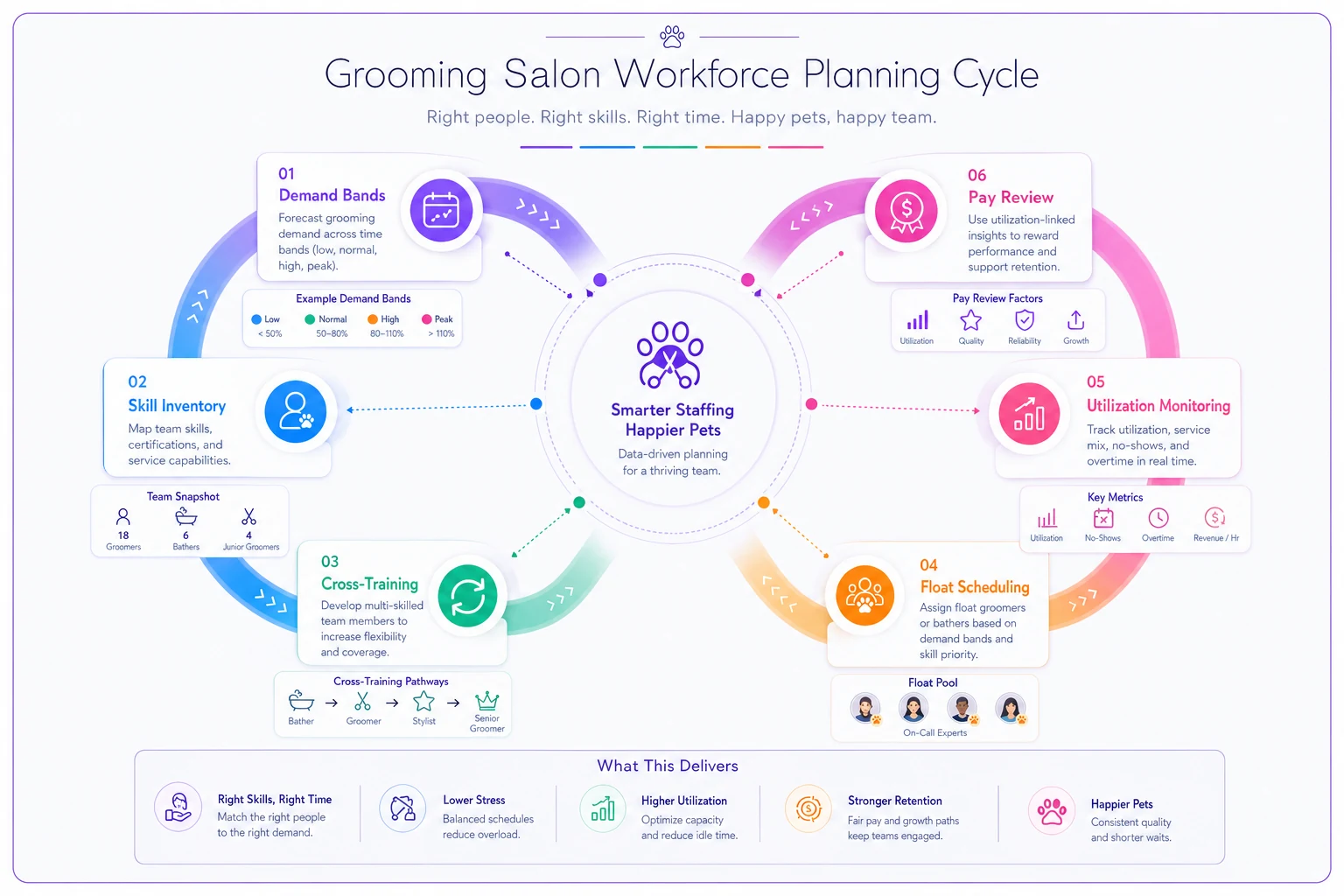
Demand bands set the target capacity. Cross-training creates the flexibility to hit that target when reality wobbles. Float scheduling is the mechanism that deploys the flexibility on the specific days variance shows up. And utilization-linked pay reviews create the incentive loop that rewards the people who make the whole thing run — the cross-trained, high-utilization, low-redo groomers who can flex into a float role without complaint.
Break any one link and the others weaken. Great demand bands with no cross-training means you can't actually flex to hit them. Cross-training with no pay recognition means people quietly stop volunteering to cover. Float scheduling with no utilization tracking means you never learn whether the float is earning its hours. The system is the point — not any single template.
Here's a quick visual of how the pieces fit together.
This is also where the manual version starts to hurt at scale. Tracking utilization across six groomers by hand, updating demand bands as booking patterns shift, and re-running float logic every week is a genuine time sink. AI-assisted scheduling and workforce platforms earn their keep here — surfacing which band a day is trending toward from live bookings, flagging when a groomer's utilization drifts, keeping cross-training coverage visible so you're not holding it all in your head. The judgment stays yours; the platform removes the manual bookkeeping that makes owners give up on governance in the first place.
A real scenario: a three-chair salon that was overstaffed and burning out at the same time
A suburban salon with four groomers and two bathers was doing roughly $52k–$58k a month. On paper, fine. In practice, the owner was frustrated: payroll felt too high and her senior groomer was clearly fried.
When they banded demand, the picture got obvious fast. Mondays and Tuesdays were running under 50% fill with three groomers scheduled — pure overstaffing. Saturdays were slammed with the same three, dumping the overflow of difficult pets onto the one senior groomer who could handle them. She was simultaneously paying for idle capacity early in the week and burning out her best person on weekends.
The fixes were unglamorous. Mondays and Tuesdays dropped to a two-groomer Band C recipe. One bather got cross-trained on finish work for easy breeds over about six weeks. Saturdays added a defined float role and spread the difficult-pet load across two groomers instead of one. Pay reviews moved to quarterly with utilization and rebook rate on the table.
Over the next two quarters, labor as a share of revenue came down a few points — a couple thousand dollars a month back into margin — without cutting anyone's hours meaningfully. The idle hours just moved to where demand actually was. The senior groomer's redo rate dropped and, more importantly, she stopped talking about leaving. Nothing dramatic, no revenue explosion. Just a salon that stopped fighting itself every week.
Where to start if this all feels like a lot
You don't build the whole system at once.
The sequence that works:
-
Week 1–2 Band your last 8–12 weeks of demand. Just get the tiers and staffing recipes on paper.
-
Week 3–4 Identify your single points of failure and pick the two highest-leverage cross-training targets.
-
Month 2 Draft a float template for your two worst variance days, with written activation triggers.
-
Month 3 Move to a quarterly pay-review cadence and start tracking utilization, even roughly, so the first review has data behind it.
The whole thing is really about replacing weekly guesswork with a small set of rules that make the obvious decisions for you — so your energy goes toward the calls that actually need judgment.
Grooming salon workforce planning isn't about squeezing more hours out of people or cutting to the bone. It's about matching capacity to demand closely enough that you stop overpaying for quiet days and stop breaking your team on busy ones.
Get the bands, the cross-training, the float, and the pay cadence talking to each other, and the schedule stops running you.
Ready to streamline your grooming business?
Join 500+ pet groomers using Furlyly to save time, reduce scheduling conflicts, and deliver exceptional client experiences.