



Most grooming owners I talk to don't struggle with making money. They struggle with knowing whether they made money — and then figuring out how much of it they can actually take home without starving the business three weeks later. Those are two separate problems and they compound each other fast.
The core issue is timing. Grooming cash comes in fast and lumpy — a busy Saturday, a slow Tuesday, a pre-holiday rush, then a dead January. Expenses go out on their own schedule: rent on the 1st, payroll every two weeks, supply reorders whenever you run low, quarterly taxes when you've half-forgotten about them. When you pay yourself off gut feel in the middle of all that, you're essentially guessing. And the guess usually goes wrong in the same direction — taking too much when things feel flush.
This article covers the full system: a one-page monthly close checklist, owner-pay decision rules, sample journal entries so your books actually reflect reality, and a 13-week cash forecast with alert thresholds tuned to how grooming money actually moves. The goal is to give you something you can run every month so the guessing stops.
Why the close matters more than the bookkeeping
Bookkeeping is recording what happened. The close is the moment you decide the month is final, reconcile everything, and actually read the result. Skipping a proper close is the most common financial mistake in small grooming operations — not because owners are careless, but because the books "sort of" balance and the bank account "sort of" has money, so it feels done enough.
Here's what that costs you. Tips sitting in your operating account inflate your cash balance, making you feel richer than you are. Card processing fees and chargebacks quietly eat 2.5–3% of revenue and rarely show up as a line anyone looks at. Retail inventory you paid for gets counted as an expense the moment you buy it, so a month where you stocked up on shampoo looks unprofitable when it wasn't. Without a disciplined close, none of that gets corrected, and your draw decision ends up built on numbers that lie.
A real close forces you to separate what's yours, what's the business's, what's the client's (tips, deposits), and what's the government's (sales tax, payroll tax). Once those four buckets are clean, everything downstream — pay, forecasting, planning — gets a lot easier.
The one-page monthly close checklist
Run this on the same day each month, ideally the 2nd or 3rd business day after month-end when card batches have settled. Once your data is clean it should take 60–90 minutes.
Never miss a grooming appointment again.
Furlyly helps you book, confirm, and manage every pet grooming appointment effortlessly.
- Unified appointment scheduling
- Automated client reminders
- Staff availability & shift management
No credit card required
-
Reconcile the bank account — match every deposit and withdrawal against your books. Flag anything unexplained over $20.
-
Reconcile card processor payouts — total gross card sales, subtract fees, confirm the net matches deposits. This is where hidden fee creep shows up.
-
Separate tips from revenue — tips are not your income. Move them out of your revenue number entirely (more on the journal entry below).
-
Record sales tax collected as a liability — not revenue. You're holding it for the state.
-
Count retail inventory — do a physical count or a blind count. Adjust cost of goods to reflect what actually sold, not what you bought.
-
Categorize all expenses — rent, payroll, supplies, insurance, software, processing fees. No "miscellaneous" over $50.
-
Accrue what's owed but unpaid — if payroll or a big supply invoice straddles month-end, record it in the month the work happened.
-
Record owner draws taken — every dollar you pulled, including that "quick $200 from the till."
-
Produce the P&L and read it — revenue, COGS, labor, overhead, net.
-
Update the cash forecast — roll the 13-week model forward one week (covered below).
-
Set next month's owner pay — using the decision rules, not your mood.
Run the checklist on the same day each month so month-to-month comparisons are consistent and easier to spot anomalies.
Here's a quick visual of the monthly-close workflow.
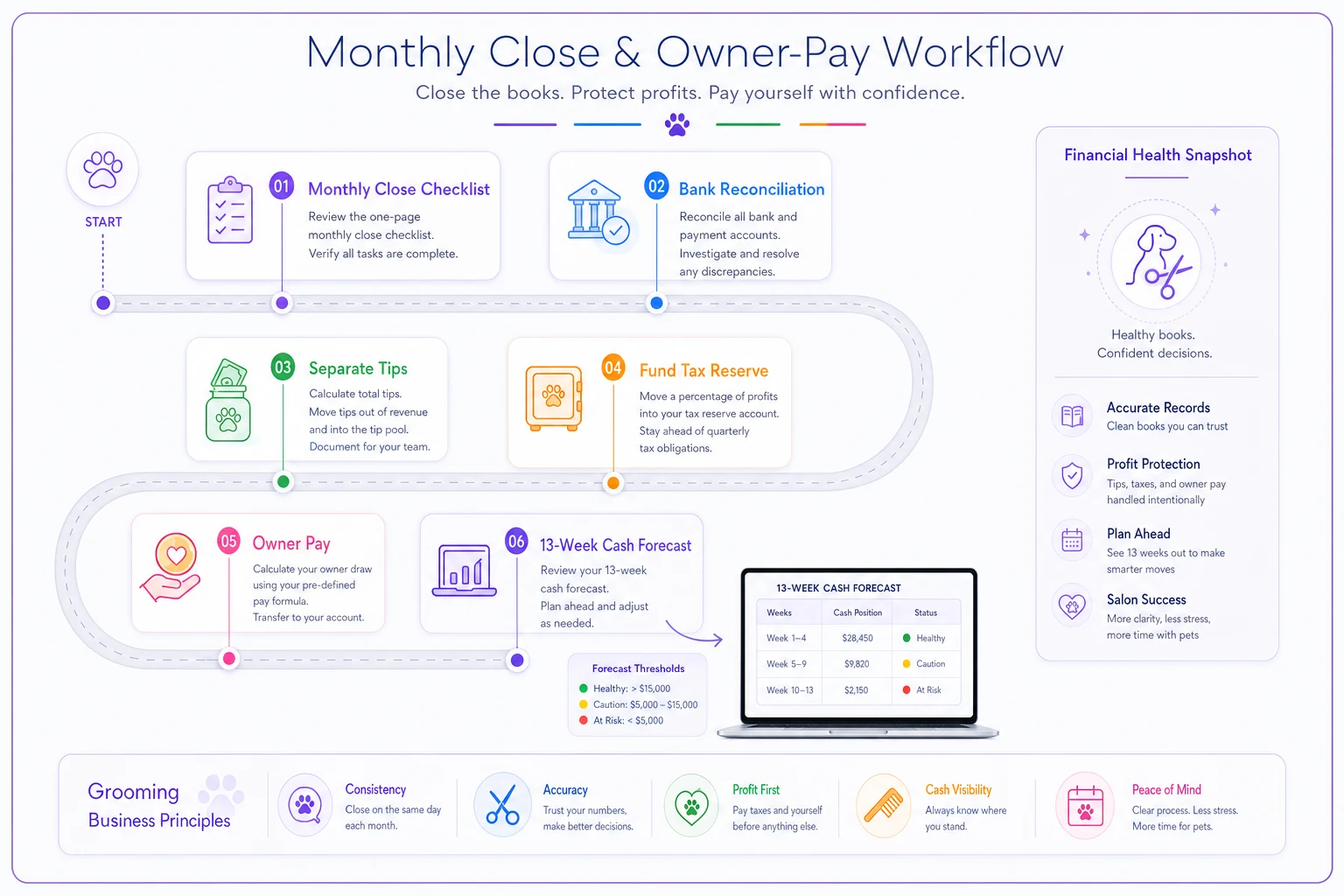
The items people skip most are tip separation and the sales-tax liability. Both make your business look more profitable than it is, and both lead directly to over-drawing.
Sample journal entries tuned to grooming
You don't need to be an accountant, but your books do need to tell the truth. Here are the entries that trip up grooming salons specifically.
A typical grooming day with card sales, tips, and sales tax. Say you rang up $1,000 in grooming services, collected $60 in sales tax (6%), and clients tipped $180 on cards. The processor takes $37 in fees and deposits the rest.
| Account | Debit | Credit |
|---|---|---|
| Cash (bank deposit) | $1,203 | |
| Merchant fees expense | $37 | |
| Grooming revenue | $1,000 | |
| Sales tax payable | $60 | |
| Tips payable | $180 |
Revenue is $1,000 — not $1,240. The tips and tax never touch your income. When you pay tips out to staff on payday, you debit Tips payable and credit Cash. It washes out. If you'd booked the full $1,240 as revenue, you'd think you earned 24% more than you did.
Retail purchase vs. retail sale. When you buy $400 of retail shampoo to resell, that's not an expense yet — it's inventory, meaning an asset:
| Account | Debit | Credit |
|---|---|---|
| Retail inventory | $400 | |
| Cash / Accounts payable | $400 |
Only when you sell it do you record the cost. Sell $150 of retail that cost you $75:
| Account | Debit | Credit |
|---|---|---|
| Cash | $150 | |
| Cost of goods sold | $75 | |
| Retail revenue | $150 | |
| Retail inventory | $75 |
Get this wrong and a stock-up month looks like a loss. This also connects directly to how you read margin by service and product line — the 30-day margin sprint system goes deeper on where the real money leaks.
Owner draw. Draws are not an expense. They reduce owner's equity:
| Account | Debit | Credit |
|---|---|---|
| Owner's draw (equity) | $2,500 | |
| Cash | $2,500 |
If you're operating as an S-corp and paying yourself a salary, that portion runs through payroll instead — but any distributions on top of salary still hit equity, not the P&L. Mixing these up is what makes owners think their business "isn't profitable" when really they just expensed their own pay twice.
Owner-pay decision rules
This is the part everyone actually wants and almost nobody has a real rule for. The instinct is to take what's in the account. That's how you end up funding rent out of next month's deposits.
-
Cover fixed obligations first. Confirm cash is set aside for rent, payroll, loan payments, and the tax reserve for the coming month. If it's not there, you don't pay yourself yet.
-
Fund the tax reserve. Set aside 25–30% of net profit into a separate account for income and self-employment tax. Every month, without exception. The owners who get wrecked in April are the ones who "meant to."
-
Fund an operating buffer. Aim to hold 4–8 weeks of fixed costs in cash before taking a full draw. If you're below that floor, take a reduced draw and keep building.
-
Take a base draw that stays constant. Pick a number you can pay yourself every month even in a slow one — this is your salary equivalent. Consistency beats occasional big pulls.
-
Take a profit distribution only from what's left. Anything above your buffer floor, after taxes are reserved, is fair game — but split it rather than sweeping it to zero.
A workable split for a healthy salon: a fixed monthly base draw, plus a quarterly distribution of maybe 50–60% of surplus cash above the buffer, leaving the rest to carry you through the slow season.
When a bigger draw makes sense
If you've held 8+ weeks of buffer for two straight months, taxes are fully reserved, and you're heading into a historically strong stretch — spring shed season, pre-holiday — pulling a larger distribution is reasonable. You've earned the cushion.
When it's a bad idea
Don't take a discretionary draw in the month you stocked up on inventory (your cash looks high but it's spoken for), right before a known slow month, or when a big annual expense like insurance renewal is 30–60 days out. And if you're financing draws with a card or line of credit, that's not a draw — that's borrowing to feel paid.
The 13-week cash forecast
A monthly P&L tells you if you were profitable. A 13-week cash forecast tells you if you're about to run out of money — which is a completely different question, and the one that actually kills grooming businesses. You can be profitable on paper and still miss payroll because a soft February collided with your insurance renewal.
Thirteen weeks is the right window because it's long enough to see a seasonal dip coming and short enough that your estimates aren't pure guesswork. Build it as a rolling spreadsheet with one column per week.
The structure, top to bottom:
-
Starting cash — this week's real bank balance in the first week; prior week's ending cash after that
-
Expected inflows — projected grooming revenue by week, plus retail, minus a realistic no-show haircut
-
Expected outflows — payroll mapped to your actual pay dates, rent, supply reorders, loan payments, software, processing fees, quarterly tax payments
-
Net weekly change
-
Ending cash — carries into next week's starting cash
The biggest forecasting mistake is treating revenue as smooth. Pull your last 12 weeks of actual weekly deposits and you'll see the real pattern — weekends carry the load, mid-month often sags, holidays swing hard. If you need help translating your booking calendar into a weekly revenue number, the lightweight booking-to-revenue forecast approach links appointments directly to expected cash so you're not pulling numbers from thin air.
Alert thresholds
-
Green — ending cash stays above your 6-week fixed-cost floor every week. Normal operations. Full draw allowed under the rules above.
-
Yellow — projected ending cash dips below the 6-week floor in any upcoming week. Action: pause discretionary draws, delay non-urgent reorders, review the slow week's schedule.
-
Red — projected ending cash drops below 2 weeks of fixed costs, or goes negative, at any point in the 13 weeks. Action: this is a real problem. Cut variable costs, push a promotion into a slow window, chase outstanding balances, and do not take a draw.
The point of the thresholds is seeing the yellow week four to eight weeks before it arrives, when you still have real options. By the time it's red in the current week, every choice is a bad one.
A worked example
A two-groomer salon doing roughly $32k–$36k a month in service revenue, plus some retail. Fixed monthly costs — rent, base payroll, insurance, software, loan — running about $19k. The 6-week cash floor works out to around $28k.
The owner had been taking whatever felt safe, usually $3k–$4k a month, sometimes more after a strong week. On paper the business looked fine. Then a soft mid-winter stretch hit: two weeks of weak bookings, an insurance renewal of about $2,400, and a shampoo restock she'd done on a "good" week the month before. Cash dropped to roughly $9k the week before payroll. She made it, barely, by skipping her own draw and pushing a reorder.
After that close call she built the 13-week forecast and started closing her books properly. First real finding: around $170 a month in processing fees she'd never isolated, and roughly $600/month in tips that had been inflating her "revenue" and her sense of how much she could take. Once tips and tax were separated out, her actual net was lower than she'd assumed — but now it was true.
She set a fixed base draw of $3,200 a month, started reserving 27% of net profit for taxes into a separate account, and rebuilt her buffer to about seven weeks of fixed costs over the following quarter. The forecast flagged the next winter dip in early November — yellow weeks showing up in January. She front-loaded a loyalty promotion into December and trimmed one slow weekday shift in January. That January, cash never dropped below the floor. Same seasonal pattern, completely different stress level. Her revenue didn't change much; her timing decisions did.
How this holds together as the business grows
The reason to treat this as one system rather than four separate chores is that each piece feeds the next, and they break in sequence. A sloppy close produces a P&L that overstates profit. An overstated profit produces an over-generous draw. An over-generous draw drains the buffer. A drained buffer turns the next slow week — which the forecast would have flagged — into a real emergency.
What changes at scale is the cost of getting it wrong. With one groomer, a bad month is a lean personal month. With four or five groomers, a missed forecast means covering a five-figure payroll out of a buffer that isn't there. The habits that feel optional at $30k a month are non-negotiable at $80k, because the swings are bigger in absolute dollars even when the percentages look the same.
The workflow doesn't get more complicated as you grow — it gets more valuable. Same one-page close, same pay waterfall, same 13-week model with the same three thresholds. You just run it with bigger numbers and more discipline. Once these three things are living documents you update on a fixed day each month, paying yourself stops being a source of anxiety and becomes what it should be: a routine decision backed by numbers you actually trust.
Start with one close done properly, build the 13-week forecast from your real weekly deposits, and set your draw by the rules instead of the balance. Do that for three months and you'll have something most grooming owners never get — a clear, unemotional answer to "how much can I actually pay myself right now."
Ready to streamline your grooming business?
Join 500+ pet groomers using Furlyly to save time, reduce scheduling conflicts, and deliver exceptional client experiences.