



Most grooming salons run experiments constantly. They just don't call them that. A new nail-grind add-on gets tossed onto the menu. Someone decides to try 15-minute buffers between big dogs. The front desk starts offering a "first-time deshed" discount because a competitor did it. None of it gets written down, measured, or formally killed when it stops working.
That's the actual problem. It's not that owners don't try new things — it's that the trying is invisible. Nobody can tell you six weeks later whether the nail-grind add-on made money or just added 4 minutes of handling time per dog and annoyed two groomers. The change lingers because removing it feels like admitting failure, and nobody tracked the baseline anyway.
A salon experimentation system fixes that invisibility. Not to make you more scientific for the sake of it — to make every change traceable, time-boxed, and reversible. So you stop accumulating a pile of half-dead policies quietly chewing through your profit.
Why untracked experiments pile up
There's a pattern that shows up in almost every shop once it has more than two or three groomers.
Decisions start getting made at different levels. The owner changes pricing. A senior groomer changes handling procedure. The receptionist changes how add-ons get offered. Each change is reasonable on its own. None of them are connected, and none have an owner responsible for checking if they worked.
So you end up with layers. The menu has a "puppy intro groom" launched 14 months ago for a promotion that ended. There's a loyalty punch card nobody remembers approving. Three different cancellation windows exist depending on who booked the client. Every one of these started as a small test that never got closed.
The cost isn't any single bad decision — it's the sediment. Dozens of untracked micro-changes that individually look fine but collectively make the business impossible to reason about. When margin slips 3 points over a year, there's no single culprit. It's death by forty untracked experiments.
The fix isn't discipline through willpower. It's a lightweight structure that makes closing an experiment as normal as starting one.
The five pieces of a working experimentation system
A real experimentation system for a grooming salon has five moving parts. None of them are complicated. The value is in having all five, because each one plugs a specific leak.
Never miss a grooming appointment again.
Furlyly helps you book, confirm, and manage every pet grooming appointment effortlessly.
- Unified appointment scheduling
- Automated client reminders
- Staff availability & shift management
No credit card required
-
A hypothesis register — one place where every proposed change gets written down before it goes live.
-
An approval flow — a quick gate so the right person signs off, especially on anything touching price or labor time.
-
Measurement templates — a pre-agreed way to tell if the thing worked, decided before you launch.
-
Rollback rules — the conditions that automatically kill the experiment, written down in advance.
-
A monthly learning repository — where results go so the same idea doesn't get re-litigated every quarter.
Here's how each one actually works on the floor.
The hypothesis register
This is just a running list. A row per idea. The point is to force a sentence most owners skip: "We think X will cause Y, and we'll know by Z."
A weak entry: "Try a teeth-brushing add-on."
A real entry: "We think offering a $12 teeth-brushing add-on at checkout will lift average ticket by at least $3 across booked grooms, without adding more than 3 minutes per dog. We'll check after 30 days."
The difference matters because the second version is falsifiable. You can look back and say it failed. The first version drifts forever because there was never a bar it had to clear.
The register also kills duplicate ideas. In a lot of salons the same three or four ideas resurface every few months — a membership plan, a weekend surcharge, a referral bonus — because nobody remembers the last attempt. Once they're logged with outcomes, you stop paying the same tax twice.
A useful register has these columns: idea, hypothesis, who owns it, start date, the metric it moves, the rollback trigger, and status. A spreadsheet works fine to start.
The approval flow (and why it's not bureaucracy)
Owners hear "approval flow" and picture friction. In a small salon it's actually the opposite — it's about making sure changes that affect money and labor time don't happen by accident.
Not every experiment needs sign-off. A groomer testing a new drying order on their own dogs? No approval needed. But anything that touches these three things should pass a gate:
-
Price (discounts, surcharges, bundle changes)
-
Handling time (buffers, slot length, add-ons that extend grooms)
-
Client-facing policy (cancellation windows, deposit rules, no-show fees)
Why those three? Because they all leak quietly. A discount test feels harmless but can erode margin for months before anyone notices. This is exactly the problem covered in the pricing governance board approach — price experiments without an approval-and-rollback gate are the single most common way salons give away margin without realizing it.
The approval step can be a 60-second conversation. The point isn't formality. It's that someone with a view of the whole P&L sees the change before it ships, so a well-meaning front-desk discount doesn't undercut a price increase you made last month.
Measurement templates: decide the scoreboard before you play
This is the piece almost everyone skips, and it's where experiments go to die vague.
The rule is simple: define success before launch, not after. If you wait until after, you'll always find a reason the result was "kind of positive." Humans are excellent at rationalizing decisions they already made.
-
The primary metric (e.g., average ticket, rebook rate, dogs-per-day, add-on attach rate)
-
The baseline number before the change
-
The minimum result that counts as a win
-
The time window and sample size needed to judge it
-
Any guardrail metric that must not get worse (e.g., groomer handling time, complaint rate)
That last one gets forgotten constantly. An add-on might lift ticket by $4 but add 6 minutes per dog, which means you groom fewer dogs and net less for the day. Without a guardrail, you'd call it a win. The experiment templates for lifting average ticket go deeper on how to measure ticket lift without quietly crushing throughput.
| Field | Example |
|---|---|
| Experiment | Checkout teeth-brushing add-on at $12 |
| Primary metric | Average ticket |
| Baseline | ~$68 avg ticket |
| Win threshold | +$3 avg ticket over 30 days |
| Guardrail | Handling time +3 min max per dog |
| Sample needed | ~150 grooms |
| Owner | Front desk lead |
| Decision date | Day 30 |
Notice the sample size. A lot of salons kill or keep an idea off five appointments. Five dogs tells you nothing. You need enough volume that the result isn't just noise — for most single-location shops that means running at least a few weeks before drawing any conclusions.
Rollback rules: the part that actually protects your margin
Rollback rules are the heart of why this whole system is safe to run. They're the pre-written conditions under which an experiment ends — automatically, no debate.
Without a rollback rule, a failing experiment doesn't stop. It just slowly becomes "how we do things." Nobody wants to be the one to reverse a decision, so bad tests calcify into policy.
A rollback rule removes the ego. You wrote it down on day one. When the condition hits, it reverses, and nobody has to argue about it.
-
"If average ticket hasn't improved by $2 after 30 days and 150 grooms, revert to standard checkout."
-
"If handling time exceeds +4 minutes per dog in week two, pause immediately."
-
"If complaint rate on this service exceeds two in a month, roll back and review."
There's also what I'd call a hard-stop rule — a condition that kills the experiment immediately regardless of the metrics, usually tied to safety or a client-trust issue. If a new handling procedure produces even one injury scare, it stops that day. Metrics don't get a vote on safety.
The connection most owners miss: rollback rules only work if your baseline and measurement are already in place. You can't roll back to "normal" if you never recorded what normal was. That's why these five pieces are a system, not a menu.
How it all connects to margin
Step back and look at how these pieces interact, because that's where the real value is.
Your pricing, your labor time, and your retail all pull on the same P&L. An experiment on any one of them ripples into the others. A discount lifts volume but can overbook groomers. A longer slot improves quality but drops dogs-per-day. A new retail push lifts attach rate but slows checkout. None of these live in isolation.
-
An idea gets logged in the register.
-
If it touches price, time, or policy, it goes through the quick approval gate.
-
Whoever owns it fills in the measurement template with a baseline and a guardrail.
-
It launches with a defined end date.
-
At the decision date, the result gets checked against the threshold.
-
It either graduates into standard operations, gets killed by a rollback rule, or gets extended with a clear reason.
-
The outcome — win or loss — goes into the monthly repository so nothing gets forgotten.
That loop is the system. Everything else is detail.
Here's a simple visual of that workflow.
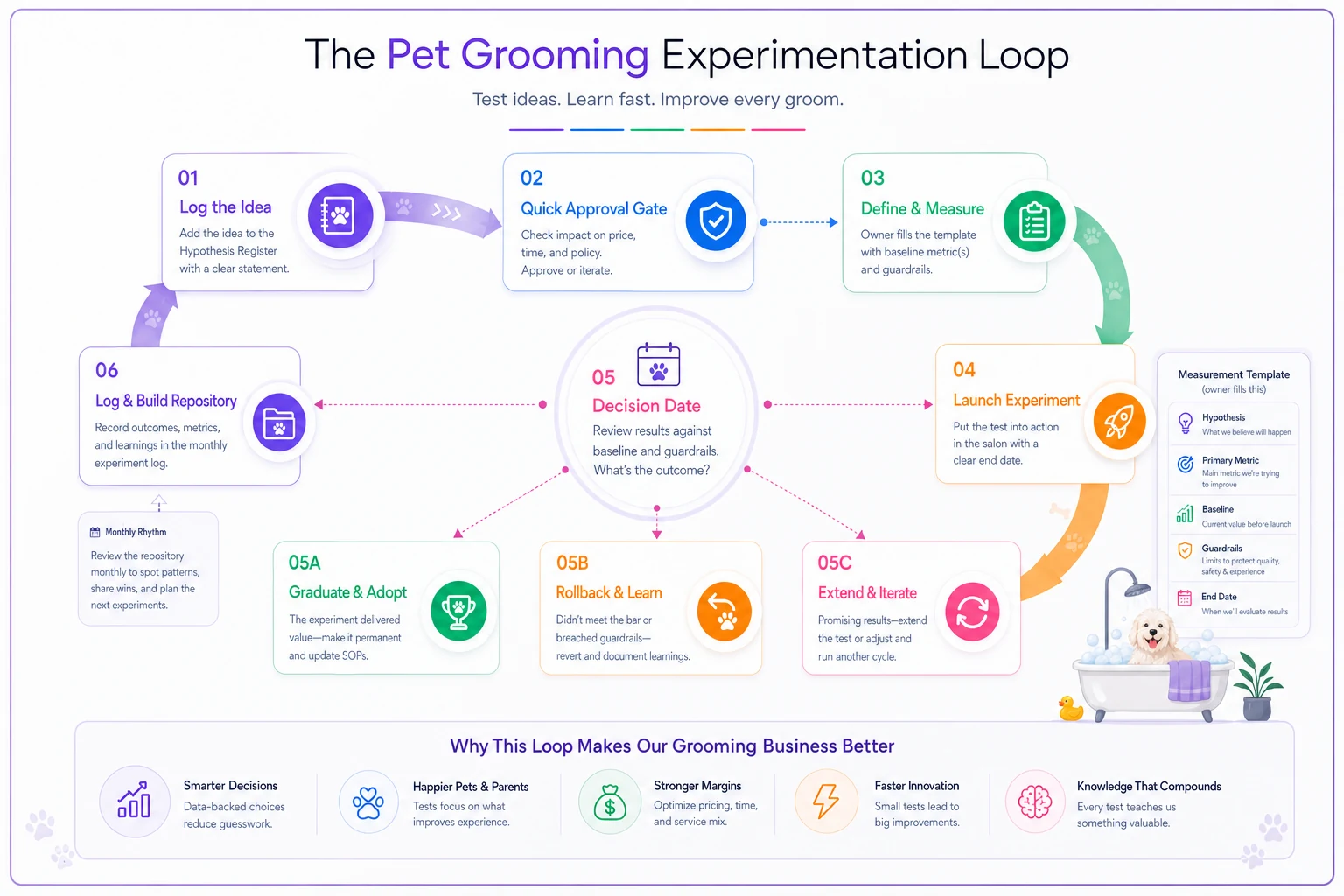
That loop is the system. Everything else is detail.
The monthly learning repository
This is the piece that turns a pile of experiments into actual institutional knowledge.
Once a month, you review what closed. Not a long meeting — 30 minutes max. Each closed experiment gets one line: what you tried, what happened, what you decided.
Two reasons this matters. First, it stops the re-litigation problem. When a staff member suggests weekend surcharges again, you pull up the entry from eight months ago and see it added friction without moving revenue. Decision made in ten seconds instead of another month-long test.
Second, patterns emerge across experiments you'd never see one at a time. After a dozen entries you might notice that every add-on priced under $10 attaches well but every one over $20 flops. That's a pricing insight you only get by looking at your experiments as a set.
A real repository entry is blunt: "Tried $25 'spa upgrade' bundle. Attach rate under 4%. Clients balked at the price jump. Killed day 30. Learning: upgrades above ~$15 don't move at our location."
A real scenario
A two-groomer salon running around 330 grooms a month kept adding menu items and discounts with no tracking. Over roughly a year their average ticket had actually drifted down — not from one bad call, but from a stack of overlapping discounts and an add-on that ate handling time.
They set up a simple register and started closing experiments on a 30-day cycle with rollback rules. The first thing the system caught was a "loyal client" 10% discount applied to about a third of bookings with no end date and no measurable retention lift. Rolled back.
Over the next quarter they ran four clean experiments. Two failed and got rolled back quickly — which cost them almost nothing because the rollback rules caught them fast. One add-on graduated and lifted ticket by a few dollars without hurting throughput. The net effect wasn't dramatic in any single month, but their average ticket recovered and climbed modestly. More usefully, they finally knew why it moved.
The real win wasn't the few dollars. It was that they stopped accumulating untracked changes. The sediment stopped building.
When this makes sense — and when it doesn't
When it's worth it:
-
You have more than one or two people making operational changes
-
You run promotions, discounts, or new services more than a couple times a year
-
Your margin has drifted and you can't point to why
-
You're planning to add locations and need changes to be traceable
When it's overkill:
-
You're a true solo mobile groomer with a fixed menu and no staff. You can hold the whole operation in your head. A formal register adds friction without payoff until you scale.
Who should NOT bolt this on yet:
Anyone whose basics aren't in place. If you don't have reliable numbers on average ticket, handling time, and rebook rate, build that visibility first. Experimentation runs on baselines. Without a baseline, every rollback rule is guesswork and every "win" is a story you told yourself.
Starting without overbuilding it
You don't need software to begin. A shared spreadsheet with the register, a note on who approves price changes, and a recurring monthly 30-minute review will get you most of the value. The discipline matters more than the tooling.
As volume grows and changes multiply across multiple groomers or locations, the manual version gets heavy. Baselines become tedious to pull, guardrail metrics are easy to forget to check, and someone has to remember every decision date. That's when AI-powered operational software that tracks changes, flags rollback triggers automatically, and keeps the learning log in one place starts earning its keep. But that's a scaling convenience, not a starting requirement.
The system works on paper first. The core idea is simple enough to hold in one sentence: every change gets a hypothesis, a measurement, and a way out. Do that consistently, and you stop accumulating the quiet layer of decisions nobody owns and nobody measures — the layer that's been eating your margin the whole time.
Ready to streamline your grooming business?
Join 500+ pet groomers using Furlyly to save time, reduce scheduling conflicts, and deliver exceptional client experiences.