



Most grooming salons don't lose margin because of one bad pricing decision. They lose it through dozens of small, uncoordinated ones that nobody tracks. A front desk person offers 15% off to smooth over a late groom. A manager runs a "back-to-school" special and forgets to turn it off in November. One groomer quietly keeps charging the old rate for a handful of loyal clients because "they've been coming forever."
None of these feel like a big deal in isolation. Added up over a year, they're the difference between a salon that hits its numbers and one that's constantly wondering where the money went.
The fix isn't stricter rules or yelling at the team. It's grooming pricing governance — a lightweight system for how price changes get proposed, approved, measured, and rolled back. Think of it less as bureaucracy and more as guardrails that let you experiment aggressively without leaking profit while you do it.
Why pricing tests turn into margin leaks
There's a pattern that shows up in almost every salon that "tests pricing" without a system behind it.
Someone has a good idea. Maybe it's a bundled bath-and-nail add-on, maybe it's a Tuesday discount to fill slow slots. They launch it. For the first few weeks, everyone remembers why it exists and roughly how it's doing. Then the person who launched it gets busy, the promo stays live, and it drifts into the background. Six months later nobody can tell you whether it made money — but the discount is still baked into a third of your bookings.
The deeper issue is that a price test has a beginning most people execute well and an ending almost nobody executes at all. Launching feels productive. Killing something feels like admitting failure, so tests just... linger. And a lingering test isn't a test anymore. It's a permanent price cut you never actually decided to make.
There's also the coordination problem. In a two-person shop, one person holds all the pricing in their head. Once you've got three or four groomers plus a front desk, pricing lives in five different heads — and each of those heads has a slightly different version of "what we're doing right now." A client gets quoted $75 by one person and $68 by another for the same doodle, and now you've got an awkward conversation and a discount you didn't plan.
What actually breaks as you add staff and locations
At a single chair, pricing governance is trivial. You know every price because you set every price. The trouble starts the moment decisions get delegated.
Never miss a grooming appointment again.
Furlyly helps you book, confirm, and manage every pet grooming appointment effortlessly.
- Unified appointment scheduling
- Automated client reminders
- Staff availability & shift management
No credit card required
The discount authority problem. Once front desk staff can offer goodwill discounts, you need a ceiling. Without one, "sorry about the wait, here's 10% off" becomes the default apology for every operational hiccup, and your service recovery gets funded straight out of margin. Salons where unauthorized goodwill discounts quietly ate 3–4% of revenue before anyone connected the dots are more common than you'd think.
The overlapping-promo problem. One person launches a new-client offer. Another runs a loyalty punch card. A third sets up a referral credit. Individually, fine. Stacked on the same appointment, you're sometimes grooming a dog for barely above labor cost — and nobody built the rule that says these can't combine.
The "which price is real" problem. As your service menu grows — and if you've built out tiered packages the way we've covered in Pricing Architecture for Grooming Packages, it will — the number of live prices multiplies. Add a few active experiments on top and your team genuinely can't tell what's a permanent rate versus a test versus an expired promo that's still sitting in the system.
The measurement gap. Even salons that track revenue rarely track it at the experiment level. So you know June was up, but you can't say whether the bump came from your new senior-dog package or just from summer demand. Without isolating the test, you're guessing — and guessing usually means keeping promos that feel good instead of ones that actually pay.
The pricing governance board: what it is and who's on it
"Board" sounds formal. In a grooming salon it's usually just you plus one or two people who touch pricing decisions — a lead groomer and whoever runs the front desk. The point isn't the meeting. It's that no price change goes live without passing through one accountable checkpoint.
-
Approval — deciding which pricing experiments actually run
-
The experiment register — one central record of every active and past test
-
Thresholds — the success/failure numbers set before a test starts
-
Rollback — the pre-written plan for turning a test off cleanly
The mindset shift that makes this work: you decide how a test ends before it begins. Not the vibe — the actual number. "If this add-on doesn't hit a 40% attach rate within 6 weeks, we kill it." Writing that down before launch removes the emotional attachment that keeps dead promos alive.
The central experiment register
This is the single most valuable piece, and it can live in a spreadsheet. The register is one row per pricing experiment, and it exists so that anyone — including future-you — can look up exactly what's running, why, and when it's supposed to end.
A workable register has these columns:
| Field | Example entry |
|---|---|
| Experiment name | Tuesday off-peak 12% |
| Owner | Maria (front desk lead) |
| Start / end date | Sep 3 – Oct 15 |
| Hypothesis | Fills 6+ empty Tues slots/week |
| Baseline metric | Tues currently ~40% booked |
| Success threshold | ≥65% booked, margin per slot ≥ $22 |
| Failure threshold | <50% booked after 4 weeks |
| Rollback plan | Remove code, revert to standard rate, notify team in Slack |
| Status | Active / Won / Killed / Rolled back |
The register does two jobs at once. It stops experiments from silently becoming permanent — every row has an end date — and it kills the "which price is real" confusion because there's now one place that lists every non-standard price and its expiration.
One pattern worth flagging: salons that keep a register almost always discover they have more live experiments than they thought. The first time an owner fills this out, they'll typically find three or four "temporary" offers that have been running for over a year. That first cleanup alone often recovers a meaningful chunk of margin.
Setting success and failure thresholds that actually mean something
The mistake here is measuring the wrong thing. A discount promo will almost always increase bookings — that's not the question. The question is whether it increased margin, and whether those bookings would've happened anyway at full price.
-
Contribution margin per appointment, not revenue. A promo that lifts revenue but drops your margin per groom below your labor-plus-supplies cost is losing money faster the more it "works."
-
Incremental vs. cannibalized bookings. If your Tuesday discount just moved clients who'd have booked Wednesday at full price, you didn't gain anything — you handed regulars a discount. Watching whether total weekly volume rises, not just Tuesday, tells you which one is happening.
Set a clear failure threshold, and make it something you'll actually act on. "Not great" is not a threshold. "Below 50% booked after 4 weeks, we roll it back" is. The failure line matters more than the success line, because the whole point of governance is having a pre-agreed reason to stop.
If you want deeper templates for structuring the tests themselves — sample sizes, what to hold constant, how to read the results — we went into that in Stop Leaving Money on the Table: Experiment Templates to Lift Your Grooming Average Ticket. The governance board sits on top of those experiments; it decides which ones run and enforces how they end.
Rollback templates: the part everyone skips
A rollback template is a pre-written checklist for cleanly ending a price test. It exists because "turn it off" is deceptively complicated once a promo has been running for a while. There's the pricing code in your booking system, the sign at the front desk, the note in the online form, the groomers who memorized the promo rate, and the handful of clients who've come to expect it.
Miss one of those and the test doesn't actually end — it just gets quieter.
-
[ ] Remove or deactivate the promo code / adjusted price in the booking system
-
[ ] Revert the affected services to standard pricing
-
[ ] Update any physical signage or printed menus
-
[ ] Update the online booking page and intake forms
-
[ ] Tell the whole team the test is over and what the price is now
-
[ ] Decide how to handle regulars who got used to the promo rate
-
[ ] Mark the experiment "Rolled back" in the register with a one-line result note
That last point about regulars is the one that trips people up most often. If a promo ran long enough for clients to expect it, ending it silently generates confused — sometimes angry — price conversations at checkout. A one-sentence script for the front desk ("that was a fall special that's wrapped up — your standard groom is $X") stops the desk from just re-offering the discount to make the moment less awkward.
A workable approval workflow
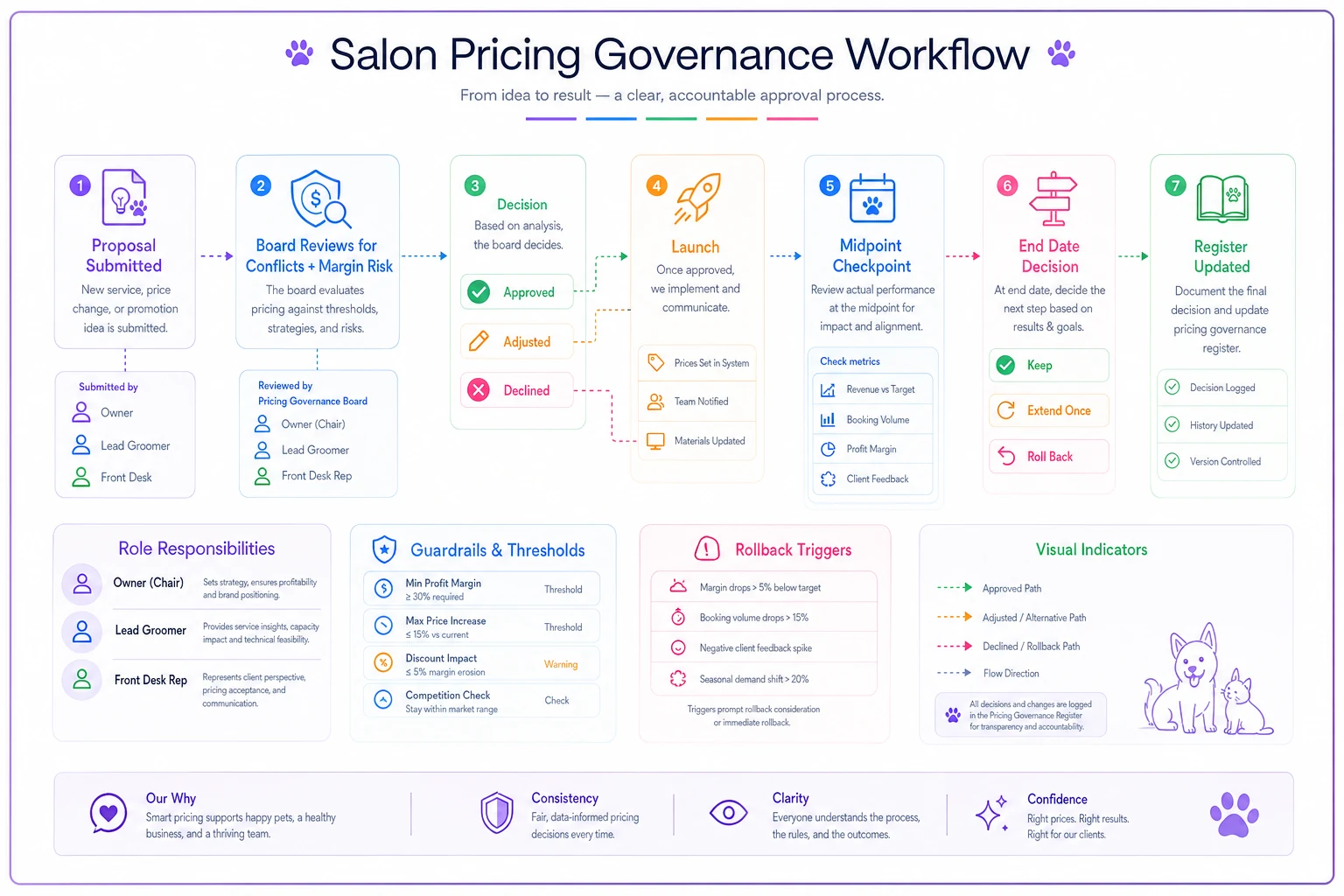
Below is the flow from idea to result, kept light enough that people actually follow it:
[Proposal Submitted] → [Board Reviews for Conflicts + Margin Risk] → [Approved / Adjusted / Declined] ↓ [Launch: Prices Set, Team Notified, System Updated] ↓ [Midpoint Checkpoint: Compare Against Thresholds] ↓ [End Date Decision: Keep / Extend Once / Roll Back] ↓ [Register Updated with Result]
-
Proposal. Anyone can pitch a pricing test — but it goes to the board as a single filled-in register row (hypothesis, thresholds, rollback plan). If someone can't fill in a failure threshold, the idea isn't ready.
-
Approval. The board checks two things
does this overlap or conflict with a live experiment, and can it stack with existing promos in a way that guts margin? Approve, adjust, or decline.
-
Launch. Owner sets the exact prices, communicates to the full team on one channel, and confirms the booking system reflects it.
-
Checkpoint. A quick review at the midpoint against the thresholds. Trending toward failure? Kill it early — you don't owe a bad test its full run.
-
Decision. At the end date
keep (make it permanent, remove from experiments), extend once with a reason, or roll back using the template.
-
Record. Update the register with the result. The dead experiments are as valuable as the winners because they stop you from re-running the same bad idea next year.
The friction is intentional but small. Requiring a failure threshold before launch filters out half-baked "let's just try a discount" ideas without slowing down genuinely good ones.
When this makes sense — and when it's overkill
When to build this now: You've got three or more people who can influence pricing, you're running more than one promo at a time, or you honestly can't name every non-standard price currently live in your system. Those are the conditions where leaks hide.
When it's overkill: You're a solo groomer or a two-person shop where one person sets every price and remembers every promo. A full board is bureaucracy you don't need — though even solo operators benefit from the register and rollback checklist, because memory fails and "temporary" promos drift regardless of headcount.
Who should not skip this: Anyone whose justification is that their team "just knows." Pricing lives in people's memory until it doesn't — and the salon that's most confident everyone knows the rates is usually the one leaking the most.
A real scenario
A three-groomer salon doing roughly 320–350 grooms a month sat down to build their first experiment register. Before that, pricing was managed informally — the owner set base rates, but the front desk had unofficial authority to discount, and there were a couple of long-running specials nobody could quite date.
Filling out the register surfaced the problem immediately. They found four live promos, two of which had been running for well over a year, plus a pattern of goodwill discounts averaging around 8–10% on a meaningful share of appointments. One "new client" discount was being applied to repeat clients because the front desk didn't have a clean way to check.
They didn't overhaul pricing. They closed the two stale promos, capped front-desk goodwill discounts at a fixed dollar amount requiring a reason code, and moved every remaining test into the register with hard end dates. Nothing dramatic on the surface. But contribution margin per groom improved by a few dollars across the board, and over the following couple of months that quietly added up to somewhere in the low thousands they'd simply been giving away. No new clients, no price hike on standard services — just plugged leaks.
That's usually how it goes. The margin isn't missing because of one bad decision. It's scattered across a dozen small ones that never got cleaned up.
The point isn't control, it's confidence
Governance sounds like the opposite of experimentation, but it's actually what lets you experiment more. When every test has a defined end and a clean rollback, you can afford to try aggressive offers — because a failed one costs you a few weeks instead of quietly bleeding for a year. The register turns pricing from a collection of half-remembered decisions into something you can actually reason about.
The salons that leak margin aren't the ones testing too many prices. They're the ones that never decided how any of those tests were supposed to end. Fix that, and you can push on pricing as hard as you want — you'll always know exactly what's running, what it's costing you, and how to shut it off.
The salons that leak margin aren't the ones testing too many prices. They're the ones that never decided how any of those tests were supposed to end. Fix that, and you can push on pricing as hard as you want — you'll always know exactly what's running, what it's costing you, and how to shut it off.
Ready to streamline your grooming business?
Join 500+ pet groomers using Furlyly to save time, reduce scheduling conflicts, and deliver exceptional client experiences.