

Most groomers inherit their product shelf. You open with whatever your trainer used, your distributor pushed, or what was cheap when you were still figuring out margins. Then years pass, the shelf grows, and nobody ever sits down to ask the uncomfortable question: why do we still use this?
That's the gap this article fills. Not compliance — we've already covered the regulatory side in detail in the Salon Chemical, Waste and Environmental Compliance Checklist. This is about the deliberate, multi-month process of moving your salon toward safer chemistry on purpose, in a way that protects your staff's lungs and hands, reduces liability, and actually becomes something clients notice and pay for.
Chemical stewardship isn't a single decision. It's a chain of connected ones — procurement, training, client communication, pricing — and when owners treat it as a one-off product swap, the whole thing quietly falls apart. Here's how the system holds together and where it typically breaks.
Why the product shelf drifts toward hazard
Nobody decides to build a dangerous shelf. It accumulates.
A groomer leaves and the replacement brings their favorite dematting spray. A distributor rep drops off samples of a high-pH degreaser that cuts wash time by two minutes, so it sticks. Flea season hits and suddenly there are three pesticide-adjacent products under the sink that nobody logged. Six months later you've got a dozen SKUs with no shared logic, half of them carrying quaternary ammonium compounds, formaldehyde-releasing preservatives, or fragrance loads that trigger your most chemically-sensitive bather's eczema.
A pattern that shows up repeatedly: salons track what they spend on products far more carefully than what those products actually contain. You know the degreaser costs $34 a gallon. You probably couldn't tell me its pH, its primary surfactant, or whether it's the reason your senior groomer's hands crack every winter.
That blind spot is the real problem. Hazard hides inside convenience, and convenience compounds with scale. A two-person salon can get away with informal product knowledge. A six-station operation with rotating staff cannot — because now the person using the product isn't the person who bought it, and the safety context is lost in translation.
What breaks when you grow
Here's the sequence that plays out in growing salons, and it's worth understanding before you start swapping anything.
Never miss a grooming appointment again.
Furlyly helps you book, confirm, and manage every pet grooming appointment effortlessly.
- Unified appointment scheduling
- Automated client reminders
- Staff availability & shift management
No credit card required
At one or two groomers, chemical risk is fairly contained because one experienced person handles the dangerous stuff and knows the quirks. At three to five, you start delegating dilution and mixing to junior staff who follow habit, not understanding. Dilution ratios drift. Someone double-doses the whitening shampoo because "the last batch didn't work." Ventilation that was fine for occasional use now runs eight hours a day.
By the time you're running multiple stations or a second location, you've got invisible liability spread across people who were never properly trained on what they're actually touching. One bad reaction — a dog with chemical burns, a bather with a respiratory complaint, a client whose allergic pet reacts to residual fragrance — and you're explaining to an insurer why you had no documented product control.
The connection most owners miss: your chemical shelf is tied to your equipment, your ventilation, and your water system. Harsh degreasers wear out dryer motors and corrode tub fittings faster. Which means stewardship isn't just a safety topic — it feeds directly into the kind of downtime problems covered in Prevent Equipment Downtime: A Maintenance Schedule, Spare-Parts Par and Emergency Swap Plan for Grooming Salons. Gentler chemistry often means longer equipment life. That's a line item almost nobody calculates.
The transition roadmap
A real transition takes time, and rushing it is how you end up with a shelf full of half-used products and a confused team. Here's the structure that actually holds up, phased over roughly a year.
Phase 1 — Inventory and classify (weeks 1–4)
You can't substitute what you haven't mapped. Pull every product off every shelf, including the ones in the back, the van, and the mop closet. For each one, record:
-
Product name and current cost per use (not per container)
-
Primary function (degrease, whiten, deshed, sanitize, etc.)
-
Key hazard flags from the safety data sheet — pH extremes, sensitizers, VOCs, corrosives
-
Who uses it and how often
-
Whether it's actually essential or just habitual
Most salons discover they have three products doing one job and one product nobody remembers buying. The classification alone usually lets you cut 20–30% of SKUs before you substitute anything.
Phase 2 — Prioritize substitutions (weeks 5–8)
Not everything swaps at once. Rank candidates on a simple two-axis logic: how hazardous versus how easy to replace. The high-hazard, easy-swap products go first — those are your quick wins that build staff confidence. High-hazard, hard-to-replace products (heavy-duty sanitizers, for example) go last and get the most testing.
Phase 3 — Test in parallel (weeks 9–20)
This is where owners get impatient and fail. You don't rip out a working product and hope the replacement performs. You run them side by side on real dogs, with real staff, for real weeks. Track wash time, result quality, rinse-out, dilution economy, and skin reactions. A "greener" shampoo that needs double the product and an extra rinse cycle isn't a win — it's a cost increase in disguise.
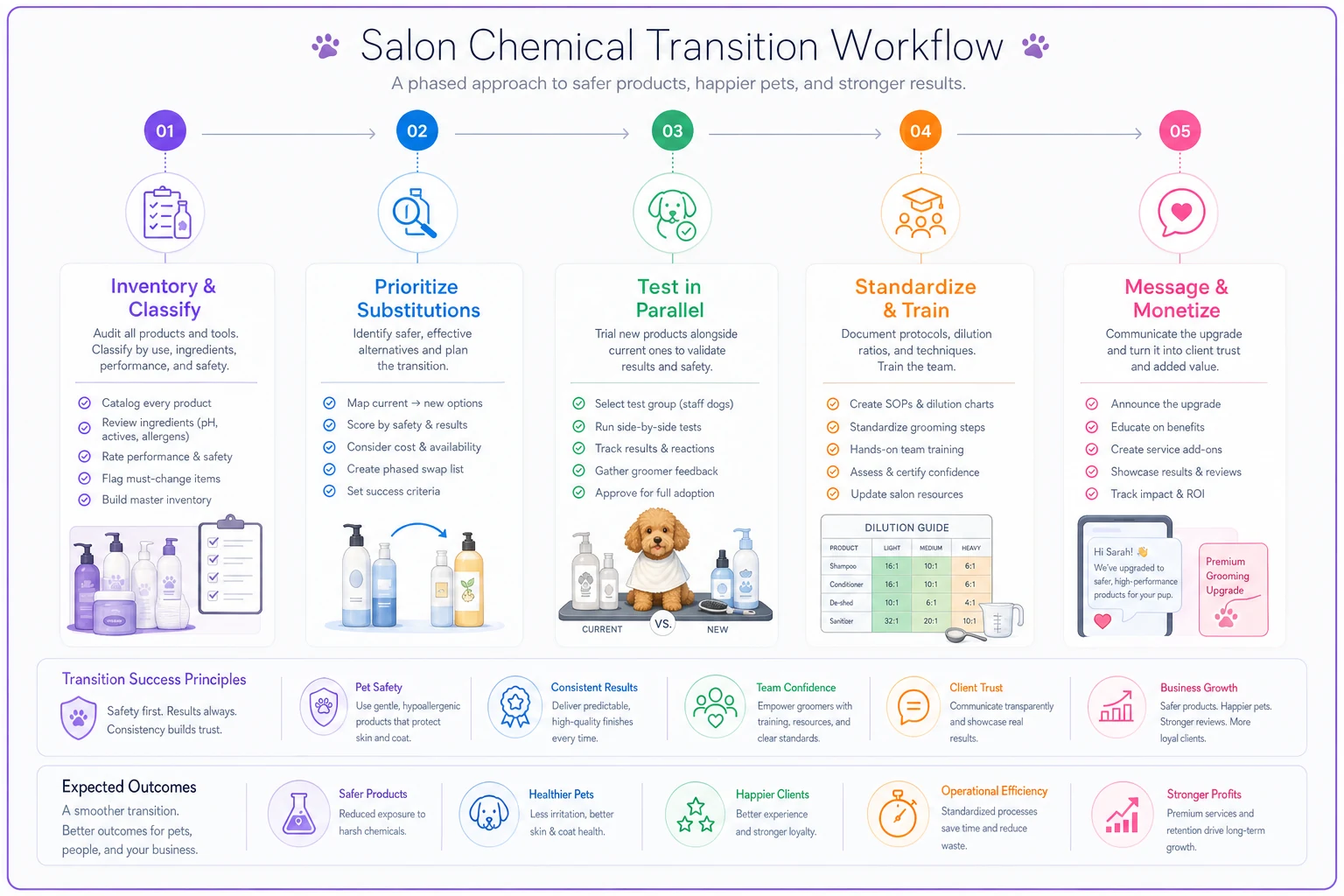
A simple visual to keep the phases straight while you're planning and assigning tasks.
Phase 4 — Standardize and train (weeks 21–36)
Once a substitute passes, lock it in. New dilution charts posted at every station. Updated safety data sheets filed. A short training session so every groomer understands not just how to use it but why it changed. Staff who understand the reasoning stop reverting to old habits.
Phase 5 — Message and monetize (weeks 37–52)
Now, and only now, you tell clients. More on that below — because the sequencing matters. Announcing a "safer salon" before your team is actually consistent is how you create a promise you can't keep.
A substitution checklist you can actually use
Before you approve any replacement product, it should clear all of these:
-
[ ] Performs equal or better on your three most common coat types
-
[ ] Dilution economy is equal or better (cost per groom, not per bottle)
-
[ ] pH is within a skin-safe range for the intended use
-
[ ] No formaldehyde-releasing preservatives or known strong sensitizers
-
[ ] Lower VOC / fragrance load than what it replaces
-
[ ] Safety data sheet is current and on file
-
[ ] Staff tested it for at least two weeks without complaints
-
[ ] Doesn't require new equipment you haven't budgeted for
-
[ ] Vendor can supply consistently (no mystery backorders)
-
[ ] Rinses cleanly — no residue clients or sensitive pets react to
If a product fails even two of these, it's not ready. Keep testing or keep looking.
The vendor conversation nobody has
Distributors are used to groomers asking two things: price and availability. The moment you start asking about chemistry, you'll learn a lot — including which reps actually know their catalog and which are just moving boxes.
Here's a Q&A script to run with every vendor before you commit to a substitution:
| Question to ask the vendor | What a good answer sounds like | Red flag |
|---|---|---|
| What's the pH of this at working dilution? | A specific number or tight range | "It's gentle, don't worry about it" |
| What preservative system does it use? | Named, and they can explain it | Can't say, or deflects |
| Any known sensitizers or allergens? | Honest disclosure with the SDS | "Totally safe for everyone" |
| What's the cost per groom at recommended dilution? | They'll help you calculate it | Only quotes container price |
| Can you guarantee consistent supply for 12 months? | Yes, with lead times | Vague on availability |
| Do you have salons my size using this already? | Real references | Generic reassurance |
| What happens to performance in hard water? | A real answer | Blank stare |
A vendor who can't answer the chemistry questions is selling you blind, and you're reselling that blindness to your staff and clients. The good vendors become genuine partners in this — they'll pull formulations, suggest alternatives, and sometimes admit a product isn't right for you. Those are the relationships worth keeping.
Telling clients without overpromising
Chemical stewardship only becomes a brand asset if you communicate it correctly. Done badly, it reads as marketing fluff and invites skepticism. Done well, it becomes a quiet differentiator that justifies a premium.
Be specific, not vague. "We use gentler, lower-irritant products" means nothing. "We switched to fragrance-free, pH-balanced shampoos because so many of our clients' dogs have sensitive skin" tells a story a worried owner actually relates to.
Lead with the pet, not the planet. Most grooming clients care more about their dog's itchy skin than about VOCs in the air. Frame the benefit around the animal first, sustainability second. The environmental angle is real and worth mentioning, but it's the supporting act.
Don't claim what you can't prove. Avoid "chemical-free" (nothing is) and "all-natural" (meaningless and legally risky). Say what you actually did: what you removed, what you replaced it with, and why.
A simple client-facing message that works, posted at reception and in booking confirmations: "We've moved to lower-irritant, fragrance-light products across our wash stations — better for sensitive skin, better air for our team, and gentler on your pup. Ask us if your dog has specific skin needs."
That last line matters. It turns a one-way announcement into an intake conversation, which is where you catch the allergy flags that prevent complaints later.
A real scenario with the numbers
A three-groomer suburban salon doing roughly 300–330 grooms a month decided to run this transition after their most experienced bather developed contact dermatitis severe enough to miss shifts.
Their starting shelf had 14 active products. After the Phase 1 inventory, they cut to 9 — three of the eliminated ones were redundant degreasers. Over the following months they substituted four high-hazard products, with the whitening shampoo and the main deshedding solution taking the longest to get right because the first replacements rinsed poorly.
The cost picture surprised them. A couple of the "safer" products were more expensive per container, but because dilution economy improved and they stopped double-dosing, their monthly product spend landed within about $40–$60 of where it started — essentially flat. The bather's dermatitis cleared within about six weeks of removing the main culprit, and they stopped losing her to sick days.
The brand payoff came slower and mattered more. They repositioned their standard bath as a "sensitive-skin-safe wash" and added a modest $4 bump to it. Over the following year, with clients actively choosing them for dogs with skin issues, that line alone added somewhere in the range of $3k–$5k. Not life-changing, but it more than covered the transition effort — and the reduced staff turnover and equipment wear were the quieter wins that never show up on a single invoice.
When this makes sense — and when it doesn't
This makes sense when you've got rotating or growing staff, you've had even one skin or respiratory complaint, your client base skews toward people who fuss over their pets, or you're repositioning toward a premium market. The transition pays for itself through retention, liability reduction, and pricing power.
This is a bad idea when you try to do it all in one month, when you swap products without parallel testing, or when you announce the change before your team is actually consistent. A rushed transition produces inconsistent results and erodes the trust you were trying to build.
Who should probably wait: a brand-new salon still figuring out its core workflow. Nail down your service quality and your basic product logic first. Stewardship is a refinement layer, not a foundation — chasing it before your operations are stable just adds variables you can't control yet.
Keeping it from drifting back
The hardest part isn't the switch — it's not sliding back into the old pattern of random product accumulation. The salons that hold the line do a few things consistently: they require any new product to clear the substitution checklist before it enters the building, they keep safety data sheets current and accessible, and they revisit the full shelf inventory once or twice a year.
This is where a shared operational system earns its keep. When your product list, dilution charts, reorder rules, and vendor records all live in one place your whole team can access — rather than in one owner's head and a stack of binders — the stewardship you built actually survives staff turnover. The goal isn't more software for its own sake; it's that the next junior groomer you hire inherits the reasoning, not just the bottles.
Schedule the annual inventory on the same month every year so it becomes an operational habit rather than a one-off task.
Chemical stewardship rewards owners who treat it as an ongoing operating discipline rather than a project with an end date. Map what you have, question what you buy, test before you commit, train the why, and only then tell the world. Do it in that order and the safety, the savings, and the brand all follow.
Chemical stewardship rewards owners who treat it as an ongoing operating discipline rather than a project with an end date. Map what you have, question what you buy, test before you commit, train the why, and only then tell the world. Do it in that order and the safety, the savings, and the brand all follow.
Ready to streamline your grooming business?
Join 500+ pet groomers using Furlyly to save time, reduce scheduling conflicts, and deliver exceptional client experiences.