

Most groomers already have some kind of loose relationship with a vet or two, maybe the pet store down the block. Someone drops off a stack of business cards, everyone shakes hands, and then nothing happens. Six months later you can't say whether a single client walked through your door because of it.
That's the real problem with groomer referral partnerships. It's not that vets and retailers won't refer — plenty are happy to. It's that most grooming salons treat the partnership as a vibe instead of a mechanism. No tracking, no offer worth mentioning, no reason for the vet tech to remember your name at the exact moment a client asks "do you know a good groomer?"
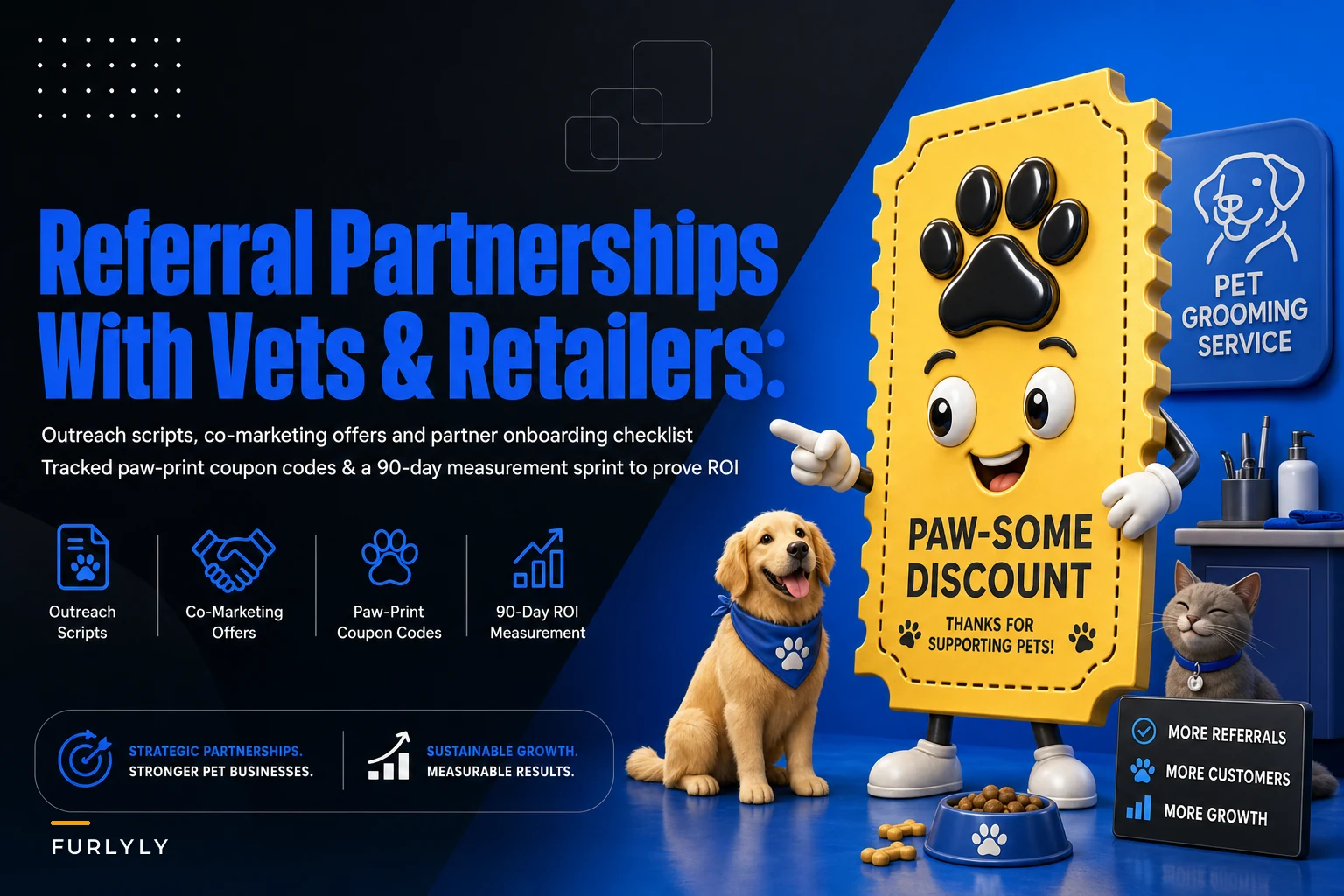
This post is about fixing that specific gap. Not general networking advice. The actual scripts, coupon mechanics, onboarding steps, and a 90-day measurement window so you know whether the whole thing is working or quietly dead.
Why most groomer referral deals quietly die
The typical failure isn't dramatic. It's slow. You meet a vet, you both agree referrals would be "great," and you leave a coupon holder at the front desk. Then reality sets in on their side of the counter.
A vet clinic front desk is slammed. Techs are triaging phone calls, checking in anxious dogs, processing payments. Your stack of coupons becomes clutter they eventually toss. Nobody is intentionally sabotaging you — the referral just never had a trigger, a script, or anything in it for the person doing the referring.
The other common failure is on your end. Even when a referred client shows up, you have no idea. They booked online, mentioned nothing, and got folded into your regular flow. So when the vet asks "hey, are those coupons working?" you shrug. Without an answer, they lose interest. A partnership you can't measure is a partnership you'll eventually abandon.
Salons that actually get this right tend to do boring, consistent things: they make referring easy, make it worth something, and make it countable. Everything below serves those three things.
Who to actually partner with (and who to skip)
Not every nearby business is worth your time. Some send high-intent clients. Some send people who booked once because of a discount and disappeared.
Never miss a grooming appointment again.
Furlyly helps you book, confirm, and manage every pet grooming appointment effortlessly.
- Unified appointment scheduling
- Automated client reminders
- Staff availability & shift management
No credit card required
| Partner type | Referral quality | Effort to set up | Notes |
|---|---|---|---|
| Local vet clinics | High | Medium | Clients already trust the recommendation; often need grooming for medical reasons |
| Independent pet retailers | Medium–High | Low | Owners are chatty, care about local ties, easy to co-market with |
| Dog trainers | High | Low | Puppy clients = long lifetime value; trainers see them weekly |
| Boarding/daycare facilities | Medium | Medium | Volume is good but clients are price-sensitive |
| Big-box pet chains | Low | High | Corporate policies usually block real referrals |
| Doggy influencers / local FB groups | Variable | Low | Cheap to test, unpredictable |
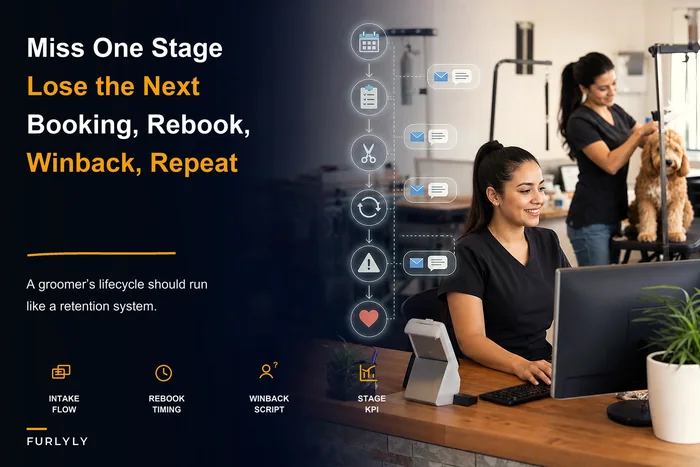
The overlooked winners here are dog trainers and puppy classes. A puppy client who finds you at 12 weeks old and gets on a schedule can be worth years of recurring visits. That connects directly to how you treat early-stage clients — if you're weak on that front, the referral value leaks out fast. Worth reading how ignoring lifecycle stages costs groomers repeat business before you pour energy into filling the top of the funnel.
Skip the big-box chains unless you have a personal relationship with a manager. Their hands are usually tied by corporate, and it rarely goes anywhere.
The outreach scripts (steal these)
The mistake most owners make is asking for the referral before offering anything. You walk into the vet clinic, introduce yourself, and essentially ask them to do you a favor. That rarely works because you're a stranger asking busy people for free labor.
Flip it. Lead with what their clients get.
Cold outreach to a vet clinic (in person, front desk):
> "Hi, I run [Salon] a few blocks over. I'm not here to sell anything — I wanted to leave a small offer your clients can use. When you see a dog that's matted, has skin issues, or needs regular grooming for a medical reason, we do a discounted first visit for anyone you send. No pressure to remember us — the coupon has a code so it works on its own. Who's the best person to leave these with?"
You're framing it as a benefit to their clients, not a favor to you. You mention the medical angle vets actually care about. And you flag the coupon code so they know it doesn't depend on anyone remembering your name.
Email follow-up to a retailer or trainer:
> Subject: A small offer for your customers — no strings > > Hi [Name], > > We're a grooming salon nearby and a lot of our clients shop with you already. I'd love to set up a simple two-way thing: your customers get $15 off their first full groom with us, and I'll happily send our regulars your way for [their product/service]. > > Everything's tracked with a code so we can both see if it's actually working after a month or two. If it flops, we drop it — no awkwardness. > > Want me to drop off a few cards this week?
The two-way ask (once they've warmed up):
> "This has been working on our end — a handful of your customers have come in. Would you be open to us keeping some of your cards at our desk too? We recommend a local retailer to every new client anyway, and I'd rather it be you."
The second ask almost always converts better than the first. Once they've seen you send business or run a clean offer, reciprocity kicks in naturally.
Co-marketing offer templates that don't cheapen your service
A referral offer has to be generous enough to move someone, but not so deep that you're training clients to only visit when discounted. The sweet spot is a first-visit incentive that gets them into a recurring cadence.
-
$15–$20 off the first full groom. Simple, clean, easy for the partner to explain.
-
Free upgrade (nail grind, teeth brushing, de-shed add-on) on first visit. Feels premium, costs you little, showcases your upsells.
-
"Two grooms, second is half off" — quietly powerful because it books the second visit before they've left the first.
Avoid percentage-off deals on your most expensive services. A 30% discount on a $120 doodle groom is a real margin hit, and doodle owners are exactly the clients who'd have booked anyway.
For co-marketing with the partner directly, the strongest format is a bundle. A retailer sells a "new puppy starter kit," and tucked inside is your first-groom coupon. In return, you hand every new puppy client a "$10 off your first bag of [retailer]'s food" card. Both of you look generous, and neither of you is discounting your own core service to the bone.
Tracked coupon mechanics: the part everyone skips
This is where partnerships live or die. If you can't count referrals, you can't defend the partnership when things get busy and you're tempted to drop it. And your partner can't feel good about sending you people if they never hear anything back.
The core rule: every partner gets a unique code. Not a shared "REFER10." A code tied to that specific vet, that specific retailer.
-
Assign codes by partner.
VETMAPLE,PETSHOPRED,TRAINERKATE. The code itself tells you the source at a glance. -
Make redemption require the code. Whether it's a booking field, a physical coupon staff scan, or a note at checkout — the discount only applies when the code is entered. No code, no discount, no tracking gap.
-
Log the code at booking, not just checkout. If you wait until the register, front-desk chaos loses half of them. Capture it when the appointment is made.
-
Tag the client record permanently. The first visit is nice. What you really want to know is whether referred clients stick. Tag them as "Ref: VetMaple" so you can pull their rebooking rate later.
-
Set an expiration. 60–90 days. It creates urgency and keeps your data clean — you're measuring recent referral activity, not a coupon from last spring.
The permanent tag in step 4 is the one most salons miss, and it's the most valuable piece. A partner that sends clients who come once and vanish is very different from one that sends clients who rebook every six weeks. You only know the difference if you've been tagging from day one.
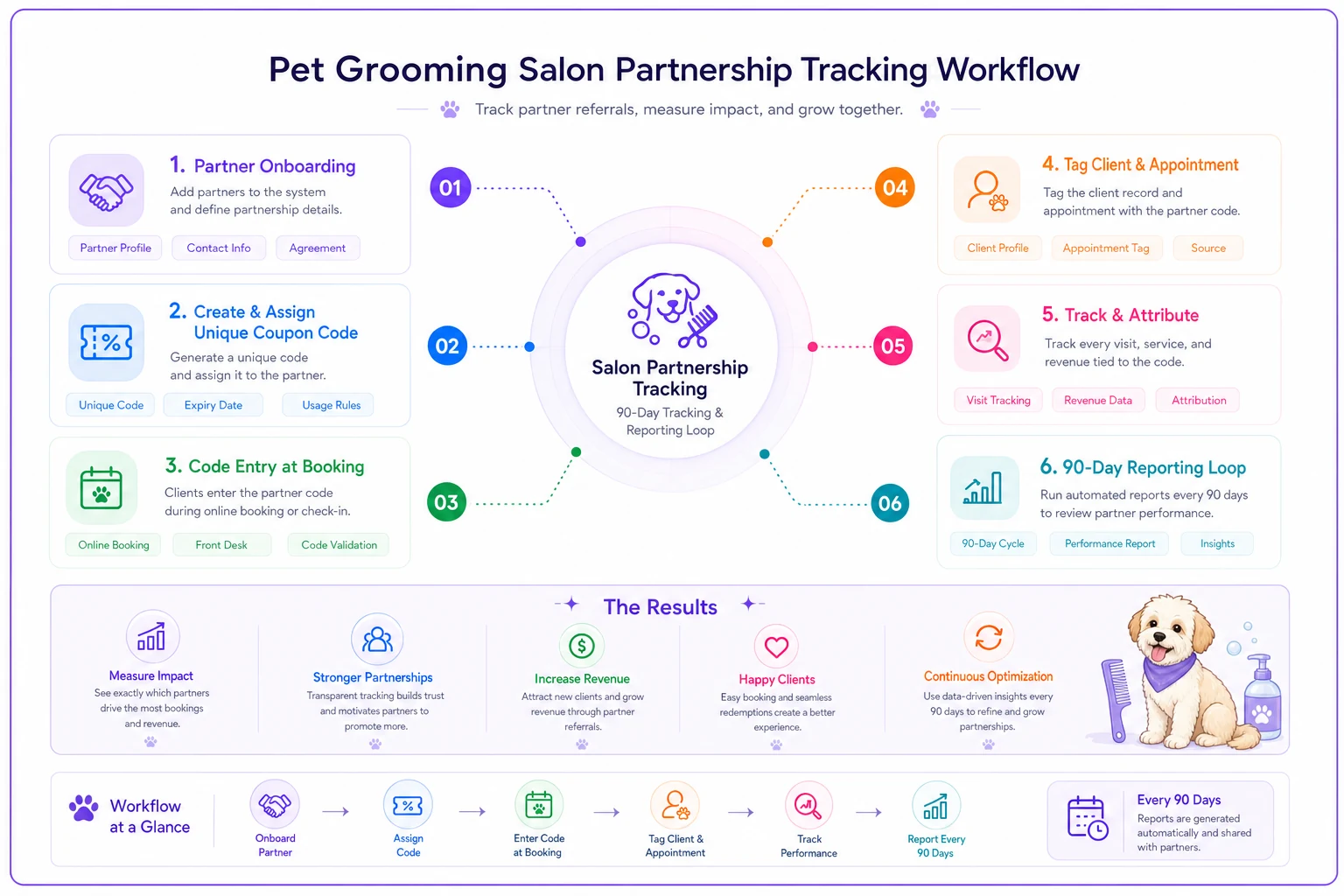
Most modern grooming or salon software lets you build a discount code with a source label and pull a report by that label. If yours does, you've got everything you need — the mechanics matter far more than the tool. If you're doing it by hand, a simple spreadsheet with columns for code, client name, first-visit date, and rebooked (yes/no) handles the first few partners fine.
Test each partner code with a fake booking right away so staff know the redemption flow before real clients use it.
Most modern grooming or salon software lets you build a discount code with a source label and pull a report by that label. If yours does, you've got everything you need — the mechanics matter far more than the tool. If you're doing it by hand, a simple spreadsheet with columns for code, client name, first-visit date, and rebooked (yes/no) handles the first few partners fine.
Partner onboarding checklist
When a partner says yes, the window to make it real is short. Get everything in place within a week or the enthusiasm cools. Run this checklist for each new partner:
-
- [ ] Unique coupon code created and tested (book a fake appointment with it)
-
- [ ] Physical coupons or cards delivered — enough to last ~2 months
-
- [ ] Named the specific person at their front desk who "owns" the coupons
-
- [ ] Explained the offer in one sentence they can repeat to a client
-
- [ ] Left a small counter display or holder (not a loose stack)
-
- [ ] Confirmed what you'll give their customers in return, if two-way
-
- [ ] Set a calendar reminder to check in at day 30
-
- [ ] Added the partner + code to your tracking sheet or software report
-
- [ ] Sent a thank-you note or small gift after the first referral comes in
That last one punches above its weight. A handwritten "your referral, Bella the schnauzer, came in today — thank you!" note to a vet tech does more for future referrals than another stack of coupons ever will. People refer to people they like and remember.
A 90-day measurement sprint
Referral partnerships need a defined evaluation window or they turn into vague goodwill you can't budget around. Run each new set of partners on a 90-day sprint, then make a real keep/drop decision.
Days 1–30: Launch and seed. Onboard 3–5 partners using the checklist. Don't spread thin — a handful done properly beats fifteen ignored. Track redemptions weekly.
Days 31–60: First read. Check the numbers. How many redemptions per partner? At this stage you're looking for any signal. A vet clinic sending 4–5 people a month is strong. A retailer sending zero after 60 days probably needs a nudge or a different contact person.
Days 61–90: Rebooking check. Now the important question: did the day-1–30 referrals come back? Pull rebooking rates by partner tag. This is the number that actually tells you which partnerships are worth deepening.
Simple ROI math: Say the VetMaple code brought in about 12 first-visit clients over the quarter. Your average first groom is roughly $65, and you gave $15 off each, so around $50 net per visit — call it $600 in first-visit revenue. But 7 of those 12 rebooked and are now on a 6-week cycle. At around $65 a visit, those 7 clients are worth somewhere in the $3k–$4k range over the next year, before any retail add-ons. Against a cost of some coupons and a thank-you note, that's an easy keep.
Meanwhile, if PetShopRed sent 3 people all quarter and none rebooked, that's not a partnership to agonize over — just quietly stop restocking their coupons and put the energy elsewhere.
A real scenario
A two-groomer salon in a mid-size suburb was getting almost all its new clients from Google and word of mouth. New-client flow was inconsistent — some months busy, some months slow. The owner had cards sitting at two vet clinics but couldn't say if they'd ever produced a single booking.
They reset the whole thing. Two vets, one independent pet store, and a puppy trainer got unique codes and proper counter displays. Every referred client got tagged. The owner personally dropped off cookies at the vet front desks the week of launch.
Over the next quarter, the tracked codes brought in around 30 first-visit clients — nothing explosive, but suddenly countable. The bigger surprise was the split: the puppy trainer's referrals rebooked at close to 80%, while one of the vet clinics sent decent volume but weak rebookers. That told the owner exactly where to put energy — more into the trainer relationship, and a real conversation with the vet about which clients they were actually sending.
By month three, new-client flow was steadier and, more importantly, the owner could finally answer "is this working?" with actual numbers instead of a guess.
When this makes sense — and when it doesn't
Do this if: you have capacity to take on new clients, your rebooking process is solid, and you're near vets, retailers, or trainers who see pet owners regularly. Referral partnerships fill your funnel with pre-trusted clients, which is about as good as new-client sources get.
Skip it if you're already booked solid weeks out. Sending a partner clients you can't fit in burns the relationship — they refer someone, that person can't get an appointment, and now the vet looks bad for recommending you. Fix your capacity first.
Be careful if your rebooking is weak. Pouring referred clients into a leaky bucket wastes the partner's goodwill and your discount budget. Get your lifecycle and follow-up tight before you scale outreach. The same logic applies if you run a mobile operation — referral geography has to match your routes, or you'll book clients you can't reach efficiently. If that's you, sort your route economics and time-window rules first, then chase partners inside your service zones.
The one thing to remember
Groomer referral partnerships aren't a networking exercise — they're a system with three moving parts: an easy referral, a real incentive, and codes you can count. Get those right and you'll know within 90 days which relationships deserve more of your time and which to quietly retire.
Salons that struggle with referrals aren't unlikeable or badly located. They just never made the referral countable, so they could never tell whether it worked. Fix the tracking, and the rest follows.
Groomer referral partnerships aren't a networking exercise — they're a system with three moving parts: an easy referral, a real incentive, and codes you can count. Get those right and you'll know within 90 days which relationships deserve more of your time and which to quietly retire.
Salons that struggle with referrals aren't unlikeable or badly located. They just never made the referral countable, so they could never tell whether it worked. Fix the tracking, and the rest follows.
Ready to streamline your grooming business?
Join 500+ pet groomers using Furlyly to save time, reduce scheduling conflicts, and deliver exceptional client experiences.