


Most grooming salons treat package pricing like a simple math problem. Take your basic groom, add some services, discount it 10%, done. But the difference between salons holding 35% margins and those stuck at 20% almost always comes down to their salon pricing architecture bundles—specifically how they structure their service families to guide customer decisions while protecting operational efficiency.
The real challenge isn't setting individual prices. It's designing a pricing system that steers clients toward profitable choices without constant staff intervention. When your pricing architecture works properly, clients naturally pick the packages that maximize both their value and your margins.
The Hidden Math Behind Package Architecture
Package design touches three things most salon owners never connect: scheduling density, labor allocation, and inventory turnover. A poorly structured bundle creates operational chaos that eats any pricing gains before you notice.
Take a salon offering a "Pamper Package"—bath, groom, nail grinding, teeth cleaning, spa treatment—for $120. Sounds profitable. You're bundling $145 worth of services. But that package needs 2.5 hours of groomer time, spans multiple stations, and punches awkward gaps into your schedule. Meanwhile your "Quick & Clean" at $65 runs 75 minutes and stays at one station.
Higher ticket on the Pamper Package, sure. But once you factor in scheduling disruption, extra product usage, and coordination overhead, the actual margin falls below the simpler service. This is exactly why salon pricing architecture bundles need guardrails beyond discount percentages.
Package bundles also train customer expectations over time. Too many customizable options and clients start treating your salon like a buffet—picking and choosing services that wreck your operational flow. Structure packages correctly and clients start seeing certain combinations as the obvious, natural choice.
Anchor and Decoy Mechanics That Actually Work
The anchor-decoy pricing model isn't new, but grooming salons usually implement it backwards. They create a premium package nobody buys, hoping it makes the middle option look reasonable. That's not how behavioral pricing works in service businesses.
Never miss a grooming appointment again.
Furlyly helps you book, confirm, and manage every pet grooming appointment effortlessly.
- Unified appointment scheduling
- Automated client reminders
- Staff availability & shift management
No credit card required
Your anchor package should be something clients genuinely want but find slightly uncomfortable to purchase every single time. For grooming, that typically means a comprehensive package priced around 20–25% above what most clients spend. Not 50% more—that just becomes invisible on the menu. The key is making it desirable enough that clients seriously consider it.
Here's a working example from a suburban salon with mostly regular clients:
-
Essential Groom - $55 - Bath, dry, basic trim - Nail clip - Ear cleaning
-
Signature Package - $78 - Everything in Essential - Nail grinding (not clipping) - Teeth cleaning - Cologne spritz - Bandana/bow
-
Luxury Spa - $98 - Everything in Signature - Deep conditioning treatment - Paw balm application - 15-minute brush-out - Take-home treat bag
The Signature Package converts at roughly 60% because it offers meaningful upgrades over Essential without the commitment of Luxury. About 15% of clients choose Luxury—usually for special occasions. Those high-margin appointments offset the operational complexity of running them.
The decoy effect works differently in grooming than retail. You're not trying to trick anyone. You're giving clients permission to spend more by framing their options strategically. The Essential package exists partly to make Signature feel like the smart choice, not the indulgent one.
Usage Guardrails That Prevent Margin Erosion
Every package needs built-in protections against unprofitable usage patterns. These aren't restrictions you advertise—they're operational rules that maintain profitability without creating customer friction.
Time-based guardrails:
-
Packages expire after specific periods (prevents hoarding)
-
Minimum booking intervals (stops gaming)
-
Peak period restrictions (protects valuable slots)
Service combination rules:
-
Certain add-ons excluded from packages
-
Maximum one package type per appointment
-
Package services must be used together, not split across visits
Client qualification requirements:
-
Behavioral incident history affects package eligibility
-
Mat condition surcharges apply regardless of package
-
Size brackets determine final package pricing
One mobile grooming operation learned this the hard way after launching an unlimited monthly membership at $199. Within two months, a handful of clients were booking biweekly appointments for multiple dogs—effectively paying around $25 per groom. The membership model collapsed their unit economics fast.
They restructured with actual guardrails: monthly packages now cover up to five visits, require six-day minimum spacing, exclude dogs over 70 pounds, and add $15 per additional dog. The new structure keeps the membership appeal intact while protecting margins.
Scheduling Impact Multipliers
Package design directly affects scheduling efficiency. A well-designed salon pricing architecture bundles system can increase effective capacity by around 20% without adding staff or hours.
The key is understanding service compatibility. Some services naturally flow together—bath and blow-dry happen at the same station with the same tools. Others create friction—moving a dog from the grooming table to the bathing area mid-service disrupts everything around it.
Station-locked packages keep dogs in one area:
-
Bath/dry/basic groom combinations
-
Nail services grouped together
-
All finishing touches at once
Groomer-locked packages prevent handoffs:
-
Junior groomer handles the entire basic package
-
Senior groomer owns the complete premium service
-
No mid-service transfers
Time-blocked packages fit standard intervals:
-
45-minute quick services
-
90-minute standard packages
-
2-hour premium experiences
A franchise location tracking their scheduling data found that mixed-service appointments—where clients picked random add-ons—took 23% longer than packaged appointments covering the same work. The context-switching and station moves just killed efficiency.
Dynamic Template System for Different Client Segments
Not all clients need the same packages. Building separate package families for distinct segments multiplies your pricing power while actually simplifying operations.
| Client Type | Package Focus | Price Range | Service Time |
|---|---|---|---|
| Regular (weekly/biweekly) | Maintenance-focused, minimal add-ons | Lower | Faster |
| Occasional (monthly/quarterly) | Comprehensive, multiple upgrades | Higher | Longer |
| Special occasion | Premium only, experience-focused | Highest | Extended |
| Problem-solving | De-matting, flea, senior, anxiety protocols | Varies | Varies |
Each family needs different anchor points and decoy structures. Regular clients might see packages from $45–$65–$85, while occasional clients see $75–$95–$125. Same services, different framing, better margins.
Managing all of this manually creates too much front-desk friction. AI-powered operational platforms can automatically recommend appropriate packages based on visit history, flag when clients try to work around guardrails, and track which combinations are actually driving the best margins.
Protecting Margins During Peak Periods
Holiday seasons and summer months test every pricing strategy. Properly structured packages actually protect margins better during high-demand periods than dynamic pricing alone.
Instead of raising all prices—which frustrates regulars—adjust package availability. During December, only offer Signature and Luxury for new bookings. Regular clients keep their normal options, but new appointments have to choose a premium package. This naturally filters for clients willing to pay for peak-period convenience.
Some salons build special peak packages that bundle normally separate services:
Holiday Express - $95
-
Full groom
-
Nail painting
-
Holiday bandana
-
Photo session
-
Guaranteed 2-hour turnaround
The time guarantee justifies the premium. The included extras make the price feel fair rather than inflated. Clients feel like they're buying convenience and a nice experience, not paying a surge price.
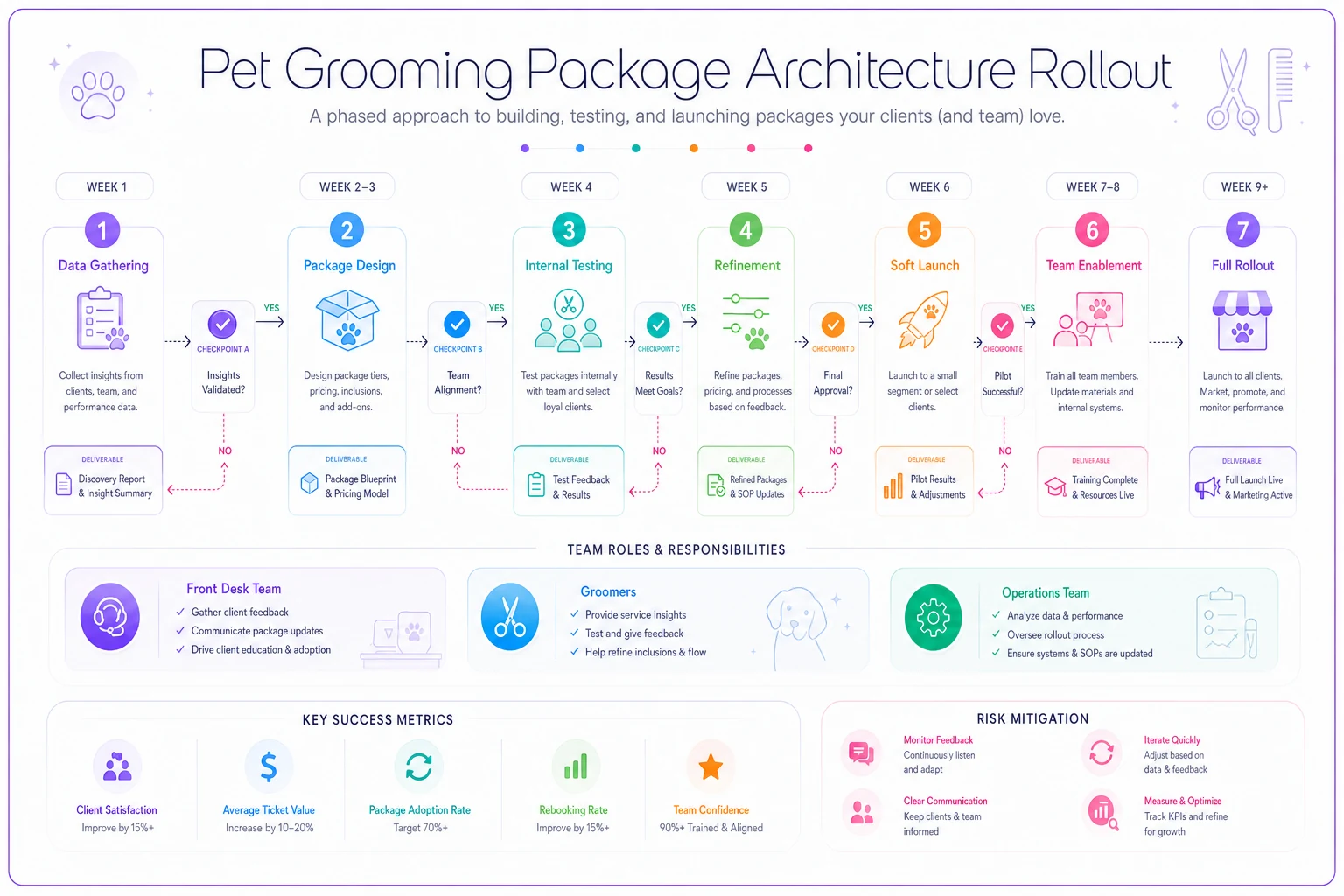
Template Implementation Workflow
Rolling out a new package architecture requires careful sequencing. Sudden changes confuse clients and staff, and the resulting chaos can destroy any margin improvements you were chasing.
-
Data gathering (Week 1–2)
Track actual service times per combination, calculate true margins including labor, identify the most common service patterns, and note scheduling bottlenecks.
-
Design initial packages (Week 3)
Create three tiers maximum, build around your operational flow, price with 15–20% gaps between tiers, and include meaningful differences between each tier.
-
Test with specific segments (Week 4–6)
New clients only at first. Existing clients get a choice. Track conversion rates and monitor scheduling impact closely.
-
Refine and expand based on results (Week 7–8)
Adjust pricing gaps, modify included services, add necessary guardrails, and train staff on how to position each tier.
-
Full rollout with communication (Week 9+)
Email existing clients about new options, update your website and booking system, create comparison charts, and implement everything in your operational software.
Going through this sequencing step by step matters more than most owners expect. Skipping the test phase is where most rollouts go sideways—you end up fixing conversion problems and scheduling chaos at the same time, and it gets messy fast.
This workflow diagram summarizes those steps.
Going through this sequencing step by step matters more than most owners expect. Skipping the test phase is where most rollouts go sideways—you end up fixing conversion problems and scheduling chaos at the same time, and it gets messy fast.
Common Architecture Mistakes
The biggest mistake grooming salons make with package design? Too many options. Every additional package multiplies complexity—staff training, client confusion, scheduling complications, inventory management.
Three packages work. Five becomes unwieldy. Seven is chaos.
Another common error: letting clients modify packages. "Can I swap the teeth cleaning for extra brushing?" sounds harmless, but it starts an erosion process that ends with fully customized services destroying your operational efficiency. Packages are packages. Modifications mean picking a different package or paying for a separate add-on service.
Underestimating setup costs also kills package profitability. That spa treatment might only use $3 in products, but if it requires heating towels, staging a special area, and extra cleanup time, your real cost could be $15 or more. Build packages around services that share setup requirements.
Some salons also fail to account for staff skill levels. If only one groomer can deliver certain package services, that package becomes a bottleneck. Design packages that multiple staff members can handle, or price specialist packages high enough to justify the constraint.
Measuring Package Performance
Track three key metrics to evaluate your salon pricing architecture bundles over time:
Conversion distribution: What percentage of clients choose each tier? A healthy distribution runs roughly 20% basic, 60% middle, 20% premium. If 80% are choosing basic, your anchor isn't doing its job.
Margin by package: Calculate actual margins including labor, products, and overhead. Your middle package should hit your target margin, basic slightly below, premium meaningfully above.
Scheduling efficiency: Compare average appointment duration for packaged vs. custom services. Packages should run 15–20% faster due to operational optimization.
Also watch secondary indicators: add-on rates (packages should reduce random add-ons), rebooking rates (package buyers typically rebook sooner), and staff satisfaction (packages reduce decision fatigue at the front desk).
Technology and Automation Impact
Modern operational software turns package management from a headache into a real competitive advantage. AI-powered platforms can analyze historical data to suggest optimal package combinations, automatically enforce guardrails, and flag which package makes the most sense for a returning client based on their visit history.
The real value is in ongoing adjustment. Your operational system tracks which packages are selling, which create scheduling problems, and which generate the strongest margins—then surfaces those patterns so you can act on them without digging through spreadsheets.
A platform might flag that Wednesday afternoons consistently show low Luxury Package bookings despite high Essential demand. You could test upgrade incentives for those slots and measure whether it moves the needle. Or it might surface that clients who buy Signature three times are highly likely to try Luxury, giving you a clear trigger for a targeted offer.
None of that optimization happens reliably by hand. With the right operational software, it becomes a normal part of how you run the business.
Making Architecture Decisions
Before restructuring your packages, a few questions worth sitting with:
Who is your ideal client? If you're serving budget-conscious families, complex luxury packages won't land. If you serve affluent retirees, basic packages might cheapen your brand perception.
What's your actual operational constraint? If you're groomer-limited, design packages that maximize revenue per groomer hour. If you're space-limited, focus on throughput. If demand is the bottleneck, create packages that encourage visit frequency.
How competitive is your market? Urban markets with dense grooming competition can support more complex package structures. Rural markets often do better with a straightforward good/better/best setup.
What's your growth strategy? Expanding locations means keeping packages simple and replicable. Deepening market penetration means more room for specialized packages targeting narrow segments.
Your salon pricing architecture bundles should support your broader business strategy, not fight against it. The wrong pricing model can quietly undermine everything else you're doing right, while the right architecture compounds your other improvements.
Package architecture isn't about nudging clients into spending more—it's about building a pricing system that aligns what clients want with how your operation actually runs. The best packages feel natural to buy, straightforward to deliver, and profitable to operate.
Most grooming salons leave real margin on the table through poor package design. They build bundles that sound appealing but create operational chaos, or they stick with individual service pricing that requires constant negotiation and in-the-moment decisions.
The salons that hold strong margins build pricing architectures that guide clients toward choices that work for everyone. Their packages protect profitability while delivering genuine value. Their guardrails prevent abuse without feeling restrictive. Their systems adjust based on real data, not gut instinct.
Start with three simple packages built around your operational flow. Add guardrails that protect profitability. Track what's working. Then optimize systematically based on actual margin data, not just revenue numbers.
The gap between struggling at 20% margins and running consistently at 35% usually isn't about charging more. It's about building a pricing structure that works with your operations instead of against them. Get that architecture right, and it becomes the foundation everything else builds on.
Ready to streamline your grooming business?
Join 500+ pet groomers using Furlyly to save time, reduce scheduling conflicts, and deliver exceptional client experiences.