

The two-dog household looks like a great booking. One arrival, one checkout, one confirmation call. What most salons figure out a few months in is that the second and third dog quietly erode the margin that made grooming worth doing — not because the work isn't there, but because the pricing and the calendar were never built for what actually happens when a family shows up with a pack.
Multi pet grooming pricing is one of those areas where salons either overthink it into a mess of discount codes, or ignore it entirely and eat the difference. This post walks through the decision rules and the actual math: when a multiplier makes sense, how to build slot-extension templates that don't blow up your day, what intake risk checks matter when pets come as a group, and whether bundling or booking each pet separately protects your margin better.
Where the money leaks first: the multi-pet slot that runs long
A household books three dogs — say a Cavalier, a Doodle, and a small terrier mix. On paper that's roughly two and a half hours of table time. In practice it runs closer to three and a half.
-
The Doodle is matted (it usually is), and matting isn't a fixed add — it grows with coat length and the last groom date.
-
Dogs from the same house feed off each other's anxiety. The terrier that's fine solo gets reactive when its housemates are stressed on nearby tables.
-
Owners of multi-pet households tend to add "while you're at it" requests at drop-off — nail grinding on all three, a de-shed on the one that wasn't booked for it.
None of this is visible when you're quoting a price on the phone. So the salon prices three standard grooms, blocks three standard slots, and then absorbs an extra 45–60 minutes of labor that never got charged. Do that a few times a week and you've handed away several hours of billable table time a month for free.
The fix isn't a bigger discount or a longer default slot for everyone. It's treating multi-pet as its own booking type with its own rules.
The price multiplier: what to actually charge
The instinct is to discount the second and third pet. Sometimes that's right. Often it's backwards.
Never miss a grooming appointment again.
Furlyly helps you book, confirm, and manage every pet grooming appointment effortlessly.
- Unified appointment scheduling
- Automated client reminders
- Staff availability & shift management
No credit card required
Think about what actually changes cost-wise when a household brings multiple pets:
-
Goes down admin time (one intake, one checkout, one confirmation), and sometimes travel for mobile.
-
Stays the same actual grooming labor per dog. A Doodle takes just as long whether it arrives alone or with two friends.
-
Goes up handling complexity, group anxiety, table-switching overhead, and the odds of "while you're at it" scope creep.
A flat "20% off each additional pet" is often a mistake — you're discounting the part that didn't get cheaper (labor) to reward the part that did (admin). A cleaner approach is a small fixed convenience credit, not a percentage off each groom.
Here's a multiplier framework that holds margin:
| Booking type | Pricing rule | Rationale |
|---|---|---|
| Single pet | Standard breed/coat price | Baseline |
| 2nd pet, same household | Full price minus a flat $5–$8 admin credit | Only admin overlap is saved |
| 3rd+ pet, same household | Full price, no additional discount | Handling complexity offsets any admin savings |
| Same-breed, same-size pair | Full price minus flat credit + 5% "efficiency" only if genuinely faster | Only discount when the second dog is truly quicker |
Discount the overhead you actually save, not the labor you don't. A household saving $10–$16 across three dogs still feels rewarded, and you haven't handed away 20% of your revenue on the theory that dogs get faster in bulk. They don't.
Slot-extension templates: stop guessing the block
The scheduling side matters as much as the price. If your booking system slots three dogs as three back-to-back standard appointments, you've built a fiction into your calendar.
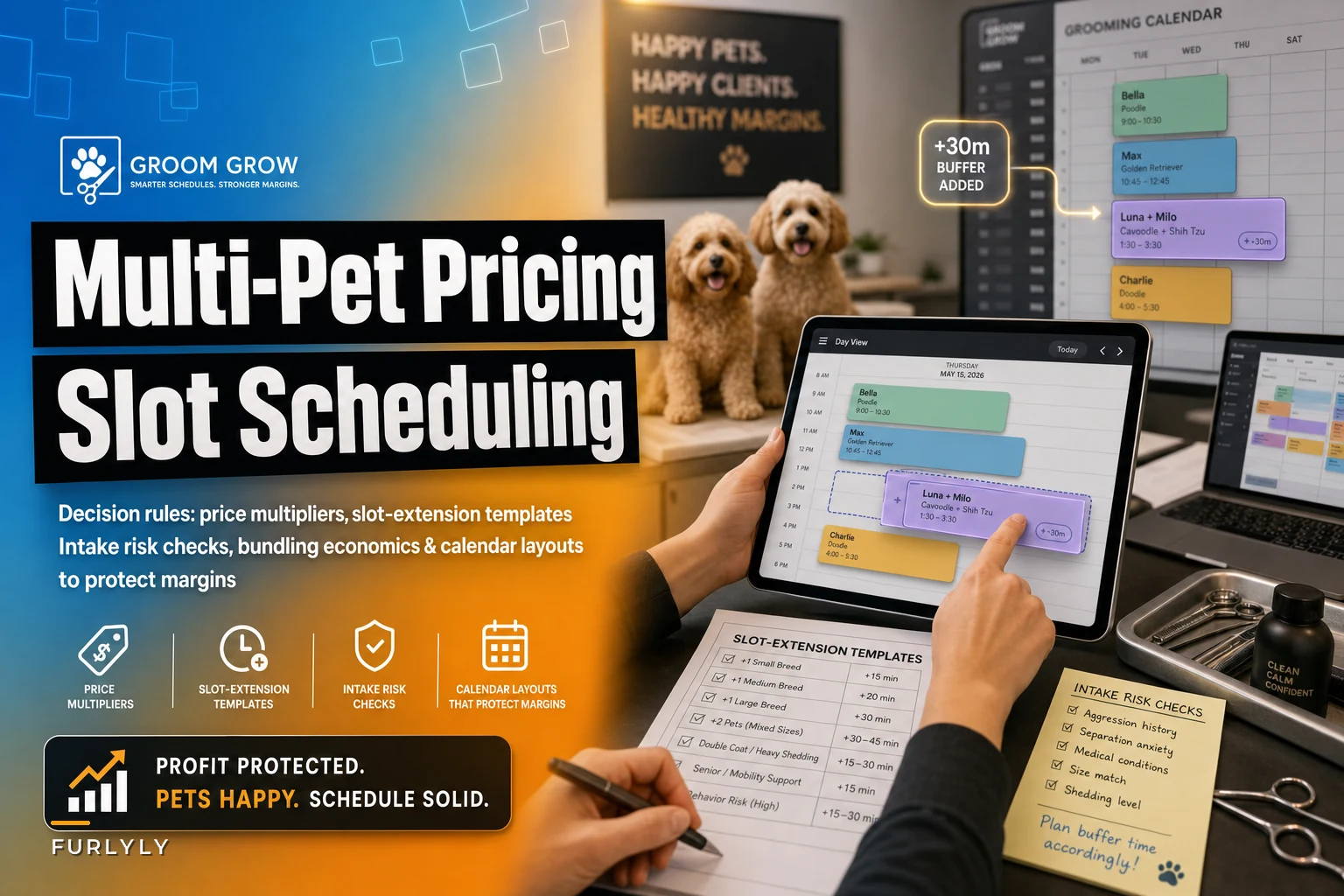
Build multi-pet slot templates instead — a small set of pre-defined blocks based on pet count and complexity, so whoever's booking doesn't have to do coat math on the fly.
-
2 pets, both short-coat, no flags sum of individual times, no buffer added.
-
2 pets, at least one long/double coat sum + 15 min shared buffer.
-
3 pets, mixed sum + 25–30 min buffer, and flag for a second set of hands during table switches.
-
3+ pets or any matting flag don't auto-book — route to manual review before confirming.
That last rule is the one salons skip and regret. Some multi-pet households simply shouldn't be a self-serve online booking. If your system supports it, gate anything above two pets behind a confirmation step so a human can look at the coats and history before the day gets committed.
A quick visual of the slot-extension workflow can make it easier for staff to follow.
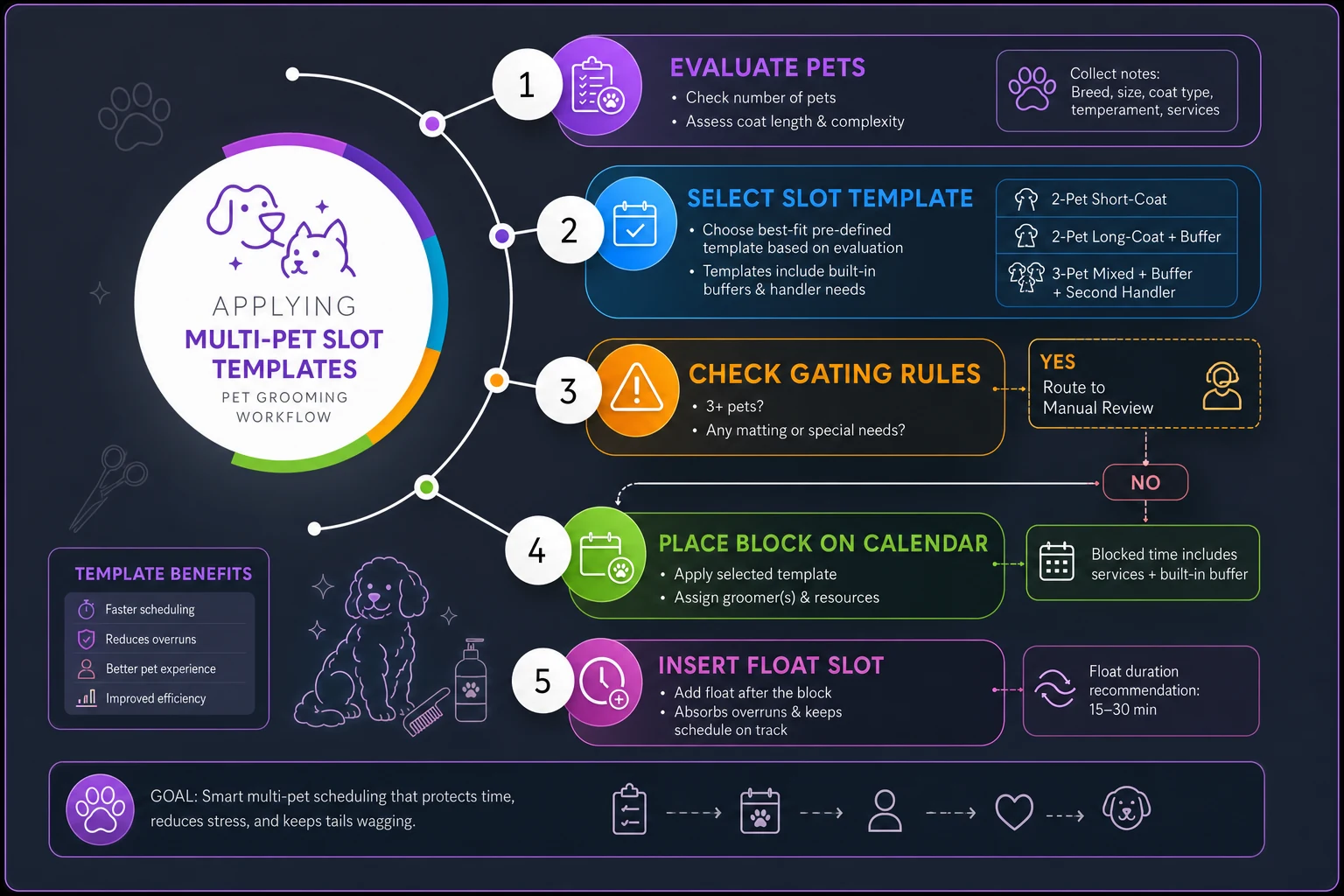
This ties directly into how you build your base time estimates. If you haven't set up per-breed, per-coat timing yet, that groundwork is covered in our piece on data-driven scheduling with capacity formulas and breed time matrices — multi-pet templates are really just those numbers summed with a complexity buffer layered on top.
Intake risk checks specific to multi-pet bookings
A single anxious dog is a known quantity. Three dogs from the same house is a different risk profile, and standard intake usually misses it.
-
Group reactivity. Ask directly
"Are your dogs comfortable being groomed near each other, or do they need to be separated?" The answer changes your staffing and your slot.
-
Staggered vs simultaneous handling. Some households do better with one dog done, then out to the car, then the next. That's a scheduling decision, not just a preference.
-
Shared skin/coat conditions. Fleas, transmissible issues, and matting often affect the whole household at once. One flagged dog means check all of them.
-
The "extra dog" risk. Multi-pet families are the most likely to text "can you squeeze in the fourth one too?" Have a rule for whether that's ever allowed same-day (usually: no).
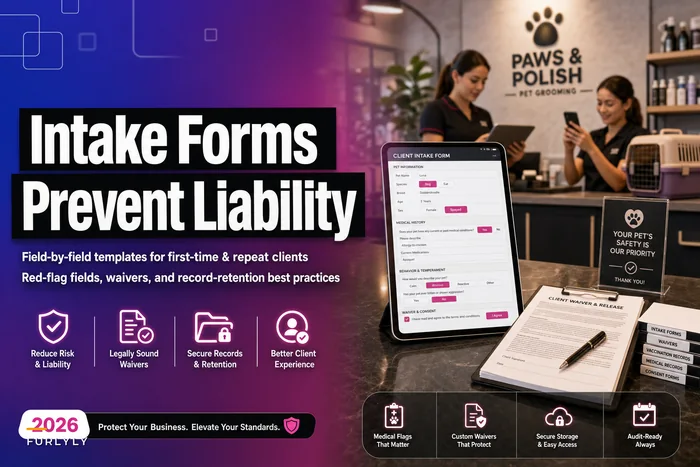
These checks belong in your intake flow, not in the groomer's head at 8am. If your intake forms aren't capturing the behavioral and medical flags that actually protect you, the field-by-field intake form templates for medical flags and waivers are worth adapting — just add a household-level section so multi-pet risk gets surfaced at booking, not discovered at the table.
Bundling vs separate booking: the economics
This is the decision most salons never actually run numbers on. Should a three-dog family be one bundled booking, or three separate appointments across the day or week?
Bundled (all pets, one visit):
-
Pros
single admin touch, one trip for the client, easier to hold the household as a repeat.
-
Cons
long block that's hard to fill if they cancel, higher no-show damage, more group-anxiety risk, harder to staff.
Separate (split across slots/days):
-
Pros
easier to fill, lower single-cancellation risk, calmer individual grooms, better table utilization.
-
Cons
more admin, more friction for the client, weaker "convenience" story.
The real number that decides it: cancellation exposure. A bundled three-dog block that no-shows costs you the whole afternoon. Three separate bookings that lose one leave you with two intact appointments.
A rough example. Say your average groom is around $70 and a three-dog bundle runs a 3.5-hour block. If that household cancels late twice a quarter — not unusual for busy families — you're looking at roughly seven hours of prime weekend table time gone, worth somewhere in the $400–$500 range each time it happens. The same household split across three separate slots would rarely lose all three at once. Over a year that difference alone can outweigh whatever admin efficiency the bundle bought you.
When bundling makes sense:
-
Loyal, low-cancellation households with a track record.
-
Small, calm, short-coat dogs where the total block stays under two hours.
-
Mobile grooming, where a single stop genuinely saves real travel cost.
When to steer toward separate booking:
-
New multi-pet clients with no history.
-
Any household with a large-breed or heavy-coat dog pushing the block past three hours.
-
Peak weekend slots you could otherwise fill with three unrelated, easier-to-recover appointments.
Who should probably not bundle at all: a solo groomer with no support staff. Three dogs on your own means one anxious animal can stall the entire block with nobody to hand off to.
Calendar layout that protects the margin
How you place these blocks on the calendar matters more than most owners expect.
-
Anchor multi-pet blocks to slower periods, not peak. A three-dog family filling your 10am–1:30pm Saturday is occupying your most recoverable, most fillable slots. Push bundles toward mid-week or early mornings where a cancellation hurts less.
-
Never stack two multi-pet blocks back to back without a real buffer between. If both run long — and they will — you've compounded the overrun into everything after.
-
Reserve a float slot on multi-pet days. A 20–30 minute unbooked gap after a three-dog block gives you room to absorb the near-certain overrun without cascading late into every appointment that follows.
-
Tag multi-pet blocks visually so whoever's managing the floor knows a long, complex booking is coming and can plan accordingly.
Tag multi-pet blocks visually so whoever's managing the floor knows a long, complex booking is coming and can plan accordingly.
A short real scenario
A two-groomer salon doing roughly 300–320 grooms a month kept offering "20% off each additional dog" on multi-pet bookings. Families loved it. What the owners didn't see: those bookings ran long almost every time, and the percentage discount was carving into full-labor grooms, not just admin overlap.
They changed two things. First, they swapped the percentage discount for a flat $6 per-additional-pet admin credit. Second, they moved multi-pet bundles out of prime weekend slots into mid-week and early mornings, with a 25-minute float after each three-dog block.
Nothing dramatic happened overnight. Over the following couple of months the multi-pet bookings stopped blowing up the schedule, the overtime creep on Saturdays eased, and effective revenue per multi-pet visit climbed somewhere in the $25–$40 range. A handful of price-sensitive families grumbled; almost all of them rebooked anyway, because the convenience was still real — they just weren't being over-rewarded for it.
The rules, condensed into a checklist
Get those four decisions right and the two-dog household goes back to being what it looked like on paper: a genuinely good booking.
-
[ ] Discount only the admin you actually save — use a flat credit, not a percentage off labor.
-
[ ] No additional discount past the second pet.
-
[ ] Build 3–4 slot-extension templates by pet count and coat complexity.
-
[ ] Gate any 3+ pet or matting-flagged booking behind manual review.
-
[ ] Add household-level intake questions
group reactivity, separation needs, shared conditions.
-
[ ] Have a firm rule on same-day "add the fourth dog" requests.
-
[ ] Run cancellation exposure math before defaulting to bundled bookings.
-
[ ] Anchor multi-pet blocks to off-peak periods, not prime weekend slots.
-
[ ] Reserve a float slot after every three-dog block.
-
[ ] Tag multi-pet blocks visually so the floor can plan staffing.
Multi-pet households are worth keeping — they're loyal, they refer, and they fill capacity. The trap is treating them like a single booking with a friendly discount stapled on. Price the overhead you save, slot the time you actually need, screen the risk the group brings, and put those long blocks where a bad day does the least damage. Get those four decisions right and the two-dog household goes back to being what it looked like on paper: a genuinely good booking.
Multi-pet households are worth keeping — they're loyal, they refer, and they fill capacity. The trap is treating them like a single booking with a friendly discount stapled on. Price the overhead you save, slot the time you actually need, screen the risk the group brings, and put those long blocks where a bad day does the least damage. Get those four decisions right and the two-dog household goes back to being what it looked like on paper: a genuinely good booking.
Ready to streamline your grooming business?
Join 500+ pet groomers using Furlyly to save time, reduce scheduling conflicts, and deliver exceptional client experiences.