

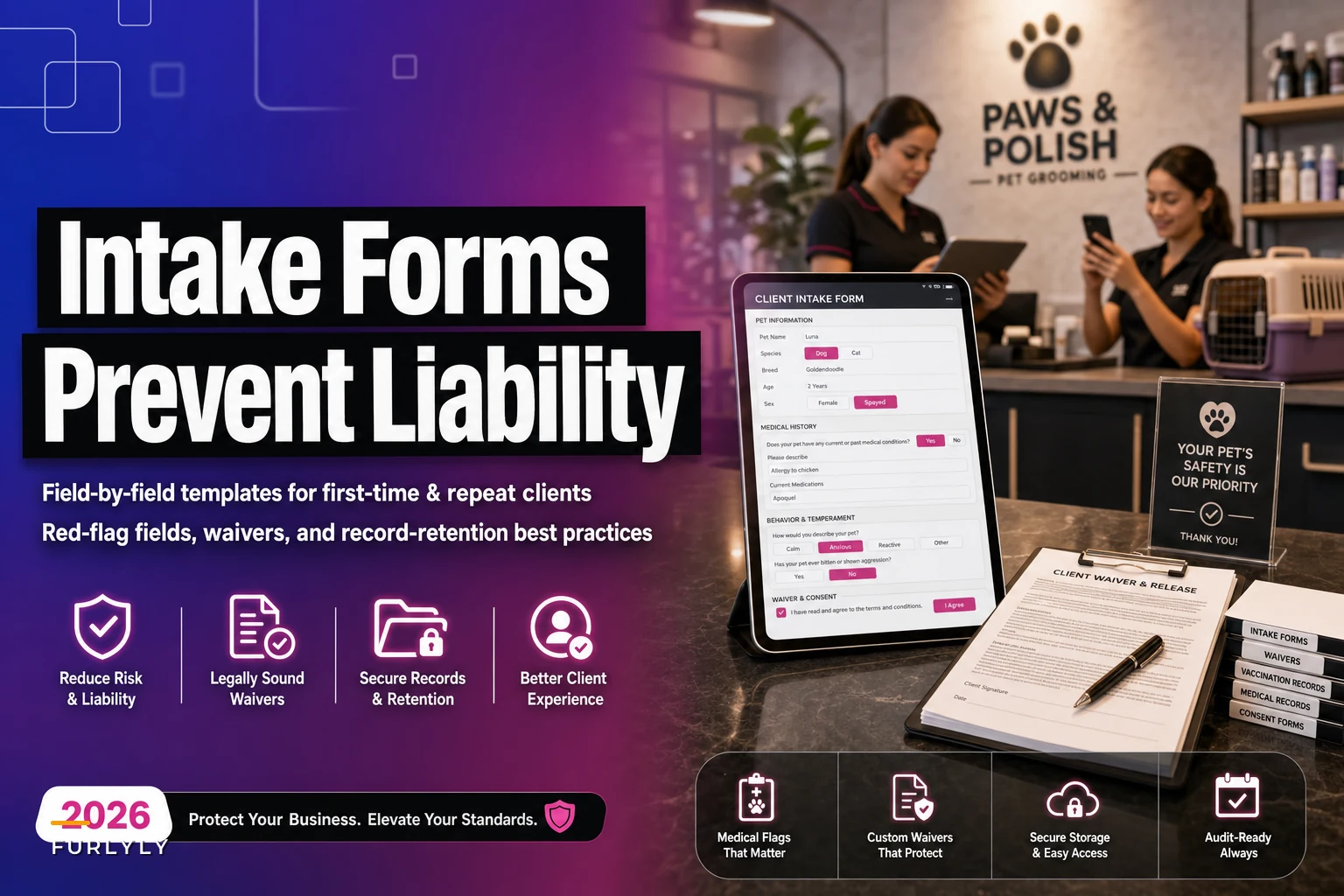

Three weeks ago, a grooming salon in Phoenix got hit with a $47,000 lawsuit. The dog — a senior golden retriever with hip dysplasia — slipped during a standard bath. The owner claimed negligence. The salon's defense? They had no documented proof the owner disclosed the medical condition during drop-off.
Their intake form had one generic line: "Any medical conditions we should know about?"
This scenario plays out hundreds of times each year across grooming salons. Not because groomers are careless, but because most intake processes rely on rushed verbal exchanges and vague paperwork that misses critical liability protection.
After working with about 90 grooming operations, the pattern becomes clear: salons treat intake forms like contact sheets instead of operational shields. They collect names and phone numbers while missing aggression histories, medication schedules, skin sensitivities, and consent language that actually holds up when tested.
Why Standard Pet Forms Create Legal Gaps
Most grooming salons pull their intake forms from Google or copy what the salon down the street uses. These templates usually cover basics — pet name, breed, owner contact. But they systematically miss the operational and legal details that matter when something goes wrong.
The typical grooming intake form asks about "health issues" without defining what constitutes a health issue. Does that mean active infections? Chronic conditions? Recent surgeries? Behavioral medication? Joint problems that affect restraint options?
When a Yorkie has a seizure during grooming (which happens more than people realize), and the owner later mentions they "forgot" to note the epilepsy medication, you're stuck in a he-said-she-said situation without documentation.
The problem gets worse with behavioral issues. Generic forms ask if pets bite. But biting during nail trims is different from resource guarding around food, which is different from fear aggression toward men specifically. Without granular behavioral documentation, you're operating blind and legally exposed.
Then there's the consent language problem. Most forms include some version of "I consent to grooming services," which means almost nothing legally. Real consent requires specific acknowledgment of risks, clear authorization for emergency care, explicit agreement about restraint methods, and documented understanding of potential outcomes.
One salon owner in Denver learned this the hard way when a cat scratched a groomer badly enough to require stitches. The owner sued for "unauthorized restraint techniques." The salon's form had no language about restraint authorization or acknowledgment that cats might require different handling methods.
The Hidden Cost of Incomplete First-Time Forms
First-time clients represent your highest operational risk. You know nothing about their pet's triggers, medical history, or owner expectations. Yet most salons use the same basic form for first-timers that they use for dogs they've groomed monthly for three years.
Never miss a grooming appointment again.
Furlyly helps you book, confirm, and manage every pet grooming appointment effortlessly.
- Unified appointment scheduling
- Automated client reminders
- Staff availability & shift management
No credit card required
A proper first-time grooming client intake form template needs to capture:
Medical red flags that affect grooming safety:
-
Current medications (especially sedatives or blood thinners)
-
Seizure history and triggers
-
Heart conditions requiring stress management
-
Joint problems affecting positioning
-
Skin conditions requiring product adjustments
-
Recent surgeries or healing wounds
-
Allergies to specific products or materials
-
Eye/ear infections requiring modified techniques
Behavioral indicators that change handling protocols:
-
Specific triggers (blow dryers, nail clippers, face touching)
-
Past grooming incidents at other salons
-
Aggression patterns by situation
-
Anxiety manifestations (trembling vs. aggression vs. shutting down)
-
Resource guarding around treats or toys
-
Reaction to restraint or confined spaces
-
History with muzzles or other safety equipment
Owner expectation mismatches:
-
Previous grooming frequency and locations
-
Specific cut preferences with photo documentation
-
Understanding of matting consequences
-
Price sensitivity and service limitations
-
Pickup time flexibility
-
Communication preferences during grooming
Without these fields explicitly documented, you're essentially gambling on every new client. The matted doodle whose owner insists you can "save the coat" becomes a two-hour negotiation. The German Shepherd with undisclosed hip dysplasia becomes a workers' comp claim when your groomer's back gives out trying to support him.
Building Your Repeat Client Fast-Track System
Repeat clients need different intake workflows. Making your regular clients fill out the same comprehensive form every visit creates friction and wastes everyone's time. But skipping documentation entirely leaves gaps that compound over months.
The solution involves a two-tier documentation system:
Initial comprehensive intake (stored permanently):
-
All the medical, behavioral, and preference fields mentioned above, plus
-
Emergency contact beyond the owner
-
Vet contact with permission to discuss
-
Photo documentation of current coat condition
-
Signed understanding of policies
-
Explicit consent for standard procedures
Visit-specific updates (captured each appointment):
-
Changes since last visit
-
Current medications or treatments
-
Specific requests for this appointment
-
Coat condition if notably different
-
Any incidents between visits
-
Updated contact information if changed
Here's what this looks like operationally:
Mrs. Chen brings her Shih Tzu, Mochi, every six weeks. Your system already has Mochi's comprehensive profile: mild anxiety around blow dryers, needs frequent breaks due to age (14 years), mom prefers teddy bear face cut, sensitive stomach so no treats.
At check-in, Mrs. Chen only confirms: "Any changes since last time? New medications? Special requests today?"
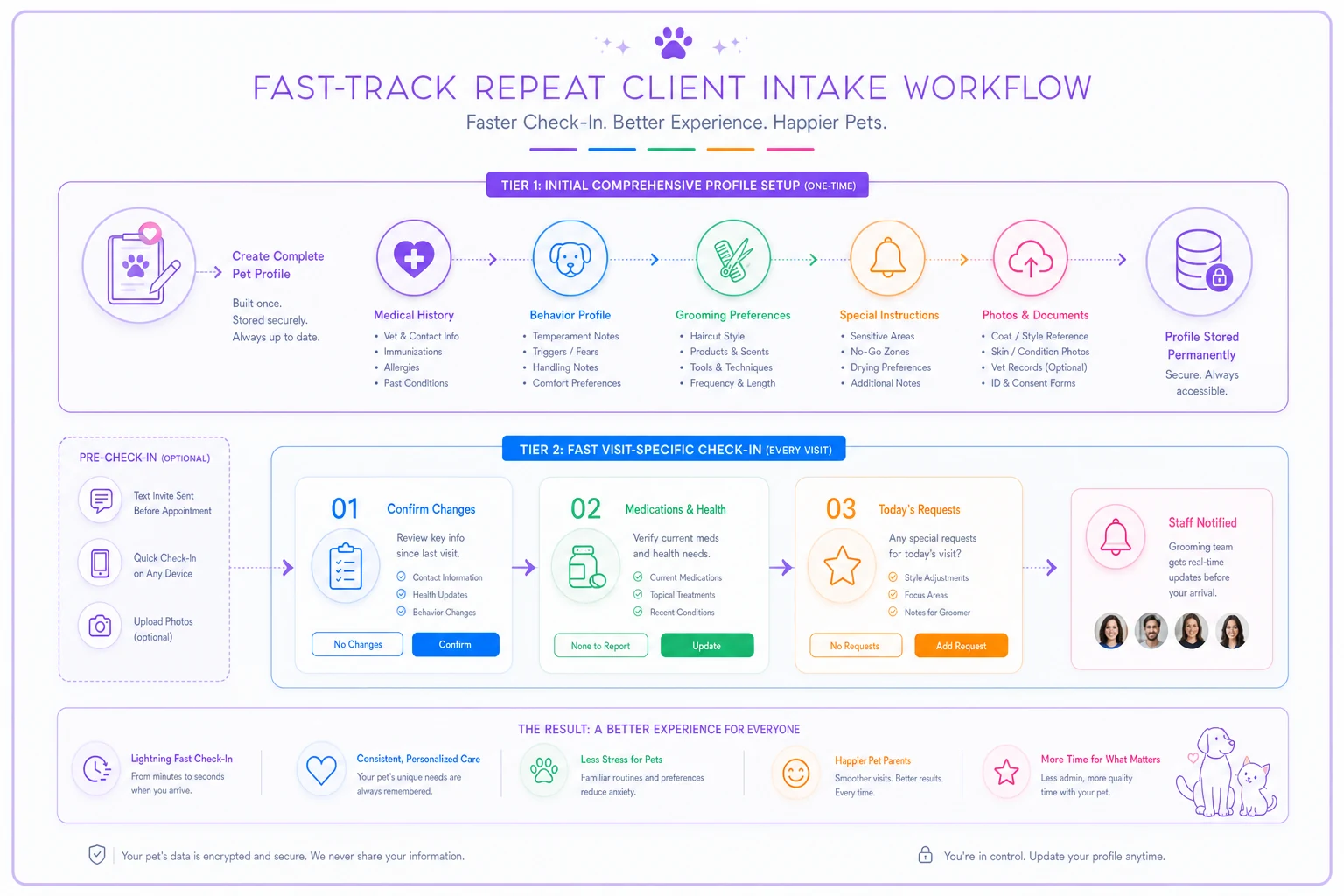
Takes 30 seconds instead of 5 minutes. But you still capture visit-specific liability protection.
The key is making the update process friction-free while maintaining documentation standards. Some salons use tablets at check-in where clients tap through three quick confirmation screens. Others have front desk staff verbally confirm while documenting responses.
Red Flag Fields That Actually Protect You
Generic medical fields don't provide real protection. You need specific fields that capture exact risk factors and create clear documentation trails.
Instead of "Any medical conditions?" break it down:
| Generic Field | Protective Fields |
|---|---|
| Medical conditions? | • Active infections (type, treatment status)<br>• Chronic conditions (managed how)<br>• Physical limitations (affects what)<br>• Recent procedures (healing status) |
| Behavioral issues? | • Bite history (context, triggers)<br>• Fear responses (to what specifically)<br>• Handling sensitivities (where, when)<br>• Previous incidents (what happened) |
| Allergies? | • Topical reactions (to what products)<br>• Environmental triggers (perfumes, cleaners)<br>• Food allergies (affects treat options)<br>• Contact sensitivities (latex, metals) |
| Special needs? | • Mobility assistance required<br>• Hearing/vision impairments<br>• Medication schedules during stay<br>• Stress indicators to monitor |
Each field should include space for details, not just checkboxes. "Heart condition" tells you nothing. "Mild heart murmur, managed with Vetmedin, vet advises minimal stress, requires breaks every 15 minutes" gives you actionable protection.
The most overlooked red flag field: previous grooming trauma. If a dog had a bad experience elsewhere, you need to know exactly what happened. Was it a specific tool? A handling method? A groomer characteristic? This information shapes your entire approach and documents that you took disclosed trauma into account.
Consent Language That Holds Up
Most grooming consent forms wouldn't survive first contact with a lawyer. They're either too vague ("I consent to services") or too aggressive ("We're not responsible for anything") to provide real protection.
For routine grooming: "I understand that grooming procedures can occasionally result in minor irritation, including but not limited to: clipper burn, minor nicks from sharp tools, eye irritation from products, or stress-related responses. I acknowledge these risks and authorize necessary handling for safe grooming completion."
For matted pets: "I understand that matt removal is a delicate process that may reveal skin conditions, cause temporary discomfort, or require a shorter cut than desired. I acknowledge that severe matting may have already caused skin damage not visible until removal. I authorize the groomer to remove matts as safely as possible, understanding that coat length is secondary to pet comfort."
For senior pets: "I acknowledge that senior pets may experience increased stress during grooming and may require modified services. I authorize the groomer to adjust services as needed for safety, including but not limited to: shorter sessions, limited services, or referral to veterinary grooming if medical monitoring is required."
For aggressive pets: "I acknowledge that my pet has shown aggressive tendencies and authorize appropriate safety equipment including but not limited to: muzzles, grooming loops, or additional handlers. I understand that if my pet's aggression prevents safe grooming, services may be limited or discontinued with partial charges applied."
Notice how each section acknowledges specific scenarios, authorizes specific responses, and sets clear expectations. This isn't about avoiding responsibility — it's about documenting informed consent.
The Mat Release Matrix
Matted pets create the most friction between groomers and owners. Your intake process needs to capture both the current condition and owner understanding of consequences.
Create a matting assessment scale:
Level 1 - Light matting: Small mats behind ears or in friction areas, combable with patience
Level 2 - Moderate matting: Multiple mat sections, requires significant dematting time
Level 3 - Pelted: Matting tight to skin, requires complete shavedown
Level 4 - Severe pelting: Matting causing skin damage, circulation issues, or hiding wounds
Document with photos and have owners initial understanding of required treatment:
"I acknowledge my pet's coat condition is [Level _] and understand this requires [specific treatment]. I authorize matt removal as deemed safest by the groomer, understanding this may result in a much shorter coat than my preference. I understand that matting this severe may have already caused skin conditions that will only become visible during the grooming process."
One salon in Portland started using this matrix and saw matting-related disputes drop by around 80%. Owners couldn't claim surprise when they'd initialed next to "Level 3 - requires complete shavedown."
Emergency Authorization Frameworks
When a dog has a seizure on your grooming table, you have seconds to decide: transport to emergency vet or wait for owner contact? Your intake form should have already answered this.
Build clear emergency frameworks:
Minor incidents (small cuts, mild reactions): "For minor injuries requiring basic first aid, I authorize treatment and request notification at pickup."
Moderate incidents (deeper cuts, allergic reactions, sustained stress): "For incidents requiring veterinary assessment, I authorize transport to [specified vet or nearest emergency clinic] and immediate phone contact at [primary number]."
Major incidents (seizures, collapse, severe injury): "For life-threatening emergencies, I authorize immediate veterinary transport and any necessary stabilization treatment. I understand this may incur significant veterinary costs which remain my responsibility."
Include financial authorization: "I authorize emergency veterinary treatment up to $[amount] without additional consent."
This prevents the nightmare scenario of a pet needing immediate care while you can't reach the owner for permission.
Photo Documentation Protocols
Words on a form mean less than visual evidence. Build photo documentation into your intake workflow, especially for:
-
Pre-existing skin conditions
-
Current coat condition and matting
-
Any visible injuries or irritations
-
Unusual physical characteristics
-
Before/after for dramatic changes
Two quick photos during intake take 15 seconds and prevent hours of dispute resolution later.
Store these with timestamps in client records. When Mrs. Peterson claims you caused that hot spot, you have timestamped arrival photos showing it already existed.
Some salons resist photo documentation thinking it slows operations. In reality, two quick photos during intake take 15 seconds and prevent hours of dispute resolution later.
Record Retention Schedules
Most salons either keep everything forever (drowning in paper) or nothing beyond the appointment (zero protection). You need a retention strategy that balances protection with practicality.
Permanent retention:
-
Initial comprehensive intake forms
-
Incident reports of any kind
-
Signed waivers and special authorizations
-
Documentation of refused services or early pickups
3-year retention:
-
Visit-specific updates
-
Photo documentation
-
Grooming notes and observations
-
Communication logs about concerns
1-year retention:
-
Routine appointment confirmations
-
Standard service records without incidents
-
Payment records (unless needed for taxes)
Digital storage makes this manageable. A basic cloud system can store thousands of records for less than your monthly coffee budget. The key is consistent categorization so you can actually find records when needed.
When Digital Intake Reduces Friction
Paper forms create bottlenecks at check-in, especially during Saturday morning rush. Digital intake systems fix this while improving documentation quality.
Paper process: Client arrives, fills out form while holding leash, handwriting barely legible, form filed in drawer, maybe gets entered into system later.
Digital process: Client receives intake link via text 24 hours before appointment, completes at home with time to check medication names, uploads current photos, signs electronically, data flows directly to groomer's tablet.
The digital advantage goes beyond convenience. Fields can be required (no skipping critical information), responses can trigger follow-ups (selecting "aggression" prompts detailed questions), and everything is searchable when you need it six months later.
Modern grooming software platforms with integrated intake can automatically flag appointments based on responses. Select "seizure disorder" and the system alerts staff to monitor stress levels. Note "sensitive to blow dryers" and it appears on the groomer's daily sheet.
This isn't about replacing human judgment with technology. It's about ensuring critical information reaches the right people at the right time, every time.
The Difference Between Protection and Paranoia
Some salons go overboard with 10-page intake forms that feel more like legal documents than service agreements. This creates its own problems — owners don't read them, staff don't enforce them, and they actually provide less protection because they're not reasonably understood.
The sweet spot involves comprehensive coverage through clear, specific language that a regular person actually understands. Your grooming client intake form template should feel thorough but not overwhelming, protective but not paranoid.
Focus documentation on high-risk areas:
-
Medical conditions affecting handling
-
Behavioral patterns affecting safety
-
Owner expectations affecting satisfaction
-
Consent for specific procedures
-
Emergency action authorization
Skip the theatrical legal language. "The undersigned hereby indemnifies and holds harmless..." means less than "I understand grooming involves sharp tools and that minor nicks can occur despite careful handling."
Making Intake Stick Operationally
The best intake form means nothing if your team doesn't consistently use it. Build intake into your operational rhythm:
Morning huddle includes: Review of new client intakes for the day, highlighting any red-flag fields or special handling needs.
Groomer handoff includes: Verbal confirmation of key intake points — "Mochi gets anxious with blow dryers, mom knows we'll air dry mostly."
Pickup includes: Confirmation that any incidents match intake documentation — "As we discussed at drop-off, Bella's matting required a close clip."
Weekly reviews include: Audit of incomplete forms, missing signatures, or documentation gaps.
The intake process should feel like part of professional service, not administrative burden. When your team understands that proper documentation protects them personally (from bite incidents, injury claims, and upset owners), compliance improves naturally.
Your grooming client intake form template isn't just paperwork. It's your first line of defense against miscommunication, your guide for safe handling, and your proof of professional standards when things go sideways.
The difference between salons that survive liability events and those that don't usually comes down to documentation. Not because paperwork prevents incidents, but because clear documentation proves you operated professionally, communicated clearly, and obtained proper consent.
Every field in your intake form should serve an operational purpose. Every consent section should address real risks. Every update protocol should balance thoroughness with efficiency.
Most importantly, your intake process should evolve based on actual incidents and near-misses. When something happens that your current form didn't capture, update it. When you discover a new risk pattern, add a field. When technology enables better workflows, adopt it.
The salons that thrive long-term aren't necessarily the ones with the best groomers or fanciest facilities. They're the ones with operational systems that prevent problems, document properly when problems occur, and protect everyone involved in the grooming process.
Your intake form is where that protection starts.
Ready to streamline your grooming business?
Join 500+ pet groomers using Furlyly to save time, reduce scheduling conflicts, and deliver exceptional client experiences.