


That 5-minute delay from your regular who got stuck behind a school bus? You're probably handling it exactly like the chronic 20-minute latecomer who throws off your entire morning. No wonder enforcement feels awkward.
The real issue isn't whether to charge late fees—it's that most salons apply blanket policies that ignore context, client history, and actual operational impact. You end up either being too harsh with good clients or too lenient with the ones causing real damage.
The salons that enforce fees without losing clients aren't necessarily stricter. They just use tiered systems that match consequences to actual business impact.
Why standard late policies fail in grooming
Traditional late fees assume all tardiness costs you the same. A 10-minute delay for a Yorkie trim doesn't hurt nearly as much as someone showing up 25 minutes late for a Standard Poodle full groom that needs 3 hours of table time.
The operational reality breaks down like this:
Minor delays (under 10 minutes): Usually absorbable if you've built buffers into your schedule. Maybe costs you a bathroom break or forces you to skip restocking between appointments.
Moderate delays (10-20 minutes): Forces you to rush the service, skip add-ons, or push into your next slot. Creates a cascade effect that compounds throughout the day.
Major delays (20+ minutes): Often means turning the appointment away or significantly compromising service quality. Can trigger overtime if it's your last booking of the day.
Most grooming late arrival policy documents treat these scenarios identically. That's why enforcement becomes subjective—staff makes gut decisions based on how much they like the client or how stressed they already are.
Building your decision tree framework
Instead of a single policy, you need a decision flow that accounts for multiple variables. Here's the framework that actually works:
Never miss a grooming appointment again.
Furlyly helps you book, confirm, and manage every pet grooming appointment effortlessly.
- Unified appointment scheduling
- Automated client reminders
- Staff availability & shift management
No credit card required
First branch: Time impact
-
Under 5 minutes → Warning track
-
5-15 minutes → Fee consideration zone
-
15-30 minutes → Automatic fee or reschedule
-
30+ minutes → Treated as no-show
Second branch: Client history
-
Track late arrivals over rolling 90-day windows
-
First offense → Education focus
-
Second offense → Formal warning
-
Third offense → Fee implementation
-
Fourth+ offense → Service restrictions
Third branch: Appointment type
-
Not all services have equal flexibility
-
Bath only → More buffer available
-
Basic groom → Standard buffer
-
Specialty cuts → Minimal buffer
-
Multiple pets → Zero buffer
The intersection of these three branches determines your response. A first-time 8-minute delay for a bath-only appointment might get a verbal reminder. That same delay from a repeat offender with a complicated doodle cut triggers your fee structure.
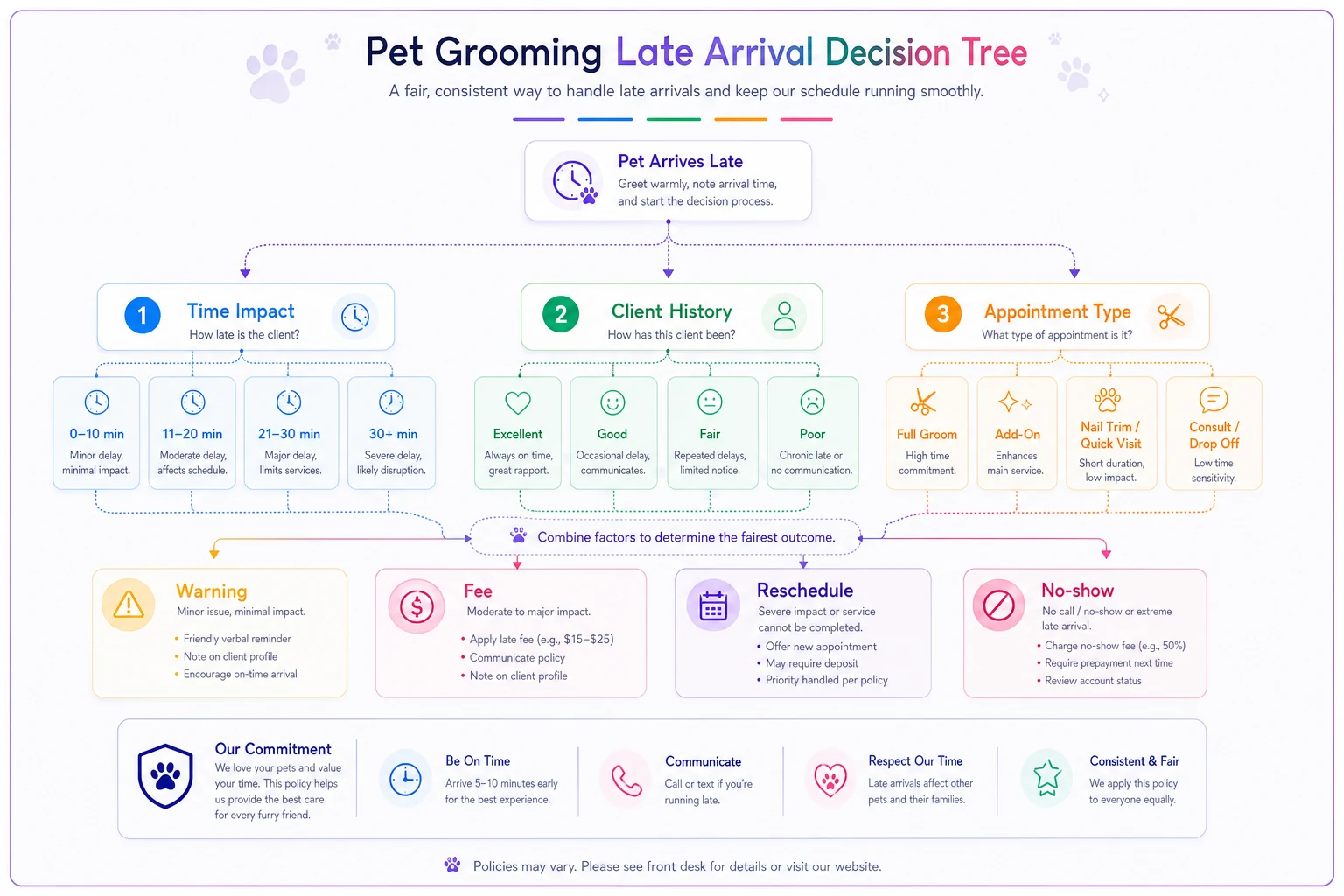
This diagram maps the decision flow above.
Fee tier templates that actually get paid
Generic "$25 late fee" policies get ignored or waived constantly. Scaled fees based on actual impact work better because they feel fair to both sides.
Tier 1: Minor impact (5-10 minutes late)
-
$10 flat fee OR
-
10% service surcharge OR
-
Loss of any active discounts/packages
Tier 2: Moderate impact (10-20 minutes late)
-
$20 flat fee OR
-
20% service surcharge OR
-
Conversion to express service (reduced styling)
Tier 3: Major impact (20-30 minutes late)
-
$35 flat fee OR
-
Full rebooking fee OR
-
Required deposit for future appointments
Tier 4: No-show equivalent (30+ minutes)
-
Full service charge OR
-
Permanent scheduling restrictions
These aren't just escalating dollar amounts. Sometimes losing a package discount changes behavior faster than a flat fee. Sometimes requiring deposits is more effective than charges. It depends on the client.
Communication scripts by scenario
How you deliver the message matters more than the policy itself. Here are scripts that tend to work:
First-time minor delay (educational tone)
"Hey Sarah, glad you made it! Just so you know, we had you down for 9am and it's 9:12 now. We'll absolutely take care of Bella today, but arrivals after 9:05 can affect our schedule. The team might need to adjust her styling slightly to stay on track. Going forward, if traffic's an issue, our 10am slots tend to have more flexibility."
Second offense (warming tone)
"Hi again! I see we're running about 15 minutes behind schedule today. This is actually the second late arrival we've noted in the past month. Today we'll proceed with a modified groom to respect our noon appointment, but future delays over 10 minutes will trigger our $20 scheduling impact fee. Would an afternoon slot work better for your schedule?"
Fee implementation (matter-of-fact tone)
"Morning! Since you've arrived 18 minutes past your appointment time, there's a $20 scheduling fee that applies today. This helps us manage the disruption and potential overtime for staff. Your total with Buddy's groom comes to $87. For future visits, would text reminders help, or should we look at different time slots?"
Chronic offender (firm but professional)
"We need to have a quick conversation about scheduling. This is the fourth late arrival in two months, which has consistently impacted our operations and other clients. Moving forward, we'll need a $50 deposit for appointments that gets applied to your service. If you're more than 10 minutes late, the deposit converts to a fee and we'll need to reschedule. Would you prefer to switch to our flexible afternoon windows instead?"
The escalation flow for repeat offenders
Progressive enforcement prevents that awkward moment where you suddenly drop the hammer on someone who's been late six times without any prior warning. Map it clearly:
Strike 1 (First 90 days): Verbal notice, logged in system. Staff mentions the late arrival and explains impact. No fee unless it's egregious (20+ minutes).
Strike 2 (Within 90 days): Written warning via email or text. Clear explanation that next occurrence triggers fees. Offer to help find better time slots. Flag account in booking system.
Strike 3 (Within 90 days): Fee implementation begins. Apply appropriate tier based on lateness. Send follow-up explaining the charge. Require confirmation of policy understanding.
Strike 4+ (Ongoing): Scheduling restrictions apply. May include deposit requirements, afternoon-only bookings, standby list only, or service termination after a sixth occurrence.
The 90-day rolling window matters. Someone late once a quarter isn't the same problem as someone late every few weeks.
Real ledger examples with recovery steps
Seeing actual account progressions helps staff understand enforcement in practice. Here's a realistic example tracked over four months:
March 5: Maxwell (Goldendoodle) - Arrived 8 minutes late
-
Service provided in full
-
Verbal reminder given
-
Account noted
"Late arrival #1 - educated on policy"
-
No fee
March 28: Maxwell - On time
-
Positive reinforcement
"Thanks for being right on time today!"
-
Previous flag remains visible
April 18: Maxwell - Arrived 14 minutes late
-
Service modified (skip cologne, basic ear cleaning only)
-
Email sent same day with policy attachment
-
Account noted
"Late arrival #2 - Written warning sent"
-
No fee (warning phase)
May 9: Maxwell - Arrived 11 minutes late
-
$20 fee applied
-
Receipt shows
"Groom $65 + Schedule Impact Fee $20 = $85"
-
Account noted
"Late arrival #3 - Fee applied per policy"
-
Follow-up text sent with deposit requirement notice
May 30: Maxwell - Arrived 3 minutes late
-
No fee (under threshold)
-
Positive note
"Much better today!"
-
Previous flags remain
June 20: Maxwell - Arrived 22 minutes late
-
$35 fee applied
-
Service significantly modified
-
Account restricted
"Deposit required for future bookings"
-
Owner offered different time slots
Notice the positive reinforcement when they do show up on time. That matters as much as the penalties.
Tracking mechanisms that don't require complex software
A spreadsheet is enough to start:
| Client Name | Pet | Date | Scheduled | Actual | Minutes Late | Action Taken | Fee | Notes |
|---|---|---|---|---|---|---|---|---|
| Johnson | Max | 3/15 | 9:00 AM | 9:08 AM | 8 | Verbal warning | $0 | First time, seemed apologetic |
| Johnson | Max | 4/20 | 9:00 AM | 9:18 AM | 18 | Written warning | $0 | Traffic excuse again |
| Johnson | Max | 5/15 | 9:00 AM | 9:21 AM | 21 | Fee applied | $20 | Accepted fee without complaint |
| Smith | Bella | 3/22 | 2:00 PM | 2:04 PM | 4 | None | $0 | Under threshold |
| Smith | Bella | 4/28 | 2:00 PM | 2:25 PM | 25 | Rescheduled | $35 | Couldn't complete service |
Keep rolling 90-day views active. Archive older data but maintain pattern history for clients with recurring issues.
Use color codes in your spreadsheet to flag repeat offenders and speed up review.
Keep rolling 90-day views active. Archive older data but maintain pattern history for clients with recurring issues.
Deposit structures for chronic offenders
Deposits shift behavior more effectively than fees alone. Instead of arguing about charges after the fact, expectations are set before the appointment even happens.
Standard deposit structure:
-
Require 50% service deposit after third late arrival
-
Deposit applies to service if on time
-
Converts to fee if late (based on tier)
-
Refundable only with 24-hour cancellation
This shifts the conversation from "you're charging me extra" to "you're keeping my deposit." Psychologically, people work harder to avoid losing something they've already paid.
When to grant exceptions
Not every late arrival deserves enforcement. Document your exception criteria so decisions stay consistent:
Automatic exceptions:
-
First visit ever (education only)
-
Documented medical emergency
-
Verified accident or road closure
-
Salon error (wrong time communicated)
Discretionary exceptions:
-
Annual late arrival from an otherwise perfect client
-
Significant lifetime value ($3,000+ annually)
-
Referred multiple quality clients
-
Genuine unusual circumstance
Track exceptions the same way you track violations. If someone is getting multiple "exceptions," that's its own pattern worth noticing.
Recovery workflows for damaged relationships
Sometimes fee enforcement goes poorly. Here's how to salvage valuable client relationships:
Step 1: Acknowledge their frustration
"I understand this fee feels frustrating, especially since you're usually on time."
Step 2: Explain the operational reality
"When appointments run late, we often have to pay overtime or rush other clients' services."
Step 3: Offer a reset path
"What if we waive half the fee this time, and going forward we try the 2pm slot that has more natural buffer?"
Step 4: Create win-win adjustments
Maybe they'd prefer:
-
First appointment of the day (no cascade effect)
-
Last appointment (natural buffer)
-
Standing appointment (same day and time weekly)
-
Text reminder upgrades
The goal isn't to be right. It's to maintain a profitable relationship while protecting your operations.
Setting up effective reminder systems
Prevention is easier than enforcement. Most tardiness isn't deliberate—people underestimate drive time or forget what they booked.
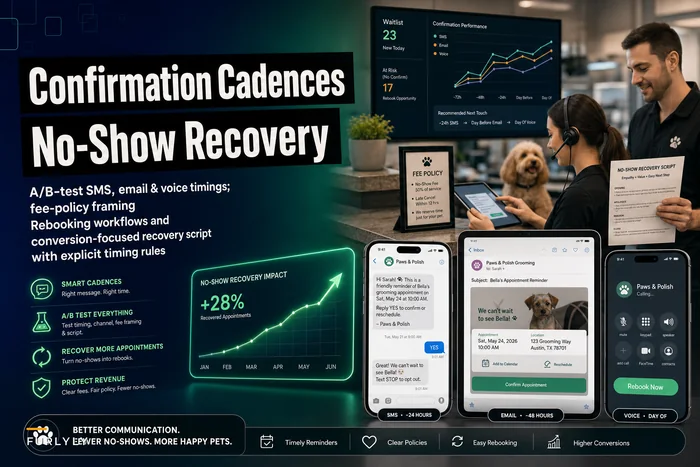
Layer your confirmation cadences and no-show recovery with specific late-arrival prevention:
48 hours before: "Reminder: Max's grooming is Thursday at 9am sharp. Please arrive 5 minutes early for check-in. Reply C to confirm."
Morning of: "Good morning! Max's appointment is in 2 hours (9am). We're located at 123 Main St. Parking is available behind the building. Please allow extra time for morning traffic."
High-risk clients (previous late arrivals): Add a 30-minute warning: "Heading out now? Your appointment is in 30 minutes. We'll need to modify or reschedule services for arrivals after 9:10am."
These aren't just reminders—they function as behavioral anchors that make on-time arrival more likely without requiring any confrontation.
Policy integration with your booking flow
Your grooming late arrival policy works best when it's embedded in operations from the start, not bolted on after problems surface. Build it into your data-driven scheduling from day one:
During booking:
-
Display late policy prominently
-
Require acknowledgment for new clients
-
Show specific arrival time, not just appointment time
-
Clarify check-in requirements
At confirmation:
-
Restate arrival expectations
-
Mention potential fees or service modifications
-
Provide parking and access instructions
During check-in:
-
Note actual arrival time immediately
-
Address lateness before starting service
-
Clarify any service modifications upfront
This removes surprise and emotion from enforcement. Everything was communicated clearly before they ever walked through the door.
Financial impact modeling
Understanding the real cost of late arrivals justifies your fee structure. Track these monthly:
Direct costs:
-
Overtime wages from cascade delays
-
Lost service revenue from rushed appointments
-
Reduced add-on sales from time constraints
Hidden costs:
-
Groomer stress and burnout
-
Other clients waiting longer than expected
-
Reception time managing delays
-
Quality compromises from rushing
A salon running 20% late arrivals can lose roughly $2,500–$3,000 monthly in direct costs and missed opportunities—before considering staff turnover from chronic schedule stress.
Your fee structure should offset these losses while encouraging better behavior. If fees just become a revenue stream without reducing lateness, the underlying problem hasn't been solved.
The technology advantage
Manual tracking works but gets overwhelming as volume increases. Modern operational software built for grooming automates most of this process. Instead of spreadsheets, AI-powered platforms can track arrival patterns, automatically apply fee tiers, and flag which clients are likely to be late based on their history.
The right system sends targeted reminders based on individual client behavior—so only the clients who actually need that extra 30-minute warning get it. It handles fee calculations, logs exceptions, and maintains audit trails without staff making manual entries or judgment calls mid-appointment.
Integrated platforms also connect late arrival data to broader operational patterns. You might discover that Tuesday morning slots have significantly more late arrivals than any other time—pointing to school drop-off conflicts you hadn't noticed. Or that certain groomers have higher late-arrival rates because they're too hesitant to enforce policy. That kind of insight lets you adjust proactively rather than just reacting to each situation as it happens.
Making enforcement stick
The biggest failure point isn't the policy itself—it's inconsistent application. Your team needs clear authority and real support to enforce rules uniformly.
Define enforcement standards:
-
Who can waive fees (owner only?)
-
How to document exceptions
-
When to escalate decisions
-
How to handle confrontation
Role-play common scenarios regularly. Let staff practice delivering scripts until they feel natural. Share wins when enforcement actually improves operations. Recognize the groomer who handled a difficult chronic lateness situation correctly.
Track whether your system is reducing late arrivals over time. If you're collecting fees but lateness isn't dropping, you're adding friction without solving anything. Adjust based on results.
Beyond punishment: Building better habits
The best grooming late arrival policy makes lateness rare, not profitable. Focus on making on-time arrival easier than being late:
Remove friction:
-
Clear parking instructions
-
Accurate GPS listings
-
Visible signage
-
Simple check-in process
Reward promptness:
-
Priority booking for on-time clients
-
Occasional acknowledgment or small discounts
-
Better appointment slots for reliable clients
Address root causes:
-
Offer different time slots that fit their actual schedule
-
Suggest realistic travel buffers
-
Standing appointments for clients who struggle with variable timing
When clients feel like you're working with them rather than policing them, they put in more effort to respect your schedule.
Late arrival policies fail when they're either too rigid or too flexible. The sweet spot uses structured decision trees that account for tardiness severity, client history, and service impact. Fee tiers should reflect actual operational costs, not arbitrary penalties. Scripts need to be firm while preserving the relationship. And tracking—whether a spreadsheet or integrated software—needs to capture patterns that inform both enforcement and prevention.
Chronic lateness is often a scheduling mismatch, not deliberate disrespect. By offering solutions alongside consequences—different time slots, standing appointments, better reminders—you turn enforcement from confrontation into problem-solving. That's what keeps clients around while actually protecting your operations.
Ready to streamline your grooming business?
Join 500+ pet groomers using Furlyly to save time, reduce scheduling conflicts, and deliver exceptional client experiences.