
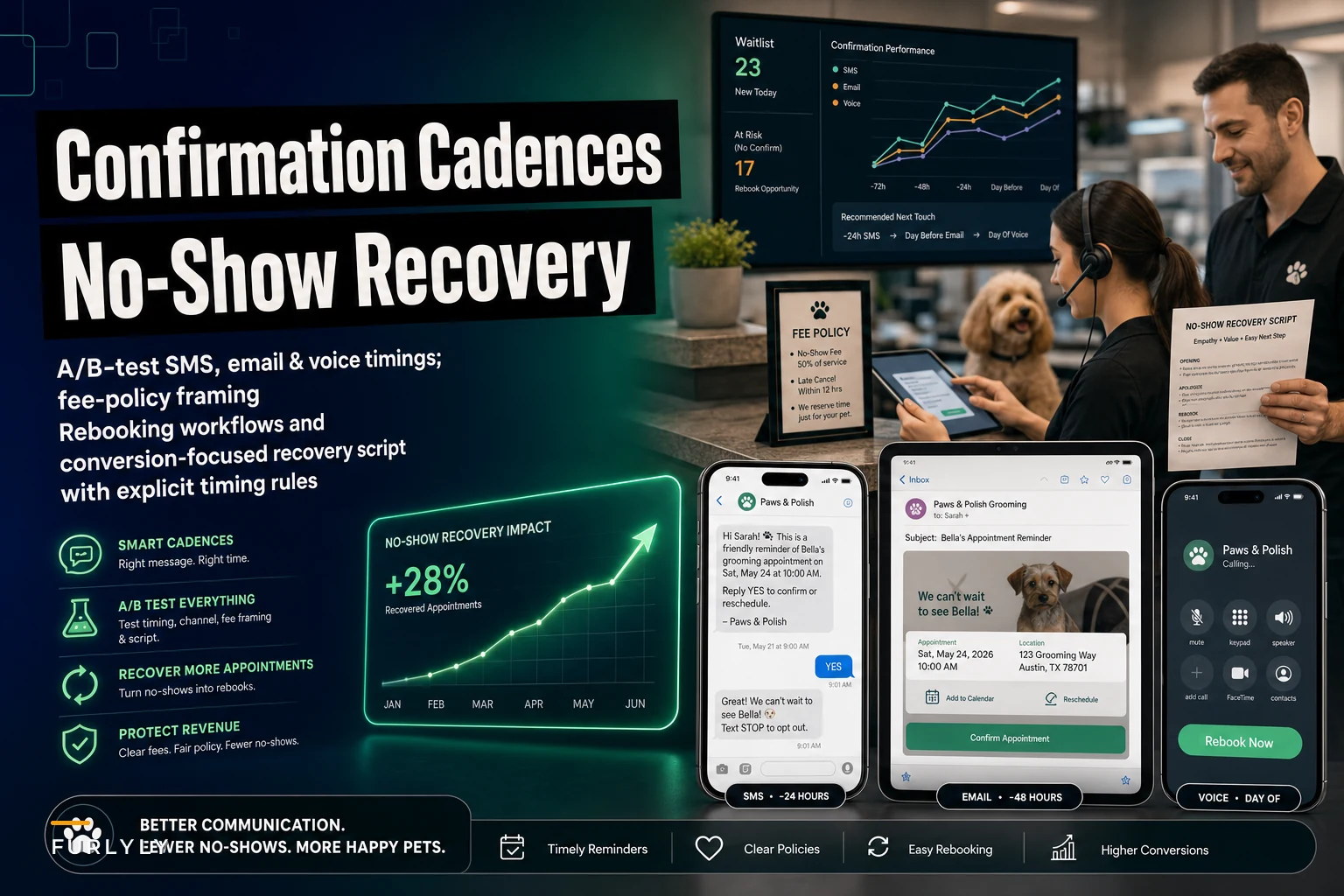

No-shows in grooming salons aren't just annoying—they're profit killers that compound into bigger operational problems. An empty grooming table at 2 PM on Tuesday is lost revenue, obviously, but it also means your groomer is sitting idle on the clock, your front desk is scrambling to fill the gap, and the clients who wanted that slot are booking somewhere else.
Most grooming salons handle confirmations wrong. They either blast generic reminders at random times or skip them entirely and hope clients remember. Neither works, because both ignore how pet owners actually behave around grooming appointments.
The real problem isn't whether you send confirmations—it's that most salons never test what actually gets responses from their specific client base. A grooming salon in suburban Phoenix has completely different confirmation needs than one in downtown Boston. Your retired clients check email at different times than working parents. Your doodle owners book differently than your yorkie regulars.
Why Standard Confirmation Templates Fail for Groomers
Generic appointment reminders assume all clients respond the same way to the same message at the same time. That's not how grooming works.
Pet grooming sits in this weird middle ground between medical necessity and luxury service. Unlike a dentist appointment booked months out, grooming appointments are usually scheduled 2-3 weeks ahead. And unlike a hair salon where missing means looking rough for another week, missing a grooming appointment can mean a matted dog that ends up needing a full shave-down.
Send reminders too early and clients forget again before the appointment. Send them too late and they can't rearrange their schedule. Frame your no-show policy too harshly and people get defensive. Frame it too softly and nobody takes it seriously.
The messaging itself matters more than most salons realize. A text that says "Reminder: Fluffy has grooming tomorrow at 10 AM" gets ignored because it doesn't require any action. But "Please confirm Fluffy's grooming tomorrow at 10 AM by replying YES, or call to reschedule" creates urgency and actually gets responses.
Building Your A/B Test Framework
Running confirmation tests doesn't require fancy software or a marketing degree. You need a simple tracking system and the discipline to change one variable at a time.
Never miss a grooming appointment again.
Furlyly helps you book, confirm, and manage every pet grooming appointment effortlessly.
- Unified appointment scheduling
- Automated client reminders
- Staff availability & shift management
No credit card required
Start by segmenting appointments into test groups. If you're handling around 300 appointments a month, that's enough volume to test properly. Split them 50/50 between your control message and your test message. Track confirmation rates, no-show rates, and rebooking rates for each group.
Test Variables That Actually Matter:
Timing windows change everything. Test these combinations:
-
48 hours before via email + 24 hours before via text
-
72 hours before via text + morning-of via text
-
24 hours before via email + 3 hours before via text
Message framing drives action. Compare:
-
"Reminder" vs "Please confirm"
-
"Your appointment" vs "Fluffy's spa day"
-
"Reply YES" vs "Reply C to confirm"
Channel preference varies by demographic:
-
Text only for clients under 40
-
Email first, text second for clients over 60
-
Voice calls for high-value clients only
Track confirmation rates, no-show rates, and rebooking rates for each group.
SMS Cadence Testing: What Actually Works
Text confirmations work best when they match how people actually use their phones. Most grooming clients check texts immediately but don't always respond right away. Your cadence needs to account for that.
The 48-24-3 pattern performs consistently well across different salon types. First touch at 48 hours gives clients time to adjust schedules. Second touch at 24 hours catches procrastinators. Final touch 3 hours before catches day-of forgetters.
What makes the real difference is message progression. Your 48-hour text should be friendly and low-pressure: "Hi Sarah! Fluffy's grooming is scheduled for Thursday at 2 PM. Reply C to confirm or R to reschedule."
Your 24-hour text gets more direct: "Tomorrow: Fluffy's grooming at 2 PM. Please reply YES to confirm. Call 555-1234 to change."
Your 3-hour text creates urgency: "See you soon! Fluffy's appointment is at 2 PM today. On your way? Reply YES. Running late? Call us now."
Start with 48-24-3 as a baseline and A/B test timing tweaks with your busiest appointment types.
Each message serves a different purpose. The first respects their time and gives options. The second creates commitment. The third uses a bit of social pressure to prevent last-minute ghosting.
Email Templates That Don't Get Deleted
Email confirmations need to compete with Amazon order updates, work messages, and newsletter spam. Most salons send boring reminders that get archived without a second glance.
Good grooming confirmation emails need three things: a subject line that gets opened, content that drives action, and a clear next step.
Subject lines that work:
-
"Fluffy's Thursday appointment - please confirm"
-
"Action needed
Confirm grooming for Thursday"
-
"Quick question about Fluffy's appointment"
Skip subject lines like:
-
"Appointment reminder"
-
"Don't forget!"
-
"See you Thursday"
The email body should be scannable in under 5 seconds. Key info goes at the top:
Fluffy's Grooming Appointment Thursday, November 14 at 2:00 PM
Then add something useful beyond just the reminder:
-
What to expect at this appointment
-
Any prep instructions (don't feed 2 hours before)
-
Notes from last visit
-
Current grooming notes on file
End with a clear button, not a text link. "CONFIRM APPOINTMENT" consistently outperforms "click here to confirm."
Voice Call Scripts for High-Value Clients
Voice confirmations feel outdated until you realize certain clients actually expect them. These aren't typical customers—they're the ones spending $200+ per visit, booking standing monthly appointments, or bringing two or three pets at a time.
Reserve phone confirmations for roughly 10-15% of your client base. More than that isn't sustainable. These calls serve a different purpose than texts or emails anyway—they're relationship builders disguised as confirmations.
The script matters less than the conversation flow. Start with recognition: "Hi Mrs. Chen, this is Ashley from Pampered Paws. I'm calling about Princess and Duke's appointments Thursday."
Then pivot to service: "We have them down for the usual—full groom with nail grinding. Did you want to add teeth cleaning this time? I noticed it's been about 3 months."
This approach turns confirmation calls into upsell opportunities while making clients feel genuinely valued. Track average ticket size for voice-confirmed appointments versus text-confirmed ones. The difference usually justifies the time investment.
Framing No-Show Fees Without Losing Clients
No-show policies create tension. Frame them wrong and clients feel nickel-and-dimed. Skip them entirely and your schedule turns into swiss cheese.
The key isn't the fee amount—it's how you position it. "No-show fee: $35" sounds punitive. "Appointment protection deposit: $35 applied to service" sounds reasonable.
Testing different frames reveals surprising patterns. Penalty framing ("$35 fee for no-shows") actually performs worse than value framing ("Your appointment reserves 2 hours of groomer time").
A salon in Orlando tested this and saw confirmation rates climb around 20%:
Instead of: "Failure to confirm 24 hours in advance may result in cancellation and a $35 fee."
They tried: "This appointment reserves your groomer's time. If plans change, please let us know 24 hours ahead so we can offer the spot to waitlisted clients."
The second version acknowledges the relationship goes both ways. You're not demanding compliance—you're explaining why it matters. That small shift reduced hostile responses while still holding clients accountable.
The Recovery Script That Actually Fills Slots
When someone no-shows, most salons either write off the slot or frantically call whoever's on their waitlist. Neither approach maximizes recovery potential.
Effective slot recovery works in stages, each with specific timing and messaging.
Stage 1: Immediate Recovery (within 15 minutes of no-show)
Text the no-show client: "Hi! We're holding Fluffy's spot for 15 more minutes. On your way? Reply NOW or call immediately."
This catches the "thought it was tomorrow" crowd and the "stuck in traffic" folks. A solid chunk of no-shows are actually late-shows who just didn't communicate.
Stage 2: Rapid Waitlist Activation (at the 15-minute mark)
Don't call your waitlist one by one. Text your top 3 waitlist clients simultaneously: "Last-minute opening NOW for full groom! First to confirm gets it. Reply YES to claim."
Creating urgency and a bit of competition fills slots faster than individual calls.
Stage 3: Re-engagement (within 24 hours)
Contact the no-show client with empathy, not frustration: "We missed Fluffy yesterday! Everything okay? Let's get them rescheduled—they're due for grooming. Reply with days that work this week."
This keeps the relationship intact while framing urgency around the pet's grooming needs rather than your business needs.
Here's a simple visual of the slot recovery workflow.
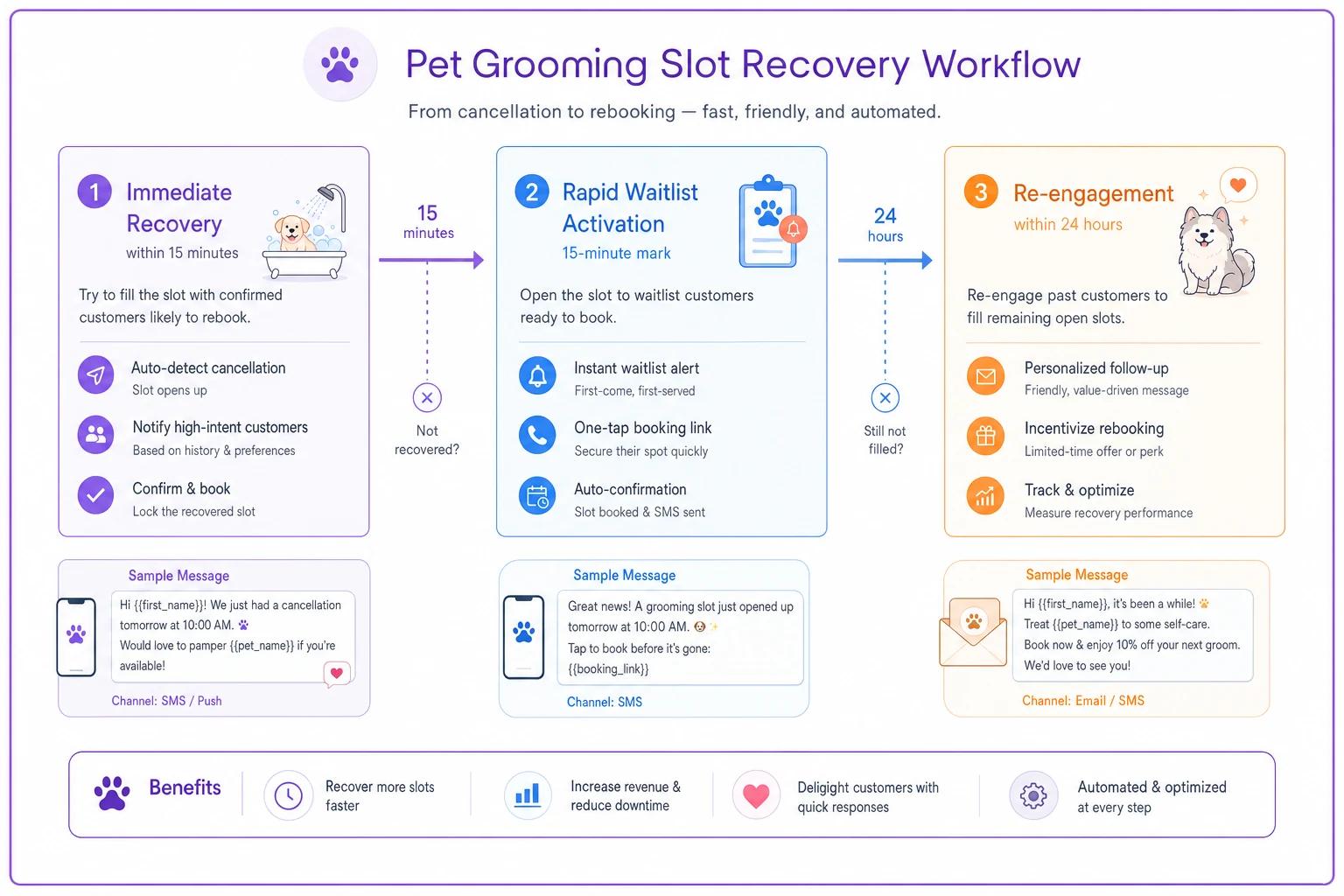
Use the staged approach to avoid frantic one-off calls and to maximize the chance of filling the slot quickly.
Timing Rules Based on Real Testing Data
Confirmation timing isn't universal, but clear patterns emerge across similar salon types.
| Salon Type | Timing & Channels |
|---|---|
| For suburban salons with family clientele: | - Initial confirmation: 72 hours before - Follow-up: 24 hours before - Final reminder: Morning of appointment - Best channels: Text primary, email secondary |
| For urban salons with professional clientele: | - Initial confirmation: 48 hours before - Follow-up: Morning of appointment - Best channels: Email for initial, text for day-of |
| For mobile grooming operations: | - Initial confirmation: 48 hours before - Route confirmation: Night before with time window - En-route notification: 30 minutes before arrival - Best channels: Text exclusively |
These patterns reflect real lifestyle differences. Suburban families plan ahead and need multiple touchpoints. Urban professionals live by their calendars and respond to fewer reminders. Mobile grooming clients need precision timing because someone has to actually be home.
Most salons land on 48 hours as the sweet spot for initial confirmation—far enough out that clients can adjust schedules, close enough that they won't forget again. But testing reveals exceptions. Salons near military bases often need 72-hour confirmations because duty schedules shift unpredictably, and salons in retirement communities can sometimes confirm morning-of without issue since plans rarely change last-minute.
Success Metrics That Matter
Tracking confirmation effectiveness means looking beyond simple response rates. A 90% confirmation rate is meaningless if 15% still no-show after confirming.
Primary metrics to track:
-
Confirmation rate by channel tells you where your clients actually prefer to communicate. If SMS gets 85% response but email gets 45%, stop splitting your energy equally between them.
-
No-show rate after confirmation shows whether your confirmations are changing behavior or just creating a false sense of security. Some salons discover confirmed appointments no-show at nearly the same rate as unconfirmed ones—which points to a different problem entirely.
-
Recovery rate measures how well you fill cancelled or no-show slots. A solid recovery system fills 60-70% of dead slots. Below 40% and your waitlist process needs a serious rethink.
-
Lifetime value impact reveals the actual cost of poor confirmation systems. Track whether clients who no-show once become repeat offenders or quietly disappear. Often, one bad experience around a missed confirmation loses a client for good.
Secondary metrics worth monitoring:
-
Time to confirmation shows engagement levels. Clients who confirm within 2 hours of getting the message rarely no-show. Those taking 20+ hours need additional follow-up.
-
Channel preference by service type sometimes reveals patterns worth acting on. Full groom clients might prefer email while nail-trim-only clients respond better to texts.
-
Upsell rate by confirmation method can justify the cost of voice confirmations. If phone confirmations consistently generate higher tickets through add-on services, the math becomes pretty obvious.
Tracking these metrics helps you prioritize which confirmation channels and messages are worth investing in.
Building Waitlist Systems That Work
Your waitlist isn't a backup plan—it's a revenue recovery system that needs its own operational process. Most salons treat waitlists like sticky notes or mental notes, which means money gets left on the table every time a slot opens.
Effective waitlists segment by urgency and flexibility. Not everyone waiting has the same constraints. The dog with severe matting needs the next available slot. The regular client wanting to move up their standing appointment can wait a bit longer.
Create three waitlist categories:
-
Urgent (medical issue or severe matting)
-
Flexible (can come same-day with 2-hour notice)
-
Specific (only certain days or times work)
When slots open, contact each category differently. Urgent gets an immediate phone call. Flexible gets the competitive text blast. Specific only gets contacted when a matching slot actually opens.
This segmentation prevents waitlist fatigue. Calling someone repeatedly for slots they can't take trains them to ignore your outreach. Respecting their actual constraints keeps them engaged.
Integration with Existing Operations
Adding confirmation processes to your existing workflow requires some honest planning. You can't bolt on new communication requirements without thinking through who handles them and when.
Most salons assign confirmation duties to whoever seems least busy in the moment, which creates inconsistent execution. Build confirmations into specific roles at specific times instead.
Morning confirmation blocks work well—set aside 9:00–9:30 AM for sending 48-hour and 24-hour confirmations. Batching this way keeps things from slipping through, and the same person handling confirmations can immediately deal with responses, update the schedule, and activate the waitlist when needed.
For voice confirmations, schedule them during natural slow periods. The hour after morning rush and the hour before closing tend to work well. Put your most personable staff member on these calls, not just whoever's available.
Track time investment honestly. If confirmations are taking more than 45 minutes daily for a salon running 20 appointments, the process needs streamlining. That might mean switching channels, tightening templates, or reconsidering which clients actually need phone confirmation.
Real Testing Example: Mixed-Service Salon
A grooming salon in Austin handling both grooming and daycare ran into an interesting problem—different services had completely different confirmation needs. Daycare clients dropped off daily and rarely no-showed. Grooming clients booked weeks out and no-showed constantly.
They ran a 60-day split test:
Grooming appointments:
-
72-hour email with preparation reminders
-
24-hour text requiring confirmation
-
3-hour text for unconfirmed appointments only
-
Result
No-shows dropped from 18% to 7%
Daycare drop-offs:
-
Morning-of text only for irregular clients
-
No confirmation for weekly package holders
-
Result
Maintained 2% no-show rate while cutting outbound texts by 70%
Reducing unnecessary daycare confirmations freed up time for more grooming follow-ups. Overall confirmation rates improved while total messages sent actually went down.
They also tested fee framing specifically for grooming no-shows. Instead of a flat cancellation fee, they tried holding deposits—clients paid $20 at booking (applied to the service) for peak Saturday slots. Saturday no-shows essentially disappeared, and booking rates barely budged.
The Rebooking Workflow That Prevents Gaps
Recovery scripts help fill sudden gaps, but rebooking workflows prevent them from forming in the first place. The best time to book the next appointment is at checkout from the current one—yet most salons consistently miss this window.
A solid rebooking workflow needs three things: timing recommendations based on breed and coat condition, some kind of incentive for advance booking, and a follow-up sequence for clients who don't rebook on the spot.
At checkout, your staff or software should calculate the ideal return date. For a standard poodle, that's probably 6-8 weeks. For a lab, maybe 10-12 weeks. Frame it as professional guidance: "Based on Fluffy's coat type, we'd recommend coming back by January 15th. Want me to get that scheduled?"
If they decline, trigger a follow-up sequence based on coat type. Week 4 for fast-growing coats, week 6 for medium coats, week 8 for slow-growing coats. The message should feel timely without being pushy: "Hi! Fluffy's due for grooming soon and our December schedule is filling up. Want to reserve their spot?"
Systematic rebooking reduces your dependence on confirmations. Regular clients on standing appointments rarely no-show because grooming becomes routine rather than something they have to remember to book.
Technology and Automation Opportunities
Manual confirmation systems work fine for smaller operations. But once you're past 400-500 monthly appointments, keeping up manually becomes a real problem—not with sending messages, but with intelligently managing responses and exceptions.
Modern operational platforms can handle the core confirmation flow automatically. They segment clients, send messages at the right times, and track responses without anyone touching a spreadsheet. The bigger value is in exception handling. What happens when someone replies "can I move to Thursday?" or "Fluffy's sick, need to cancel"?
AI-enhanced systems handle these situations without creating a manual task every time. Reschedule requests update the calendar. Cancellations trigger waitlist notifications. Ambiguous responses get flagged for human review. That kind of intelligent routing makes a real difference when you're managing a full schedule.
Coordination also matters more than most people realize. When confirmations, scheduling, waitlists, and rebooking all live in separate tools or disconnected spreadsheets, things fall through the cracks. Integrated platforms make sure a cancelled Tuesday appointment immediately triggers the right downstream actions—waitlist notification, schedule adjustment, rebooking follow-up.
These tools also make testing easier at scale. Instead of manually tracking A/B test results across spreadsheets, the system automatically segments, tests, and reports on what's working. You figure out what performs best for your specific client base without the administrative overhead.
Grooming appointment confirmations and no-show recovery aren't just about filling schedules—they're about respecting both your team's time and your clients' needs. The salons that get this right don't just guess. They test, measure, and refine based on how their actual clients behave.
Start with one simple test. Pick your biggest problem—Saturday no-shows, last-minute cancellations, whatever it is. Design two different confirmation approaches and run them for 30 days. Track the results, pick the winner, then test the next variable.
The compound effect adds up faster than you'd expect. Reducing no-shows from 15% to 8% sounds incremental, but across 400 monthly appointments, that's 28 recovered slots. At an average ticket of $75, that's over $2,000 a month recovered just from better confirmations.
Your confirmation system is also often the only touchpoint between appointments. It shapes how clients perceive your professionalism even when they're not sitting in your salon. When done right, confirmations don't just prevent no-shows—they strengthen client relationships and smooth out the operational chaos that comes from an unpredictable schedule.
The scripts, timings, and frameworks here are a starting point. Your salon's ideal confirmation system will come from testing with your specific clients in your specific market. Start testing now—your future schedule stability depends on it.
Ready to streamline your grooming business?
Join 500+ pet groomers using Furlyly to save time, reduce scheduling conflicts, and deliver exceptional client experiences.