
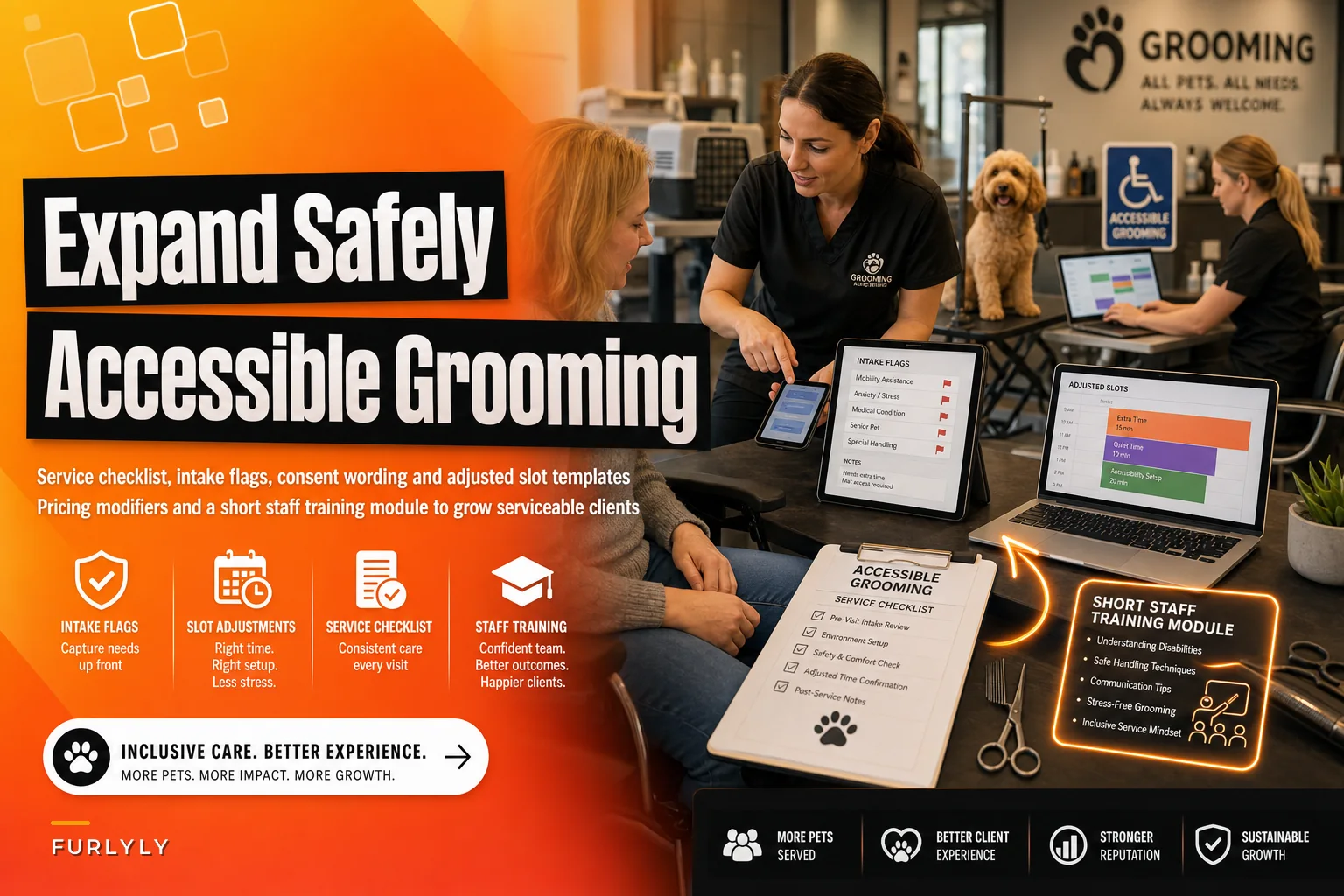

The grooming industry loses real revenue every year from salons that turn away elderly pet owners, wheelchair users, and clients with sensory processing needs—not from discrimination, but from operational uncertainty. Staff don't know how to adjust their workflows, so they default to "we might not be able to help with that" and the client goes elsewhere.
Most salons already have everything they need to serve these clients. They just lack the intake mechanisms, adjusted scheduling, and staff confidence to handle these appointments without things getting awkward. The gap between "we can't accommodate that" and picking up a meaningful chunk of underserved clients often comes down to three missing pieces: better intake, adjusted slot templates, and basic staff training.
The Hidden Market You're Already Turning Away
Picture the typical rejection scenario. A client calls and mentions she uses a walker and can't lift her 45-pound golden retriever onto your scale. The receptionist doesn't know if this creates a liability issue or will disrupt the day's flow, so they hedge: "sorry, we might not be able to accommodate that." Nothing malicious. Just no protocol to fall back on.
Or the autistic teenager who drops off the family cat but needs written instructions instead of verbal back-and-forth, minimal eye contact, and a little extra transition time. Without any guidance, staff either fumble through or suggest the client might be "more comfortable elsewhere."
These aren't rare situations. Around 26% of adults have some form of disability, with mobility and cognitive differences being the most common. Add in temporary limitations—post-surgery recovery, pregnancy, short-term injuries—and you're looking at close to a third of your potential client base that might need basic adjustments.
The operational reality is that most of these accommodations require zero extra equipment and add maybe 5-10 minutes to a slot. Yet salons routinely lose out on bookings because nobody built the intake flags and protocols to handle them smoothly.
Why Standard Intake Forms Create Barriers
Standard grooming intake focuses entirely on the pet—breed, temperament, medical history, grooming preferences. The owner is basically just a payment method and contact number. That works fine until an accommodation need shows up mid-appointment and staff have no idea what to do.
Never miss a grooming appointment again.
Furlyly helps you book, confirm, and manage every pet grooming appointment effortlessly.
- Unified appointment scheduling
- Automated client reminders
- Staff availability & shift management
No credit card required
A client with limited hand mobility arrives for pickup. She can't sign the receipt. She struggles with the leash handoff. She needs help getting her dog into her vehicle. Staff scramble while the waiting room piles up.
It compounds with communication differences. A deaf client shows up for drop-off and staff don't know even basic pointing gestures for common decisions. A client with early-onset dementia can't remember whether he approved the add-on bath. A client with social anxiety needs everything handled by text but nobody flagged it.
-
Service delays — Staff spend 10-15 minutes sorting out accommodations that could've been handled in 30 seconds during booking.
-
Inconsistent experiences — Different staff handle the same client differently. That's frustrating for everyone and creates potential safety problems.
-
Liability exposure — Without documented accommodation agreements, salons risk complaints even when they're genuinely trying to help.
The fix isn't extensive accessibility training across your whole team. It's better intake that captures what people need upfront and converts it into simple operational flags.
Building Your Accommodation Intake System
A two-tier intake approach works well here—separating pet information from owner accommodation needs. This keeps the standard booking flow from getting overwhelming while making sure the critical stuff actually gets captured.
Primary Intake Addition
Add one question to your standard intake: "Do you have any accommodation needs we should know about to make your visits easier?"
Open-ended works better than a checklist because clients understand their own needs better than you can pre-populate. Someone might need text communication because their hearing aids don't work well on calls. Another might need you to meet them at their car because your front entrance doesn't work with their wheelchair.
When clients indicate they have accommodation needs, route them to a secondary intake form with these fields:
Mobility accommodations:
-
Curbside service needed (drop-off, pickup, or both)
-
Assistance with pet handling (lifting, leash transfer, crate loading)
-
Accessible parking requirements
-
Extended arrival/departure time
Communication preferences:
-
Written communication only (text/email)
-
Visual communication needs (ASL, written instructions)
-
Simplified language
-
Proxy communication authorized (caregiver, family member)
Sensory accommodations:
-
Reduced lighting
-
Quiet environment
-
Minimal physical contact
-
Specific staff gender preferences for religious or cultural reasons
Cognitive support:
-
Reminder frequency preferences
-
Decision-making support
-
Consistent staff assignment
-
Written service summaries
Add a single booking checkbox that routes clients to the secondary form so reception stays fast while capturing needed details.
Each category maps directly to an operational adjustment—not a medical diagnosis. You don't need to know if someone has MS or autism. You need to know they require curbside service or written communication.
Consent and Liability Language
"We're committed to providing accessible pet grooming services for all clients. By indicating accommodation needs, you authorize our staff to make reasonable adjustments to our standard service protocols. We'll do our best to meet indicated needs but cannot guarantee all accommodations in all circumstances. Please note: - Staff assistance is limited to pet handling and cannot include personal physical assistance - Accommodation needs may affect appointment scheduling and pricing - We reserve the right to require authorized proxies for clients who cannot provide legal consent - Significant accommodation needs may require advance scheduling notice - Some accommodations may include modest service modifications or additional fees"
You're not agreeing to become caregivers. You're adjusting pet grooming operations to be more accessible—and making that distinction explicit protects everyone.
Here's a simple flow to visualize the intake and flagging process.
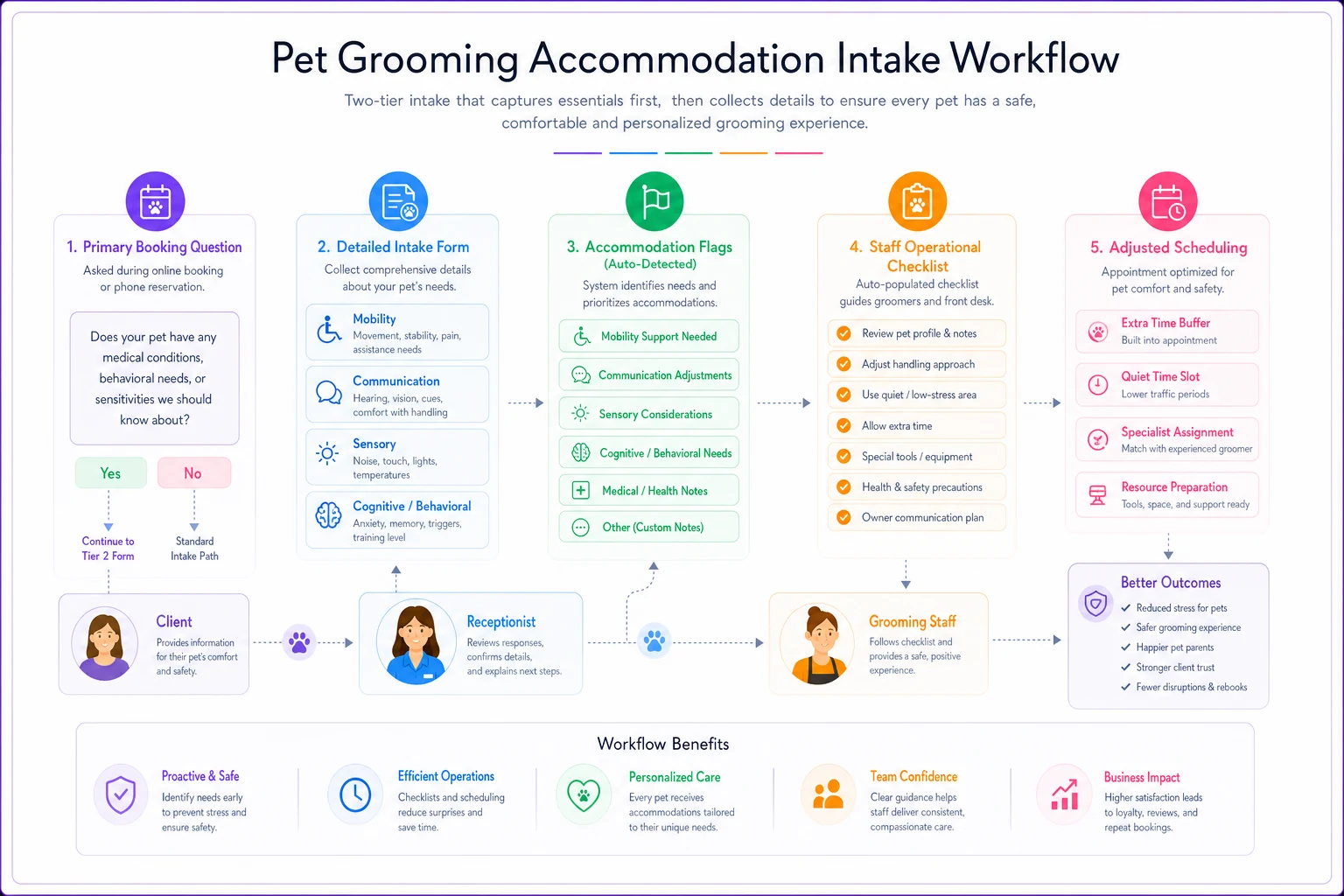
Use this workflow as a quick reference for staff.
Service Checklist Templates for Common Accommodations
Convert accommodation flags into specific checklists staff can follow without making judgment calls. This takes the guesswork out completely.
Mobility Accommodation Checklist
-
Pre-arrival setup (5 minutes before) - Clear pathway from accessible parking to entrance - Position mobile ramp if available - Assign specific staff member for assistance - Prepare rolling cart for belongings if needed
-
Arrival protocol - Staff meets client at vehicle - Assists with pet leash/carrier transfer only - Verbally confirms all services before client leaves - Provides estimated pickup time in writing
-
Pickup protocol - Text client 10 minutes before ready - Bring pet to client vehicle - Complete payment at vehicle if needed - Assist with loading pet (not client)
Communication Accommodation Checklist
-
Visual/Written communication - Print service options with checkboxes - Use pointing and gestures for yes/no questions - Write pickup time on appointment card - Text updates instead of calling
-
Simplified communication - Use short, clear sentences - Avoid grooming jargon - Confirm understanding before proceeding - Provide visual aids (photos of cut styles)
-
Proxy communication - Verify authorized proxy in system - Confirm all decisions with authorized person - Document who approved services - Send confirmations to both parties
Sensory Accommodation Checklist
-
Environment modifications - Dim reception lighting if possible - Reduce background music volume - Minimize strong scent products in lobby - Offer seating away from main traffic
-
Interaction modifications - Maintain professional distance - Avoid sudden movements - Speak at moderate volume - Allow extra processing time for decisions
When system flags these needs, staff simply follow the checklist—no judgment calls, no on-the-spot policy creation.
Adjusted Slot Templates and Scheduling Rules
Accommodation appointments usually need different time blocks than standard bookings. Squeezing them into regular slots causes delays and frustration. Specific templates that account for the actual time requirements work a lot better.
Standard vs. Accommodation Time Slots
| Service Type | Standard Slot | Mobility Accommodation | Communication Accommodation | Combined Accommodation |
|---|---|---|---|---|
| Small dog full groom | 90 minutes | 100 minutes | 95 minutes | 105 minutes |
| Large dog full groom | 120 minutes | 135 minutes | 130 minutes | 145 minutes |
| Cat grooming | 60 minutes | 70 minutes | 65 minutes | 75 minutes |
| Nail trim only | 15 minutes | 20 minutes | 20 minutes | 25 minutes |
The extra time isn't for the grooming itself—it's for adjusted drop-off and pickup. Curbside service adds roughly 5-8 minutes per transaction. Written communication adds 3-5 minutes. Combined needs can push total additions to 10-15 minutes.
Scheduling Concentration Strategy
Rather than scattering accommodation appointments throughout the day, concentrate them in dedicated windows. This lets you assign experienced staff to those blocks, keep standard efficiency during peak hours, and reduce the context-switching fatigue that builds up when staff jump between very different appointment types.
Most salons find Tuesday/Thursday mornings and Wednesday afternoons work well. Steady availability without touching the weekend rush.
Pricing Modifier Framework
-
Curbside service fee $5–10 per appointment Covers additional staff time for vehicle-side handling
-
Extended appointment fee $10–15 for appointments needing 15+ extra minutes Compensates for reduced daily booking capacity
-
Consistent staff assignment $5 per appointment Same groomer every time for clients who need routine stability
-
Written documentation fee $3–5 per appointment Detailed written summary of services performed
-
Express scheduling priority $10–15 Specific time slots for clients with medical appointments or caregiver schedule constraints
Frame these as "accommodation service fees" rather than surcharges. Most clients will pay modest fees for services that genuinely make grooming accessible to them.
The 30-Minute Staff Training Module
Staff resist accommodation services mostly from fear of getting something wrong—not unwillingness to help. A focused training module that emphasizes protocols over theory builds confidence fast.
Module Structure (30 minutes total)
Part 1: Why Accommodations Matter (5 minutes)
-
Accommodation clients tend to rebook at higher rates (closer to 85% vs. around 70% for standard clients)
-
They refer similar clients, creating natural clusters
-
They often book during slower periods
-
They leave reviews specifically mentioning accessibility
Part 2: Boundary Setting (8 minutes)
-
You assist with pets, not people
-
You modify services, not provide medical care
-
You accommodate reasonable requests, not every request
-
You follow checklist protocols, not make medical judgments
Practice scenarios:
-
Client asks for help getting into their car → politely decline, offer to bring pet to them instead
-
Client seems confused about services → refer to authorized proxy
-
Client requests staff stay late for pickup → offer a next-day hold
Part 3: Common Accommodation Protocols (12 minutes)
-
Wheelchair user with large dog
- Meet at vehicle - Use slip lead for transfer - Confirm services verbally - Return pet to vehicle at pickup
-
Deaf client with cat
- Use written service menu - Point to options - Write pickup time clearly - Text when ready
-
Elderly client with memory issues
- Check for authorized proxy - Document all service decisions - Provide written receipt - Call proxy with pickup time
Part 4: Practice Role-Play (5 minutes)
Pair staff to run through one accommodation scenario. One plays the client, one follows the checklist. Debrief briefly on what felt comfortable and what felt awkward.
Ongoing Reinforcement
-
Monthly 5-minute accommodation scenario reviews
-
Rotating accommodation appointment assignments
-
Share positive client feedback when it comes in
-
Address concerns immediately rather than letting anxiety build quietly
After initial training:
Converting Accommodations into Operational Advantage
The salons doing this well don't treat accommodations as a burden—they systematize them into a competitive edge. Accommodation clients are an underserved, loyal segment with specific requirements that, once you've met them consistently, generate reliable revenue.
Think about your current "difficult client" list. How many of those situations are actually unmet accommodation needs in disguise? The client who calls repeatedly might have memory issues and needs written confirmation. The one who doesn't respond to friendly small talk might be dealing with sensory overload in your loud lobby. The one who's always running a few minutes late might genuinely struggle with mobility and needs a bit more travel buffer.
Proper intake flags, adjusted scheduling, and clear protocols convert those friction points into smooth appointments.
Your existing intake forms might already cover some medical and behavioral flags, but accommodation needs require their own systematic approach. Similarly, while you may have safety protocols for anxious or aggressive pets, accommodation protocols handle the human side of the service equation—which is a different problem entirely.
Tracking Accommodation Success Metrics
Accommodation booking rate: Percentage of total bookings requiring accommodations Target: 8–12% indicates healthy accessibility without overwhelming operations
Accommodation no-show rate: Compare to standard no-show rates Should be similar or lower given the higher client investment
Accommodation rebooking rate: 90-day return tracking Target: 10–15% higher than standard clients
Accommodation service time variance: Actual vs. scheduled time Helps you keep refining slot templates
Staff comfort scores: Monthly survey on accommodation confidence Surfaces training gaps before they become real problems
Modern operational software can automatically flag accommodation appointments, track these metrics, and keep service delivery consistent across staff and shifts. AI-assisted platforms help by identifying patterns in scheduling needs, maintaining accommodation documentation, and surfacing client requirements for staff at the right moment—without exposing private medical details.
The broader impact is worth noting. Salons known for accessibility attract not just clients with disabilities but their extended networks—family members, caregivers, community organizations. You end up as the recommended option in disability support groups, senior communities, and healthcare provider referral lists.
Getting from "we can't accommodate that" to "here's how we handle that" doesn't require expensive modifications or lengthy training programs. It requires systematic intake, clear operational checklists, adjusted scheduling templates, and staff who know what to do when an accommodation flag shows up. With those pieces in place, any salon can serve this underserved market while keeping operations running efficiently.
The salons that thrive long-term won't be the ones that only took easy, standard appointments. They'll be the ones that built systems to profitably serve everyone who needs pet grooming, regardless of human limitations. The question isn't whether to offer accessible services—it's whether you build the systems for it before your competitors do.
Ready to streamline your grooming business?
Join 500+ pet groomers using Furlyly to save time, reduce scheduling conflicts, and deliver exceptional client experiences.