

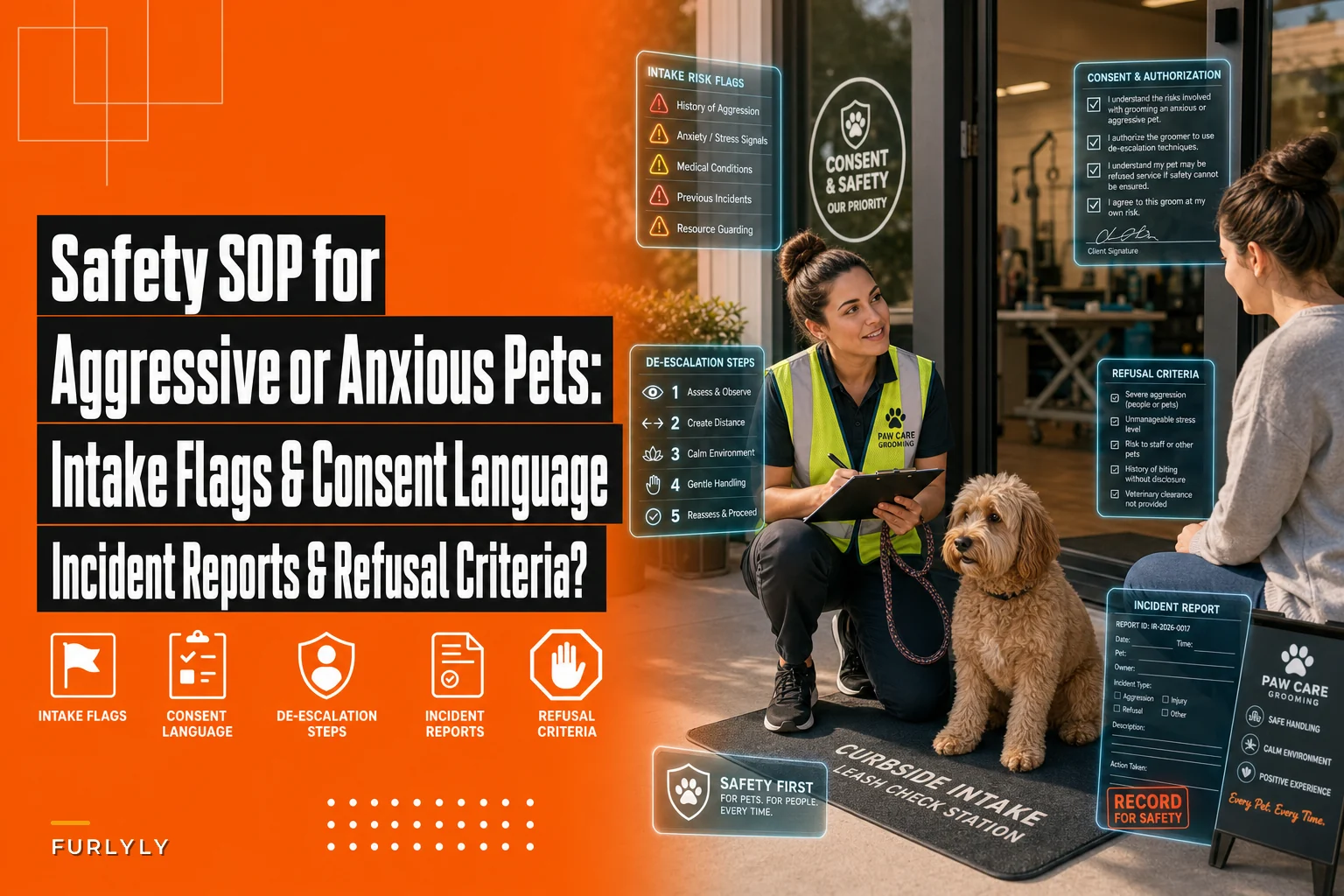

A grooming salon in Denver got sued after a nervous German Shepherd bit through a groomer's hand during nail trimming. The bite required surgery, four months recovery, and the salon's insurance only covered $12,000 of the total damages. What killed them wasn't the bite itself—it was their intake form that said "dog seems friendly" when the owner had actually mentioned anxiety issues during drop-off.
The conversation just wasn't documented properly.
This happens in variations across the grooming industry more than owners realize. Not because groomers are careless, but because most salons run on verbal agreements, quick phone assessments, and memory-based safety decisions that fall apart when something goes wrong.
The liability gap between what owners tell you and what gets documented
Clients casually mention their dog "gets nervous around strangers" or "doesn't like his paws touched" during booking calls or drop-off conversations. Your staff mentally notes it, maybe mentions it to the groomer, but nothing gets formally recorded. Then six weeks later when that same dog snaps during a groom, you have zero documentation that the owner warned you about behavioral issues.
Your groomer safety protocols for aggressive dogs need to capture these warnings systematically—not rely on whether your receptionist remembers to pass along a comment from Tuesday's phone call.
Most grooming salons treat safety protocols as an afterthought rather than an operational system. They'll have beautiful service menus, detailed pricing sheets, impressive before/after photos on Instagram, but their actual safety documentation consists of a basic waiver downloaded from the internet and maybe some informal "be careful with Buster" notes stuck to a computer monitor.
When you dig into actual bite incidents and claims, the salon usually knew the dog had issues. Someone, somewhere in the process, had a red flag. But that information lived in someone's head instead of a documented system that could protect both the groomer and the business.
Breaking down the four-layer safety system
A functional groomer safety protocol for aggressive dogs operates on four distinct layers, each designed to catch risks the previous layer might miss.
Never miss a grooming appointment again.
Furlyly helps you book, confirm, and manage every pet grooming appointment effortlessly.
- Unified appointment scheduling
- Automated client reminders
- Staff availability & shift management
No credit card required
| Layer | Description |
|---|---|
| Layer 1: Pre-Booking Assessment | This happens before the dog ever enters your salon. When someone calls to book, your intake process should include specific behavioral questions—not generic "is your dog friendly" nonsense that every owner answers yes to. Questions like "Has your dog ever growled, snapped, or shown teeth during grooming?" and "Does your dog require sedation at the vet?" actually surface real information. |
| Layer 2: Visual Intake Flags | The moment a dog walks through your door, visual assessment protocols kick in. Body language, owner handling, leash behavior—these observable signals need structured documentation. Not "dog seemed stressed" but specific markers: whale eye, tucked tail, excessive panting without exertion, owner using two hands to control on leash. |
| Layer 3: Handling Protocols | Once you've identified risk levels, handling protocols determine who works with which dogs and under what conditions. A Level 2 anxiety flag might mean two-person handling for nail trims. A Level 3 aggression flag might require the owner present or muzzle consent before proceeding. |
| Layer 4: Incident Documentation | When something does happen—even minor growling or air snapping—the documentation needs to be immediate and specific. Not tomorrow, not after lunch, but right then while details remain fresh. |
Most salons have one or two of these layers partially implemented. The gap between partial and complete is where lawsuits live.
High-risk intake flags that actually predict problems
Analyzing incident reports from dozens of salons shows certain intake signals consistently predict safety issues. Not the obvious "dog has bitten before" flags, but the subtle patterns that inexperienced staff miss.
The "Only I Can Handle Him" Owner When an owner insists they need to be the one to hand the dog over, or makes comments about the dog only listening to them, you're looking at a control issue that often translates to aggression when the owner leaves. These dogs frequently seem fine during handoff then explode once isolated with staff.
Medical Anxiety Correlation Dogs that require sedation for veterinary exams almost always present grooming challenges. The correlation is strong enough that this single question should trigger enhanced protocols. Yet most intake forms don't even ask about vet visit behavior.
The Parking Lot Struggle Watch the parking lot through your window. If an owner spends several minutes trying to coax a dog out of the car, or if the dog is being physically dragged toward your door, that's not normal pre-grooming nervousness. That's a dog that associates your building with negative experiences.
Breed-Specific Camouflage Certain breeds hide aggression signals better than others. A stressed Golden Retriever looks obviously uncomfortable—whale eye, panting, pulling away. A stressed Chow or Akita might look stoic right until they bite. Your intake protocols need breed-adjusted assessment criteria, not universal signals.
Previous Groomer Switching When someone has been through three groomers in the past year, they're not "just particular about their dog's cut." There's a behavior issue they're not disclosing. The question "Why did you leave your previous groomer?" should be mandatory, with specific follow-up if the answer seems vague.
Writing consent language that holds up legally
Generic waivers don't protect you. That boilerplate text about "grooming has inherent risks" means nothing when a lawyer argues you knew specific risks about a specific dog and proceeded anyway without proper consent.
Effective consent language addresses exact risks with exact consequences: "Owner acknowledges that [Dog Name] has displayed [specific behavior: growling, snapping, resistance to nail trimming] and consents to [specific handling: muzzle use, two-person restraint, modified grooming plan]. Owner understands these behaviors increase risk of injury to both pet and staff, and assumes all liability for injuries resulting from disclosed behavioral issues."
The specificity matters. "Aggressive behavior" is vague. "Has bitten previous groomer requiring medical attention" is specific. Courts care about whether owners gave informed consent, and informed means you told them exactly what risks their dog presents and exactly how you plan to handle those risks.
For Anxiety Cases:
"Dog displays anxiety symptoms including [trembling, excessive panting, attempting to hide]. Grooming will proceed with calm-down protocols including [scheduled breaks, shortened service, quiet room placement]. Owner acknowledges anxiety may escalate to defensive behavior and assumes associated risks."
For Elderly/Medical Cases:
"Dog has disclosed medical conditions including [arthritis, heart condition, seizure history]. Grooming modifications include [no cage drying, limited standing time, immediate stop if distress observed]. Owner acknowledges pre-existing conditions increase grooming risks and releases salon from liability for medical episodes."
For Known Aggression:
"Dog has history of aggressive behavior including [specific incidents]. Grooming will require [muzzle throughout service, owner remains on-site, sedation from veterinarian before appointment]. Owner acknowledges aggressive history and assumes all liability for any incidents, including but not limited to injury to staff, damage to equipment, or injury to other pets."
Notice how each module lists specific behaviors, specific protocols, and specific liability assumptions. That's what makes consent legally meaningful versus decorative paperwork.
De-escalation sequences that prevent bites before they happen
Bites aren't sudden. They follow an escalation pattern that trained staff can interrupt if they recognize the signals and have clear response protocols.
-
Stillness Recognition - When a normally wiggly dog suddenly goes rigid, that's not cooperation—that's freeze response. Protocol: Immediate stop, step back, 30-second observation. Many groomers interpret stillness as the dog calming down when it's actually the opposite.
-
Tension Release - If the dog remains tense after stepping back, don't restart grooming. Switch activities entirely. If you were doing nails, move to brushing. If brushing caused tension, take a water break. The goal is to break the escalation momentum before it builds further.
-
Growl Response - A growl is communication, not defiance. The protocol isn't to power through or "show them who's boss"—it's to acknowledge the communication and adjust approach. This might mean switching groomers, changing tools (clippers to scissors), or modifying the service scope.
-
Air Snap Protocol - An air snap ends the session. No exceptions, no "just let me finish this paw." The dog has communicated maximum tolerance. Document exactly what triggered the snap, what warning signs preceded it, and what modifications you'll require for future visits.
De-escalation isn't about calming the dog down to continue grooming. It's about recognizing when to stop before anyone gets hurt.
Service refusal criteria that protect your business
Some dogs shouldn't be groomed in your salon. That's not failure—it's operational reality. Without clear refusal criteria, staff make inconsistent decisions that create both safety risks and customer relations problems.
Automatic Refusal Triggers:
-
Previous bite requiring medical attention (at your salon or elsewhere)
-
Owner refuses muzzle consent for known aggressive dog
-
Dog cannot be safely transferred from owner to staff
-
Sedation recommended by vet but owner declines
-
Dog has injured another pet during previous grooming
Conditional Refusal Scenarios:
-
Three or more de-escalation events in single appointment
-
Progressive worsening behavior over multiple visits
-
Owner disputes or refuses to acknowledge documented behavior issues
-
Insurance specifically excludes breed or bite history
-
Staff unanimous discomfort (trust groomer instinct)
Document the refusal reasoning in writing and provide it to the owner. "We've determined we cannot safely provide grooming services for [Dog Name] due to [specific safety concern]. We recommend consulting with a veterinary groomer or behaviorist for alternative options."
This isn't about being discriminatory. It's about recognizing your operational limitations. A standard grooming salon isn't equipped for every behavioral challenge, and pretending otherwise puts everyone at risk.
The incident report template that lawyers actually respect
When incidents happen, your documentation quality determines legal outcomes. A vague "dog bit groomer on hand" report is worthless. Legally protective documentation requires systematic detail capture:
Section 1: Temporal Specifics
-
Exact time of incident (not "morning" but "11
47 AM")
-
Service duration before incident (dog was 35 minutes into 60-minute groom)
-
Last successful handling before incident (completed face trim without issue at 11:30 AM)
-
Previous visits without incident (4 successful grooms over 8 months)
Section 2: Behavioral Progression
-
First warning sign observed (whale eye during nail trim setup at 11
40 AM)
-
De-escalation attempted (stopped nail trim, offered water break)
-
Escalation sequence (returned to nail trim at 11
45 AM, dog pulled paw away twice)
-
Immediate trigger (reached for back left paw, dog turned and bit)
Section 3: Injury Documentation
-
Exact location (puncture through right palm between thumb and index finger)
-
Immediate appearance (two punctures, moderate bleeding)
-
First aid provided (pressure applied, wound cleaned with saline, bandaged)
-
Medical referral (directed to urgent care, declined ambulance)
Section 4: Witness Information
-
Staff present (Sarah Miller, bather, 6 feet away facing incident)
-
Customer witnesses (none in salon, owner called immediately)
-
Video evidence (camera 3 captures grooming table, footage preserved)
Section 5: Post-Incident Actions
-
Owner notification (called at 11
52 AM, arrived at 12:15 PM)
-
Medical treatment (groomer went to urgent care at 12
30 PM)
-
Workers comp filing (submitted online at 2
15 PM same day)
-
Dog disposition (isolated in kennel until owner arrival, no further handling)
This level of detail feels excessive until you're sitting across from an insurance adjuster or lawyer.
When safety protocols become operational intelligence
Your safety documentation isn't just legal protection—it's operational data that should inform scheduling, pricing, and staff development.
Track patterns across incidents:
-
Which services trigger the most issues (nail trims cause a disproportionate share)
-
Which staff handle difficult dogs best (experience doesn't always correlate)
-
Which times create more stress (last appointments often go worse)
-
Which breeds need modified protocols (regardless of individual temperament)
A salon with frequent behavioral flags might realize they need a dedicated "difficult dog" groomer who works at a higher price point with longer appointment slots. Or they might discover that moving anxiety-prone dogs to morning slots cuts incidents significantly.
Certain dogs require two-person handling, muzzles, or extended appointment times. Those accommodations should carry premium pricing—not as punishment, but as recognition of increased operational cost and risk.
Building institutional knowledge from safety data
Every incident, every close call, every successful de-escalation becomes institutional knowledge—but only if you capture and share it systematically.
Create a behavioral database that follows dogs across visits:
-
Trigger catalog (specific actions that cause reactions)
-
Successful techniques (what actually calmed this specific dog)
-
Handler notes (which groomer has best success rate)
-
Progressive tracking (is behavior improving or declining over time)
When a groomer calls in sick, whoever covers knows exactly how to handle their difficult regulars. When you hire new staff, they inherit accumulated behavioral intelligence instead of learning every dog from scratch.
You'll identify which interventions actually improve behavior (consistent handlers, schedule consistency, specific approach sequences) versus what just feels helpful but doesn't show results in the data.
The connection between documentation and team confidence
Clear protocols remove the guesswork from dangerous situations when you implement comprehensive groomer safety protocols for aggressive dogs.
Instead of wondering "should I continue or stop," groomers have explicit decision criteria. Instead of feeling unsupported when refusing to groom a dangerous dog, they point to documented policy. Instead of dreading certain appointments, they know exactly what safety measures are in place.
This confidence translates directly to safety outcomes. Nervous groomers make more mistakes, miss warning signs, and sometimes push through situations they shouldn't because they don't want to seem incapable. Clear protocols give permission to prioritize safety over service completion.
The documentation also protects groomers personally. If they follow protocol and still get injured, the paper trail shows they weren't negligent or careless. That matters for workers' comp claims, for professional reputation, and for peace of mind about returning to work.
Implementing without overwhelming your team
Rolling out comprehensive safety protocols in an operational salon feels overwhelming. You can't shut down for training, and you can't dump 50 pages of new procedures on staff who are already juggling full appointment books.
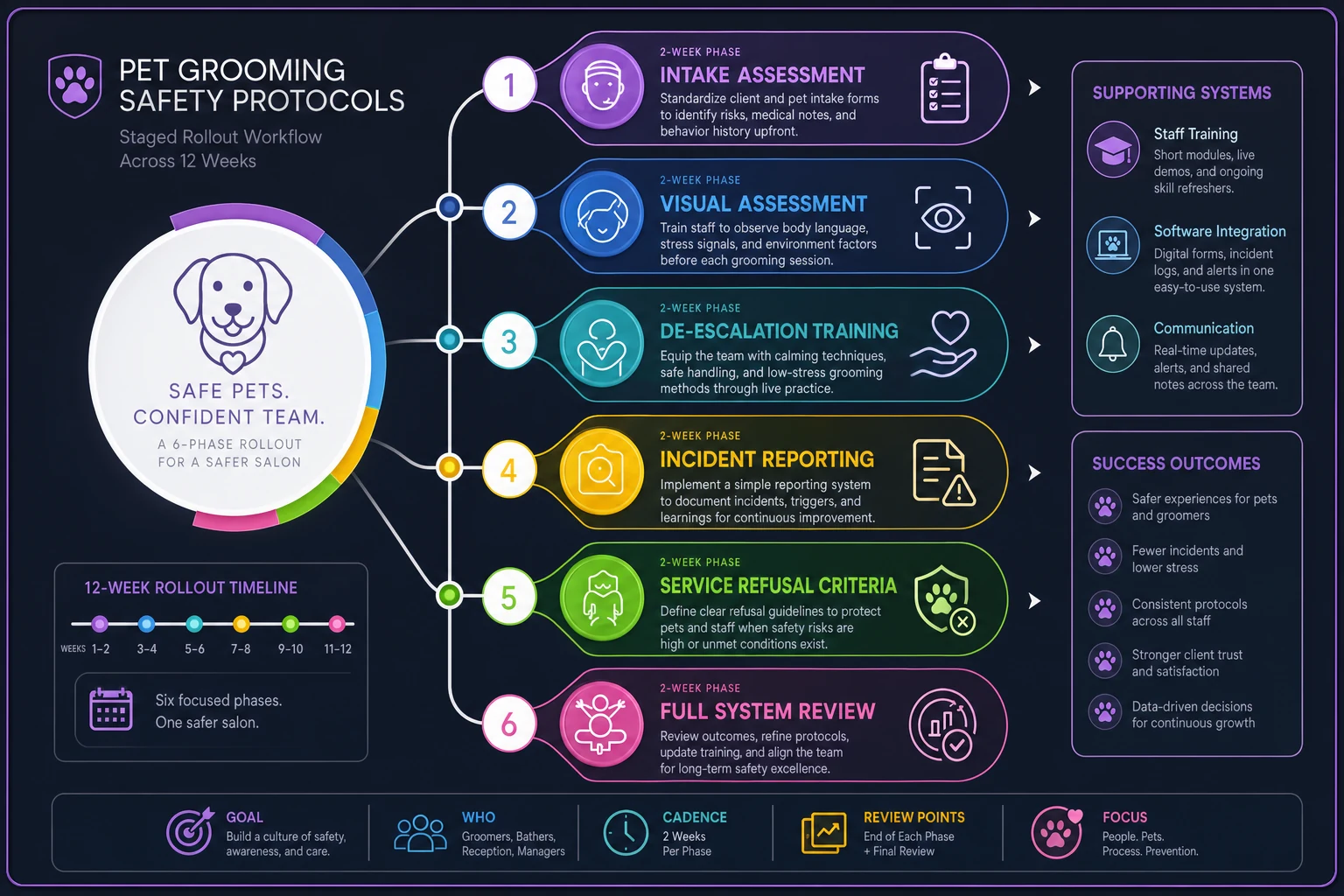
Start with the highest-risk touchpoint: intake assessment. Get your front desk asking the right questions and documenting answers. Once intake assessment becomes routine (usually 2-3 weeks), add the next layer.
Start small: make intake questions mandatory before booking and hold staff accountable for entering responses in the system.
Paper forms and filing cabinets don't work for real-time safety protocols. Your team needs instant access to behavioral history when a regular shows up with a substitute owner who doesn't mention the dog's nail trim aggression.
-
Week 1-2
Behavioral intake questions
-
Week 3-4
Visual assessment checklist
-
Week 5-6
De-escalation protocols
-
Week 7-8
Incident reporting templates
-
Week 9-10
Service refusal criteria
-
Week 11-12
Full system review and refinement
Each layer builds on the previous one. Staff master one component before adding complexity.
Modern operational software designed for grooming salons can flag high-risk appointments automatically, surface historical incidents during booking, and ensure consent forms match identified risks. The system becomes your institutional memory, maintaining safety standards even when experienced staff leave.
The financial case for comprehensive safety protocols
Beyond avoiding lawsuits, proper safety protocols improve profitability through multiple channels most owners don't track.
Reduced worker's comp claims save money, but consider the hidden costs: When a groomer gets bitten, you lose their productivity for days or weeks. You pay overtime for coverage. You might lose customers who had relationships with that specific groomer. The disruption ripples through your operation.
Groomers leave unsafe salons. When staff constantly worry about getting bitten, or feel unsupported in refusing dangerous dogs, they find other shops. Turnover costs you training investment, customer relationships, and operational consistency.
Safety protocols also enable premium pricing for difficult dogs. When you can document exactly what additional resources a dog requires—two groomers, extended appointment, muzzle handling—you can justify charging 50-100% premiums. Owners of difficult dogs will pay for salons that can handle their pets safely.
The reputation impact compounds over time. Salons known for safety attract both better groomers and more responsible clients. The cowboys who want to power through aggressive dogs go elsewhere. You build a customer base that values professionalism over cheap, quick grooms. In a grooming market where most salons compete on price and convenience, comprehensive safety protocols become a differentiator that attracts higher-value customers and better staff. The initial investment in systems and training pays dividends through reduced liability, lower turnover, premium pricing opportunities, and a reputation that draws clients who prioritize professional handling of their pets' behavioral needs.
The reputation impact compounds over time. Salons known for safety attract both better groomers and more responsible clients. The cowboys who want to power through aggressive dogs go elsewhere. You build a customer base that values professionalism over cheap, quick grooms. In a grooming market where most salons compete on price and convenience, comprehensive safety protocols become a differentiator that attracts higher-value customers and better staff. The initial investment in systems and training pays dividends through reduced liability, lower turnover, premium pricing opportunities, and a reputation that draws clients who prioritize professional handling of their pets' behavioral needs.
Ready to streamline your grooming business?
Join 500+ pet groomers using Furlyly to save time, reduce scheduling conflicts, and deliver exceptional client experiences.