
The most damaging thing a groomer can hear from a returning client isn't a complaint. It's a shrug. "Last time it was shorter around the face." "The nails felt smoother when the other girl did it." Those aren't dramatic problems — they're quiet ones. And quiet quality drift is exactly what kills retention without ever showing up as a single bad review.
Most salons don't have a quality problem in the sense that any one groom is bad. They have a consistency problem. Two groomers, same breed, same package, two visibly different results. That gap stays invisible on your P&L until you notice one groomer's rebook rate is sitting 15 points below another's and you can't figure out why.
A salon service quality operating system isn't a binder of standards nobody reads. It's a small set of connected mechanisms — onboarding, a competency ladder, QA sampling, recovery triggers, and a quarterly improvement cycle — that an owner can actually run without becoming the bottleneck. This is how those pieces fit together, and where they usually break.
Why consistency breaks even in good salons
Quality inconsistency almost never comes from bad groomers. It comes from undefined standards that live in people's heads.
When your salon was two people, quality was consistent because you were both in the same room correcting each other in real time. You didn't need a system — you were the system. Then you hired a third groomer, then a fifth, then maybe a second location, and suddenly "the way we do it here" splintered into "the way each person learned it."
-
The person who trained your newest hire was themselves trained by someone who slightly modified the original standard.
-
Nobody writes down the acceptable range of an outcome, only the ideal — so groomers under time pressure improvise silently.
-
Feedback becomes personal instead of procedural, so people stop giving it to avoid conflict.
The result is drift. Not a cliff — a slope. Standards erode by a degree at a time until a longtime client tries a different groomer and gets a genuinely different service. They don't rebook. You never hear about it. It shows up three months later as a softer schedule.
The whole point of building this kind of governance pack is to move quality out of individual heads and into a shared, checkable standard — without turning your salon into a bureaucracy nobody respects.
The five parts and how they connect
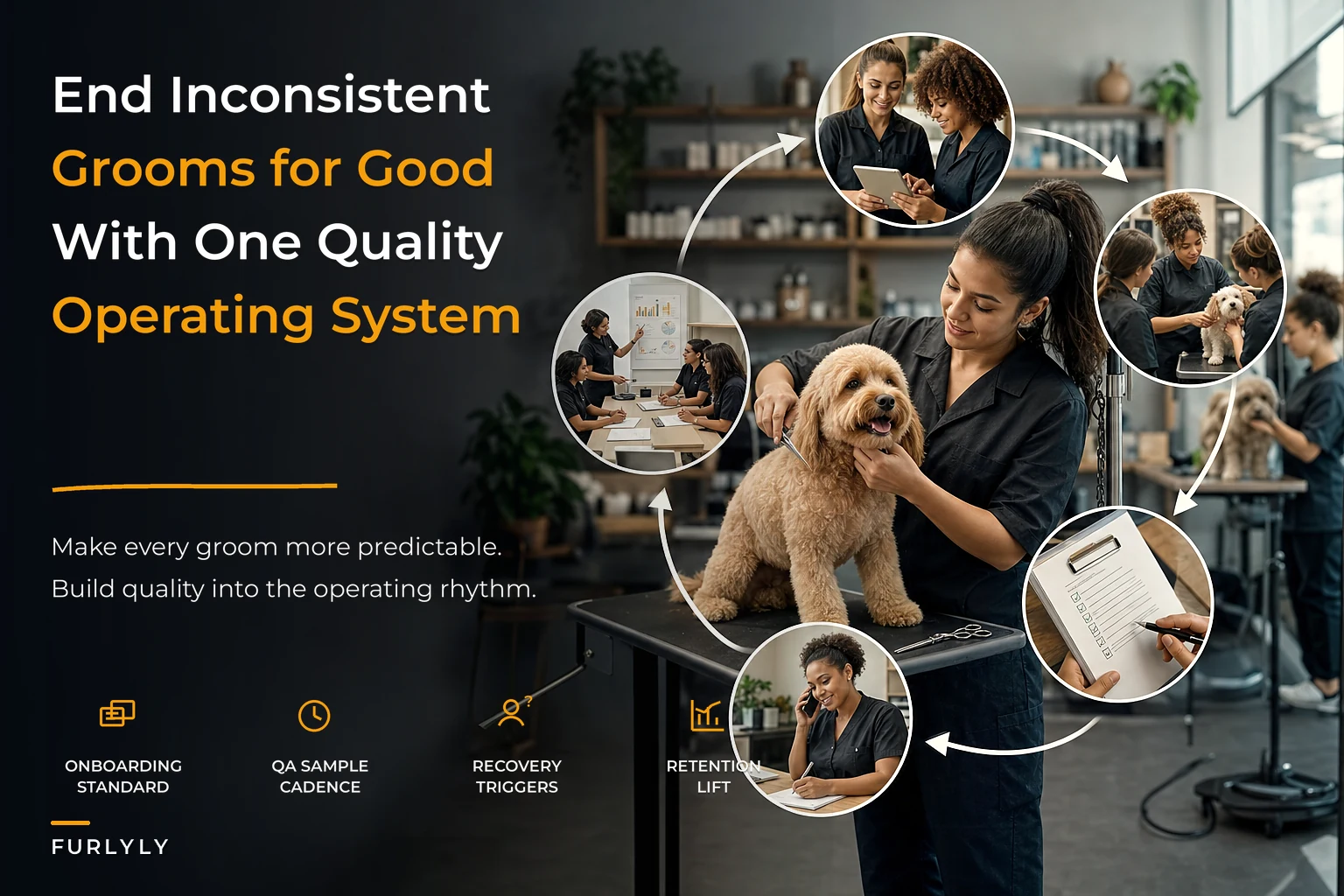
Think of the system as a loop, not a list. Each piece feeds the next.
Never miss a grooming appointment again.
Furlyly helps you book, confirm, and manage every pet grooming appointment effortlessly.
- Unified appointment scheduling
- Automated client reminders
- Staff availability & shift management
No credit card required
| Component | What it does | What breaks without it |
|---|---|---|
| Onboarding integration | Sets the baseline standard from day one | New hires inherit whichever senior groomer trained them, drift compounds |
| Competency ladder | Defines skill levels and what "billable at this tier" means | Everyone's called a "groomer," pay and expectations blur |
| QA sampling cadence | Checks actual output against the standard on a schedule | Problems only surface through complaints, which is far too late |
| Recovery triggers | Defines automatic responses when a groom misses standard | Recovery depends on someone remembering, so it's inconsistent |
| Quarterly improvement sprint | Ties the whole loop to retention numbers and fixes the biggest gap | The system ossifies, standards get stale, nothing improves |
The real value isn't any single component. It's that a QA sample flags a recurring issue, which points back to a gap in the competency ladder, which reshapes onboarding, which gets prioritized in the quarterly sprint based on what's actually hurting rebook rate. It's a closed circuit.
Here's a simple visual of the loop and how each piece pushes to the next.
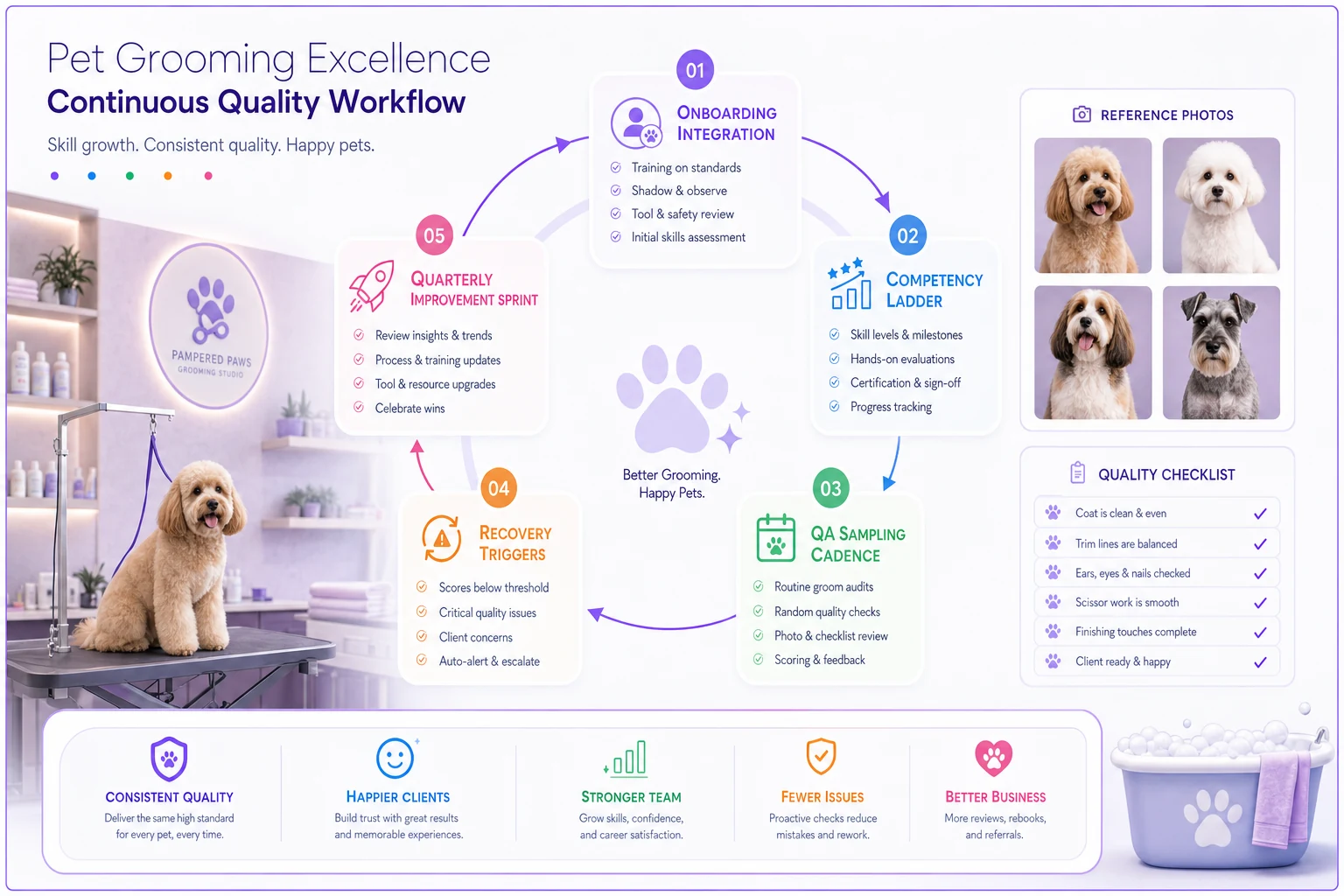
The loop should make clear where information flows: sampling data drives ladder changes, ladder changes update onboarding, and sprints prioritize the biggest retention risks.
Onboarding: where the standard actually gets set
Onboarding is where consistency is either baked in or lost. If you don't define the standard at intake, the new hire absorbs whatever their trainer happens to do that week.
The fix isn't more paperwork. It's making the outcome explicit and photographable. For each core service, you want a small reference set — what a finished Doodle full groom looks like from three angles, what nail length is acceptable, what "clean sanitary trim" means visually. New groomers should be matching against a picture, not a paragraph.
This is separate from the operational side of ramping someone up — the pay milestones, the shadowing schedule, the point at which they're independently billable. If you haven't built that part yet, it's worth pairing this quality baseline with a structured competency-based 30‑60‑90 onboarding plan so the speed of ramp and the standard of ramp reinforce each other instead of competing.
Worth flagging: salons that onboard fast but loose end up with groomers who are billable quickly and inconsistent forever. Salons that onboard slower but standard-anchored take a few extra weeks upfront but almost never have to un-teach bad habits. Second group wins on retention every time.
The competency ladder: stop calling everyone a "groomer"
A competency ladder does something quietly powerful — it separates "can perform the service" from "can perform it to standard, unsupervised, at speed." Those are three different things, and lumping them together is why pay conversations and quality conversations both go sideways.
-
Assisted — bathing, brushing, prep. Not finishing groomers solo.
-
Core competent — handles standard breeds and packages to standard, may need help on difficult coats or temperaments.
-
Full competent — handles the full breed range, including tricky doubles and hand-scissoring, at target time.
-
Lead / standard-setter — the person whose work defines the reference photos and who signs off on others moving up a rung.
Each rung needs an explicit gate: what a groomer has to demonstrate to move up. Not time served — demonstrated output. The mistake most salons make is promoting on tenure. Someone's been there two years, so they're "senior," even though their scissoring never actually reached the top tier. Now they're training juniors and passing along a mid-tier standard as if it were the ceiling.
Tie the ladder to pay and to which services someone gets scheduled for, and you get a second benefit: your booking system can route the hard breeds to people who can actually handle them, instead of whoever has an open slot.
QA sampling: check the work before the client does
You can't inspect every groom. You also can't inspect zero. The answer is sampling on a cadence — a predictable number of grooms checked against the reference standard, weighted toward newer groomers and higher-risk services.
A practical starting cadence for a salon running around 300–400 grooms a month:
-
Every groomer on rungs 1–2
3–4 grooms sampled per week
-
Rungs 3–4
1–2 grooms sampled per week
-
Any groom that generated a client comment, rebook decline, or redo
automatically sampled, regardless of who did it
The check itself should take three or four minutes: photos against reference, nail and sanitary check, a quick scan for missed mats or uneven blending. Score it pass / minor / miss. The data matters more than any single result — after a month you can see whether misses cluster around a person, a breed, a package, or a time of day. Friday afternoon quality dips are shockingly common, for what it's worth.
Keep sampling focused on risk: new hires, high-volume services, and anyone with recent misses.
When heavier sampling makes sense: right after hiring, right after a policy change, or when a particular groomer's rebook rate softens. When to ease off: once a groomer strings together enough clean weeks at their rung, dial their sampling down and shift that attention to whoever's newest. Sampling should flow toward risk, not sit at a flat rate indefinitely.
The mistake is treating QA as surveillance. Framed correctly — "we check work so problems get caught by us, not the client" — groomers generally welcome it. It protects them from getting blindsided by a complaint they didn't know was coming.
Recovery triggers: what happens automatically when a groom misses
A miss caught in sampling, or flagged by a client, needs a predefined response. Otherwise recovery depends on whoever's at the desk that day remembering the right move, and that inconsistency is its own quality problem.
-
Sampled miss on a groom already picked up → proactive call before the client complains, offer a complimentary tidy-up within 7 days
-
Client flags dissatisfaction at pickup → immediate redo offer or partial credit per a fixed tier, logged
-
Two misses on the same groomer in a rolling two weeks → triggers a coaching session, not a warning — this is a training signal, not a discipline event
-
Same breed missed by multiple groomers → escalates to the quarterly sprint as a standard/training gap, not an individual issue
That last distinction is one salons get wrong constantly. A pattern across multiple people is a system failure — your standard or training is unclear. A pattern within one person is a coaching need. Treating a system failure as an individual failure just makes people defensive and hides the real cause.
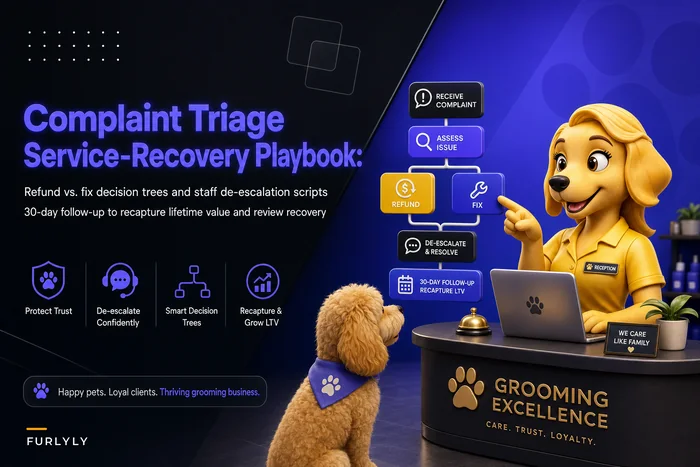
This connects directly to how you handle complaints once they actually reach the client. If you don't have that side mapped yet, the complaint triage and service‑recovery playbook covers the scripts and decision trees for client-facing recovery, while the triggers above are about catching things before they get that far.
The quarterly improvement sprint tied to retention
Everything above generates data. The quarterly sprint is where that data becomes actual change — otherwise you're collecting scores nobody acts on.
-
Pull the numbers. Rebook rate by groomer, redo rate by service, sampling miss patterns, and the top three breeds or packages generating recovery events.
-
Pick one gap. Not ten. The single issue most tied to retention loss. Maybe it's Doodle full grooms — high volume, high miss rate, soft rebook. That's your target.
-
Fix the standard, not the symptom. Update the reference photos, run a short training block on that specific gap, adjust the competency gate if needed.
-
Set the check. Increase sampling on that service for the next quarter and watch whether the miss rate and rebook rate actually move.
Anchoring each sprint to a retention KPI — rebook rate on the targeted service — keeps the whole thing honest. It's easy to run quality initiatives that feel productive and change nothing measurable. If the number doesn't move next quarter, your fix was wrong. That's still useful information.
A real scenario
A three-groomer salon doing around 330 grooms a month noticed something odd: overall reviews were fine, but one groomer's clients rebooked at roughly 55% while the other two sat near 70%. No complaints, no obvious cause.
They started light QA sampling — four grooms a week on the lower-rebook groomer. Within three weeks the pattern was clear: her finishing work on longer-coated breeds was rushed and uneven, specifically on the hindquarters. Not bad, just not to standard. Nobody had ever defined the standard clearly enough for the gap to be visible — including to her.
They pulled reference photos from the lead groomer's work, ran two short coaching sessions focused only on that finishing step, and kept sampling elevated for the next quarter. Her miss rate on those breeds dropped, and over the following couple of months her rebook rate climbed into the mid-60s. Nothing dramatic. Just a quiet gap, found and closed. The kicker: she'd been frustrated by her own inconsistency for months and had no idea what was actually wrong.
That's the whole system in miniature. Sampling surfaced it, the competency standard defined the fix, and the retention number confirmed it worked.
Where the moving parts get hard to hold
Running this manually works at three or four groomers. Past that, the coordination load starts to bite. Someone has to remember whose sampling is due, whether a flagged groom actually got its recovery call, which groomers are approaching a competency gate, and what rebook trends look like by person and service. That's a lot of threads, and the ones that get dropped are always the invisible ones — the recovery call that never happened, the sampling that quietly stopped.
This is where operational software with some automation underneath earns its place — not as a magic fix, but as the thing that remembers what humans forget. A platform that logs QA samples against booking records, flags when a groomer's rebook rate dips below your threshold, and surfaces the right recovery trigger the moment a groom gets flagged means the system keeps running even when you're slammed on the floor. The value isn't fancy analytics. It's that the loop doesn't quietly fall apart the week you're short-staffed.
The distinction worth making: the system is yours. The standards, the ladder, the sprint priorities — those are judgment calls only an owner should make. Software just keeps the mechanics turning so those judgment calls actually get executed consistently.
Who should not build this yet
Solo groomer or two-person shop where you personally see every finished groom? You don't need this. Your feedback loop is already tight. Building a formal QA cadence for two people is overhead with no payoff.
This starts to matter around the point where you can no longer eyeball every groom that leaves — usually three-plus groomers, or the moment you open a second location and lose line-of-sight entirely. That's when quality drift goes invisible, and invisible drift is the expensive kind.
If you do build it, resist the urge to launch all five components at once. Start with reference photos and a light sampling cadence. Get the standard visible first. The competency ladder, recovery triggers, and quarterly sprint layer on naturally once you can actually see where your quality varies. Trying to install the whole apparatus in one week just guarantees nobody follows any of it.
Consistency isn't a talent your groomers either have or don't. It's an outcome of a system that defines the standard, checks against it, catches misses early, and improves on a schedule. Build that loop, keep it running, and "it depends on who's working" stops being your quiet retention leak.
Ready to streamline your grooming business?
Join 500+ pet groomers using Furlyly to save time, reduce scheduling conflicts, and deliver exceptional client experiences.