



Most grooming salons lose around $8,000 to $12,000 every time they hire a junior groomer. Not because the hire doesn't work out—but because owners assume training happens naturally through observation and repetition.
The standard approach looks familiar: pair the new hire with your senior groomer for two weeks, have them watch appointments, maybe handle some nail trims after day three. By week four, you're wondering why they're still asking basic questions about coat types and why your senior groomer is staying late to fix their work.
This disconnect happens because grooming businesses confuse exposure with competency. Watching someone groom a Doodle doesn't mean understanding mat prevention techniques, skin assessment, or proper blade selection for different coat densities. Without structured milestones and evaluation points, you're essentially paying someone to shadow for months while hoping skills magically transfer.
Why traditional grooming training creates expensive waiting periods
The typical grooming salon operates on thin margins—usually 15-20% after all costs. When a new groomer takes four to six months to become independently billable, that extended ramp destroys profitability for the entire quarter.
Consider what actually happens during those early months. Your new groomer handles maybe two dogs per day while a seasoned groomer manages six to eight. They're not just producing less revenue though. They're consuming your senior groomer's productive capacity through constant questions, work corrections, and supervision needs.
A senior groomer generating $800 daily in services drops to $500 when mentoring. Meanwhile, the junior groomer might produce $150 in billable work. You've effectively turned $800 in daily capacity into $650 while paying two salaries.
The root problem isn't the junior groomer's ability to learn. Most salons rely on vague assessments like "getting better" or "needs more practice" instead of concrete competency markers tied to actual billable services. Without measurable checkpoints, you're flying blind on what skills they've actually mastered versus what still needs work.
Building your groomer onboarding checklist around revenue milestones
A competency-based system flips the traditional approach by connecting every training activity to specific billable outcomes. Instead of "shadow for two weeks," you create skill progressions that unlock service capabilities.
Never miss a grooming appointment again.
Furlyly helps you book, confirm, and manage every pet grooming appointment effortlessly.
- Unified appointment scheduling
- Automated client reminders
- Staff availability & shift management
No credit card required
Tie each training task to a specific service price so progress shows immediate ROI to owners and trainees.
Days 1-30: Foundation Skills Tied to Entry Services
Your first month shouldn't focus on grooming at all. Establish the operational competencies that enable safe, efficient service delivery.
Week 1: Safety and Handling Certification
-
Stress signal recognition (documented through video review of 10 different dogs)
-
Proper restraint techniques for anxious dogs (demonstrated on 5 anxiety cases)
-
Bite prevention protocols (written test plus live demonstration)
-
Tool safety and maintenance (timed equipment setup and breakdown)
Each skill gets evaluated through specific scenarios, not general observation. For stress signals, the trainee watches recorded appointments and identifies specific markers. They don't pass until correctly identifying 8 out of 10 signals.
Week 2: Basic Service Execution
-
Nail trim competency (15 dogs, mixed temperaments, zero blood draws)
-
Ear cleaning protocol (10 dogs, proper depth assessment documented)
-
Bath and dry technique for short coats (8 dogs, meeting time standards)
-
Sanitary trim basics (5 dogs, evaluated by senior groomer)
Notice how each item includes quantity and quality metrics. A junior groomer becomes billable for nail trims after completing 15 successful procedures, not after "feeling comfortable."
Week 3-4: Assessment and Documentation
-
Skin condition identification (photo documentation of 10 conditions)
-
Coat type classification (20 dogs across 8 breed categories)
-
Service note documentation (15 detailed reports reviewed)
-
Client consultation basics (5 observed check-ins)
By day 30, your new groomer should independently handle bath services, nail trims, and basic maintenance tasks—generating roughly $200-250 daily in billable work.
Days 31-60: Intermediate Skills and Speed Building
Week 5-6: Breed-Specific Techniques
-
Terrier coat basics (3 dogs, senior groomer evaluation)
-
Doodle maintenance cuts (5 dogs, before/after photos reviewed)
-
Spaniel ear and foot trimming (3 dogs, timed execution)
-
Double-coat brushing and deshedding (5 dogs, undercoat removal check)
Week 7-8: Time Management and Multi-tasking
-
Complete 3 dogs in 4-hour blocks (mixed services)
-
Manage overlapping appointments (bath while another dries)
-
Handle walk-in nail trims between scheduled services
-
Maintain tool organization during busy periods
Your evaluation rubric here measures both quality and speed. A successful Doodle groom at this stage means completing the service in under 90 minutes with no major corrections needed.
By day 60, daily billable output should reach $350-400, covering roughly 70% of their wage and overhead costs.
Days 61-90: Advanced Skills and Independence
Week 9-10: Complex Grooming Patterns
-
Breed standard cuts (2 different breeds, photo comparison to standards)
-
Creative grooming requests (3 custom cuts from photo references)
-
Difficult dog handling (3 dogs with documented behavior issues)
-
Senior dog modifications (3 elderly dogs with mobility limits)
Week 11-12: Business Operations Integration
-
Independent scheduling decisions (booking appropriate time slots)
-
Upsell identification (document 10 additional service opportunities)
-
Client education delivery (5 observed consultation sessions)
-
Problem resolution without escalation (3 client concerns handled)
The 90-day mark represents full productivity—handling 5-6 dogs daily, generating $500-600 in services, and requiring minimal supervision.
Here's a quick visual of the onboarding flow.
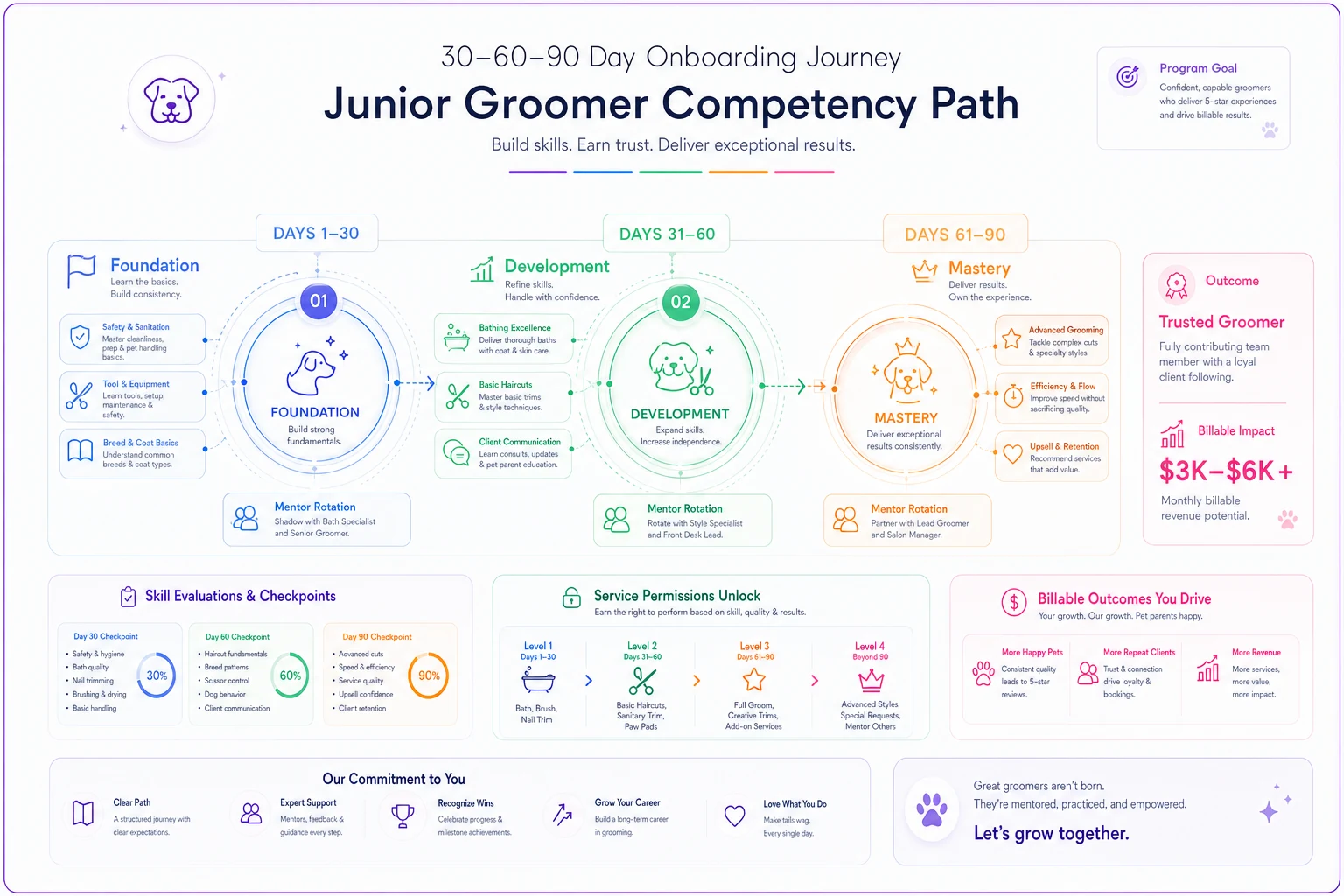
The visual maps training activities to revenue milestones and mentor touchpoints.
Creating mentor pairing templates that actually transfer knowledge
Random pairing wastes everyone's time. Your senior groomers have different strengths, and new hires learn differently. A structured pairing system matches teaching styles with learning needs while protecting senior groomer productivity.
The Rotation Model
Technical Skills Mentor (Week 1-2) Usually your most precise groomer who excels at breed standards. They teach tool selection, cutting techniques, and pattern execution. Limited to 2-hour blocks to prevent mentor burnout.
Speed and Efficiency Mentor (Week 3-4) Your fastest groomer who maintains quality. They demonstrate workflow optimization, time-saving techniques, and multi-tasking strategies. New hires work alongside them, not just observe.
Client Relations Mentor (Week 5-6) The groomer clients specifically request. They model consultation skills, difficult conversation handling, and upselling approaches. New hires participate in check-ins and check-outs.
Structured Observation Sheets
-
Specific technique to observe (example
thinning shear blending)
-
Questions to answer (Why this blade choice? What indicates correct length?)
-
Hands-on practice component (trainee completes one leg while mentor does others)
-
Mistake identification (trainee spots and documents any corrections needed)
Mentor Time Protection
-
Limit mentoring to 2 hours daily maximum
-
Pay a training premium ($5-10 per hour when actively teaching)
-
Assign simple services during training blocks (basic baths, not complex grooms)
-
Create training-free zones (certain days or times with no shadowing)
One salon reduced senior groomer frustration by 80% just by implementing protected productivity windows where no training questions were allowed.
Evaluation rubrics that eliminate guesswork
Vague feedback like "getting better with scissors" helps nobody. Competency rubrics provide objective measurement of specific skills.
The Three-Level Mastery Framework
Level 1: Assisted Performance Can complete task with verbal guidance. Requires correction but understands basic concept. Safe but slow execution.
Level 2: Independent Execution Completes task without help. Meets quality standards consistently. Works at 70% of expected speed.
Level 3: Billable Proficiency Performs at professional speed and quality. Can handle variations and complications. Teaches others the skill.
Sample Evaluation: Poodle Face Trim
Level 1 Criteria:
-
Holds clippers correctly
-
Follows basic pattern with guidance
-
Achieves roughly even length
-
Completes in 20 minutes with coaching
Level 2 Criteria:
-
Creates clean lines without guidance
-
Maintains proper angles around eyes
-
Blends muzzle to ears smoothly
-
Completes in 15 minutes independently
Level 3 Criteria:
-
Executes perfect topknot shape
-
Creates precise eye corners
-
Adjusts for individual face structure
-
Completes in 8-10 minutes consistently
Weekly Skill Audits
-
Which Level 1 skills moved to Level 2?
-
What prevented Level 2 skills from reaching Level 3?
-
Where did regression occur and why?
-
What additional practice is needed next week?
Document these observations in a simple spreadsheet. Pattern recognition across multiple hires reveals training program gaps.
The daily task progression that builds confidence
Random task assignment creates skilled gaps. A progressive daily structure ensures comprehensive skill development.
Week 1 Daily Structure
Monday:
-
Morning
Watch 3 nail trims, document hold techniques
-
Afternoon
Practice nail trim on calm dog with mentor
-
End of day
Review video of their technique
Tuesday:
-
Morning
Complete 2 supervised nail trims
-
Afternoon
Learn ear cleaning on compliant dog
-
End of day
Quiz on ear infection indicators
Wednesday:
-
Morning
3 independent nail trims (mentor nearby)
-
Afternoon
First bath and dry on small dog
-
End of day
Tool cleaning and organization
This structured progression prevents the overwhelm that causes many new groomers to quit in the first two weeks.
Week 4 Daily Structure
Monday:
-
Morning
Complete 3 bath services independently
-
Afternoon
Observe and assist with Doodle groom
-
End of day
Practice scissor techniques on practice dog
Tuesday:
-
Morning
Handle 2 bath appointments plus nail trim add-ons
-
Afternoon
First supervised face trim on regular client
-
End of day
Review photos of work, identify improvements
The progression from observation to assistance to independence happens gradually, with clear daily objectives that build toward weekly competency goals.
Shortening ramp time through milestone-based advancement
Traditional training uses time as the metric—two weeks shadowing, four weeks supervised, then maybe independent work. Competency-based advancement uses skill demonstration instead.
Some groomers master bath services in five days. Others need two weeks. By tying advancement to demonstrated skills rather than calendar days, faster learners start generating revenue sooner while struggling learners get necessary support.
Early Billing Opportunities
-
Nail trims ($15-20, learnable in 2-3 days)
-
Basic baths on small dogs ($30-40, learnable in one week)
-
Brush-outs on friendly dogs ($25-35, learnable in 3-4 days)
-
Tooth brushing add-ons ($10-15, learnable in one day)
A motivated trainee can generate $100+ daily by day seven through these simple services.
The 70% Productivity Target
Rather than waiting for 100% capability, identify when groomers reach 70% productivity and adjust their booking accordingly.
-
Full bath services on all sizes
-
Basic trimming on cooperative dogs
-
Simple breed cuts with minor mentor review
-
4 dogs daily versus the standard 6
This generates roughly $320 daily versus the full $480 target—but that's $320 more than zero while waiting for perfection.
Tracking competency against billable output
Your tracking system should connect skill development directly to revenue generation.
The Competency Revenue Matrix
| Skill Level | Services Unlocked | Daily Revenue Potential | Supervision Needed |
|---|---|---|---|
| Week 1 | Nail trims, tooth brushing | $60-80 | Constant |
| Week 2 | Basic baths (small dogs) | $120-150 | Frequent checks |
| Week 4 | All bath services, simple trims | $200-250 | Periodic review |
| Week 8 | Standard breed cuts | $350-400 | Minimal |
| Week 12 | All services, special handling | $500-600 | None |
Track each groomer's position on this matrix weekly. If someone stalls at week 4 levels despite being employed for eight weeks, you've identified a specific training gap rather than a general performance issue.
Daily Revenue Tracking
Date: [Date] Groomer: [Name] Services Completed:
-
9am
Bath & nail trim (small dog) - $45
-
10
30am: Bath & basic trim (medium dog) - $65
-
1pm
Nail trim walk-in - $18
-
2pm
Bath & brush-out (large dog) - $55
Total Generated: $183 Hours Worked: 8 Revenue per Hour: $22.88
When groomers see their hourly revenue generation, motivation increases. They understand the connection between skill development and earning potential.
Where operational software transforms onboarding efficiency
Manual tracking of competencies, daily tasks, and evaluation points becomes overwhelming after two or three simultaneous new hires. AI-powered operational platforms make a significant difference here.
Instead of maintaining spreadsheets and paper checklists, modern grooming management software automates the entire competency tracking process. Each completed service automatically logs against skill requirements. When a junior groomer completes their fifteenth nail trim, the system recognizes the milestone and unlocks additional service permissions.
The software analyzes patterns across all your historical onboarding data. It identifies which skill combinations predict faster ramp times and suggests optimized training sequences for each new hire based on their early performance indicators.
For scheduling, the platform automatically assigns appropriate services based on documented competency levels. A week-three groomer only sees bath appointments in their calendar, preventing the booking mistakes that frustrate clients and damage reputation.
Progress reporting happens automatically. Salon owners receive weekly summaries showing each trainee's competency progression, revenue generation, and projected timeline to full productivity. No more guessing about whether someone is on track or needs additional support.
The difference between a four-month ramp and a six-week ramp isn't the quality of your new hires—it's the structure of your onboarding process. By building your groomer onboarding checklist around specific competencies tied to billable services, you transform training from an expensive waiting period into a progressive revenue generator.
Start with one new element: implement competency-based evaluation for just nail trims. Track how many each trainee completes, document their accuracy, and only allow independent nail trim bookings after they demonstrate consistent success. This single change typically reduces nail trim incidents by 90% while accelerating the timeline to first billable service.
The salons seeing the fastest ramp times share three characteristics: they document specific skill requirements for each service level, they protect senior groomer productivity through structured mentoring windows, and they advance groomers based on demonstrated competency rather than time served.
Your next new hire doesn't need to cost you three months of losses. With clear daily tasks, objective evaluation rubrics, and milestone-based advancement, you can build confident, capable groomers who contribute to revenue within weeks, not months.
Ready to streamline your grooming business?
Join 500+ pet groomers using Furlyly to save time, reduce scheduling conflicts, and deliver exceptional client experiences.