
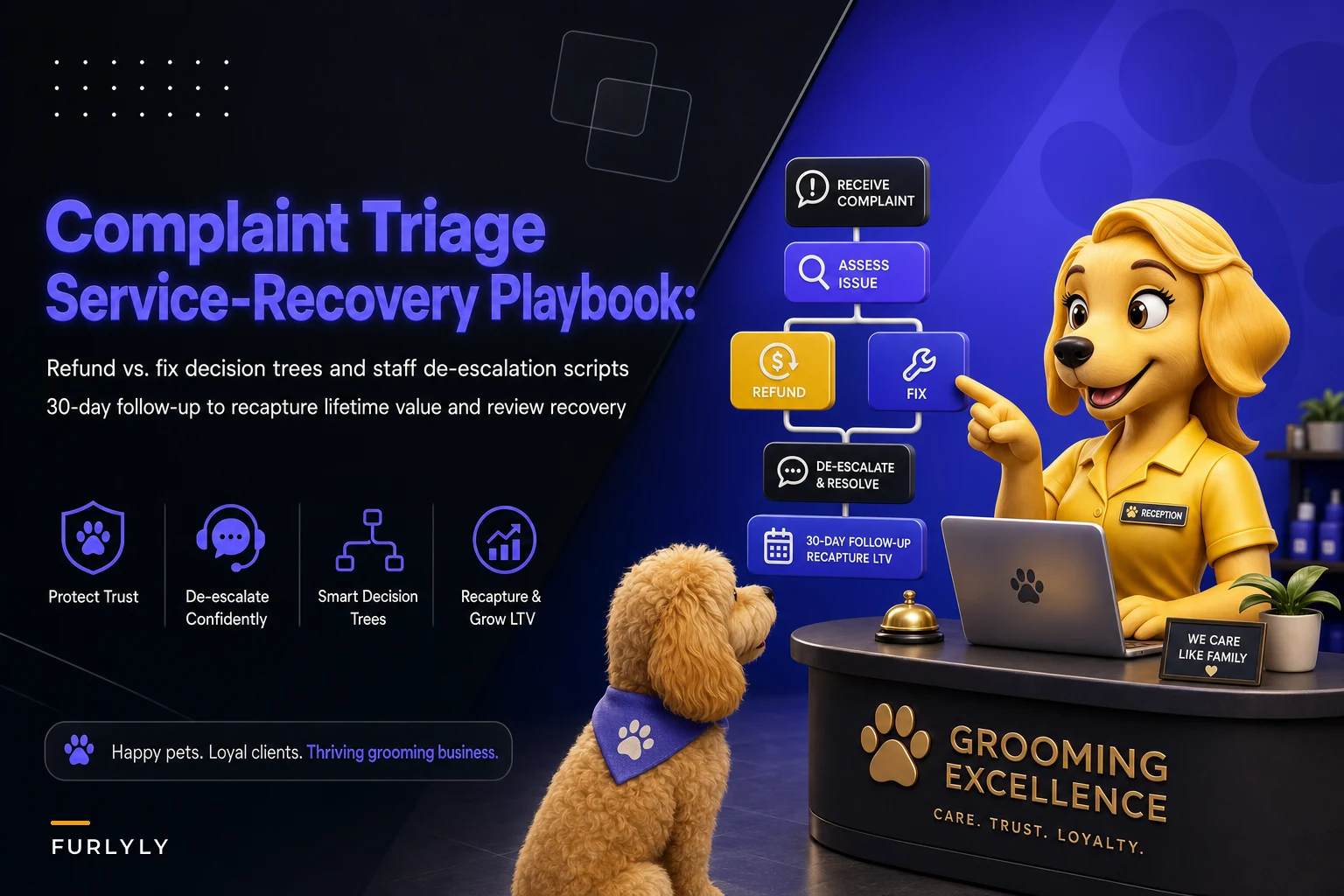

You know that stomach-drop feeling when you see a one-star review pop up on Google? Or when a client storms out after pickup, clearly upset but not saying much? Most grooming salons handle complaints by winging it—sometimes offering refunds too fast, sometimes digging in when they shouldn't, and almost never following up properly to rebuild the relationship.
The real damage isn't the complaint itself. It's what comes after. A poorly handled grooming customer complaint handling situation typically costs you that client plus three to five referrals they would've sent your way. Factor in the review damage, and a single botched response can easily represent $2,000–3,000 in lost lifetime value.
The Triage Framework That Changes Everything
Most salons treat all complaints the same way. That's the core mistake. A matted coat complaint needs completely different handling than a minor trim preference issue. The owner upset about a nick needs different treatment than someone frustrated by scheduling confusion.
What actually works: segment complaints into three response tracks based on severity and recovery potential.
Track 1: Minor Service Preferences Style disagreements, slightly uneven cuts, "not quite what I expected" situations where the dog is safe and the service was technically completed. Recovery rate when handled correctly runs around 85–90%.
Track 2: Service Failures Clear mistakes on your end—missed appointments, wrong services performed, significant grooming errors. These need immediate acknowledgment and clear compensation. Recovery potential sits around 60–75% with proper handling.
Track 3: Safety Incidents Any injury, however minor. Even a small nick or irritation. These require a completely different protocol focused on documentation, veterinary follow-up, and careful communication. Recovery varies widely, but proper handling prevents escalation into legal territory.
The triage happens at first contact. Your front desk needs clear criteria to route complaints immediately to the right track. No hesitation, no "let me check with the manager"—immediate routing based on complaint type.
The Decision Tree That Removes Guesswork
Picture your receptionist fielding an angry call. Without a clear framework, they either over-promise ("We'll definitely refund everything!") or under-respond ("The groomer did their best"). Both kill your recovery chances.
Never miss a grooming appointment again.
Furlyly helps you book, confirm, and manage every pet grooming appointment effortlessly.
- Unified appointment scheduling
- Automated client reminders
- Staff availability & shift management
No credit card required
Here's the decision flow that works:
Initial Contact Decision Points
-
Question 1
Is there any mention of injury, health, or safety?
- Yes → Route to Track 3 protocol immediately - No → Continue to Question 2 -
Question 2
Can the issue be physically corrected?
- Yes (uneven cut, missed spots) → Offer immediate re-groom - No (cut too short, style preference) → Continue to Question 3 -
Question 3
Is this a repeat complaint from this client?
- Yes → Escalate to manager with full history - No → Continue to Question 4 -
Question 4
Was our service standard clearly not met?
- Yes → Track 2 (Service Failure) - No → Track 1 (Preference Issue)
This removes the panic from complaint handling. Staff follow the tree, land in the right track, and know exactly what to offer.
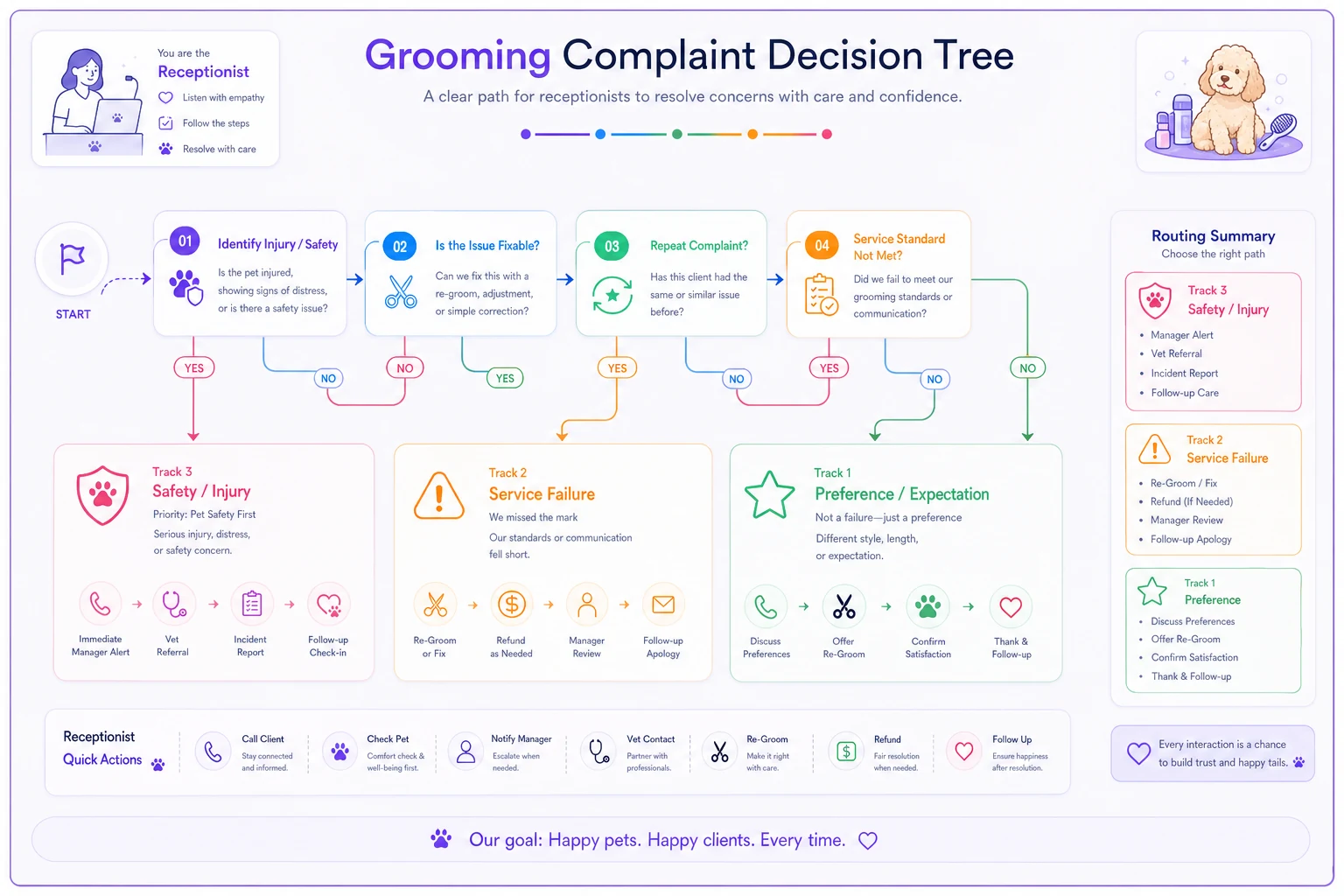
Place this flowchart where reception can see it during calls so routing is immediate and consistent.
De-Escalation Scripts That Actually Work
Generic customer service scripts sound robotic and tend to make people angrier. Grooming complaints need specific language that acknowledges both the pet and the owner relationship.
Track 1 Script (Preference Issues)
"I can hear you're disappointed with [specific issue]. That's not the experience we want for you and [pet name]. While our groomer followed the standard cut for [breed/style], I understand it's not matching what you had in mind. Here's what I can do right now..."
Then offer ONE of:
-
Complimentary touch-up appointment within 48 hours
-
20% discount on today's service
-
Credit for an add-on service next visit
Never offer all three. One clear solution prevents negotiation.
Track 2 Script (Service Failures)
"You're absolutely right—that shouldn't have happened. We clearly made a mistake with [specific issue]. I'm going to take care of this immediately. First, I want to make sure [pet name] is okay. Then let's fix this for you."
Immediate offers:
-
Full refund for affected service
-
Complimentary future service
-
If applicable
coverage of any vet check needed
Track 3 Script (Safety Incidents)
"I need to understand exactly what happened with [pet name]. Are they okay right now? Do you need our vet referral? Let me get our incident form started while you tell me what you're seeing."
This shifts to information gathering, not defending. Document everything, offer immediate vet coverage if needed, and follow your safety incident protocol.
The Refund vs Recovery Decision Matrix
Not every complaint deserves a refund, but knowing when to offer one saves more money than being stingy about it. The decision comes down to two factors: fault and future value.
| Situation | Clear Our Fault | Unclear/No Fault |
|---|---|---|
| High-Value Client (>$1,500/year) | Full refund + future service credit | Partial refund or service credit |
| Average Client ($500-1,500/year) | Full refund OR future service credit | Touch-up or 15-25% discount |
| New Client (<3 visits) | Full refund + aggressive win-back | Partial refund or redo |
| Problem Client (multiple complaints) | Refund + polite exit | No refund, document thoroughly |
The matrix removes emotion from the decision. A $45 refund to save a client worth $1,800 annually is obvious math, but in the heat of a complaint, that logic disappears without a framework.
Why Standard Recovery Fails
Most salons think complaint handling ends when the client leaves somewhat satisfied. That's where the real opportunity gets lost. A client who complains but gets properly recovered can actually become more loyal than someone who never had an issue—but only if you follow through.
The problem is usually timing. Salons either follow up too soon (looks desperate) or never (looks careless). The other issue is message mismatch—sending a generic "how was your experience" survey to someone you just refunded feels tone-deaf.
Recovery needs a different communication sequence entirely. One that acknowledges the issue, shows improvement, and gradually rebuilds trust.
The 30-Day Recovery Sequence
This sequence has pulled back a significant share of complained-but-resolved clients in salons that actually execute it. The key is mixing channels and providing real value—not just checking in, but giving people reasons to return.
Day 1: Immediate Confirmation Channel: Email Message: Document the resolution, what was offered, and what happens next. This prevents "I thought you said..." issues later. "Following up on our conversation about [pet name]'s appointment today. As discussed, we've [specific resolution]. Your account shows [credit/refund details]. Please let me know if you need anything else."
Day 3: The Check-In Channel: Text Message: Brief, personal, focused on the pet "Hi [Name], just wanted to check how [pet name] is doing after Tuesday. Everything looking good? -[Staff name]" This shows care beyond the transaction. Around 40% respond, usually positively if the initial resolution was handled well.
Send the Day 3 text from the staff member who had the best rapport with the client for higher response rates.
Day 7: The Value Add Channel: Email Message: Provide something useful, no selling "Hi [Name], I wanted to share our guide for maintaining [pet name]'s coat between grooms. These tips help prevent the matting issues we discussed. [Link to care guide]" Positions you as helpful, not pushy.
Day 14: The Soft Invite Channel: Text or Email (alternate from Day 7) Message: Mention upcoming availability without pressure "Hi [Name], wanted you to know we have our senior groomer available next week if [pet name] needs anything. No pressure, just didn't want you to miss the option. -[Manager name]" About 30% book at this stage if they're going to come back.
Day 21: The Feedback Request Channel: Email Message: Ask for input on improvements "[Name], we've made some changes to our [relevant service] process based on feedback like yours. Would you mind taking a look at this quick update? Your input really helps." Include one specific change you've actually made. This shows their complaint mattered.
Day 30: The Win-Back Offer Channel: Email or Text Message: Clear value proposition for return "[Name], it's been a month since [pet name]'s last groom. We'd love to welcome you both back with [specific offer—usually 20-30% off or a free add-on]. Valid for the next two weeks if you'd like to give us another chance." This is your final active attempt. A meaningful portion of recovered clients book from this message.
The Review Recovery Component
Bad reviews hurt, but leaving them unaddressed does more damage. The recovery sequence above prevents many negative reviews from being posted in the first place, but when they do appear, you need a specific response approach.
Don't respond immediately when you're still emotional. Wait 24 hours, then follow this structure:
-
Acknowledge the specific issue (shows you actually read it)
-
Apologize without admitting legal fault
-
Reference your resolution attempt
-
Invite offline resolution
-
Sign with a name, not "Management"
"Thank you for sharing your experience with [specific issue mentioned]. We're sorry [pet name]'s grooming didn't meet expectations. We've attempted to reach out to resolve this directly and would appreciate the chance to make this right. Please contact [specific person] at [direct line]."
Then document that you responded and attempted resolution. If they don't engage, you've done your part publicly.
Tracking What Actually Matters
Most salons track complaint volume. That's the wrong metric. What matters is recovery rate and lifetime value preservation.
-
Complaints by track (1, 2, or 3)
-
Initial resolution accepted rate
-
30-day return rate after complaint
-
Review prevention rate (complaints that don't become reviews)
-
Lifetime value retained
A solid complaint handling system shows roughly 60% return rate within 30 days and prevents most potential negative reviews from going public. If you're below those numbers, the issue is usually in the follow-up, not the initial handling.
When to Fire a Client Instead
Not every client is worth recovering. Serial complainers who cost more in discounts and staff stress than they generate in revenue need a different approach.
-
Three or more complaints across different groomers
-
Complaints escalate despite resolutions
-
Abusive language toward staff
-
Threats of legal action or regulatory complaints
-
Demands that go well beyond reasonable compensation
The termination script: "We don't feel we can meet your expectations for [pet name]'s grooming. We'd like to refer you to [other salon] who might be a better fit. We'll provide records if needed."
Document everything, refund their last service, and move on. One toxic client can do real damage to your team's morale.
Where Automation Prevents Complaint Spirals
The biggest complaint generator in grooming isn't bad haircuts—it's communication failures. Clients complain because they're surprised. The dog looks different than expected, the price is higher than anticipated, or the pickup time changed without clear notice.
AI-powered operational software can flag potential complaint triggers before they happen. When a new groomer takes on a regular client, the system prompts them to review past preferences. When a service price would exceed the historical average by a noticeable amount, it triggers a pre-service confirmation. Small automations like these prevent the surprise factor that generates most complaints.
The same platform can manage your entire 30-day recovery sequence automatically. Instead of manually tracking who needs which follow-up and when, the system triggers the right message at the right time based on complaint type and resolution. That consistency is nearly impossible to maintain manually across dozens of complaints a month.
Operational software can also surface complaint patterns you'd miss on your own. When multiple clients flag issues with the same groomer's dematting technique, or Tuesday afternoons keep generating scheduling complaints, those trends show up before they become a review problem. That kind of visibility ties directly into your customer lifecycle patterns and helps you address systematic issues rather than just putting out individual fires.
Making Recovery Systematic, Not Heroic
The salons that handle complaints well don't do it because they have nicer staff or more patient managers. They do it because they have systems that remove emotion, provide clear frameworks, and ensure consistent follow-through.
Your complaint triage should run regardless of who's working the desk. The decision tree should eliminate manager bottlenecks for routine issues. The recovery sequence should execute whether you remember to send it or not. And your tracking should tell you what's actually working.
Stop treating complaints as failures to avoid. Start treating them as retention opportunities with clear protocols. The client who complains but gets properly recovered will typically spend more over their lifetime than the silent customer who just disappears—but only if you have a system to capitalize on it.
The math is fairly straightforward: implementing this system might recover 10–15 additional clients monthly. At an average lifetime value of $1,500–2,000, that's real revenue that would otherwise walk out the door. The scripts take an afternoon to customize. The decision tree takes one training session to implement. The follow-up sequence can be templated once and automated after that. Start with the triage framework. Add the scripts. Build the follow-up sequence. Your review rating and your revenue both depend on what you do with the next complaint that walks through your door.
Ready to streamline your grooming business?
Join 500+ pet groomers using Furlyly to save time, reduce scheduling conflicts, and deliver exceptional client experiences.