

Most grooming salons don't have a marketing problem. They have a measurement problem dressed up as one. You post a Facebook photo, drop some flyers at the vet down the street, maybe run a $99 dog-wash special — and then nothing. No idea what worked. No idea what to repeat. So next quarter you do the same scattered thing and hope for different results.
A 90-day sprint fixes that by forcing three things at once: your Google Business Profile does the heavy lifting on discovery, a small handful of neighborhood partners send you warm referrals, and every single one gets tracked so you know what's actually paying off. That's the whole game for local marketing for groomers — not more channels, just tighter ones you can actually measure.
This is also built around how grooming actually works: appointment cadence (6–8 week rebook cycles), seasonal swings, and the hard ceiling of how many dogs you can physically handle in a day. Growth that ignores capacity doesn't scale — it just creates chaos. So everything here ties back to slots you can realistically fill.
Why 90 days, and why these three levers
Ninety days is long enough to see a rebook cycle complete and short enough that you don't lose the thread. A new client groomed in week 2 should be booking their second appointment around week 8–10, which lands inside the sprint. That means you can measure not just acquisition but early retention — the thing that actually determines whether a new client is worth anything.
The three levers matter because they compound. GBP gets you found by people already searching "dog groomer near me." Partnerships get you in front of pet owners who trust a local recommendation more than any ad. Referrals turn your existing happy clients into a cheap, steady pipeline. Alone, each is fine. Run together with shared tracking, they tell you which source produces clients who actually come back.
Salons that try to "do everything" usually can't tell you which channel produced their best clients. The ones that grow predictably run fewer channels but know the lifetime value coming out of each one.
The 90-day structure at a glance
The sprint breaks into four phases. Each one builds on the last, and the final phase is intentionally about cutting, not adding.
Never miss a grooming appointment again.
Furlyly helps you book, confirm, and manage every pet grooming appointment effortlessly.
- Unified appointment scheduling
- Automated client reminders
- Staff availability & shift management
No credit card required
| Phase | Weeks | Primary focus | What "done" looks like |
|---|---|---|---|
| Foundation | 1–2 | GBP overhaul, tracking setup | Profile fully optimized, referral codes live, spreadsheet built |
| Activation | 3–6 | Partner outreach, review engine | 3–5 partners onboarded, review request flow running |
| Momentum | 7–10 | Referral push, GBP posts weekly | Referral volume measurable, GBP ranking improving |
| Measure & prune | 11–13 | Kill what's dead, double the winner | One channel identified as best CAC, reallocate effort |
Notice the last phase isn't "add more." It's pruning. Most sprints fail because owners keep piling on and never cut the dead weight.
Visualize the sprint workflow below.
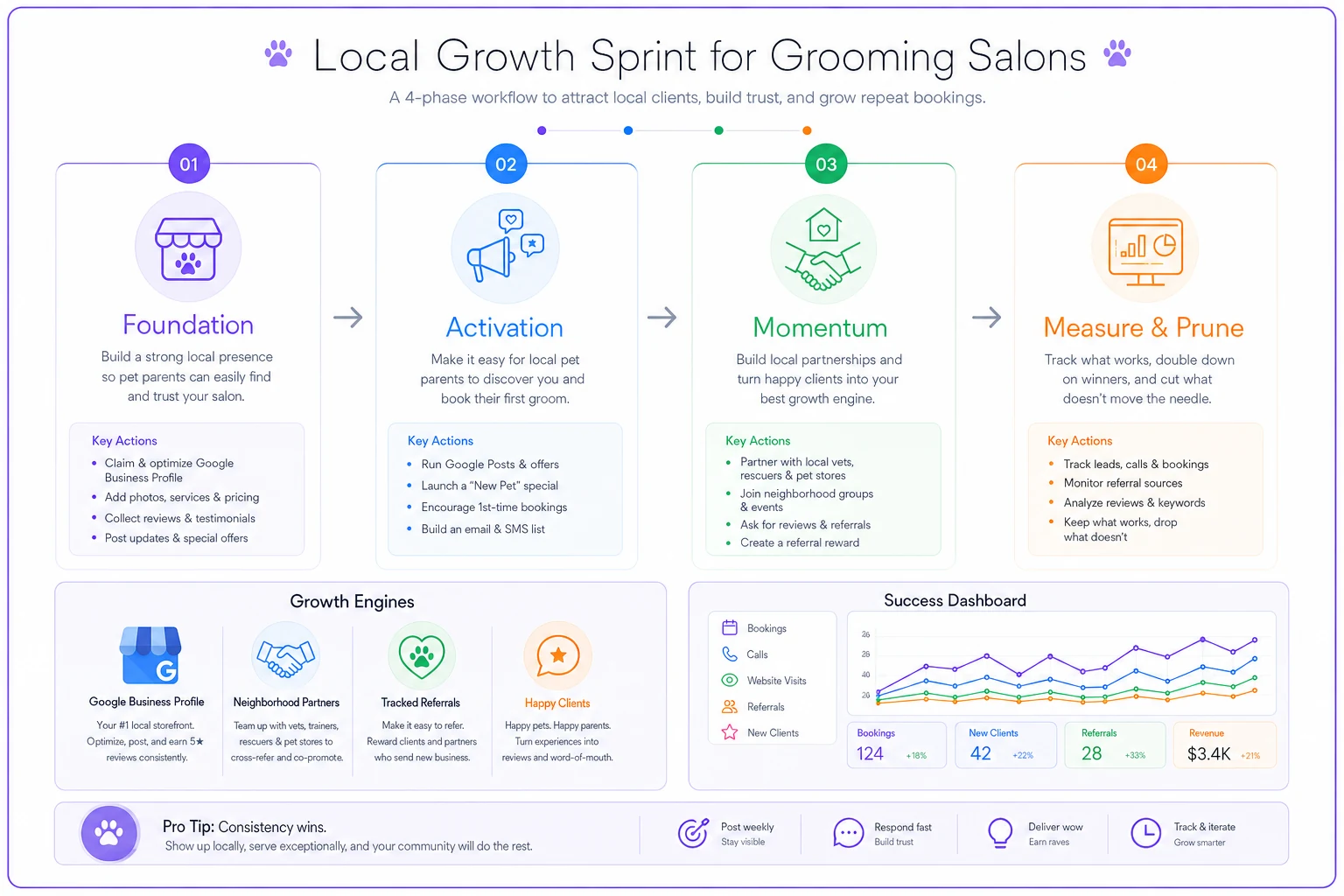
This shows how each phase feeds into the next.
Phase 1: The Google Business Profile checklist that actually moves ranking
Your GBP is the closest thing grooming has to free foot traffic. But "claimed and filled out" isn't the same as optimized. The difference between a lazy profile and a sharp one is often the difference between showing up in the local 3-pack and sitting on page two where nobody scrolls.
Work through this in order. Don't skip the boring parts — the boring parts are what Google reads.
-
Primary category set to "Pet Groomer" (not "Pet Store," not "Veterinarian"). Add secondary categories only if you genuinely offer them — mobile grooming, dog day care, etc. Wrong primary category is the single most common ranking killer.
-
Business name exactly as it appears on your signage and legal docs. No keyword stuffing like "Happy Paws Grooming Best Dog Groomer Downtown." Google penalizes that and it looks spammy to actual humans.
-
Service area or address consistent everywhere — website, Facebook, Yelp, directories. Inconsistent NAP (name, address, phone) confuses ranking. Pick one format and enforce it.
-
Hours accurate, including holiday hours. Nothing tanks trust faster than a client driving over to a "closed" sign when your profile said open.
-
Services listed individually with prices or price ranges — Full Groom (Small), Full Groom (Large), Bath & Brush, Nail Trim, De-shed. Each service is a keyword surface.
-
Photos
at least 15–20, refreshed monthly.
Before/afters, your team, the front of the shop, happy dogs. Interior and exterior shots help Google verify you're real. Geo-tagged if you can manage it. -
Q&A section seeded by you. Post the five questions clients actually ask ("Do you handle anxious dogs?" "How long does a full groom take?") and answer them yourself. Don't leave it blank for randoms to fill in.
-
Booking link connected directly to your scheduling system so the "Book" button works from search.
-
Attributes filled — women-owned, wheelchair accessible, appointment required, etc. These show up as badges and filters.
Once the profile is solid, the ongoing job is small but non-negotiable: one GBP post per week. A seasonal reminder, a before/after, a slot-availability nudge. Profiles that post regularly consistently out-rank dormant ones.
Post GBP updates on the same day each week to build a habit and keep the profile fresh.
The review engine
-
Groom finishes, dog looks great, owner is happy — that's the emotional peak. Ask then, in person: "If you're happy with how Bella turned out, a quick Google review really helps us."
-
Send a follow-up text two hours later with the direct review link. Not the next day — same day, while it's fresh.
-
Track who you asked and who actually left a review, so you can see your ask-to-review conversion rate over time.
A salon doing around 40 grooms a week that asks consistently can pull 8–12 new reviews a month. Most salons pull one or two because nobody owns the ask.
Reviews compound fast when someone actually takes responsibility for the process. It's one of those things that feels like a small operational detail until you realize it's directly tied to where you rank locally.
Phase 2: Neighborhood partnerships that send real referrals
Vets and pet retailers get covered constantly, so let's go wider. The most underused partners in local grooming are businesses that share your customer but don't compete: dog walkers, boarding facilities, doggy daycares, trainers, apartment complex leasing offices with pet amenities, local pet-sitter networks. These people talk to pet owners every single day.
The outreach script (adapt it, don't read it robotically)
> "Hi [Name], I run [Salon] a few blocks over. A lot of our clients also use [dog walkers / daycare / trainers], and I'd rather send them to someone local I trust than have them Google it. Would you be open to a simple two-way referral setup? I'll hand your info to my clients who need [their service], and if you're comfortable, you'd do the same. I can give you a small stack of cards with a code on them so we can both see if it's actually working — no pressure either way."
That last line does the heavy lifting. You're offering them referrals first, and you're proposing tracking so it's not a vague favor. Reciprocity plus measurement.
Partner tiers — where to spend your energy
| Partner type | Referral fit | Effort to land | Priority |
|---|---|---|---|
| Doggy daycare / boarding | Very high (dirty dogs, daily contact) | Medium | First |
| Dog trainers | High (build relationships early in dog's life) | Low | First |
| Dog walkers / pet sitters | High (see coat condition constantly) | Low | Second |
| Apartment leasing offices (pet-friendly) | Medium (new pet owners moving in) | Medium | Second |
| Local coffee shops / independent retail near you | Low-medium (foot traffic only) | Low | Optional |
Land two or three strong partners rather than ten weak ones. A single daycare sending you three dogs a month is worth more than fifteen counters with dusty flyers on them.
Partner onboarding — keep it simple
-
Give them a unique referral code or coded card (e.g., "PAWSDAYCARE" gets the client 15% off their first groom).
-
Log the code in your system so redemptions auto-attribute to that partner.
-
Check in at day 30 with a real number
"You've sent us four clients so far — here's a fresh stack of cards."
-
Reciprocate honestly. If you're not actually sending them business back, the relationship dies quietly.
That day-30 check-in with a specific number is what separates partnerships that last from ones that fizzle. People keep referring when they can see it's doing something.
Phase 3: Tracked referrals from your existing clients
Your current happy clients are your cheapest acquisition source and the one most salons never systematize. Word of mouth happens on its own — but tracked word of mouth tells you your real cost per acquisition and lets you reward the people actually driving it.
-
Give existing clients a personal referral code, not a generic one. "Refer a friend, you both get $15 off your next groom." Personal codes let you see exactly who your top referrers are.
-
Attach the reward to the referrer's next appointment, not a cash payout. This drives rebooking and keeps the reward inside your ecosystem.
-
Cap the discount stacking so someone can't refer six friends and get free grooms all year. A reasonable rule: max one referral discount applied per visit.
-
Trigger the ask at the right moment — after a great groom, or in the rebook confirmation. Not randomly mid-month.
Track every referral somewhere simple — a spreadsheet or your booking software: referrer name, referred client, code used, whether the new client rebooked. That last column matters more than the first sale. A referral source that brings clients who never come back isn't actually a good source. It just feels like one.
Measurement rules tuned to grooming's cadence
Most sprints get sloppy here. They measure "new clients" and stop. But a new client who ghosts after one groom cost you a discount for nothing. Tie your measurement to the rebook cycle.
The three numbers that actually matter:
-
New clients by source — GBP, each named partner, each referrer. No source attribution? No useful data. Every new booking needs to be tagged.
-
First-to-second rebook rate by source — of the new clients from each source, how many booked a second groom within 10 weeks? This is your quality signal.
-
Cost per retained client by source — total spend and discounts for a source divided by clients who rebooked. Not total clients acquired. Retained ones.
A worked example helps here. Say over the sprint:
-
GBP brought around 22 new clients, roughly 65% rebooked, cost basically your time.
-
Daycare partner brought around 12 new clients at a 15% first-groom discount, about 75% rebooked.
-
Client referrals brought around 9 new clients with $15/$15 discounts, roughly 80% rebooked.
Even though GBP produced the most volume, the referral and daycare channels produced stickier clients. That tells you where to lean in Phase 4 — and it's often the opposite conclusion you'd reach if you only counted first bookings.
Because grooming demand isn't flat, read these numbers against the calendar too. A spring surge can make any channel look great. If you want to separate real channel performance from seasonal lift, it's worth reviewing your seasonal demand patterns alongside the sprint data so you don't over-credit a channel that just happened to launch during your busy window.
A real scenario
A two-groomer salon in a mid-size suburb was sitting at roughly 55–60 grooms a week and had plateaued. Marketing was "whatever we remember to post." They ran the 90-day sprint with almost no ad spend.
Foundation phase: fixed the GBP primary category (it was set to "Pet Store"), added service-level pricing, started weekly posts, and built a same-day review ask into checkout. Reviews went from around 30 total to about 60 over the quarter, and they started showing up in the local 3-pack for searches they'd never ranked for before.
Activation: they landed one boarding facility and one trainer as tracked partners. The boarding facility alone was sending roughly one dog a week once the relationship warmed up.
By the end of 90 days they'd added somewhere around 40 new clients across all sources, and about 70% of them rebooked. Weekly volume moved into the mid-70s. No meaningful ad budget — just tighter execution and knowing which source did what. When they pruned in Phase 4, they quietly dropped the random Facebook boosts entirely and redirected that energy toward landing a second partner.
When this sprint makes sense — and when it doesn't
It's worth being honest about fit before you commit 13 weeks to this.
It makes sense when:
-
You have open capacity to fill. Running growth marketing when you're already fully booked just creates a waitlist and burnout.
-
Your service quality is consistent enough that new clients will actually rebook. Driving traffic to inconsistent grooms is pouring water into a leaky bucket.
-
You can commit an owner or manager to owning the tracking for 13 weeks.
It's a bad idea when:
-
You're chronically understaffed and can't take more dogs. Fix capacity first.
-
Your rebook rate is already poor. Acquiring more clients who leave doesn't help — you'll just discount your way to the same revenue.
Who should skip it entirely: a fully-booked solo groomer with a six-week waitlist. Your problem is pricing or capacity, not demand. Mobile operators are a special case too — your growth is geographically constrained by routing, so partnerships and referrals should be clustered inside your efficient service zones rather than spread wide. If that's you, tighten route economics before chasing volume, or you'll just add unprofitable drive time.
The templates you actually need
You can run this whole sprint on one spreadsheet with four tabs:
-
GBP tracker — posts scheduled, reviews requested vs. received, updated weekly.
-
Partner log — partner name, code, cards handed out, redemptions, day-30 check-in date.
-
Referral log — referrer, referred client, code, first-groom date, rebooked (Y/N).
-
Source scoreboard — new clients, rebook rate, and cost-per-retained-client per source, updated weekly.
Keep it simple and visible. The salons that grow aren't the ones with the fanciest tools — they're the ones who actually update the sheet on Fridays and make one decision from it.
Wrapping up
The reason local grooming marketing feels like a coin flip most of the time is that nothing gets tracked back to a rebooked client. Fix that, and everything else gets easier — you stop guessing, you stop discounting blindly, and you double down on the two or three sources that reliably bring people who stick around.
Run the 90 days honestly: optimize the profile, land a few real partners, wire up trackable referrals, and read the numbers against your rebook cycle. At the end you won't just have more clients. You'll know where they came from and whether they're worth keeping, which is the only foundation worth building the next quarter on.
Ready to streamline your grooming business?
Join 500+ pet groomers using Furlyly to save time, reduce scheduling conflicts, and deliver exceptional client experiences.