

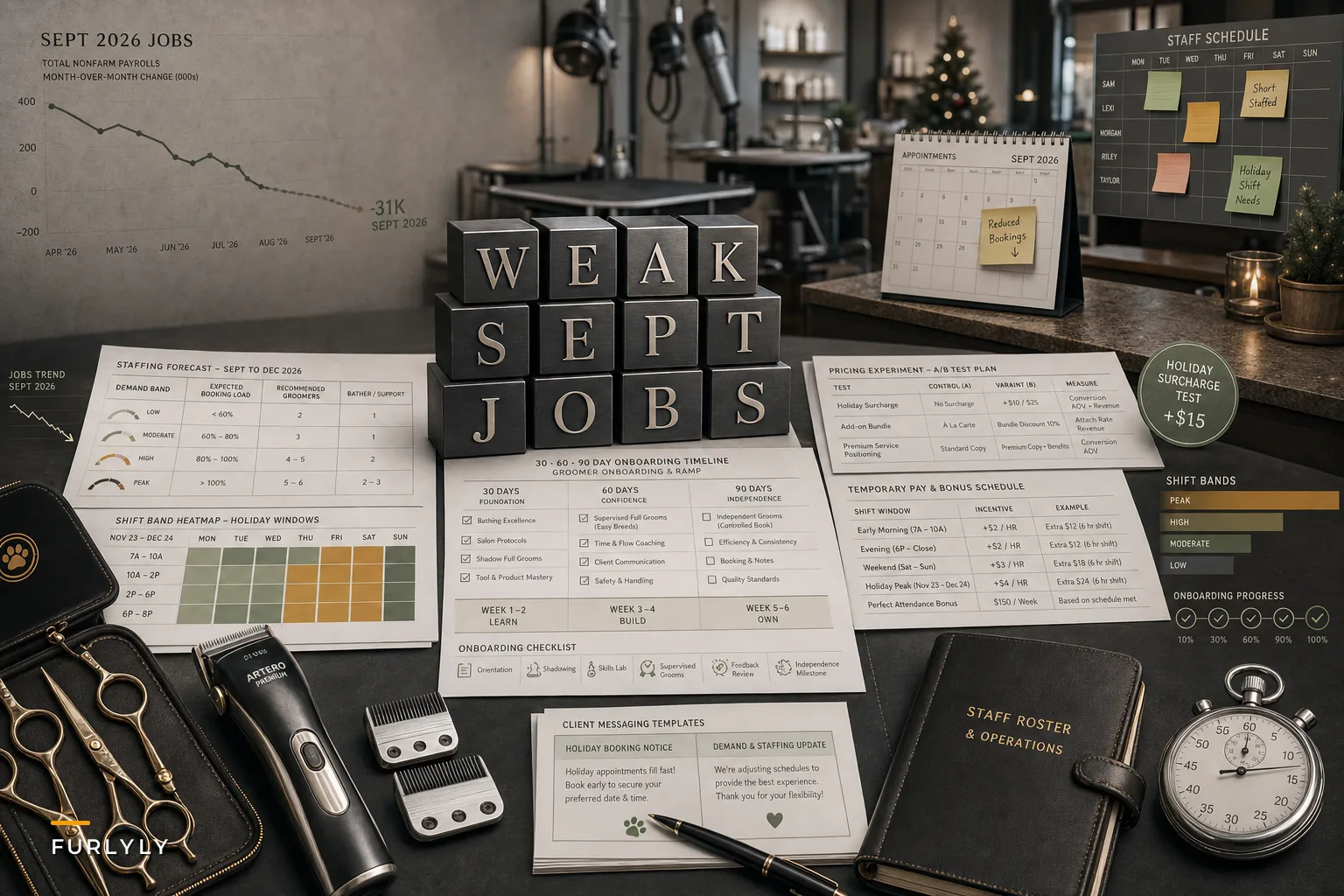

The September numbers landed softer than almost anyone expected. Nonfarm payrolls grew by just 29,000, unemployment ticked up to 4.2%, and wage growth cooled to roughly 3.0% year over year. As CNBC reported, the labor market "faltered" after months of mostly steady reads — and the timing matters because this is exactly when grooming salons start locking in holiday staffing and setting December pricing.
For a national economy, one soft month is noise until proven otherwise. For a grooming salon running four or five chairs, it's a signal you can actually act on — because the two things this report moves, candidate availability and consumer confidence, both hit your P&L directly. Easing labor pressure on one side. Potentially jumpier spending on the other. The salons that handle the next 60 days well won't be the ones who react hardest. They'll be the ones who adjust their bands — staffing bands, pay bands, pricing bands — instead of making one big swing in either direction.
Two forces pulling in opposite directions
A weak jobs report creates a real tension for a service business like yours.
On the labor side, slower hiring and cooler wage growth mean the frantic bidding war for groomers eases a little. When payroll growth slows nationally, the groomers who were job-hopping for a $2/hour bump start staying put. Candidate flow improves. You stop losing bake-offs on wage alone. That's genuinely good news if you've spent the last two years overpaying just to hold a bench together.
On the demand side, the picture is murkier. A softening labor market tends to dent consumer confidence right before the holidays — and grooming sits in that awkward zone between discretionary and essential. Nobody skips the vet. Plenty of people stretch a full groom from every 5 weeks to every 7 when they're feeling cautious. Reuters noted the labor market "remains stable" overall, which keeps this from being a panic situation. But stable-and-cooling is exactly the condition where consumer behavior gets inconsistent — and inconsistent demand is harder to staff for than a clean up-or-down trend.
So you've got easing labor costs and softening-but-not-collapsing demand arriving at the same time. The mistake is treating these as one story. They require two different responses.
The underlying problem: most salons staff for the booking volume they hope for
This is what a report like this exposes, and it has almost nothing to do with the report itself.
Never miss a grooming appointment again.
Furlyly helps you book, confirm, and manage every pet grooming appointment effortlessly.
- Unified appointment scheduling
- Automated client reminders
- Staff availability & shift management
No credit card required
Most grooming salons don't actually have a staffing band. They have a headcount. They hired up when demand was hot, and now that headcount is fixed cost whether 40 dogs come through the door this week or 28. When the economy is clearly booming, overstaffing hides because everyone's busy. When it softens, the gap between scheduled labor hours and actual billable hours turns into a quiet margin leak that nobody notices until the monthly close looks ugly.
A typical example: a three-groomer salon staffs roughly 120 labor hours a week. In a strong month, billable utilization sits around 78–82%. In a softer month, bookings slip and utilization drops to the mid-60s — but the schedule doesn't change, because nobody wants to cut a groomer's hours on a hunch. That 15-point drop on 120 hours is around 18 paid-but-unbilled hours a week. At a loaded labor cost of roughly $28/hour, that's close to $500 a week bleeding out for one modest demand dip. Nobody sends that invoice. It just shows up as a thinner month.
The jobs report doesn't cause this problem. It just makes the cost of not having a flexible staffing model visible faster. The fix isn't to slash hours reactively — it's to build the band before demand wobbles, which is the whole premise behind treating workforce planning as an operating system rather than a monthly guessing game.
Move 1: Tighten your staffing bands before you touch anything else
Before you think about pricing or hiring, redraw your schedule as a range, not a fixed block.
The practical version of this is defining three staffing tiers tied to forecasted bookings, then pre-agreeing with your team which tier runs each week. Done right, nobody gets surprised by a cut shift because the rules were set in advance.
| Tier | Forecasted weekly bookings | Groomer coverage | Bather/support | Flex action |
|---|---|---|---|---|
| Lean | Below ~30 | 2 full | 1 part-time | Pull one flex shift, extend buffers |
| Base | ~30–42 | 3 full | 1 full | Standard schedule |
| Peak | Above ~42 | 3 full + 1 flex | 1 full + 1 part | Open Saturday overflow, add evening slots |
The point isn't the exact numbers — yours will differ by chair count and average ticket. The point is that you decide now what triggers a move between tiers, so when a soft week shows up, you're executing a plan instead of debating one at 7am Monday.
Build the flex into scheduled roles, not into firing and rehiring.
One thing worth stressing: build the flex into scheduled roles, not into firing and rehiring. The groomers most willing to flex their hours are the ones who trust that the flex is fair and predictable. If your "flexibility" just looks like random hour cuts, you'll lose exactly the people you wanted to keep going into a holiday season where a weaker labor market makes rehiring slightly easier — but never actually easy.
Move 2: Use the easing wage pressure to fix ramp time, not just pay
This is the part most owners miss. When wage pressure cools, the instinct is to feel relief and freeze pay. But the real opportunity in a softer labor market isn't paying less — it's hiring better and ramping faster.
With candidate flow improving, you can afford to be pickier, and you can redirect the budget you'd have spent in a wage war toward shortening the time it takes a new groomer to become billable. A groomer who hits full productivity in 6 weeks instead of 11 is worth far more than one you hired $1.50/hour cheaper.
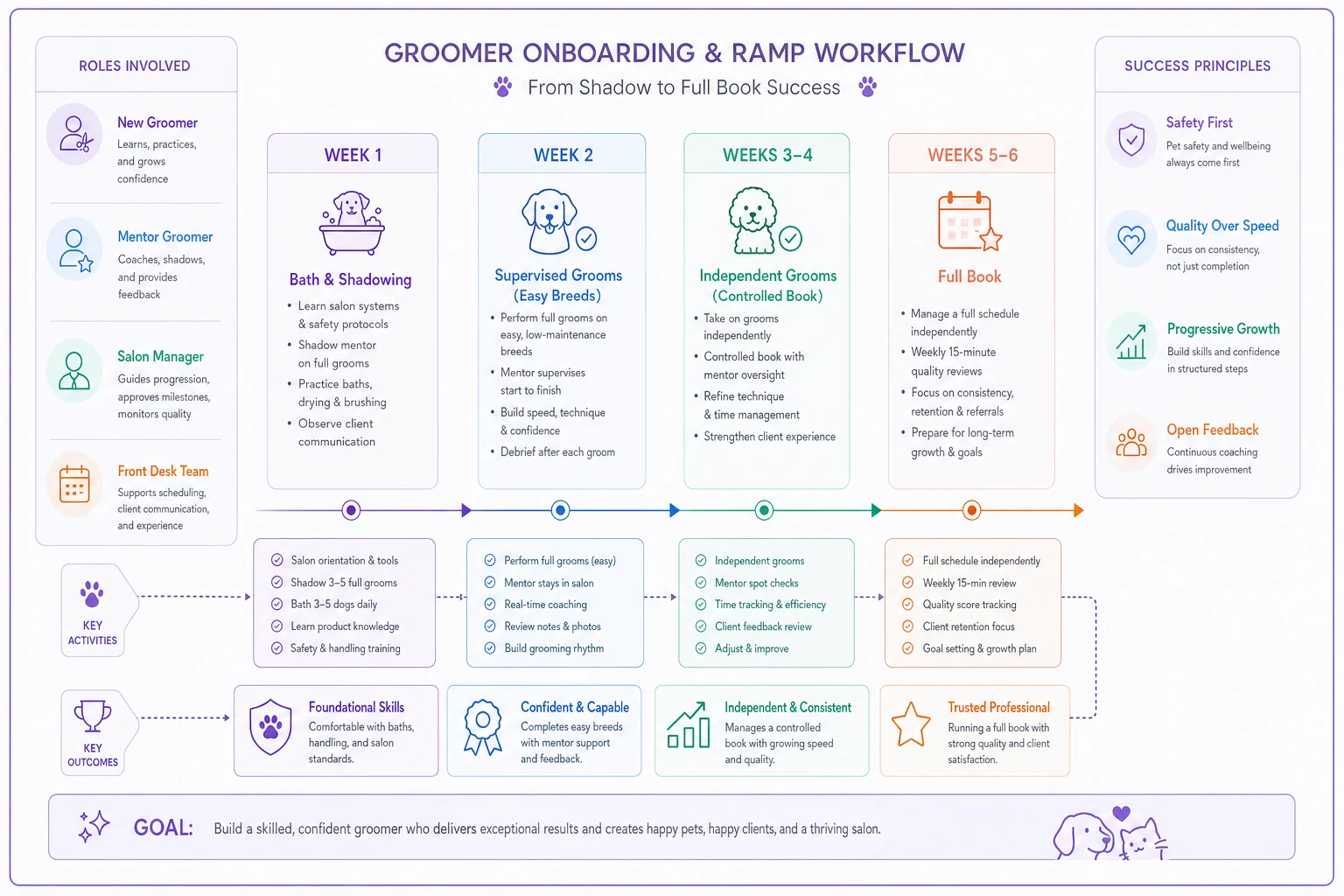
A tight onboarding sequence built for speed during this window:
-
Week 1 — shadowing + bathing only. New hire runs the bath and prep station solo by day three, freeing your senior groomers for full grooms. This alone recovers billable capacity immediately.
-
Week 2 — supervised full grooms on easy breeds. Short-coat, low-anxiety dogs only. Senior groomer checks finish quality, not every step.
-
Weeks 3–4 — independent on a controlled book. Fill their schedule with repeat, well-behaved clients. Keep first-timers and difficult dogs off their plate.
-
Weeks 5–6 — full book with quality spot-checks. Billable at near-full rate, with a weekly 15-minute quality review instead of constant oversight.
Here's a quick visual of a tightened onboarding workflow.
The salons that get this right during a soft labor stretch come out the other side with a deeper, cheaper-to-run bench than their competitors who spent the whole stretch chasing wages. Faster ramp is the compounding advantage — it's just not as visible as a pay rate.
Move 3: Test pricing carefully — because demand is the uncertain variable
Labor got clearer. Demand did not. That asymmetry should shape how aggressive you get on price.
A blunt across-the-board price hike into a softening-confidence holiday season looks fine on a spreadsheet and quietly loses you steady clients in practice. The smarter play is surgical: raise where you have pricing power, hold where you don't, and add optional revenue that cautious clients can decline without feeling pushed out.
Where pricing power usually hides in grooming:
-
Peak-slot premiums. Saturday mornings and the two weeks before major holidays sell out regardless. A modest surcharge there rarely dents demand.
-
Add-ons framed as upgrades, not fees. A "holiday finish" package — bandana, cologne, nail polish, longer brush-out — captures clients who want to spend without alienating the ones watching their budget.
-
De-shedding and large-breed surcharges. These are already time-and-cost justified. If you haven't repriced them in over a year, rising supply and labor costs probably mean you're underwater on them.
Where to hold the line: your standard full groom for your core repeat base. These are the clients whose cadence stretches first when confidence softens. A $6 bump on a recurring groom can quietly push a 6-week client to an 8-week interval, and you'll never see the connection in the data — you'll just notice the gaps.
When a price increase actually makes sense right now
-
Your supply and labor costs have climbed and you haven't repriced in 12+ months.
-
You're regularly turning away peak-slot bookings.
-
The increase targets premium tiers or add-ons, not your core recurring service.
When it's a bad idea right now
-
Your retention is already soft and rebooking rates are slipping.
-
You'd be raising the base full-groom price on your steady repeat clients.
-
You can't measure the effect cleanly, so you won't know if it backfired until the quarter's over.
Where to hold the line: your standard full groom for your core repeat base. These are the clients whose cadence stretches first when confidence softens. A $6 bump on a recurring groom can quietly push a 6-week client to an 8-week interval, and you'll never see the connection in the data — you'll just notice the gaps.
A real scenario: the two-location salon that rebalanced instead of overreacting
Consider a two-shop operation — five groomers total across both locations — that went into October nervous after the jobs report. Their instinct was to freeze hiring and push a 7% price increase everywhere to protect margin ahead of a possibly soft holiday.
Instead, they split the problem. On labor: they kept pay rates flat (the cooling wage market meant they didn't need to raise), and they finally defined a three-tier staffing band per location so soft weeks pulled one flex shift automatically instead of carrying full coverage. On pricing: they skipped the blanket hike entirely. They added a holiday upgrade package at around $22 and put a small premium on their perpetually-full Saturday slots.
Over the following two months, utilization on soft weeks climbed from the mid-60s back toward the mid-70s — mostly because they stopped paying for empty chair-time. The upgrade package attached on roughly a third of grooms in December. Their core clients saw no base-price change, and rebooking held steady. The net result was a meaningful margin improvement, not from one big lever, but from refusing to pull the wrong lever hard.
The lesson is boring and important: the soft report pushed them to tighten the system, not to make a dramatic one-time bet.
Your 60-day checklist
Run through this before the holiday peak hits:
-
[ ] Define three staffing tiers tied to forecasted bookings, with clear trigger numbers for moving between them.
-
[ ] Pre-communicate the flex rules to your team so no cut shift feels arbitrary.
-
[ ] Review your last 90 days of utilization — if soft weeks drop below ~70%, your band is too rigid.
-
[ ] Hold base pay steady; redirect would-be wage spend toward faster onboarding.
-
[ ] Compress new-hire ramp to billable in 6 weeks using a bathing-first sequence.
-
[ ] Reprice de-shedding and large-breed surcharges if untouched for 12+ months.
-
[ ] Build one optional holiday upgrade package instead of raising base prices.
-
[ ] Add a small peak-slot premium where you're already turning bookings away.
-
[ ] Protect your core recurring full-groom price — that's the cadence that stretches first.
-
[ ] Track rebooking rate weekly, not monthly, through the holiday window.
Run through this before the holiday peak hits:
The real takeaway
A soft jobs report is a prompt, not a plan. The salons that get hurt by moments like this are the ones running on fixed headcount and fixed pricing, reacting in big jerky movements when the data finally forces their hand. The ones that do fine have already turned staffing and pricing into adjustable bands — so a cooler labor market becomes a chance to hire better and ramp faster, and softer demand becomes a reason to get surgical on price instead of swinging blind.
You don't need to predict the holiday season perfectly. You need a schedule that flexes without drama, an onboarding path that turns new hires billable in weeks instead of months, and a pricing structure that captures clients who want to spend without pushing away the ones being careful. Build those bands now, while you still have two months to do it without pressure — and whatever the next report says won't catch you flat-footed.
A soft jobs report is a prompt, not a plan. The salons that get hurt by moments like this are the ones running on fixed headcount and fixed pricing, reacting in big jerky movements when the data finally forces their hand. The ones that do fine have already turned staffing and pricing into adjustable bands — so a cooler labor market becomes a chance to hire better and ramp faster, and softer demand becomes a reason to get surgical on price instead of swinging blind.
You don't need to predict the holiday season perfectly. You need a schedule that flexes without drama, an onboarding path that turns new hires billable in weeks instead of months, and a pricing structure that captures clients who want to spend without pushing away the ones being careful. Build those bands now, while you still have two months to do it without pressure — and whatever the next report says won't catch you flat-footed.
Ready to streamline your grooming business?
Join 500+ pet groomers using Furlyly to save time, reduce scheduling conflicts, and deliver exceptional client experiences.