

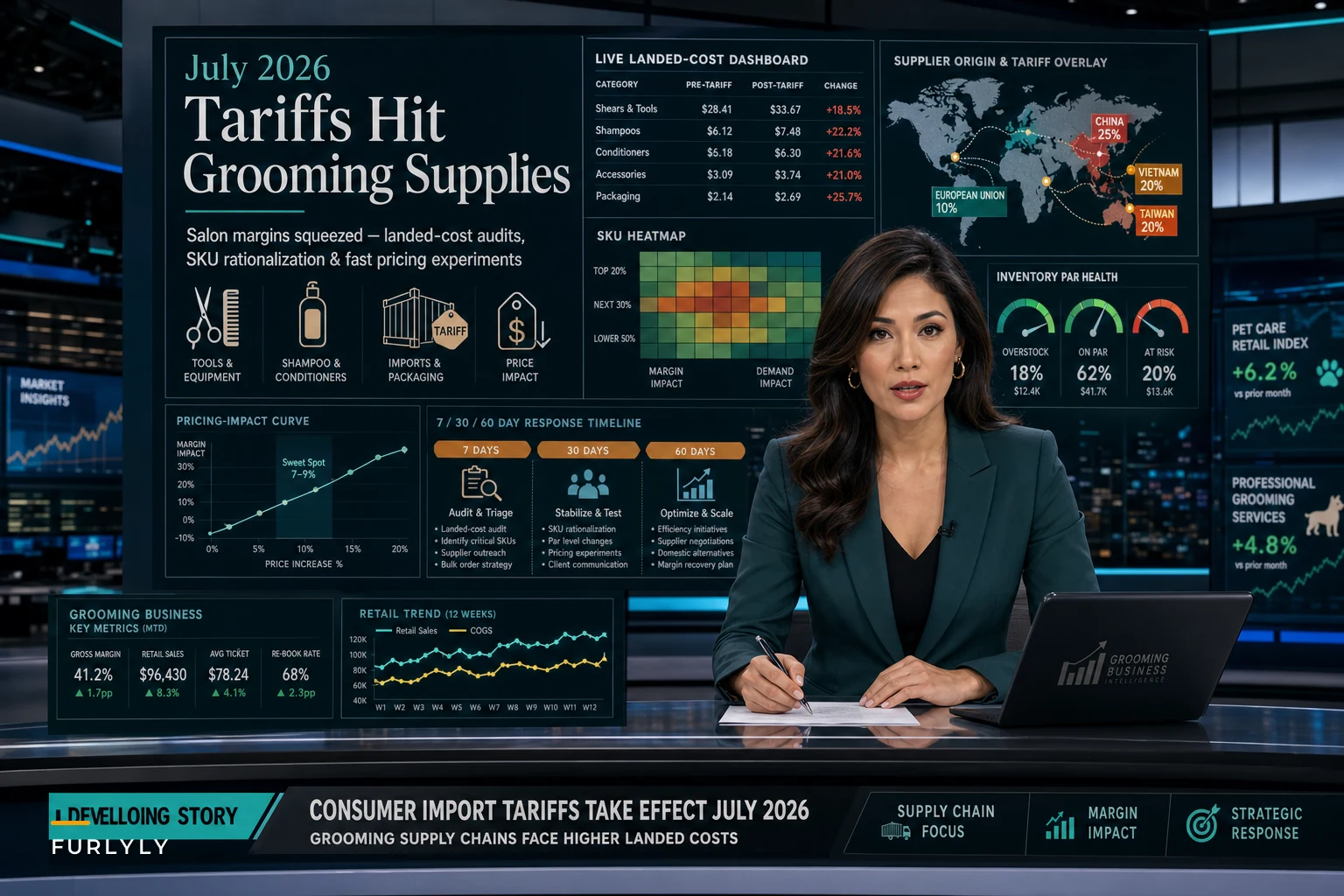

The new global import tariffs announced by NBC News — 10% to 12.5% on goods from 60 trading partners — went into effect July 24. For grooming salons, this means your next supply order just got more expensive. Shampoos, conditioners, grooming tools, retail products, dryers, clippers — if it's imported (and most grooming supplies are), you're paying more starting now.
The timing is rough. Back-to-school grooming season is picking up, and suddenly landed costs on essential supplies jumped overnight. That bottle of hypoallergenic shampoo you sell for $24? Wholesale cost probably moved from $11 to somewhere around $12.35. Doesn't sound catastrophic until you multiply it across 200+ SKUs and realize you're looking at thousands in extra costs monthly.
What makes this particularly awkward for grooming salons is that unlike restaurants or retail stores that can swap suppliers without much drama, grooming supplies are often breed-specific, coat-specific, or tied to client sensitivities. You can't just replace your oatmeal shampoo with whatever's cheapest this week — Mrs. Henderson's goldendoodle with the sensitive skin needs that specific formula, and she'll go elsewhere if you stop carrying it.
The supply chain math that's about to bite you
Most salon owners don't realize how exposed they are to import costs until something forces the issue. Walk through your supply closet and check labels — easily 70% of grooming products come from overseas manufacturers or use imported ingredients. Even "American-made" products often rely on imported components somewhere upstream.
Here's a typical breakdown from a 4-station salon in suburban Atlanta:
| Category | Monthly Cost | Source |
|---|---|---|
| Shampoos/conditioners | $1,400 | Canada, Korea |
| Tools/equipment | $600 | Germany, China |
| Retail products | $1,200 | Mixed domestic/imported |
| Consumables | $600 | India, various |
With the new tariffs, their monthly supply cost jumps to roughly $4,200–$4,300. That's an extra $5,000+ annually straight out of profit margins. For a salon running at 15% net margins, you'd need to generate an additional $33,000 in revenue just to break even on the tariff impact.
The kicker? This isn't like a minimum wage increase where you have months to prepare. These tariffs are effective immediately. Your next reorder will reflect the new pricing, and distributors are already updating their systems.
Why standard margin protection tactics won't work here
The knee-jerk reaction is to raise prices. Add $2 to every groom, problem solved, right? Except grooming clients get oddly stubborn at certain price thresholds. Cross that invisible line from $65 to $70 for a standard groom, and you'll see the appointment book thin out faster than you'd expect.
Never miss a grooming appointment again.
Furlyly helps you book, confirm, and manage every pet grooming appointment effortlessly.
- Unified appointment scheduling
- Automated client reminders
- Staff availability & shift management
No credit card required
A salon in Phoenix tried this exact move during the 2022 supply chain crunch — raised prices 8% across the board to cover increased costs. They lost around 22% of regular clients within two months. The math didn't work out.
The other common response — switching to cheaper suppliers — runs into the sensitivity problem. Grooming isn't like food service where you can swap tomato vendors without anyone noticing. Dogs' skin reacts to formula changes. Groomers have strong preferences for specific tool brands that affect their speed and quality. Your retail customers buy specific products for specific reasons.
The three-phase response system that actually works
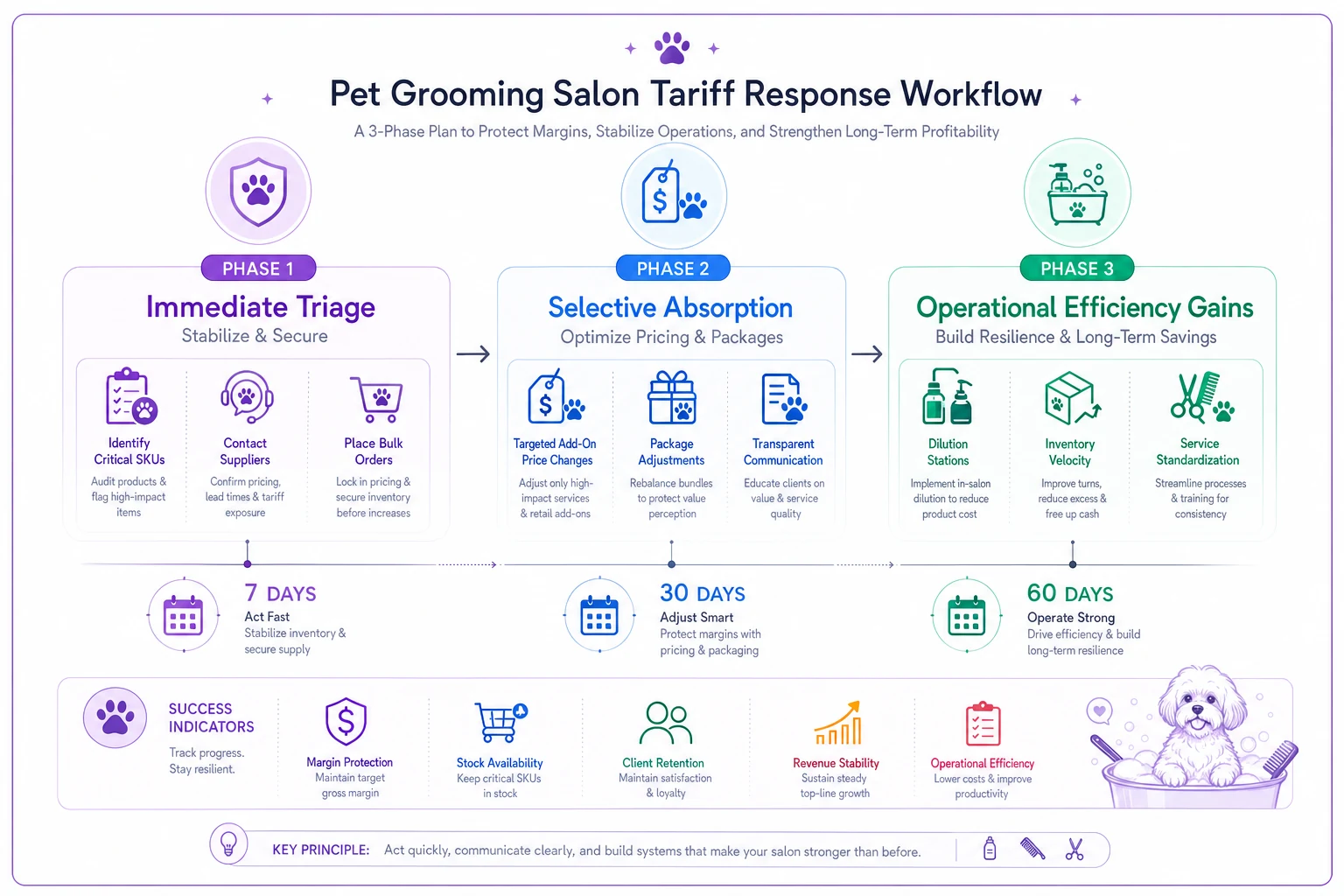
Phase 1: Immediate triage (next 7 days)
Start with a supply audit, but not the way you'd think. Don't catalog everything — that wastes time. Identify your "critical 20" — roughly 20% of products that generate 80% of your supply costs and usage.
Pull your last three months of purchase orders. Highlight items you buy weekly or bi-weekly. For most salons, the critical list looks like:
-
Your top 3–4 shampoo lines
-
Basic conditioning treatments
-
Ear cleaning solution
-
Blade coolant and lubricant
-
Your best-selling retail items (usually 5–8 products)
Contact your suppliers about these specific items only. Ask three questions:
-
What's the price increase effective immediately?
-
Can you lock in current pricing if I place a larger order today?
-
What's your 30-day price forecast?
One salon owner in Tampa discovered her distributor hadn't updated pricing yet on prepaid orders. She placed a 3-month supply order at old pricing and saved roughly $800.
Phase 2: Selective absorption strategy (next 30 days)
You can't raise all prices, but you can raise some strategically. The trick is identifying where clients have the least price sensitivity.
Add-on services: Clients who already committed to a $65 groom won't balk at a teeth cleaning going from $12 to $14. The percentage increase feels small relative to their total spend.
Specialty shampoos: That de-skunking treatment or flea bath? Bump it $3–5. It's essentially an emergency service with weak price memory.
Express services: Nail grinding going from $8 to $10 feels reasonable when positioned around specialized equipment costs.
Package deals: Clients accept package increases better than individual service hikes. A 6-groom package going from $350 to $365 generates less resistance than a single groom increase of $2.50.
Meanwhile, protect your core service pricing for now. The basic bath and groom price is what clients remember and compare.
Phase 3: Operational efficiency gains (next 60 days)
Consumption tracking: Most salons use 20–30% more product than necessary — not from carelessness, but from lack of measurement. Dilution stations with marked containers fix this fast. A groomer using concentrated shampoo straight from a gallon jug can easily use 3x what they need. Simple pump dispensers with dilution ratios typically cut usage by 25% without affecting quality.
Inventory velocity: Salons commonly carry 45–60 days of inventory. With prices rising, that ties up cash. Drop to 20–25 day levels for everything except critical supplies. Use the freed cash for the selective bulk buying from Phase 1.
Service standardization: Create standard product protocols by coat type, not breed. Instead of separate "golden retriever shampoo" and "lab shampoo," use a "double-coat protocol" that covers both. Consolidating from 15 specialized products down to 6–7 protocols cuts inventory costs and complexity considerably.
Use labeled pump dispensers with dilution ratios to enforce consistent product usage and cut waste.
Visual workflow of the three-phase response:
Getting these three phases right requires decent visibility into what's actually happening across your operation — and that's harder than it sounds when you're managing appointments, staff, and clients simultaneously.
The retail arbitrage opportunity everyone's missing
While tariffs squeeze margins on wholesale supplies, they're creating an unexpected opening in retail. Competitors who haven't adjusted retail pricing yet are essentially subsidizing their customers' purchases.
Smart salons are quietly expanding retail offerings right now, focusing on products with stable domestic sourcing. Local or regional brands that manufacture in the U.S. suddenly have a 10–12% cost advantage over imported alternatives.
One salon in Orlando partnered with a local pet bakery and a regional shampoo maker, replacing half their retail shelf with locally-sourced products. They avoided tariff impacts on those items entirely, and the "local" angle actually increased retail sales by around 15%. The window here is narrow — within 30–60 days, most competitors will adjust retail pricing and the advantage disappears.
Building tariff resistance into your operating model
These tariffs might stick around. And even if they don't, supply chain volatility isn't going away. Building a tariff-resistant operation isn't about predicting policy — it's about flexibility.
Supplier diversity: Map every critical supply to at least two suppliers, ideally from different countries. Yes, more vendor management. But when tariffs hit Chinese goods harder than Korean ones, or Canadian imports get exempted, you can pivot without scrambling.
Formula flexibility: Train staff on 2–3 alternative product lines for each service type. When your primary line jumps 15% in cost, you can shift volume to alternatives without retraining or client disruption.
Margin-based pricing triggers: Instead of quarterly price reviews, tie adjustments to margin thresholds. When blended supply costs exceed 13% of service revenue (typical is 10–11%), specific price changes trigger. This prevents the dramatic catch-up increases that lose clients.
The coordination problem that makes everything worse
What really hurts salons during supply cost spikes is the information gap between ordering, service delivery, and financial tracking. Your receptionist doesn't know supply costs are up 12%. Your groomers don't track product usage. Your bookkeeper sees expenses rising but can't tell why.
Operational software changes this dynamic. When supply costs, service delivery, inventory levels, and financial metrics live in one system, you spot problems before they compound. You see that switching from Product A to Product B saves $3 per service. You notice that one groomer uses 40% more product than another for the same coat types. You identify which services absorb cost increases best without hurting retention.
One approach that's proven effective is rationalizing your SKU count while setting smarter par levels. Fewer products mean better bulk pricing and less tariff exposure. The real power comes from connecting these decisions across your operation — when your inventory system talks to your appointment scheduler, you can adjust service offerings based on supply availability and costs.
Specific moves for the next 30 days
Forget the comprehensive overhaul — you need tactical wins while managing day-to-day operations. Here's the priority sequence:
-
Week 1 Audit critical supplies for price increases, place bulk orders on stable-price items, identify 3–5 add-on services for selective price increases, set up basic dilution stations.
-
Week 2 Implement the add-on price changes, contact alternative suppliers for quotes, reduce inventory levels on slow-moving items, start tracking product usage by groomer.
-
Week 3 Test one package price increase, partner with one local supplier for retail, standardize protocols for top 3 coat types, calculate true per-service supply costs.
-
Week 4 Review results and adjust, lock in favorable supplier terms, roll out successful changes salon-wide, set margin-based pricing triggers.
It's not a complicated system, but most salons skip the review step in Week 4 and lose the compounding benefit of what they learned.
The reality check
These tariffs aren't a death blow, but they're not nothing either. A typical 4-station salon will absorb $4,000–6,000 in additional annual costs. That's real money that needs a real operational response.
The salons that handle this best won't be the ones panic-raising prices or slashing quality. They'll be the ones getting surgical — protecting core margins while finding efficiency gains and selective revenue opportunities.
Supply shocks like these expose how thin grooming margins really are. But they also force operational improvements that should've happened anyway. Tighter inventory control, smarter pricing, better supplier relationships — these aren't just tariff responses. They're just good business practices that happen to be urgent right now. Your competitors are either panicking or ignoring this, and neither approach wins.
Start with Phase 1 tomorrow morning.
Start with Phase 1 tomorrow morning.
Ready to streamline your grooming business?
Join 500+ pet groomers using Furlyly to save time, reduce scheduling conflicts, and deliver exceptional client experiences.