

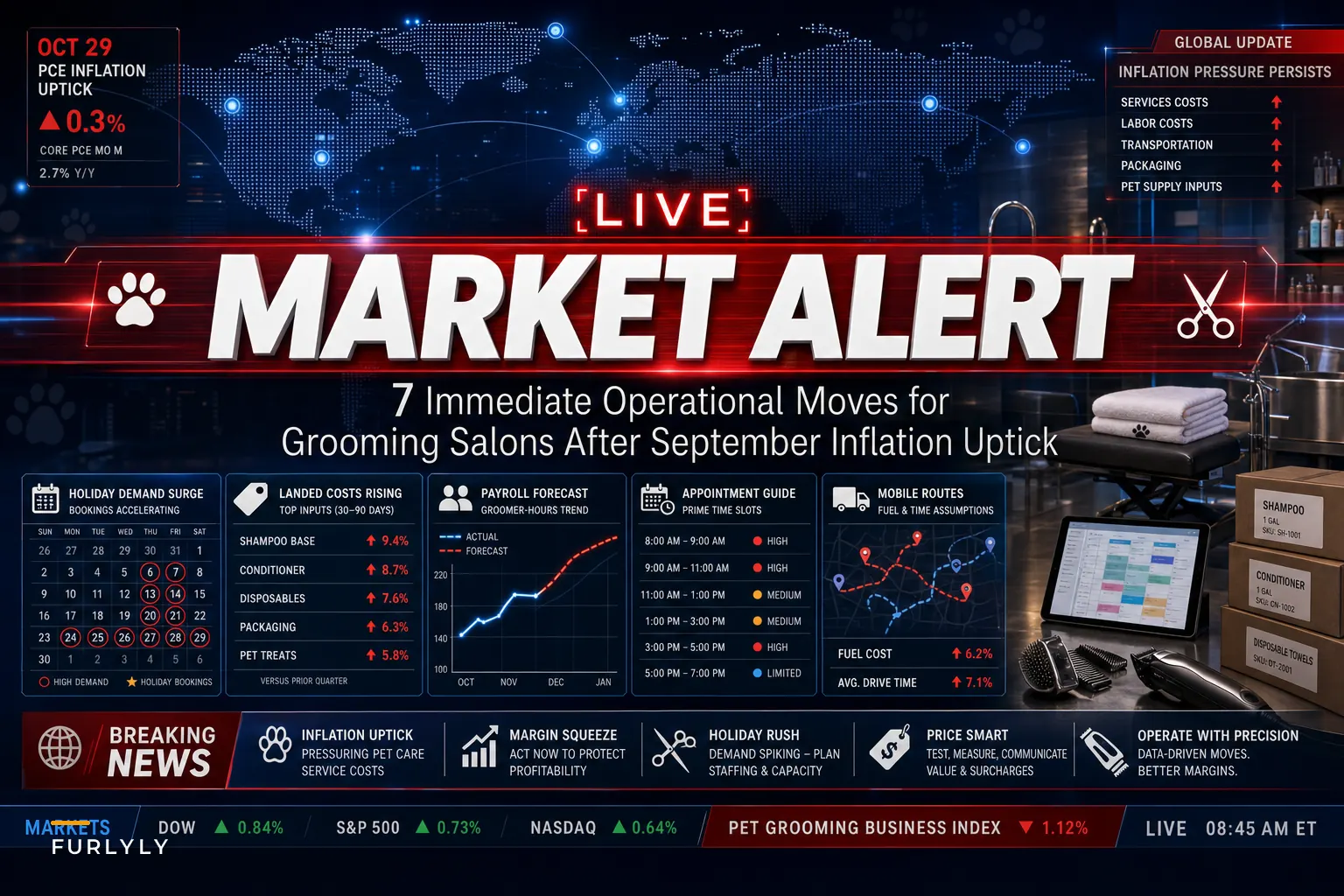

The timing couldn't be more awkward. Just as your schedule starts filling up with holiday-coat bookings and December double-bookings, the September inflation data landed harder than most people expected. Reuters reported that U.S. inflation heated up in September while consumer spending kept rising, and the PCE numbers that CNBC broke down pointed to the same thing: input costs are climbing again, but people are still spending.
For a grooming salon, that combination is weirdly good news and bad news at once. Clients aren't tightening up — holiday grooming is still happening. But every shampoo jug, utility bill, and payroll hour just got a little more expensive, and you've got roughly 8 weeks before peak demand hits. If you don't make a few deliberate moves now, you'll spend December working harder for thinner margins and wondering where the money went.
This isn't about overreacting to one month of data. It's about the handful of operational levers that actually move when costs rise and demand stays strong — and doing them before the rush, not during it.
Why this particular combination is tricky for groomers
Most margin advice assumes one of two scenarios: costs go up and demand softens (so you cut back), or costs stay flat and demand rises (so you add capacity). September handed us the uncomfortable middle — costs up, demand resilient.
That middle is dangerous because it hides the squeeze. When the phone keeps ringing and the books look full, it's easy to assume everything's fine. Revenue looks healthy. But the margin on each groom quietly erodes while you're too busy to notice. By the time the January close shows a worse owner-pay number despite a record December, the damage is already baked in.
The underlying problem this exposes isn't inflation itself — it's that most salons run on last quarter's cost assumptions. Your pricing, your reorder quantities, your labor budget per groom — all set when supplies and wages were cheaper. Resilient demand just means you'll run those stale assumptions at higher volume, which multiplies the leak.
So the real work here is recalibration, not panic. Here are the seven moves, roughly in the order I'd do them.
1. Re-cost your three highest-volume services this week
Before you touch prices, you need to know what each groom actually costs today. Not last spring. Today.
Never miss a grooming appointment again.
Furlyly helps you book, confirm, and manage every pet grooming appointment effortlessly.
- Unified appointment scheduling
- Automated client reminders
- Staff availability & shift management
No credit card required
Pull your three most-booked services and rebuild the cost per groom using current supply prices and current labor rates. Most owners are shocked by how much has drifted.
A realistic example: a mid-size salon's "full groom, medium double-coat" was priced at $85 and penciled out to about $34 in direct cost a year ago — shampoo, conditioner, utilities allocation, and labor at the old wage. Re-run that with today's chemical prices and a $2/hr pay bump, and the same groom now costs closer to $41–$43. The price didn't move, but the margin dropped from roughly 60% to around 50%. On 15 of those a day, that's real money walking out the door.
| Cost component | Old assumption | Current reality | Impact |
|---|---|---|---|
| Shampoo/conditioner per groom | ~$4.50 | ~$5.80 | +$1.30 |
| Utilities allocation | ~$3.00 | ~$3.60 | +$0.60 |
| Labor (per groom hour) | base | +$2/hr | +$5–7 |
| Direct cost per full groom | ~$34 | ~$41–43 | +$7–9 |
You don't need to do this for all 20 services. The top three usually cover 60–70% of your volume. Fix those and you've fixed most of the leak.
2. Reprice with anchors, not apologies
Once you know the new cost, raise prices on the services that drifted — but do it structurally, not with a sheepish "sorry, everything's more expensive now" email.
-
Raise your most-booked services 6–10%, not 3%. A 3% bump barely covers the cost drift and you'll be repricing again in three months.
-
Hold your entry-level service closer to flat as a price anchor, so the mid-tier still feels reasonable.
-
Push increases live before you send holiday reminders, so the new price is simply "the price" when clients book their December slot.
The mistake most owners make is waiting until January to reprice "after the busy season." That's backwards. The holidays are when clients are least price-sensitive and most locked into needing you. Raise prices going into demand, not coming out of it.
3. Rebuild your reorder quantities around new lead times and prices
Higher input costs change the math on how much to buy and when. There's a real tension here: buying ahead locks in today's price before further increases, but it ties up cash right when holiday payroll is heaviest.
The move isn't "stockpile everything." It's to separate your SKUs into two buckets:
-
Price-volatile, shelf-stable, high-volume (shampoos, de-shedding solution, conditioner) — worth buying 8–10 weeks of par now if the cash allows, because the price is likely to keep climbing and it won't spoil.
-
Everything else — keep on normal par. Don't tie up cash hoarding bandanas and cotton balls to save pennies.
If cash is tight, prioritize buying the shelf-stable, price-volatile SKUs first so you avoid stockouts on core items.
Also recheck lead times. Several distributors stretched their delivery windows over the last couple of months, and a reorder point set for a 3-day lead time will leave you short if it's quietly become 6. Running out of core shampoo during the second week of December is the kind of self-inflicted wound that costs you far more than the inflation you were trying to get ahead of.
4. Recalibrate the booking-to-payroll link for peak volatility
This is the move most owners skip, and it's the one that quietly protects owner pay.
In a normal month, you might staff to a rough ratio — groomer-hours per booked appointment. When demand is strong and labor is more expensive, that ratio has to tighten. Every hour of slack on the floor costs more now than it did in the spring.
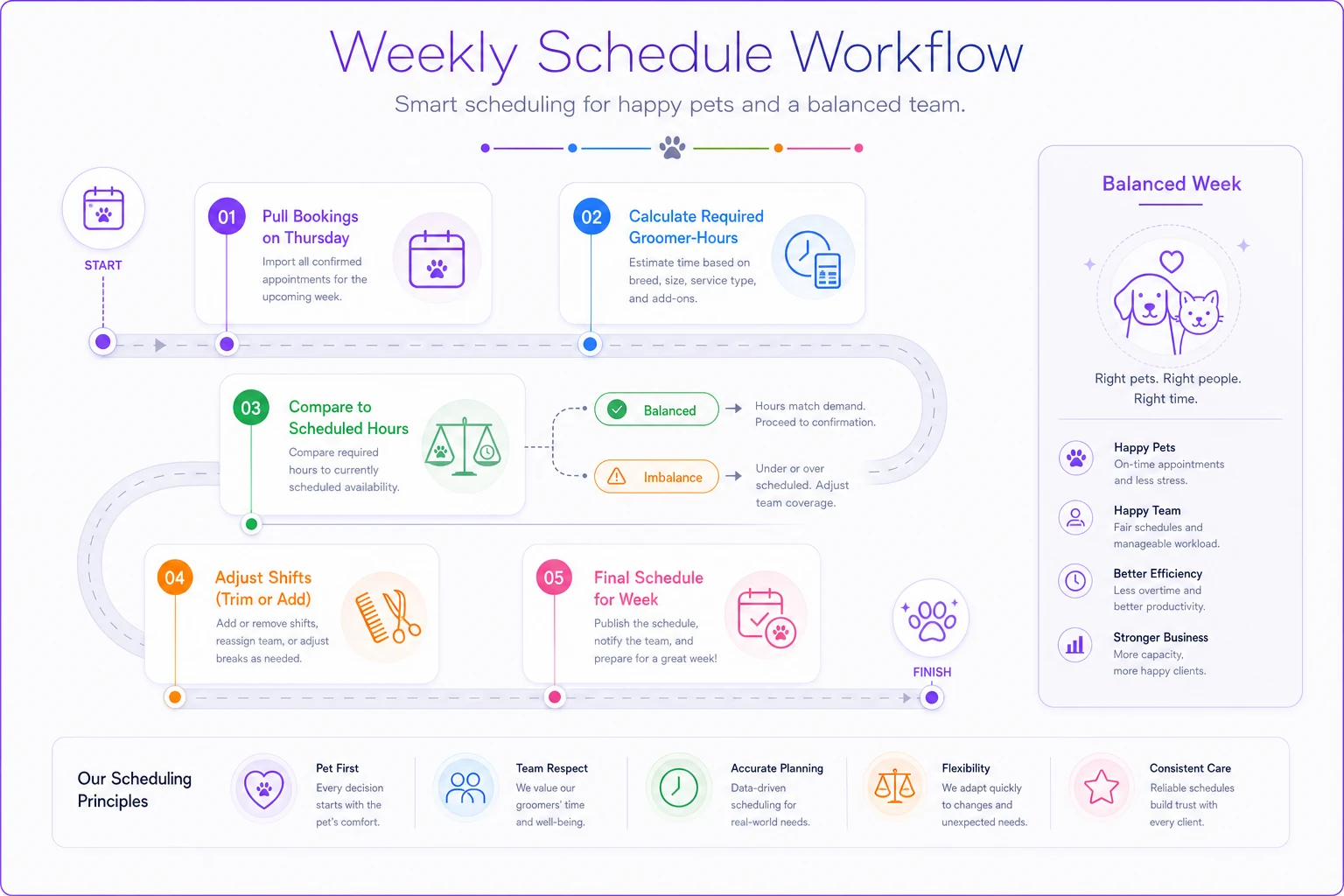
A simple visual of the weekly flow can help managers follow the steps without skipping any.
-
Pull next week's confirmed bookings every Thursday.
-
Convert bookings into required groomer-hours using your actual breed and time mix (a schedule heavy on doodles needs far more hours than one loaded with short-coat small dogs).
-
Compare required hours to scheduled hours. If you're scheduled 15%+ above what the bookings justify, trim a shift or shorten one. If you're under, you've got room to open more slots or add a holiday overflow day.
The point is to let the bookings drive the schedule week by week, instead of running the same fixed roster through a season where both volume and cost are moving. A salon doing around 330–360 grooms a month can easily waste 20–30 paid hours a week on loose scheduling — at today's rates, that's a meaningful chunk of December's profit gone before you ever see it.
5. Protect your no-show and late-cancel policy — it matters more now
When your cost per empty chair rises, no-shows hurt more. A missed $90 appointment during a fully-booked holiday week isn't just lost revenue; it's a slot you turned away another paying client for.
Two small tightenings worth making before peak:
-
Move holiday bookings to a card-on-file requirement if you don't already run one. Booking abandonment on this is minor; the protection is real.
-
Shorten your cancellation window for December appointments from 48 to 24 hours only if you also run confirmation reminders — otherwise you'll just generate disputes.
Don't overhaul the whole policy mid-season. Just firm up the edges where a missed slot now costs you the most.
6. Decide which services to quietly throttle during the rush
Not every service deserves a slot in your busiest weeks. Some grooms are low-margin and time-heavy — the ones that tie up a bather for 90 minutes for a thin return. During peak season, those are exactly the appointments that crowd out higher-margin work.
You don't have to discontinue anything. You just make the low-margin, time-heavy services slightly harder to book in December — fewer available slots, or steer them toward slower weekdays. This is where knowing your profit-per-service actually pays off, and it ties directly into the kind of recurring margin discipline we laid out in the repeatable profitability system built around 30-day margin sprints. The season just raises the stakes on choices you should be making year-round anyway.
When this makes sense: you're genuinely capacity-constrained and turning clients away.
When it's a bad idea: your books have gaps — don't throttle anything when you've got open chairs to fill.
7. Write the client message now, before you need it
If you're raising prices, the communication should be ready before the first client asks. Not reactive, not defensive — just clear.
The framing that works best is value and consistency, not a line-by-line cost justification. Something like: "Our holiday grooming packages now include teeth brushing and a seasonal finish — new pricing is live for December bookings." Clients accept "here's what's included" far more easily than "here's why we had to charge more."
Draft it once, load it into your confirmation and reminder flow, and you're done. The salons that struggle with repricing are almost never the ones whose prices went up — they're the ones who scrambled to explain it mid-rush and came across as apologetic.
A quick real scenario
A two-groomer suburban salon, roughly 300 grooms a month, went into last fall assuming "we're busy, we're fine." They didn't re-cost anything. December was their biggest revenue month ever — and their owner pay came in lower than November's.
The autopsy was simple: supply costs had drifted up about 15% since summer, they'd added a wage bump mid-year, and they'd run a loose fixed schedule through a month where every slack hour cost more. Record revenue, eroded margin, invisible until the close.
This year they did five of the seven moves above — re-costed their top three services, raised mid-tier packages around 8%, tightened the weekly schedule to actual bookings, and moved to card-on-file for holiday slots. Same roughly 300-groom volume. Owner pay came out somewhere in the range of 12–15% better for the month, almost entirely from margin they stopped leaking rather than new clients.
The checklist, condensed
Run these before Thanksgiving:
-
[ ] Re-cost your three highest-volume services at today's supply and labor rates
-
[ ] Reprice top services 6–10%, structured inside packages, live before holiday reminders go out
-
[ ] Buy 8–10 weeks of par on price-volatile, shelf-stable core supplies (cash permitting)
-
[ ] Recheck distributor lead times and reset reorder points
-
[ ] Convert weekly bookings into required groomer-hours and trim slack shifts
-
[ ] Move holiday bookings to card-on-file and tighten the cancellation window
-
[ ] Draft the repricing client message and load it into your confirmation flow
None of these are dramatic. That's the point. The salons that come through a cost spike with their margins intact aren't making big strategic bets — they're quietly recalibrating stale assumptions before the volume arrives to multiply the mistake.
Resilient consumer spending is a gift, but only if your pricing and scheduling reflect what things actually cost right now. You've got a few weeks of runway before the chaos starts. Use them on the boring stuff, so December works for you instead of against you.
Ready to streamline your grooming business?
Join 500+ pet groomers using Furlyly to save time, reduce scheduling conflicts, and deliver exceptional client experiences.