

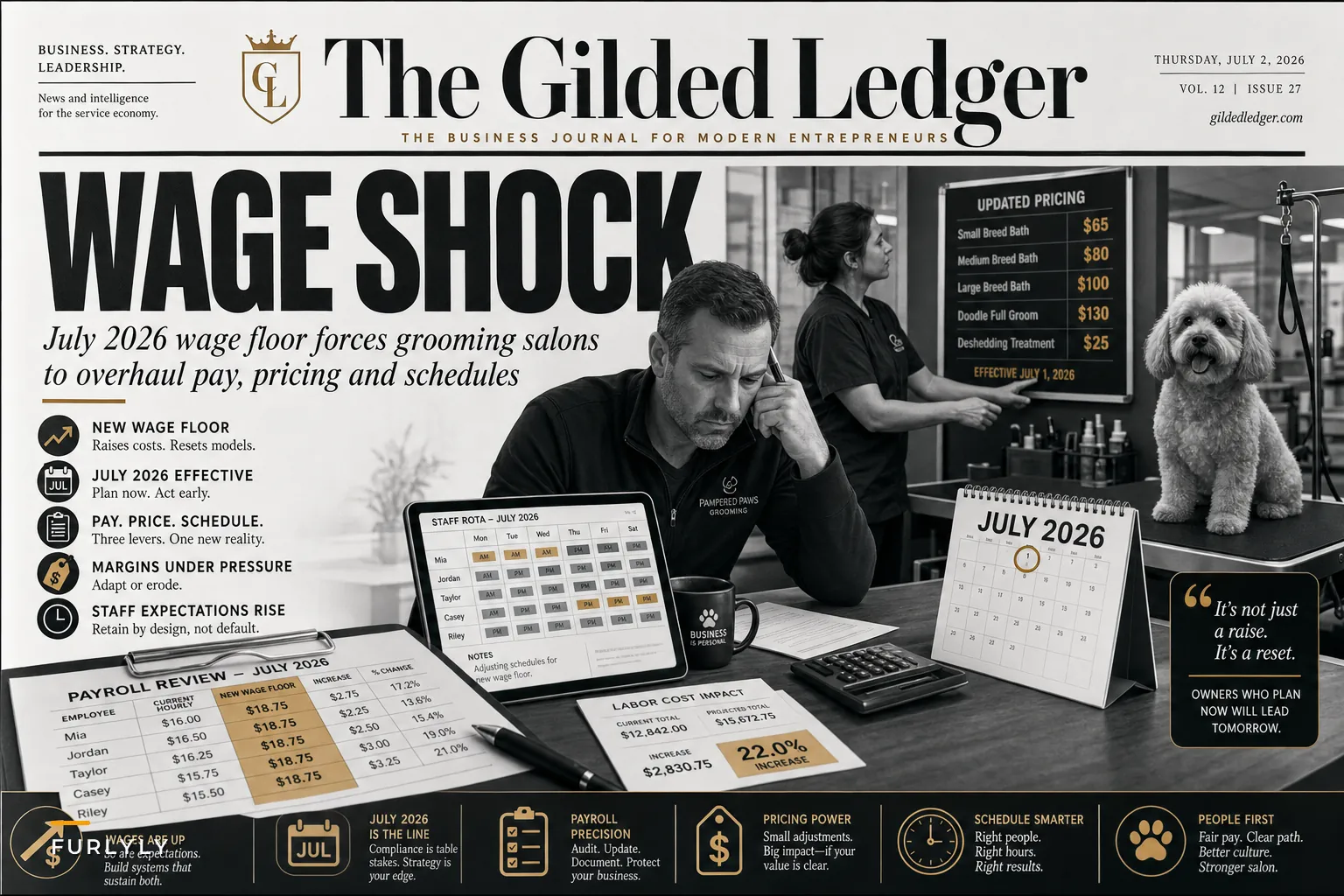

The July 2026 minimum wage increases aren't theoretical anymore. Alaska jumped to $14/hour. DC hit $18.40. Chicago's at $16.80. If you're running a grooming salon in any of the 20+ jurisdictions with July 1 increases, your next payroll cycle is already more expensive.
Most salon owners find out when their payroll processor sends an alert. By then, you're already behind. The bather you're paying $13/hour needs an immediate raise. The junior groomer at $15 is browsing Indeed. And your margins on basic bath services? Already thin, now thinner.
When minimum wage jumps mid-year like this, everything compresses. The gap between your lowest and mid-tier employees shrinks overnight — that creates morale problems before you've even had a chance to respond. Your pricing suddenly doesn't cover labor the way it used to. That seasonal hiring plan you built out in January is basically irrelevant now.
Why grooming salons get hit harder than retail
Grooming isn't like a coffee shop where you can shuffle shifts or trim hours when labor costs spike. You've got appointments booked weeks out, dogs scheduled back-to-back, clients who expect their regular groomer every six weeks like clockwork.
The compression problem is real. When minimum wage rises to $14, your $14.50 bather is now making barely more than someone walking in off the street with zero experience. That groomer you've had for three years at $18/hour? They're now only $4 above entry level instead of the $6 differential that made their seniority feel worth something. The whole internal pay structure starts to feel unfair — because it is.
Then there's the service mix problem. Basic services — nail trims, baths for small dogs, quick sanitary clips — these already run on thin margins. A golden retriever bath that takes 90 minutes might bring in $65. At old wages you had maybe $22 in direct labor cost. Factor in the ripple effect on senior staff wages and you're closer to $27. That's a roughly 23% margin hit on one of your most common services.
Mobile grooming operations have it even worse. Drive time was already paid but unproductive. Now that dead time costs more while still generating zero revenue. A route that was barely profitable can flip surprisingly fast.
The three-move survival sequence
Move 1: Surgical repricing — not across-the-board hikes
Never miss a grooming appointment again.
Furlyly helps you book, confirm, and manage every pet grooming appointment effortlessly.
- Unified appointment scheduling
- Automated client reminders
- Staff availability & shift management
No credit card required
Most salons panic and raise everything by 10%. That's the wrong move. Blanket price increases erode trust and confuse longtime clients. Instead, map your services by labor intensity and actual margin. Most salons, when they actually run the numbers, find their pricing makes no operational sense — a maltese full groom priced the same as a standard poodle despite taking half the time.
Start with labor-heavy, low-margin services. Nail trims going from $15 to $18 won't lose you customers. Bath-only services for large breeds need an 8–10% increase immediately. But that premium hand-stripping service sitting at 40% margin? Leave it alone.
The smarter structure is a "base price + modifier" approach. Instead of fixed prices per breed, charge $45 base with add-ons: matted coat adds $15, over 50 pounds adds $20. This captures real labor cost without repricing your entire menu and confusing people who've been coming to you for years.
| Service Type | Margin Before Wage Increase | Action |
|---|---|---|
| Nail trim (small dog) | ~18% | Reprice immediately |
| Bath only (large breed) | ~22% | Reprice immediately |
| Full groom (mid-size) | ~30% | Monitor closely |
| Hand-stripping / specialty | ~40%+ | Leave alone for now |
| Express bath and tidy | ~35% | Expand and promote |
Not every service needs to change right now. Knowing which ones do — and acting on just those — is what separates a thoughtful adjustment from a messy price sheet that confuses everyone.
Move 2: Restructure pay before compression destroys morale
Pure hourly pay breaks when minimums rise. The answer isn't fighting the minimum — it's restructuring compensation to keep meaningful differentials in place before people start quietly quitting.
Convert experienced groomers to hybrid commission models. Base hourly at or near minimum wage, plus 20–30% commission on services above a daily threshold. A groomer doing $400 in services might earn base wage on the first $250, then commission on everything above. This maintains their total earnings while reducing your fixed cost exposure on slower days.
Bathers need a different approach. Certification micro-bonuses work well here — $0.50/hour for completing large dog handling training, another $0.50 for learning specific breed cuts. These small raises cost less than blanket increases but preserve a sense of advancement that matters more than most owners expect.
One thing that actually works and often gets overlooked: productivity pools. Junior and senior staff share a small bonus tied to daily salon revenue. When everyone benefits from working efficiently, wage compression stings less. Senior staff essentially get rewarded for helping bring up the people around them.
For a closer look at structuring these models, check out our guide on pay models that cut turnover and boost upsells.
COMPENSATION RESTRUCTURING FLOW Current hourly-only model ↓ Audit internal pay gaps created by new minimum ↓ Identify who gets hybrid commission vs. milestone bonuses ↓ Set daily revenue thresholds for commission triggers ↓ Launch productivity pool tied to salon daily revenue ↓ One-on-one conversations with each staff member ↓ Monitor total comp vs. old model for 30 days
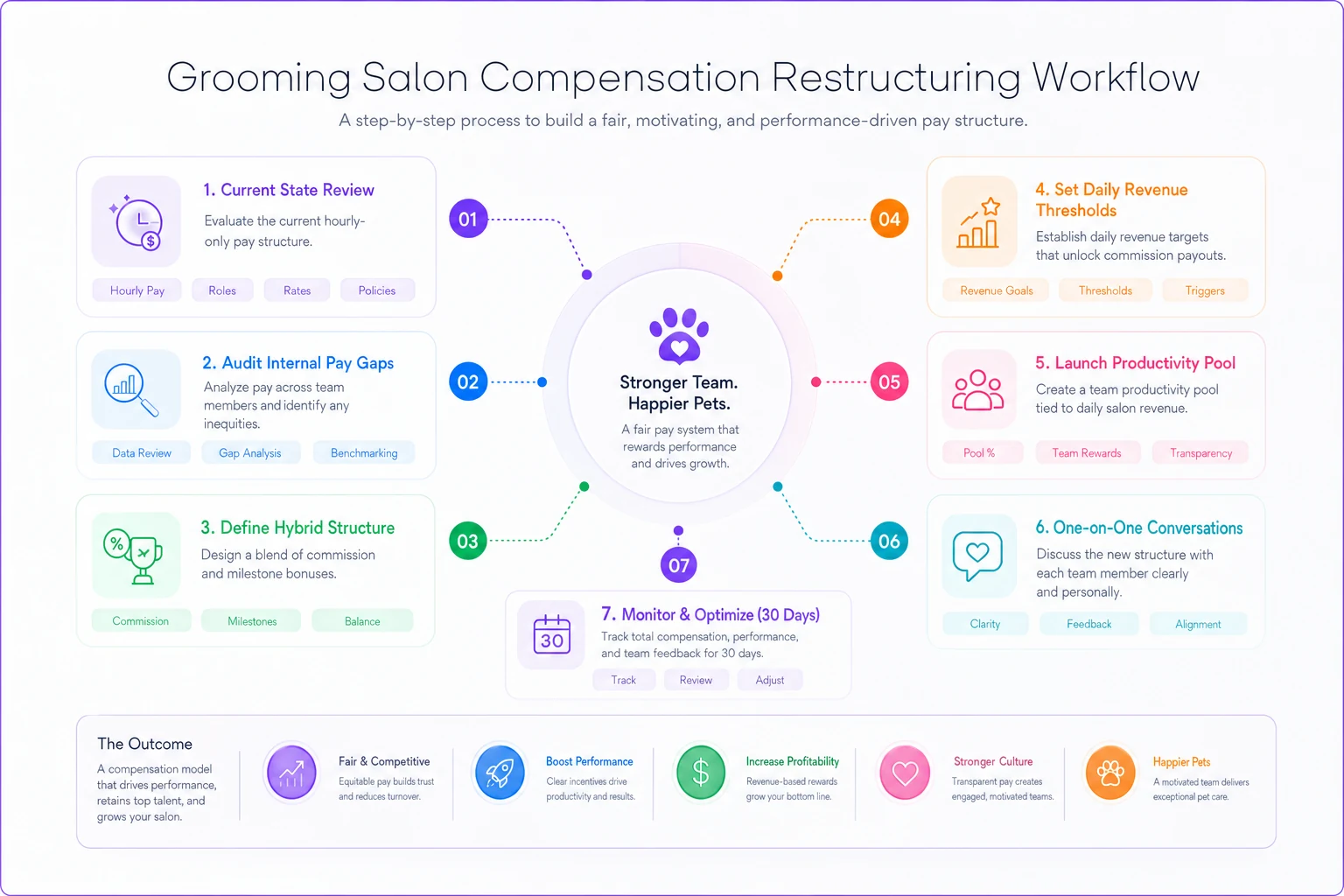
Below is a visualization of the compensation restructuring flow.
After about 30 days, you'll have a clearer picture of whether the thresholds are set right and whether the pool bonus is actually motivating anyone. Adjust from there.
Move 3: Tighten scheduling around demand
Most salons still run schedules like it's five years ago. Standard shifts, even distribution, hoping walk-ins fill the gaps. That gets expensive fast when labor costs jump.
Switch to demand-cluster scheduling. Instead of spreading appointments across the day, pack them into peak windows. Running four groomers from 8am to 5pm is 36 hours of payroll. Clustering the same appointments into two focused blocks with overlapping staff can cut that to around 28 hours — same output, meaningfully less payroll.
The part that's easy to miss: deliberate understaffing during shoulder hours. Tuesday 2pm–4pm might see one appointment. Don't staff for coverage — staff for actual work. One groomer handling intake, bath, and basic services during those dead zones is usually enough.
Express services matter more under this model. A 30-minute "bath and tidy" at $35 keeps price-sensitive clients while maintaining strong hourly revenue. Stack three of them in the time a full groom used to take and the margin math actually improves under the new wage reality.
When the math says close certain days
Some salons will find that Wednesday operations now lose money. Light bookings plus minimum staffing requirements can create a guaranteed weekly loss — and these aren't temporary. The Department of Labor's wage tables make clear these increases compound over time.
If Wednesday generates $800 in revenue but now requires $640 in labor plus $200 in fixed cost allocation, you're underwater every single week. Better to close that day, concentrate demand into the rest of the week, and offer those hours to senior staff who actually want them. Clients adjust faster than most owners expect.
Operational automation that actually offsets wage pressure
The temptation is to think about automating the grooming itself — that's not realistic. But everything surrounding the actual grooming work is a different story, and that's where real savings exist.
Appointment confirmation calls average about 3 minutes each. At 40 appointments daily, that's roughly 2 hours of payroll just for confirmations. Automated text confirmations with rescheduling links cut that to zero. At new minimum wages, that's easily $500 or more per month recovered without changing a single thing about your service quality.
Automate confirmations and intake first; they deliver the quickest labor savings without customer friction.
Digital intake forms save another 5 minutes per appointment. Owners complete them before arrival — selecting services, noting health issues, uploading vaccine records. Your front desk stops doing data entry and starts rebooking or recommending add-ons. Twenty appointments a day at 5 minutes each is close to an hour and a half of labor redirected toward actual revenue.
Centralized AI-powered scheduling platforms can distribute appointments based on skill level, service type, and flow efficiency — eliminating an hour or more of daily management time that's currently invisible on paper but very real on payroll. Payment automation matters too. Cards on file with automatic post-service charging eliminates the checkout bottleneck entirely. Your front desk stops processing payments and starts doing something more useful.
The retail angle most salons ignore
Minimum wage increases make pure service models more vulnerable. Retail margins are unaffected by the wage hike. The problem is that most grooming salons treat retail as an afterthought — a few products on a shelf nobody mentions.
Cut your retail down to 20 high-velocity SKUs. Shampoo, dental chews, basic grooming tools — things that actually connect to the services you're already providing. Then build service bundles that include retail naturally. A bath service includes a travel-size shampoo. A full groom includes a dental chew. Labor cost went up, but the bundle margin holds up better.
One item per visit, consistently suggested based on the service performed, adds $7–8 in average ticket without extending appointment time at all. It's not glamorous, but it adds up across a full week of appointments.
Making the July transition less painful
A simple week-by-week approach for the first month:
-
First week of July Run a break-even analysis on every service. Revenue minus new direct labor cost minus supplies. Anything under 30% margin needs repricing or needs to come off the menu entirely.
-
Second week Individual conversations with staff about compensation changes. Don't announce this in a group — wage compression creates comparison and resentment quickly. One-on-one discussions let you frame changes in a way that feels personal and fair.
-
Third week Roll out new pricing. Don't over-explain it to customers. "We've adjusted our pricing to better reflect our services" is enough. Most won't notice a $3–5 increase if your quality stays consistent.
-
Fourth week Start tracking the metrics that actually matter now — services per labor hour, retail attachment rate, rebook percentage. These efficiency numbers tell you more about profitability than hourly wages alone.
These steps give you a manageable cadence to make changes without blowing up staff trust or customer relationships.
The actual operational reality
Surviving minimum wage increases isn't about finding one lever to pull. It's about coordinating several smaller adjustments that compound over time. The salons that come out okay don't just raise prices — they rethink operations around the new labor reality.
Your competitors are probably panicking right now, doing across-the-board price hikes or cutting staff dangerously thin. That's an opening. While they chip away at service quality trying to preserve margins, there's real room to restructure thoughtfully and come out with better operations than you had before July.
Salons running outdated pay models, scattered scheduling, and untouched retail finally have a real reason to fix things. The city and county-level increases hitting alongside state mandates mean there's no waiting this out. The wage increase isn't the core problem — it's a spotlight on how inefficiently a lot of grooming salons were already running.
The next 90 days matter. The choices made right now — about pricing, compensation structure, scheduling, and where to actually spend labor hours — will determine whether your salon comes through this stronger or joins the closures that follow every major wage adjustment. Move on it now, before the bank account forces the decision for you.
Surviving minimum wage increases isn't about finding one lever to pull. It's about coordinating several smaller adjustments that compound over time. The salons that come out okay don't just raise prices — they rethink operations around the new labor reality.
The next 90 days matter. The choices made right now — about pricing, compensation structure, scheduling, and where to actually spend labor hours — will determine whether your salon comes through this stronger or joins the closures that follow every major wage adjustment. Move on it now, before the bank account forces the decision for you.
Ready to streamline your grooming business?
Join 500+ pet groomers using Furlyly to save time, reduce scheduling conflicts, and deliver exceptional client experiences.