

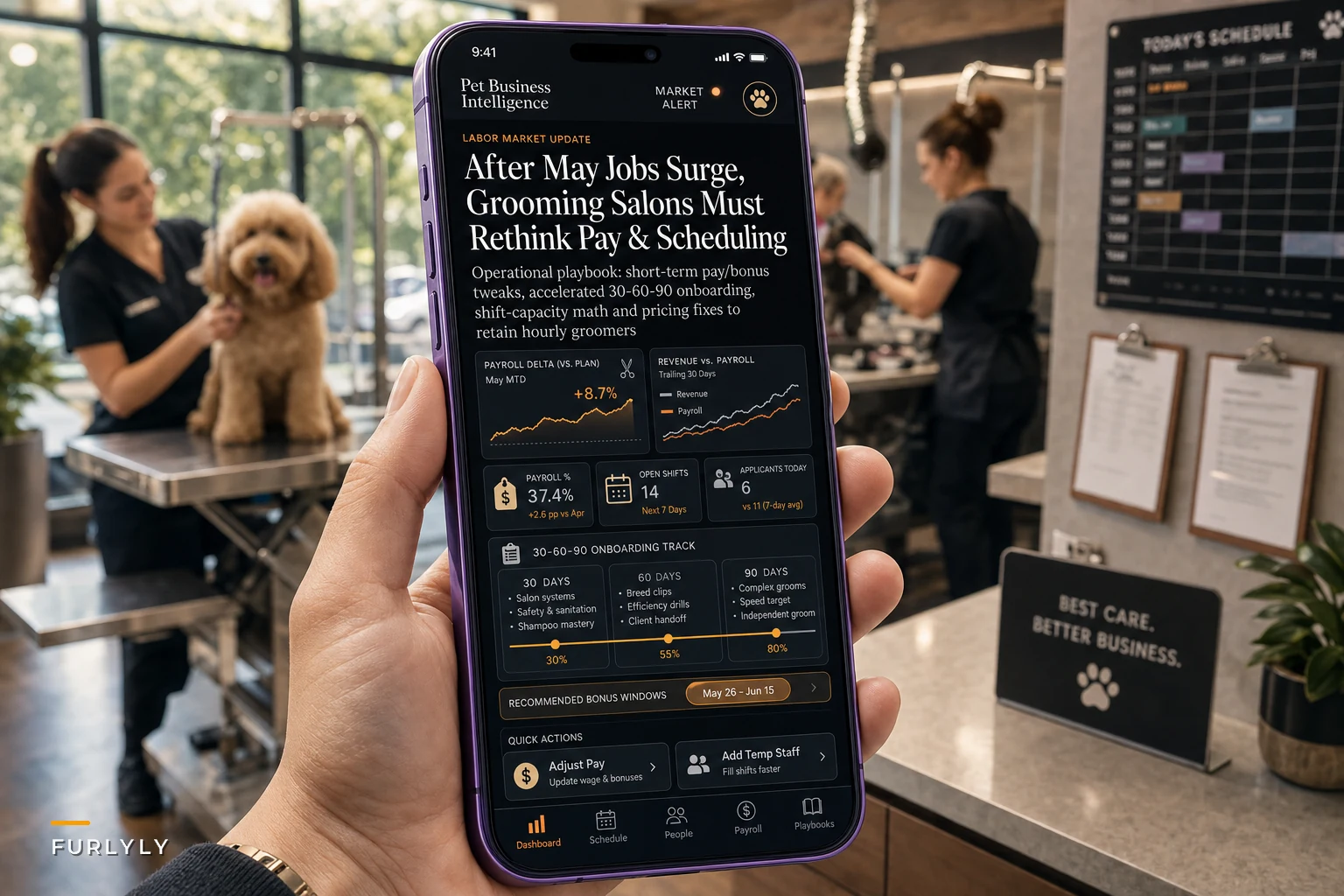

The May jobs report dropped last week showing 172,000 new positions added to the economy, way above what economists expected. According to CNBC's analysis, restaurants, bars, and hospitality led the surge. That's bad news if you run a grooming salon because those sectors pull from the same pool of hourly workers you're trying to hire.
Yesterday morning I talked with three salon owners who all mentioned the same thing — their Indeed posts from April that used to get 20+ applicants are now getting maybe four or five. One owner in Phoenix said she's been trying to fill a bather position for six weeks. The pay she offered in January ($16/hour) isn't even getting callbacks anymore.
We're heading into peak grooming season when everyone wants their dog looking good for summer activities, and salons are already stretched thin. The combination of stronger labor competition and seasonal booking pressure means groomer staffing just became your biggest operational challenge for the next three months.
Why restaurants winning means salons are losing
Every grooming salon owner knows the feeling when a solid groomer gives their two-week notice right before Memorial Day weekend. What's happening now goes beyond typical turnover patterns.
Service businesses that never competed for your staff before are suddenly offering comparable or better packages. The local Chili's that used to pay $14/hour plus tips is now advertising $18 base pay. Target's offering $19 with set schedules. Even the car wash down the street jumped their starting wage by $3.
Your experienced groomers see these numbers. They're doing the math on whether dealing with matted doodles and anxious shepherds is worth the same money as folding clothes at Old Navy with zero bite risk.
The wage pressure hits grooming salons differently because of our weird pay structures. Most salons run some hybrid of hourly base plus commission, or straight commission with productivity bonuses. When a groomer making 50% commission on $70 grooms sees their friend making $22/hour guaranteed at Costco, that commission structure suddenly looks less attractive on slow Tuesday afternoons.
A salon I work with in Austin had three groomers approach management last month asking to switch from commission to hourly. These weren't newbies — one had been there four years. The owner panicked and offered a compromise that basically broke their entire pay model. Now everyone wants the same deal and payroll is up 18% without any revenue increase.
The scheduling nightmare nobody talks about
Groomer staffing is especially brutal right now because you can't just throw bodies at the problem like a restaurant can with servers. When a groomer quits, you lose their specific client base. Those 40 regular dogs who only want Jennifer touching them? Half will follow her to whatever salon she goes to next. The other half scatter to competitors while you scramble to hire and train someone new. A salon in Denver shared their numbers with me after losing two senior groomers in March. Combined, those groomers handled about 280 dogs monthly. The salon managed to hire two replacements within three weeks (miracle timing). But new groomers, even experienced ones, take 60-90 days to build up to full productivity in a new environment. During that ramp-up, the salon could only book them at roughly 40% capacity.
Never miss a grooming appointment again.
Furlyly helps you book, confirm, and manage every pet grooming appointment effortlessly.
- Unified appointment scheduling
- Automated client reminders
- Staff availability & shift management
No credit card required
| Month | Lost Revenue | New Groomer Revenue |
|---|---|---|
| Month 1 | ~$19,600 | ~$3,900 |
| Month 2 | ~$19,600 | ~$7,200 |
| Month 3 | ~$19,600 | ~$11,500 |
That's a $24,000 revenue hole over three months, not counting the clients who never came back.
The owner tried to compensate by overbooking the remaining groomers. Bad move. One groomer injured her wrist from the extra workload. Another started making sloppy mistakes — sent a schnauzer home with a half-finished face because she was rushing to the next dog. The Google reviews that month were brutal.
What competitive pay actually means in 2026
Throwing money at the problem seems logical until you run the numbers. Most grooming salons operate on 15-25% profit margins. Labor already eats up 45-55% of revenue. There's not much room to boost pay without touching prices.
-
Guaranteed weekly minimums vs pure commission volatility
-
Tool allowances (quality shears cost $400-800)
-
Paid sick days (huge for a physical job)
-
Schedule flexibility and no Saturday requirements
-
Clear paths to higher commission tiers
Smart salons are getting creative without blowing up their payroll. A salon in Tampa restructured their entire commission system last month. Instead of flat 50% commission, they created a matrix based on service speed and rebooking rates.
-
Fast groomer who gets dogs done in standard times
48% commission
-
Fast groomer whose clients rebook consistently
52% commission
-
Slower groomer with high rebooking
50% commission
-
Slower groomer with poor rebooking
46% commission
The rebooking bonus motivated groomers to build better client relationships. The salon's 90-day rebooking rate jumped from 64% to 79%. Revenue per groomer increased about $600/month without raising prices.
They also added a $200 monthly tool stipend that groomers could accumulate if unused. Sounds expensive, but it cost less than the turnover they were experiencing. One groomer told the owner it was the tool stipend that made her turn down an offer from a corporate salon paying $2 more per hour.
Speed up onboarding or watch your summer season tank
Traditional grooming onboarding is broken. The old model where a new hire shadows for two weeks, then slowly takes easy dogs while building speed over 2-3 months doesn't work when you need bodies in June.
-
Day 1-2 Only washing and drying dogs while experienced groomer handles cuts
-
Day 3-4 Doing basic clips on regular, easy dogs with experienced groomer supervising
-
Day 5 Handling full grooms on prescreened easy breeds
By week two, new groomers were at 70% productivity instead of the usual 30-40%. The trick was the prescreening. The manager went through their client database and tagged every dog by difficulty. New groomers only got green-tagged dogs (calm, simple cuts, no matting) for their first month.
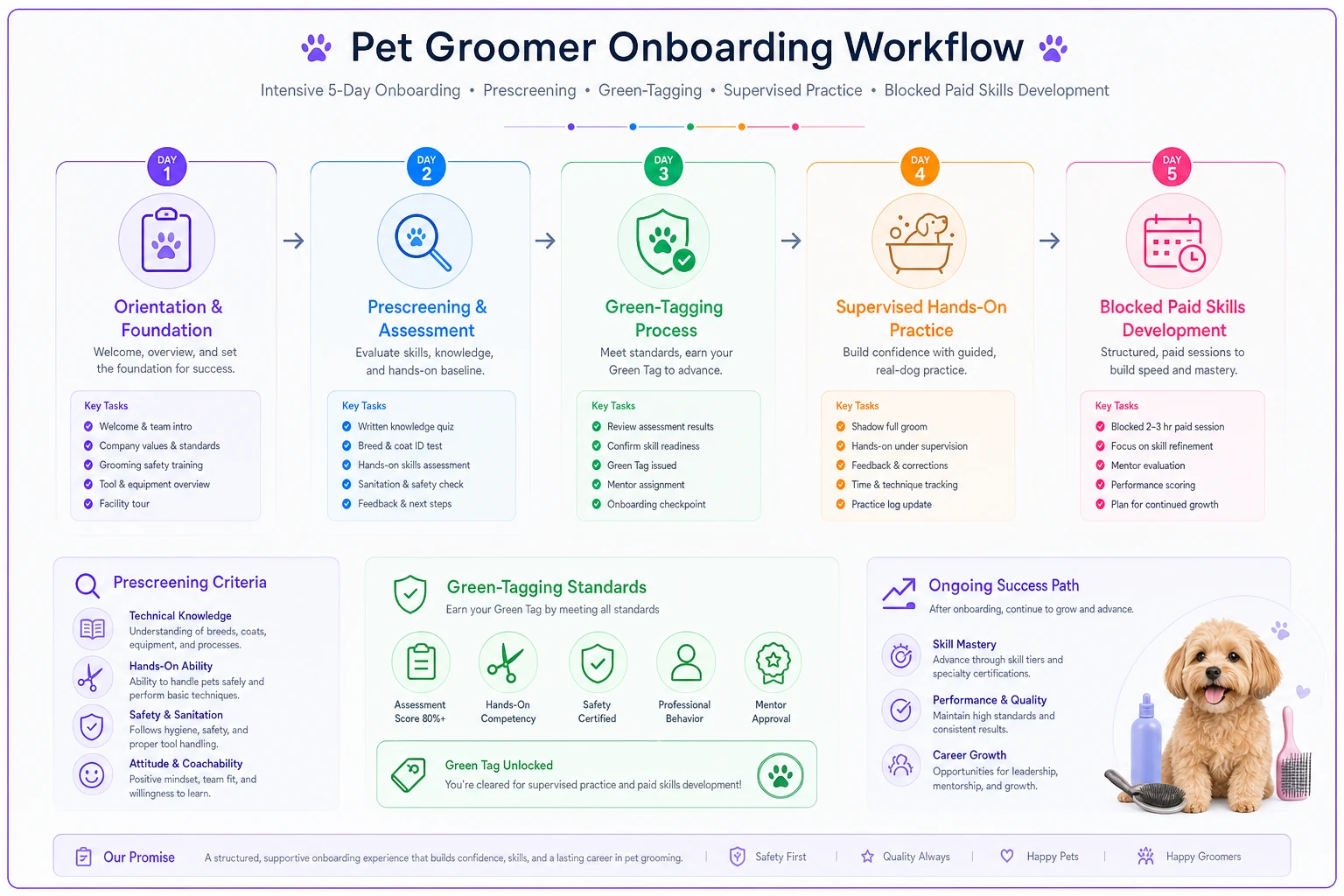
They also changed how they scheduled training time. Instead of having new groomers come in early or stay late for training, they blocked out 2-4pm every Wednesday as paid skills development. Experienced groomers demonstrated techniques, everyone practiced on mannequin heads, and they reviewed problem scenarios.
Block training times on the public schedule so clients can't book them over, and pay groomers for that time.
The retention difference was huge. Their previous system had 40% of new hires quitting within 90 days. The new system dropped that to 15%. This approach completely changed how they thought about getting new staff productive quickly.
Stop competing on pay alone — fix the actual job
Most grooming salon owners obsess over hourly rates and commission percentages while ignoring why groomers actually quit. The biggest driver of turnover isn't money — it's the daily frustration of preventable operational chaos.
A groomer in Orlando broke down her average day for me:
-
8am
First dog arrives, no notes about behavior issues, bites her thumb
-
9am
Cannot find the right blade guard, wastes 10 minutes searching
-
10am
Dog parent complains the cut is "wrong" but can't explain what they wanted
-
11am
Scheduled for a "small dog," turns out to be a 70-pound doodle
-
12pm
No lunch break because morning ran over
-
2pm
Blow dryer breaks, has to share with another groomer
-
3pm
Last client shows up 30 minutes late, throws off entire schedule
-
4pm
Manager asks her to squeeze in a walk-in nail trim
-
5pm
Stays late to catch up, unpaid
She left for a corporate salon paying the same rate but with better systems. The new place had equipment that worked, clear breed standards, protected lunch breaks, and strict no-walk-in policies.
Your operational chaos is costing you more than any pay raise would. What actually keeps groomers from jumping ship:
Protected schedules: Block 30-minute lunch breaks as "appointments" in your booking system. No exceptions. A hungry, exhausted groomer makes mistakes and quits faster.
Equipment redundancy: Every station needs backup clippers, blades, and dryers. Downtime from broken equipment frustrates groomers and costs money. Budget $300 per station for backup tools.
Clear service menus: Stop letting clients book "whatever Fluffy needs." Define exactly what's included in each service. Full groom includes: bath, blow-dry, nail trim, ear cleaning, and breed-standard cut. Period.
Intake enforcement: Require photos and behavior notes for first-time clients. Use an intake form that asks specific questions: "Has your dog ever bitten anyone? Does your dog panic during nail trims? When was the last professional groom?" Store this in your booking system so groomers see it before the dog arrives.
The salons surviving this labor shortage aren't necessarily paying the most. They're the ones where groomers can actually do their job without fighting broken systems all day.
The part-timer and contractor reality check
Traditional salons keep trying to hire full-time W-2 groomers while ignoring that half the talented groomers in their market want nothing to do with that model anymore.
The NPR report on May's job numbers highlighted how workers increasingly want flexibility. Groomers are no different. Many experienced groomers are going solo, working from home garages, or joining mobile operations specifically to control their schedules.
A salon in Portland flipped their entire model to accommodate this shift. Instead of fighting it, they created a hybrid structure:
-
Three full-time employees (W-2) as the stable core
-
Four part-time contractors who rent chair space
-
Two weekend-only contractors
The contractors pay $400-600 monthly for chair rental depending on hours used. They bring their own clients but can also take salon overflow bookings at a 60/40 split (60% to groomer). The salon provides all supplies, handles booking, and manages payments.
This model let them tap into experienced groomers who'd never work full-time. One contractor is a mom who only works school hours. Another has a mobile route three days a week and uses the salon space for difficult dogs that need salon equipment.
The key was getting the legal structure right. Clear contractor agreements, proper insurance, and making sure contractors truly controlled their schedules to avoid misclassification issues. They spent $2,000 on legal setup but saved probably $30,000 in turnover costs over the past year.
Building a bench before you need it
The salons struggling most right now are the ones trying to hire after someone quits. The labor market's too tight for reactive hiring. You need a pipeline of potential groomers before positions open.
An approach that works: running a paid bather apprentice program. You hire dog lovers with zero grooming experience as bathers at $15-17/hour. While they wash dogs, you train them in basic grooming skills during slow periods.
After 3-6 months, promote the best bathers to junior groomer positions. They already know your clients, your systems, and your standards. The training investment pays off because they're grateful for the career path and tend to stick around longer than external hires.
One salon in Phoenix runs this program with two bather positions constantly filled. Over 18 months, they promoted four bathers to groomers. Three are still there. Their external groomer hires during the same period? Zero success — both quit within 90 days.
The program costs roughly $8,000 per promoted groomer when you factor in the training time and slower initial productivity. But compare that to the $15,000+ cost of a bad external hire who quits after two months and takes clients with them.
Technology won't replace groomers, but it helps you keep them
Operational software isn't magic, but the right system reduces the daily friction that makes groomers consider other jobs. The correlation between salons using modern booking and management platforms versus paper schedules is pretty stark when it comes to retention.
A salon switching from paper to digital booking typically sees:
-
25% reduction in scheduling conflicts
-
40% less time spent on phone bookings
-
90% reduction in missed appointments with automated reminders
-
Elimination of double bookings
More importantly, it removes the chaos that burns groomers out. When the schedule is clear, client notes are accessible, and payment processing is smooth, groomers can focus on actual grooming instead of administrative confusion.
The pay structure changes I've written about before become way easier to implement when you have software tracking services, calculating commissions, and showing groomers their real-time earnings. Transparency in pay calculations alone reduces a major source of groomer frustration.
Where this leaves you for summer 2026
The May jobs report is just confirmation of what you're already feeling — hiring and keeping groomers is harder than ever. The unemployment rate sitting at 4.3% means the people you want to hire already have jobs. You're not recruiting the unemployed; you're poaching from competitors.
Immediate moves for June:
-
Audit your current pay against local restaurants and retail (not just other salons)
-
Add one meaningful non-wage benefit (tool stipend, guaranteed lunch, flexible scheduling)
-
Fix your biggest operational pain point that frustrates groomers daily
-
Start a waiting list for services you're booked out on — you'll need it
Set up for July-August:
-
Launch a batcher apprentice program if you don't have one
-
Create clear documentation for your 20 most common groom styles
-
Implement upfront intake requirements for new clients
-
Consider contractor positions for experienced part-timers
Longer-term positioning:
-
Build relationships with local grooming schools (offer internships)
-
Develop a reputation as the salon that respects work-life balance
-
Create advancement paths beyond just grooming (shift lead, training role, client coordinator)
-
Invest in equipment and systems that make the job physically easier
The salons that make it through this summer without imploding will be the ones that stopped trying to win on pay alone. Labor competition isn't going away. The service sector expansion isn't slowing down. Your groomers have options they didn't have two years ago.
The question isn't whether you'll have to adapt your staffing model — it's whether you'll do it strategically now or desperately in July when half your team quits during peak season. The math is pretty straightforward: every week you wait costs you money in lost bookings, rushed bad hires, and burned-out remaining staff. Start with fixing one broken system that frustrates your team daily. That $500 investment in better equipment or $2,000 in software setup looks cheap compared to the $20,000 revenue hit from losing a senior groomer in June.
Ready to streamline your grooming business?
Join 500+ pet groomers using Furlyly to save time, reduce scheduling conflicts, and deliver exceptional client experiences.